What a Real Contact Center AI Investment Should Actually Deliver in Year One


$500K in AI. Twelve Months Later, the Board Wants Numbers.
A VP of CX approves a contact center AI investment. The vendor demo was strong. The pilot showed promise. The contract gets signed.
Twelve months later, the board asks for ROI. What does the CX leader hand them?
Most cannot answer that question clearly — not because the AI failed to deliver, but because the organization never defined what Year 1 success looked like in numbers. The vendor proposed a feature list. The procurement team approved a budget. Nobody wrote down what five metrics would look different by month twelve.
This article does that. Not features. Not capabilities. Outcomes — the kind CX and ops leadership can put in front of finance and defend.
The real question is not whether contact center AI can deliver ROI. The research is settled. A 2024 Forrester Total Economic Impact study found that organizations using AI-elevated CX platforms achieved a 212% return on investment and a net present value of $14.5 million over three years. The question is what you committed to measuring — and whether your vendor signed up for those same numbers.
TL;DR
Contact center AI investments fail to show Year 1 ROI when outcomes are not defined before deployment. The fix is not a better vendor — it is a clearer measurement framework. The five outcomes that matter most in Year 1 are self-service resolution rate, first contact resolution, average handle time, agent retention, and CSAT. Each has an industry benchmark, a Year 1 target range, and a concrete measurement method. PanTerra's thinking on what a $500K AI investment should deliver is in the original announcement. The Streams.AI platform is built to report against all five outcomes from day one.
Key takeaways:
- Metrigy's 2025 research projects 65.7% of inquiries will be resolved by AI — organizations without AI need 2.3 times more agents to handle the same volume.
- A 212% ROI over three years is achievable — but only when leadership defines Year 1 milestones before go-live.
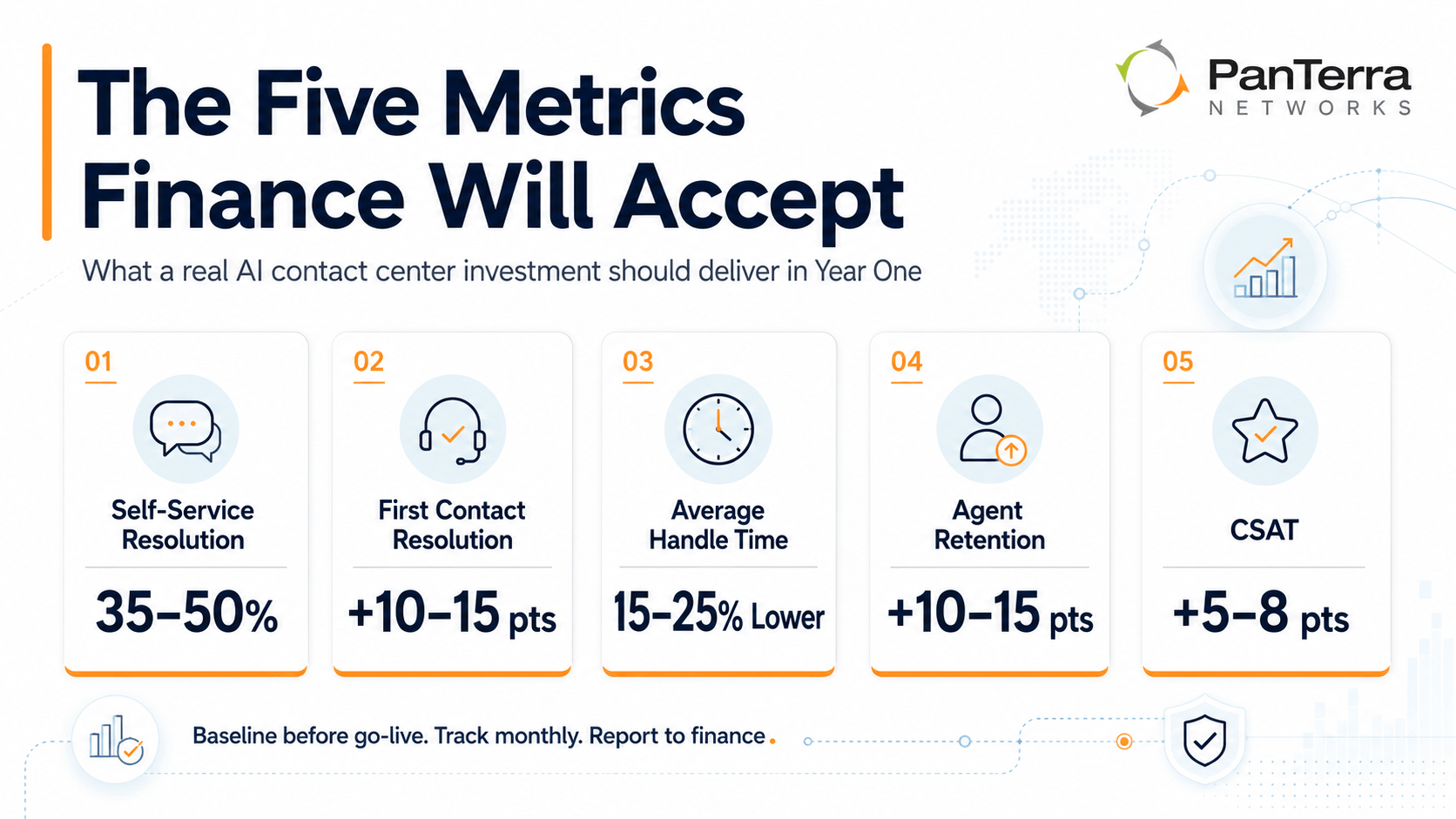
- The five measurable Year 1 outcomes: self-service resolution rate, first contact resolution, average handle time, agent retention, and CSAT.
- Gartner research on AI in customer service finds organizations that set specific outcome targets before deployment are significantly more likely to meet their ROI goals.
- Most AI contact center evaluations focus on capabilities. The right evaluation focuses on what numbers will move, by how much, and by when.
Why Most Deployments Can't Show Year 1 ROI
The pattern repeats across mid-market and enterprise deployments alike.
AI gets approved on the strength of a capability story: agent assist, sentiment analysis, omnichannel routing, virtual agents. These are real capabilities. They work. But none of them is an outcome. They are mechanisms that produce outcomes — if deployed against a clear target and measured consistently.
When the board asks for ROI at month twelve, the answer usually falls back to the capability story. "We have agent assist deployed on 80% of calls." That is not ROI. That is utilization dressed up as an outcome.
In real business terms: the difference between a deployment that can show Year 1 ROI and one that cannot is almost never the technology. It is whether the CX organization set five specific numbers before go-live and tracked them monthly.
What businesses actually need to evaluate before signing an AI contract is not just what the platform can do. It is what specific outcomes the vendor will commit to — and what the measurement method for each looks like.
The Year 1 ROI Framework: Five Outcomes That Finance Will Accept
The table below defines each outcome category, its industry baseline, a realistic Year 1 improvement target, and how to measure it cleanly.
|
Outcome category |
Industry baseline |
Year 1 target |
How to measure it |
|---|---|---|---|
| Self-service resolution rate | 15–25% of inquiries resolved without agent involvement | 35–50% (AI virtual agents handling routine volume) | Track interactions resolved by AI vs. total contact volume, per channel, monthly |
| First contact resolution (FCR) | 65–75% industry average for assisted contacts | +10–15 percentage points above your pre-deployment FCR baseline | Measure contacts closed without callback or escalation within 24 hours, by channel |
| Average handle time (AHT) | Varies by industry; typically 4–8 minutes for voice | 15–25% reduction through AI auto-summary, agent assist, and intelligent routing | Compare AHT pre- and post-deployment by queue type; exclude outlier escalations |
| Agent retention / turnover | Contact center average: 30–45% annual turnover | 10–15 percentage point improvement; meaningful reduction in early attrition | Measure 90-day voluntary attrition pre- and post-deployment for agent cohorts |
| CSAT / customer satisfaction | Benchmark varies; industry average 72–78 on a 0–100 scale | +5–8 points above pre-deployment baseline by month twelve | Post-contact CSAT surveys, consistent methodology, same channels pre- and post |
The trade-off worth understanding: these five outcomes are not independent. A 20% AHT reduction frees agent capacity that reduces hold time, which lifts CSAT. Higher CSAT reduces repeat contacts, which improves FCR. A lower-stress environment reduces agent attrition. The compound effect is what produces three-year ROI at the 212% level — but the measurement discipline has to start in Year 1 to show the curve.
What Good Looks Like at 30, 90, and 180 Days
Year 1 ROI builds in stages. Here is what CX leaders should expect at each checkpoint.
Days 1–30: Baseline metrics captured. CSAT, AHT, FCR, and attrition are documented before any AI influence. No improvement expected yet.
Days 31–90: Virtual agents handling routine volume. AHT reduction typically appears here as auto-summary and agent assist reach full deployment. Self-service resolution climbs as AI tunes to real call patterns.
Days 91–180: FCR improves as intelligent routing matures. CSAT begins moving. Early agent retention signals visible.
Days 181–365: All five metrics measurable against baseline. Year 2 capacity planning can use AI resolution rate rather than headcount projections.
What to Ask Before You Sign
When I walk a VP of CX through a contact center AI evaluation, five questions reveal whether the vendor has been through real deployments — or just demos.
1. What five metrics will you commit to at month twelve?
A vendor who cannot answer this in a sales conversation will not help you answer it to finance at month twelve.
2. What is your typical self-service resolution rate at 90 days, for a deployment our size?
This is the fastest signal in Year 1. No benchmark answer means it has not been measured.
3. How does your platform report on FCR and AHT pre- and post-deployment?
Reporting on these metrics should be native to the platform — not a custom analytics build.
4. What does agent assist rollout look like, and when does it reach full coverage?
Full coverage is the prerequisite for meaningful AHT improvement. Partial rollouts produce partial results.
5. What are verified buyers saying in their own words?
G2 reviews for AI contact center platforms are one of the few places to read unedited buyer feedback about what happened at month six and month twelve — not what was promised at demo.
FAQ
Why do most AI contact center deployments struggle to show Year 1 ROI?
Almost always because outcome metrics were not defined before deployment. Features were approved, budgets were set, implementation started — but no one wrote down what five numbers would look different by month twelve.
Is the 212% three-year ROI figure realistic for mid-market organizations?
It is based on enterprise-scale deployments. Mid-market organizations see proportionate returns on a smaller absolute scale. The percentage improvement targets in the table above hold regardless of organization size.
What does PanTerra's Contact Center AI cover in Year 1?
Agent assist, real-time sentiment, intelligent routing, AI virtual agents for routine volume, omnichannel engagement across voice, chat, email, and social, and built-in analytics that track FCR, AHT, and CSAT natively — all on the Streams.AI platform.
How do you baseline before deployment?
Export your AHT, FCR, CSAT, and attrition data for the 90 days before go-live. If the vendor cannot help you pull clean pre-deployment benchmarks, that is itself a signal about post-deployment reporting.
What This Adds Up To
The gap between AI contact center investments that show Year 1 ROI and those that don't is almost never the technology. It is measurement discipline. Five outcomes. Baselines before go-live. Monthly tracking. A vendor who commits to the same numbers you report to finance.
Take the Year 1 outcome framework in this article into your next vendor conversation. Ask the five questions. See who answers them.
The full PanTerra view on what AI investment should deliver — and the Streams.AI platform capabilities behind each outcome — is available at the contact center AI overview.
.jpg?width=500&height=500&name=Are%20you%20Getting%20a%20Good%20Deal%20(1).jpg)
Comments