What a Real AI Contact Center Investment Should Actually Deliver in Year One

"We have agent assist deployed on 80% of calls." That is not ROI — it is utilization dressed up as an outcome.
Contact center AI investments fail to show Year 1 ROI when outcomes are not defined before deployment. The fix is not a better vendor. It is a clearer measurement framework. The difference between a contact center AI deployment that justifies its budget in Year 1 and one that gets flagged for review is almost never the technology. It is whether the CX organization set five specific numbers before go live and tracked them monthly. See our Contact Center AI overview for a product introduction; this article is about the measurement framework that makes the investment accountable.
This article covers what those five numbers are, what the industry benchmarks say about achievable Year 1 results, and what the math looks like for a mid-market contact center.
TL;DR: Key Takeaways
- The five outcomes that matter in Year 1: self-service resolution rate, first contact resolution (FCR), average handle time (AHT), agent retention, and CSAT. Each has a measurable industry benchmark.
- McKinsey research found Gen AI-enabled agents achieved a 14% increase in issue resolution per hour and a 9% reduction in average handle time: real gains, not marketing claims.
- For 66% of businesses, it takes more than six months to see ROI from AI implementations. Year 1 builds in stages — expect no impact in the first 30 days and material impact by Day 180.
- The average return on AI customer service investment is $3.50 for every $1 spent. Leading organizations achieve up to 8x ROI.
- Industry analysis shows a company handling 50,000 monthly conversations at $8 per human interaction that shifts 60% to AI at under $1 per resolution saves approximately $2.5 million annually.
- PanTerra's Contact Center AI reports against all five outcomes from day one.
Who This Is For
- Best for: VPs of CX, operations directors, and IT leaders building the business case for contact center AI or evaluating whether an existing deployment is on track to deliver.
- Not ideal for: Organizations in initial research on what contact center AI is. Start with our Contact Center AI overview before this article.
- Top use case: Defining the five measurable Year 1 milestones before signing a contact center AI contract, so the investment has a clear success benchmark from day one.
Why Most AI Contact Center Deployments Miss Year 1
The adoption numbers are striking. In 2026, 88% of contact centers have deployed AI in some form. Only about 25% have operationalized it into day-to-day workflows where it generates measurable ROI. The gap between deployment and results is not a technology problem.
It is a measurement problem.
Organizations that define outcomes before go live: specific metrics, specific targets, specific measurement cadences. These organizations consistently outperform those that deploy AI and then look for results afterward. The reason is structural: without baseline measurements taken before AI goes live, there is nothing to compare the post-deployment data against. 'Our agents seem more efficient' is not an ROI story a CFO will accept when the renewal conversation comes.
The good news: the five outcomes that predict Year 1 success are consistent across industries, and the benchmarks for each are well-established.
The Five Year-One Metrics That Actually Matter
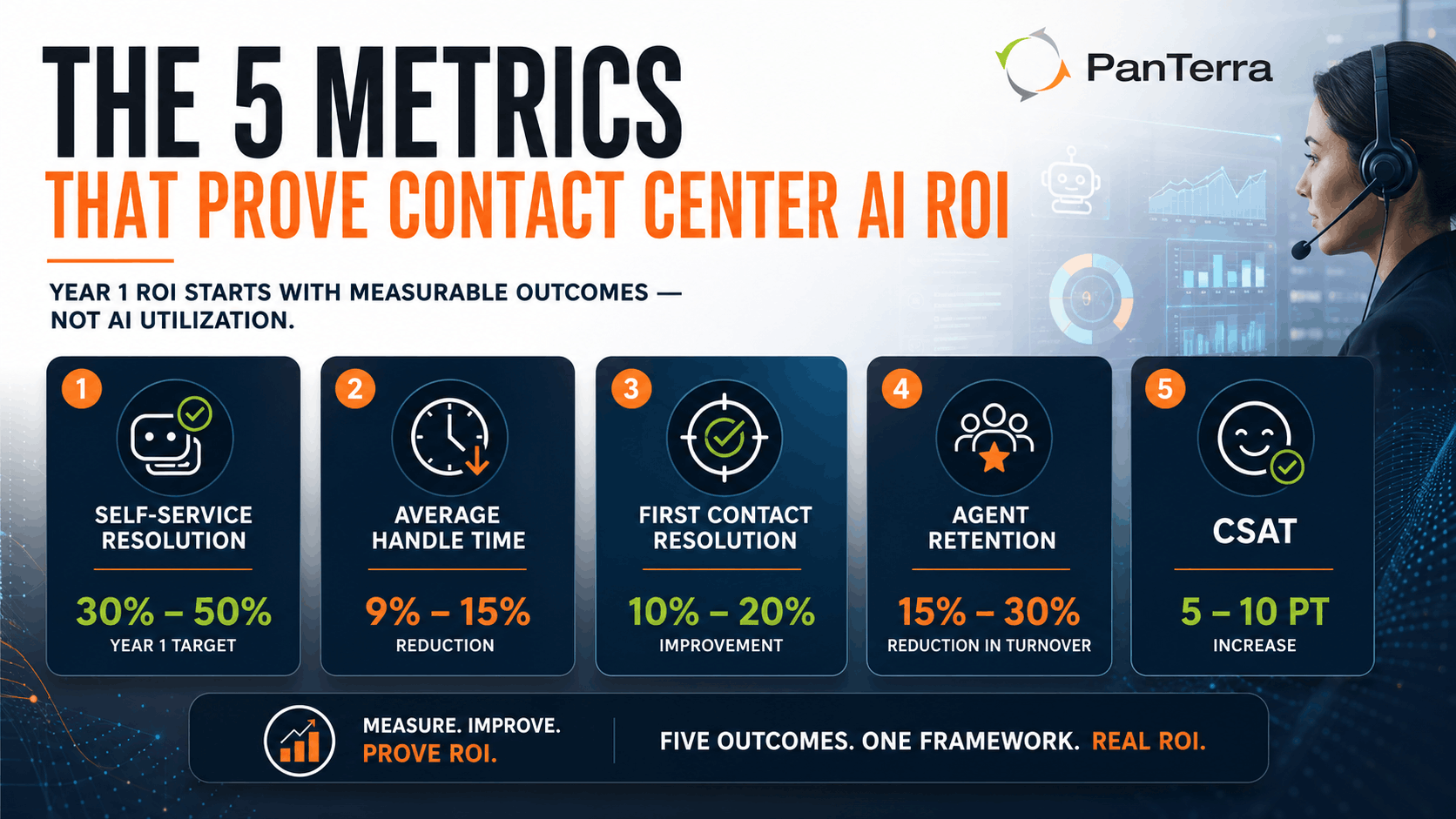
1. Self-Service Resolution Rate
What it measures: Percentage of inbound contacts resolved by AI without agent involvement.
Industry baseline: AI agents now deflect over 45% of incoming queries on average. Organizations without AI need 2.3x more agents to handle equivalent volume.
Year 1 target: 30% to 50% self-service resolution on appropriate interaction types (routine inquiries, status checks, scheduling, FAQ responses). Complex and compliance-sensitive interactions should still route to humans.
How to measure: Total AI-resolved contacts / Total inbound contacts, tracked weekly.
2. Average Handle Time (AHT)
What it measures: Total time an agent spends on a customer interaction including talk time, hold time, and after-call work.
Industry baseline: After-call work alone takes agents ~3 minutes per call on average. 54% of all calls require ACW. McKinsey research documents a 9% AHT reduction for Gen AI-enabled agents.
Year 1 target: 8% to 15% AHT reduction. Auto-generated call summaries eliminate manual after-call work. Real time agent assist reduces search time during calls.
How to measure: Average seconds/minutes per completed interaction including after-call work, tracked weekly against pre-deployment baseline.
3. First Contact Resolution (FCR)
What it measures: Percentage of customer issues resolved on the first interaction without a repeat contact, transfer, or escalation.
Industry baseline: Industry FCR averages 70% to 75%. Integrated omnichannel with intelligent routing has driven 31% reductions in first-resolution times.
Year 1 target: 5 to 10 percentage point improvement over baseline. Expect this metric to move in the second quarter of deployment, not the first, as routing maturity develops.
How to measure: Interactions with no repeat contact within 7 days / Total interactions, tracked monthly. Pull from CRM records, not agent self-reporting.
4. Agent Retention
What it measures: Percentage of agents who remain in role over the measurement period.
Industry baseline: Contact center annual turnover runs 30% to 45%. Agent replacement costs 16% to 20% of annual salary. 74% of agents report AI copilots help them feel more confident in complex calls.
Year 1 target: 5 to 10 percentage point improvement in retention rate. Reduction in after-call work and improvement in FCR address two of the most consistent drivers of agent dissatisfaction.
How to measure: (Agents at end of period / Agents at start of period) × 100, measured quarterly against pre-deployment baseline.
5. Customer Satisfaction (CSAT)
What it measures: Customer satisfaction scores collected post-interaction.
Industry baseline: Organizations implementing AI customer service correctly report 10 to 20 point CSAT gains in production. Every 1% improvement in FCR typically drives a 1% improvement in CSAT.
Year 1 target: 5 to 10 point improvement in CSAT score. This metric moves last — expect movement in months four through six, not months one through three.
How to measure: Post-interaction surveys on a consistent scale, measured monthly. Track AI-resolved and agent-assisted interactions separately.
The Year 1 Timeline: What to Expect at Each Checkpoint
Year 1 ROI builds in stages. A contact center AI deployment showing no improvement by Day 90 is not necessarily failing — it may be in the configuration phase that precedes measurable gains.
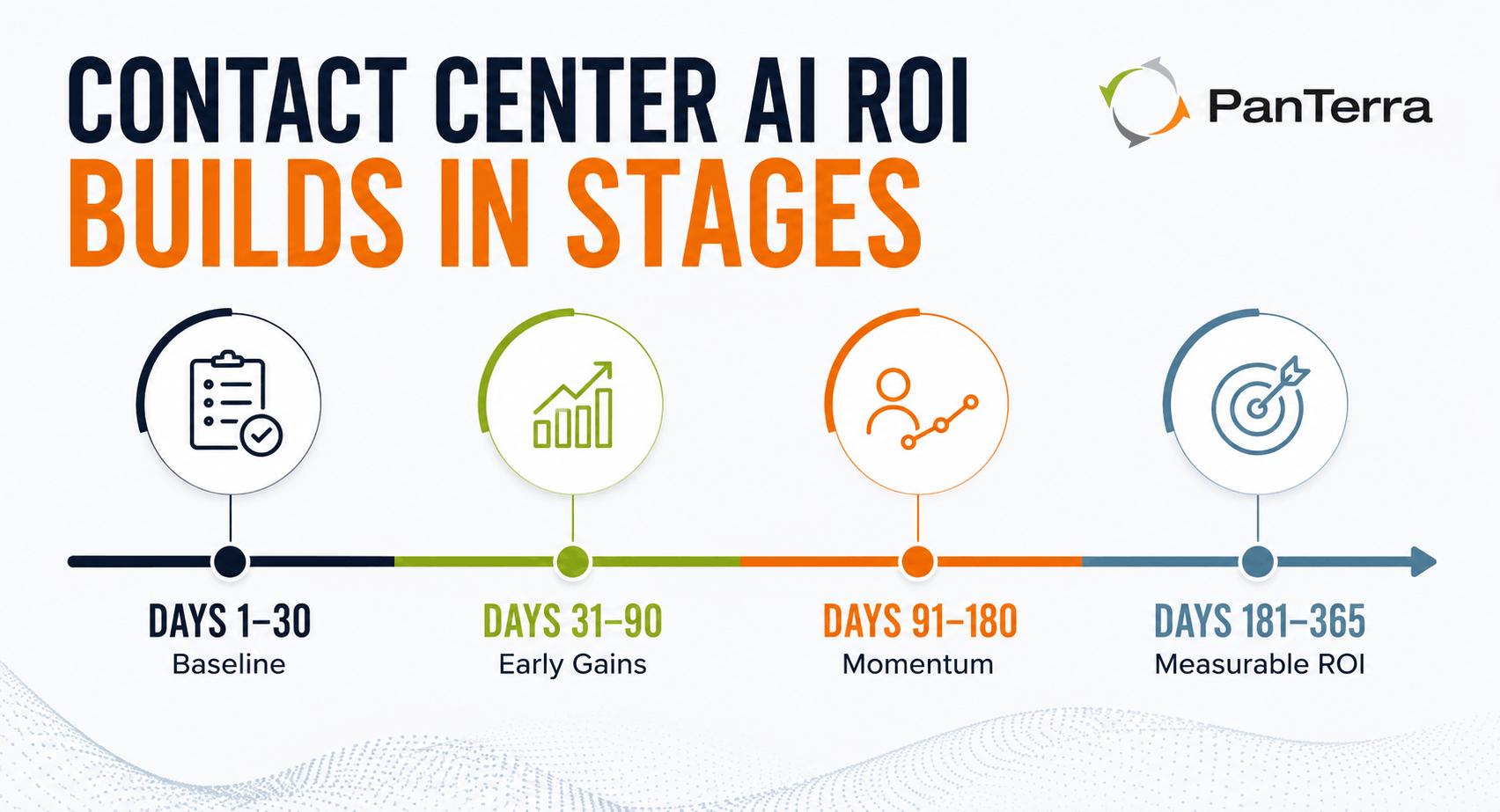
Days 1 to 30: Baseline metrics captured. CSAT, AHT, FCR, and agent retention documented before any AI influence. No improvement expected. This phase creates the comparison data that makes later results credible.
Days 31 to 90: Virtual agents handling routine volume. AHT reduction typically appears here as auto-summary and agent assist reach full deployment. Self-service resolution rate climbs as AI tunes to real call patterns.
Days 91 to 180: FCR improves as intelligent routing matures. CSAT begins to move. Early agent retention signals become visible in satisfaction surveys.
Days 181 to 365: All five metrics measurable against baseline. Year 2 capacity planning can use AI resolution rate as an input rather than headcount projections alone.
A contract with a 90-day performance review clause is appropriate for initial deployments. But the measurement framework needs to be agreed upon before signing, not established after the first review.
The ROI Math for a Mid-Market Contact Center
The model below uses conservative assumptions from published industry benchmarks.
Baseline assumptions (mid-market contact center):
- Monthly interaction volume: 10,000 contacts
- Current cost per human interaction: $8.00
- Monthly agent labor cost: $80,000
- Agent annual turnover rate: 35%
- Agent replacement cost per departure: $8,000
Year 1 AI impact (conservative benchmarks):
- Self-service resolution rate: 35% (3,500 contacts resolved by AI)
- AI resolution cost: $0.99 per interaction
- AHT reduction on remaining 6,500 assisted contacts: 9% (McKinsey benchmark)
- Agent retention improvement: 7 percentage points (from 65% to 72%)
Year 1 value calculation:
- Interaction cost savings: 3,500 × ($8.00 - $0.99) = $24,535/month = $294,420/year
- AHT productivity gain: 9% × $80,000 monthly labor × 12 = $86,400/year
- Retention savings: 35% baseline × 50 agents × 7% improvement × $8,000 = $9,800/year
Total Year 1 value: approximately $390,000
A platform investment of $100,000 to $150,000 annually at this scale returns 2.6x to 3.9x in Year 1, within the range of the $3.50 per $1 invested industry average. Organizations achieving higher self-service rates (50%+) and stronger AHT reductions see significantly higher returns.
Calculate Your Specific ROI
Talk to a PanTerra Contact Center AI specialist who can run this model against your actual volume, cost per interaction, and team size. Get a personalized Year 1 projection before you sign.
Five Questions That Reveal Whether a Vendor Is Ready for Year 1
1. What is your average self-service resolution rate at 90 days for similar deployments?
A vendor without a consistent answer here has not standardized their deployment process enough to predict outcomes.
2. How do you handle interactions that fall outside the AI's training data?
The escalation path matters as much as the resolution rate. Graceful handoffs to agents with full context separate production-ready AI from demo-ready AI.
3. What does your baseline measurement process look like before go live?
If the vendor has no structured pre-deployment data collection process, there will be nothing to measure results against.
4. How is after-call work automation handled?
Auto-summary generation is one of the fastest-acting ROI levers. Vendors who cannot explain their specific approach to ACW automation are not addressing one of the highest-impact use cases.
5. What does your Year 1 success review process look like?
Any vendor confident in their deployment outcomes will have a structured review process. A vendor who defers this question to the post go live period is one who does not expect the results to be impressive.
How PanTerra Contact Center AI Reports Against These Metrics
PanTerra's Contact Center AI, built natively into the Streams.AI platform, reports against all five Year 1 metrics from day one. The deployment team establishes baseline measurements before go live. The Admin AI portal provides real time visibility into self-service resolution rates, AHT by channel, FCR trends, and CSAT by interaction type.
The platform runs on PanTerra's proprietary Tier 4 US infrastructure with a 99.999% uptime SLA. HIPAA and HITECH certification covers every channel including contact center interactions, with a BAA included on every plan. Review Contact Center AI features and pricing or see the full Streams.AI platform overview for current plan details.
Frequently Asked Questions
How long does it take to see ROI from contact center AI?
For most mid-market organizations, the first measurable ROI signals appear between 90 and 180 days after deployment. Self-service resolution rates and AHT reductions typically move first (60 to 90 days). FCR and CSAT improvements follow in months four through six. 66% of businesses see meaningful ROI after six months.
What is a realistic ROI for contact center AI in the first year?
Industry benchmarks place average contact center AI ROI at $3.50 per $1 invested. A mid-market center handling 10,000 monthly interactions at $8 per human interaction, shifting 35% to AI, generates approximately $294,000 in annual interaction cost savings plus AHT and retention gains. Total Year 1 value in this model runs approximately $390,000 on a $100,000 to $150,000 platform investment.
What is the most common reason contact center AI fails to deliver ROI?
Undefined outcomes before deployment. Organizations that deploy AI without baseline measurements cannot establish credible comparisons. The second failure mode is misaligning AI capability to interaction type: attempting to automate complex, emotional, or compliance-heavy interactions before the AI has the training data to handle them reliably.
What is a good self-service resolution rate for contact center AI in Year 1?
A realistic Year 1 self-service resolution rate for a first AI deployment is 30% to 50% on appropriate interaction types. Routine queries: status checks, scheduling, FAQ responses, account lookups, are the highest-yield starting point. Organizations that start with routine interaction automation and expand the AI's scope progressively achieve higher and more durable resolution rates.
How does contact center AI improve agent retention?
Contact center agent turnover is driven primarily by repetitive administrative burden and burnout from high-volume low-complexity interactions. AI addresses both: after-call work automation eliminates manual documentation burden, real time agent assist provides tools to resolve complex calls confidently, and AI-handled routine volume frees agents for higher-complexity work where their skills are required. Industry data shows 74% of agents report AI copilots helped them feel more confident in their work.
Can contact center AI be HIPAA compliant?
Yes. Compliance depends on the platform, not the AI category. PanTerra's Contact Center AI operates on HIPAA and HITECH certified infrastructure, covering all channels: voice, chat, email, and AI managed interactions, under a single Business Associate Agreement included on every plan.
What is the difference between agent assist and autonomous AI resolution?
Agent assist (AI copilot) operates alongside a human agent during a live interaction, surfacing knowledge base articles, suggesting responses, and generating real time summaries. The agent remains in control. Autonomous AI resolution handles the entire interaction from initial greeting through resolution without agent involvement. The two modes are complementary: autonomous resolution handles routine volume, agent assist improves human-handled interactions. Both contribute to AHT reduction and FCR improvement.
How is PanTerra Contact Center AI priced?
Contact Center AI is available as an add-on to the Streams.AI Call Center plan, starting at $44.95/user/month retail ($29.95/user/month qualified for annual agreements or migrations). Review current pricing for plan details and qualified rates.
.jpg?width=500&height=500&name=Are%20you%20Getting%20a%20Good%20Deal%20(1).jpg)
Comments