VoIP Statistics & Market Data 2026 [Complete Reference Guide]


This page is a curated reference for VoIP and UCaaS market data, robocall and spam statistics, STIR/SHAKEN adoption metrics, remote work phone system trends, and cost benchmarks. Every statistic is sourced and dated. The guide is updated quarterly.
Use the section navigation below to jump directly to the data category you need.
Sections:
- Section 1: VoIP and UCaaS Market Size
- Section 2: Business VoIP Adoption
- Section 3: Robocall Volume and Spam Data
- Section 4: STIR/SHAKEN Authentication Metrics
- Section 5: Remote Work and Distributed Teams
- Section 6: Cost Savings and ROI Benchmarks
- Section 7: AI and Emerging Technology in VoIP
- Section 8: Infrastructure, Security, and Compliance
TL;DR: Key Data Points
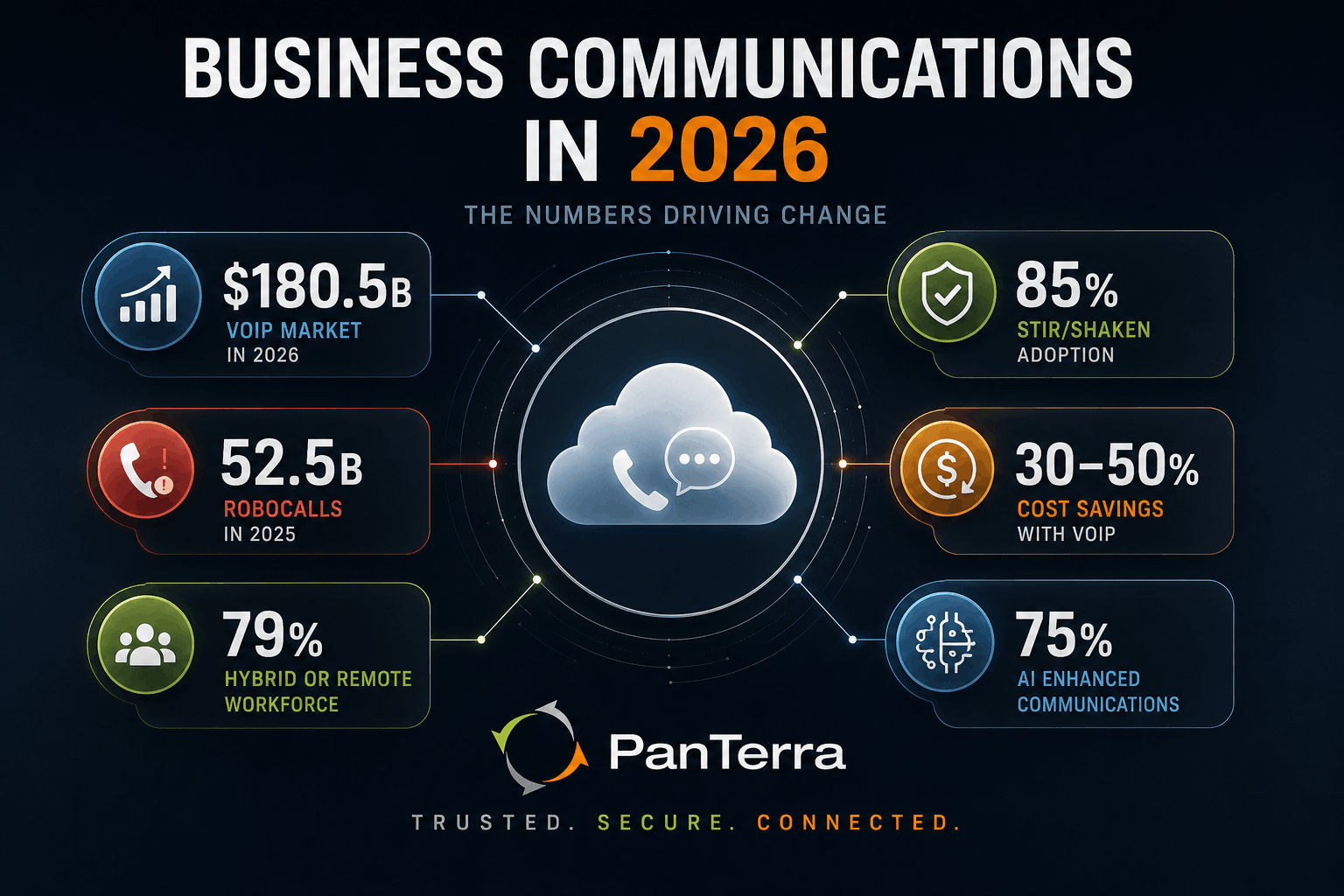
- 52.5 billion robocalls hit U.S. consumers in 2025, averaging 143.8 million per day. (YouMail, January 2026)
- Global VoIP services market was valued at $161.6 billion in 2025 and is projected to reach $180.5 billion in 2026, expanding to $488.6 billion by 2035 at an 11.7% CAGR. (Research Nester, 2026)
- UCaaS market stands at $70.56 billion in 2026, projected to reach $221.14 billion by 2031 at a 25.67% CAGR. (Mordor Intelligence, January 2026)
- 85% of voice traffic between Tier-1 U.S. carriers was signed with STIR/SHAKEN in 2025; 93% at A-level attestation. (TNS 2026 Robocall Report)
- 80% of consumers now avoid answering unknown calls. (TNS, 2025)
- Businesses switching to VoIP from legacy landlines report 30% to 50% savings on communication costs.
Who This Is For
- Best for: Journalists, analysts, UCaaS buyers, IT decision-makers, and content teams that need sourced, current VoIP and cloud communications data.
- Not ideal for: Teams looking for a product comparison or buying guide — see our UCaaS comparison articles for vendor evaluations.
- Top use case: Citing current VoIP market data, robocall statistics, or STIR/SHAKEN adoption metrics in research, analysis, or content.
Section 1: VoIP and UCaaS Market Size
Global VoIP Market
The global VoIP services market was valued at approximately $161.6 billion in 2025 and is forecast to reach $180.5 billion in 2026. Research Nester projects the market will expand to $488.6 billion by 2035, at a CAGR of 11.7%.
Market size estimates vary by research firm based on scope and methodology:
|
Source |
2025/2026 Value |
Forecast Year |
CAGR |
|---|---|---|---|
| Research Nester (2026) | $161.6B (2025) / $180.5B (2026) | 2035: $488.6B | 11.7% |
| Coherent Market Insights (2026) | $201.97B (2026) | 2033: $472.21B | 12.9% |
| Research and Markets (2025) | $169.38B (2025) | 2029: $264.27B | 11.8% |
| IMARC Group | Mobile VoIP: $46.9B (2024) | 2033: $120B | n/a |
North America accounted for approximately 34.8% to 39.5% of global VoIP and UCaaS revenue in 2025. Asia-Pacific leads the fastest VoIP growth among global regions at approximately 12% CAGR through 2033. (Cognitive Market Research)
UCaaS Market
The global UCaaS market stands at $70.56 billion in 2026 and is projected to reach $221.14 billion by 2031 at a 25.67% CAGR. (Mordor Intelligence, January 2026) A Custom Market Insights analysis places UCaaS at $94.6 billion in 2025 growing to $605.5 billion by 2035 at a 20.4% CAGR.
- The broader UC market (on-premise and cloud combined) will reach $628.5 billion by 2033, growing at a 17.4% CAGR. (DataHorizzon / Grand View Research)
- Healthcare held the largest share of the UCaaS market in 2024. (Introspective Market Research)
- Mobile UCaaS currently represents approximately 15% of the total UCaaS market. (Cavell)
- The global UCaaS market will surpass 131 million users by 2028. (Telecoms Tech News)
Section 2: Business VoIP Adoption
Enterprise Shift From Landlines
- PSTN lines in the United States declined from 171 million in 2005 to approximately 11.7 million in 2024: a 93% reduction. (FCC / public carrier reporting)
- 73% of American adults and 83% of children lived in a household without a landline by the end of 2022. (National Center for Health Statistics)
- AT&T stopped accepting new copper line orders on October 15, 2025, with FCC approval to retire over 30% of its copper footprint by end of 2026, affecting roughly 90,000 business customers.
- The FCC's March 2026 Network Modernization Order eliminated the Section 214 discontinuance process, removing key regulatory barriers to copper retirement. See our landline to VoIP migration guide for the full timeline.
- 31% of companies already run on VoIP as their primary telephony infrastructure. (Tragofone, 2026)
- When choosing a new voice service, 36% of software buyers choose VoIP compared to 24% for traditional POTS. (GetApp)
Cloud and UCaaS Preference
- 65% of enterprises are shifting to cloud based VoIP systems. (Business Research Insights, 2026)
- 85% of businesses were expected to adopt cloud-first principles by 2025. (Gartner)
- By 2030, analysts predict VoIP will represent 90% of all business communication. (Nuacom)
- 82% of businesses reported significant cost savings as a direct result of cloud migration. (Microsoft)
- 49.5% of UCaaS users have no plans to replace their current primary provider; when they do switch, cost is the primary driver. (Tragofone, 2026)
- Enterprise desktop and cordless-phone hardware revenue fell 9.2% to $2.21 billion in 2024 and is projected to decline 3.2% annually through 2031. (Frost & Sullivan)
Section 3: Robocall Volume and Spam Data
Total Robocall Volume
U.S. consumers received 52.5 billion robocalls in 2025: an average of 143.8 million calls per day, or approximately 1,663 per second. (YouMail Robocall Index, January 2026)
Monthly robocall data from YouMail's Robocall Index in early 2026:
|
Month |
Volume |
Daily Average |
|---|---|---|
| May 2026 | 4.1 billion | 132.8 million/day |
| March 2026 | 4.2 billion | 135.7 million/day |
| February 2026 | 3.8 billion | 135.7 million/day |
| January 2026 | 3.9 billion | ~126 million/day |
Six consecutive months (October 2025 through March 2026) maintained robocall volumes under 4 billion per month: a level not sustained since May 2022. (YouMail, March 2026)
Robocall Composition (2025)
- Scam-related calls surged to over 35% of all robocalls in 2025, up from 30% the prior year. (YouMail 2025 Robocall Index)
- Telemarketing and scam calls combined accounted for 58% of all robocall traffic in February 2026. (YouMail / BriefGlance)
- Approximately 30 billion unwanted telemarketing and scam calls were placed annually in 2025, a number continuing to grow despite mitigation efforts. (YouMail CEO Alex Quilici, January 2026)
- 15% of spam-tagged calls were linked to SIM farm operations exploiting MVNO complexities. (TNS 2026 Robocall Report)
Consumer and Business Impact
- 80% of consumers now avoid answering unknown calls. (TNS, 2025)
- 43% of subscribers filed a robocall report in 2025, up from 28% in 2023. Reporting among adults aged 25 to 34 jumped to 57%. (TNS 2025 Robocall Report)
- 85% of users report daily annoyance from robocalls. (YouMail survey)
When carrier analytics engines flag a business number for spam-like behavior: high volume, brief call duration, geographic targeting. That number can receive a "Spam Likely" label visible to call recipients before they answer — degrading answer rates regardless of call legitimacy. See our phone number reputation management guide for how labels are assigned and how remediation works.

Section 4: STIR/SHAKEN Authentication Metrics
STIR/SHAKEN (Secure Telephone Identity Revisited / Signature-based Handling of Asserted information using toKENs) is the FCC-mandated call authentication framework. Key metrics from the TNS 2026 Robocall Investigation Report (published March 2026):
- 85% of all voice traffic between Tier-1 U.S. carriers (Verizon, UScellular, T-Mobile, Lumen, Comcast, Charter, AT&T) was signed and verified with STIR/SHAKEN protocols in 2025.
- 93% of that signed Tier-1 traffic was authenticated at A-level attestation in 2025.
- Only 17.5% of call traffic from non-Tier-1 carriers was signed in 2025: a gap that represents a persistent vulnerability in the authentication framework.
- 43% of spam traffic carries A-level attestation, meaning STIR/SHAKEN signing alone does not indicate call legitimacy.
- Of 9,242 voice service providers registered in 2025, only 44% had fully installed proper caller ID authentication. 31% had not implemented STIR/SHAKEN at all, an increase from 2,567 non-compliant providers in 2024. (CallerID Reputation / U.S. PIRG)
- Carriers have been fined $200 million for failing robocall blocks since 2021.
For a full explanation of attestation levels and what they mean for your outbound calling, see our STIR/SHAKEN explained guide.
Section 5: Remote Work and VoIP Adoption
Workforce Distribution in 2026
- Among remote-capable U.S. employees, 52% work in hybrid arrangements, 27% are fully remote, and 21% are entirely on site in 2026. (Gallup)
- Approximately 34.6 million employed people in the U.S. teleworked in August 2025. (Bureau of Labor Statistics)
- The U.S. telework rate has ranged between 17.9% and 23.8% consistently from late 2022 to early 2025. (BLS)
- Stanford economist Nick Bloom's research estimates approximately 27% of paid full-time workdays in the U.S. are now worked from home.
- Only 30% of companies plan to completely remove remote work by 2026.
- 83% of global CEOs anticipate a full return to office work by 2027, but badge and cell phone data show employees are not complying at the rates employers expect. (PwC)
Remote Work as a VoIP Driver
- UCaaS platforms are projected to grow at a 15.18% CAGR from $85.19 billion in 2025 to $172.69 billion in 2030, driven substantially by remote work adoption. (Research and Markets)
- 73% of remote employees use personal devices for work. (WorkTime, 2025)
- Implementing UCaaS saves employees an average of 30 minutes per day by centralizing communication and streamlining workflows. (Network World)
- 75% of UCaaS users report increased employee productivity. (Frost & Sullivan)
See our best cloud phone system for remote teams guide for how these workforce trends translate to platform requirements.
Section 6: Cost Savings and ROI Benchmarks
Switching From Landlines to VoIP
- Businesses migrating from legacy landlines to VoIP report 30% to 50% savings on communication costs compared to traditional telephony. (Research Nester, VMR, Brightlio: consistent across multiple sources)
- Small businesses on usage-based VoIP plans report savings up to 68%. (Brightlio / ExpertMarket, 2025)
- Small businesses migrating from traditional lines save up to 40% on local calls and up to 90% on international calls. (2025 SIP trunking research)
- Subscription-based VoIP models reduce installation costs by up to 90% compared to PSTN. (Global Newswire)
- Businesses using an integrated UCaaS platform report a 30% cost reduction for conferencing tools alone. (Network World)
Productivity and Operational Gains
- VoIP and UCaaS adoption increases employee productivity by 30 minutes per user per day on average. (Network World / Yeastar)
- Advanced VoIP features (call forwarding, voicemail to email, CRM integration) increase employee productivity by 20%. (Nuacom)
- SMEs adopting VoIP report a 30% increase in productivity due to mobile integrations and remote accessibility. (Nuacom)
- 35% of businesses are willing to pay 20% or more above standard pricing for enhanced UCaaS features beyond core calling. (Metrigy Research)
- Companies with flexible remote work policies experienced 21% higher revenue growth over three consecutive years compared to those with rigid in-office requirements. (WorkTime, 2025)
SIP Trunking
- The SIP trunking services market will grow from $16.75 billion in 2024 to $18.52 billion in 2025, reaching $30.65 billion by 2029 at a 13.4% CAGR. (Business Research Insights)
- Switching to SIP trunking can cut communication costs by 20% to 60%. (Newswires)
Section 7: AI and Emerging Technology in VoIP
- AI integration in VoIP systems is projected to grow by 35% by 2025, bringing features like real time transcription, call sentiment analysis, and intelligent call routing. (Nuacom)
- 58% of VoIP providers integrate AI driven analytics and automation tools. (Business Research Insights, 2026)
- 51% of information workers are already at firms rolling out Microsoft Copilot, with the same share adopting ChatGPT Enterprise. (Forrester, 2025)
- By 2026, conversational AI in contact centers is expected to reduce agent labor costs by $80 billion. (Gartner)
- By 2027, AI is expected to handle 50% of service cases, up from 30% in 2025. (Tragofone, 2026)
- The cloud meetings and team collaboration market is estimated to reach $21.6 billion by 2029. (Frost & Sullivan)
- 5G networks allow up to 50% more simultaneous HD VoIP calls compared to 4G. (FreJun)
- 2.9 billion 5G subscriptions are expected by end of 2025, reaching 6.3 billion by 2030. (Ericsson)
Section 8: Infrastructure, Security, and Compliance
- Global average cost of a data breach reached $4.4 million in 2025, a 10% increase from 2023. (IBM)
- Public cloud data breaches cost an average of $5.17 million. (IBM)
- 40% of breaches affect data spread across multiple cloud environments. (IBM)
- 76% of cybersecurity professionals say remote work makes their organization more vulnerable. (Stanford / Gable.to)
- Remote-related data breaches cost an average of $1.07 million more than office-based incidents. (Stanford / Gable.to)
- 42% of VoIP users report security and data privacy concerns as a major limitation affecting adoption decisions. (Business Research Insights)
- In 2024, the healthcare sector held the largest share of the UCaaS market, driven by telehealth expansion and HIPAA-compliant communications requirements. (Introspective Market Research)
PanTerra's Streams.AI platform provides HIPAA and HITECH certification across all channels on every plan. Phone number reputation management is available as a native add-on for businesses where outbound call answer rates drive revenue.
Frequently Asked Questions
What is the current size of the global VoIP market in 2026?
The global VoIP services market is estimated at $180.5 billion in 2026 per Research Nester. Other research firms place it between $96.4 billion and $201.97 billion depending on scope. The market is projected to reach between $488.6 billion (Research Nester) and $472.21 billion (Coherent Market Insights) by 2033 to 2035 at an 11.7% to 12.9% compound annual growth rate.
How many robocalls did U.S. consumers receive in 2025?
U.S. consumers received 52.5 billion robocalls in 2025, averaging 143.8 million per day. Despite government and industry mitigation efforts, total annual volume has remained above 50 billion calls, with scam and telemarketing calls now accounting for more than 58% of all robocall traffic. (YouMail Robocall Index, January 2026)
What percentage of U.S. call traffic uses STIR/SHAKEN authentication?
Among Tier-1 U.S. carriers, 85% of all voice traffic was signed and verified with STIR/SHAKEN protocols in 2025, with 93% of that signed traffic at A-level attestation. However, only 17.5% of call traffic from non-Tier-1 carriers was signed. (TNS 2026 Robocall Investigation Report)
What percentage of workers are fully remote or hybrid in 2026?
Among remote-capable U.S. employees, 52% work in hybrid arrangements and 27% are fully remote in 2026, leaving only 21% entirely on site. Approximately 34.6 million employed people in the U.S. teleworked in August 2025. (Gallup / Bureau of Labor Statistics)
How much can a business save by switching from landlines to VoIP?
Businesses migrating from traditional landlines to VoIP consistently report 30% to 50% savings on communication costs. Small businesses report savings up to 68% on usage-based plans. SIP trunking specifically can cut costs by 20% to 60%. UCaaS adoption additionally saves employees an average of 30 minutes per day in productivity, and businesses using integrated platforms report 30% reductions in conferencing costs.
What is the difference between STIR/SHAKEN and phone number reputation management?
STIR/SHAKEN is a call authentication protocol that verifies whether the phone number on a caller ID is legitimately owned by the originating party, preventing number spoofing. Phone number reputation management is a separate service that monitors how carrier analytics engines score your business phone numbers based on behavioral data. A number can be fully STIR/SHAKEN authenticated and still carry a spam label. See our phone number reputation management guide and STIR/SHAKEN explained guide for a full breakdown.
What is driving UCaaS market growth in 2026?
UCaaS market growth in 2026 is driven by four primary factors: the structural shift to remote and hybrid work (now the default for knowledge workers), the retirement of legacy PSTN and copper infrastructure, AI integration into communication platforms (projected to handle 50% of service cases by 2027), and the consolidation of fragmented communication tools into single-platform UCaaS solutions. The UCaaS market CAGR of 20.4% to 25.67% through 2035 reflects the acceleration of these drivers.
How does VoIP market growth vary by region?
North America dominates global VoIP revenue with approximately 34% to 40% market share. Asia-Pacific leads growth at approximately 12% CAGR through 2033, fueled by rapid 5G rollouts and mobile-first workforces. Europe's IP telephony and UCaaS market was projected to reach $26 billion by 2025. Latin America accounted for approximately 5% of global VoIP revenue in 2023 but forecasts 10%+ CAGR through the latter half of the decade.
Data Sources and Update Methodology
This reference guide is updated quarterly. Statistics are drawn from primary and secondary sources cited inline throughout the document.
Market Research: Research Nester (2026) | Mordor Intelligence (January 2026) | Custom Market Insights (2026) | Coherent Market Insights (2026) | Research and Markets (2025) | Business Research Insights (2026) | Grand View Research | DataHorizzon | IMARC Group
Robocall and Authentication Data: YouMail Robocall Index (monthly, 2025-2026) | TNS 2026 Robocall Investigation Report (March 2026) | FCC public filings | CallerID Reputation | U.S. PIRG Education Fund (2025)
Workforce and Remote Work: Gallup Workplace Research (2026) | Bureau of Labor Statistics (2025) | Nick Bloom / Stanford WFH Research | WorkTime (2025)
Infrastructure and Productivity: Frost & Sullivan | Network World | Forrester (2025) | Gartner | Microsoft | IBM Cost of Data Breach Report (2025) | Ericsson Mobility Report
Note on methodology: Market size estimates vary significantly across research firms due to differences in scope definition, geographic coverage, and estimation methodology. This guide cites multiple sources where estimates diverge materially rather than presenting a single figure as authoritative.
.jpg?width=500&height=500&name=Are%20you%20Getting%20a%20Good%20Deal%20(1).jpg)
Comments