Why Is My Business Phone Number Showing as Spam Likely?

If your business phone number is showing as “Spam Likely,” your phone number reputation has already been damaged. Customers see a warning label instead of your business name before they decide whether to answer, and most will not pick up.
This guide explains exactly why business numbers get flagged, how carrier algorithms make the decision, what STIR/SHAKEN has to do with it, and the step-by-step process to fix the label and protect your number going forward.
Why Business Numbers Get Flagged as Spam Likely
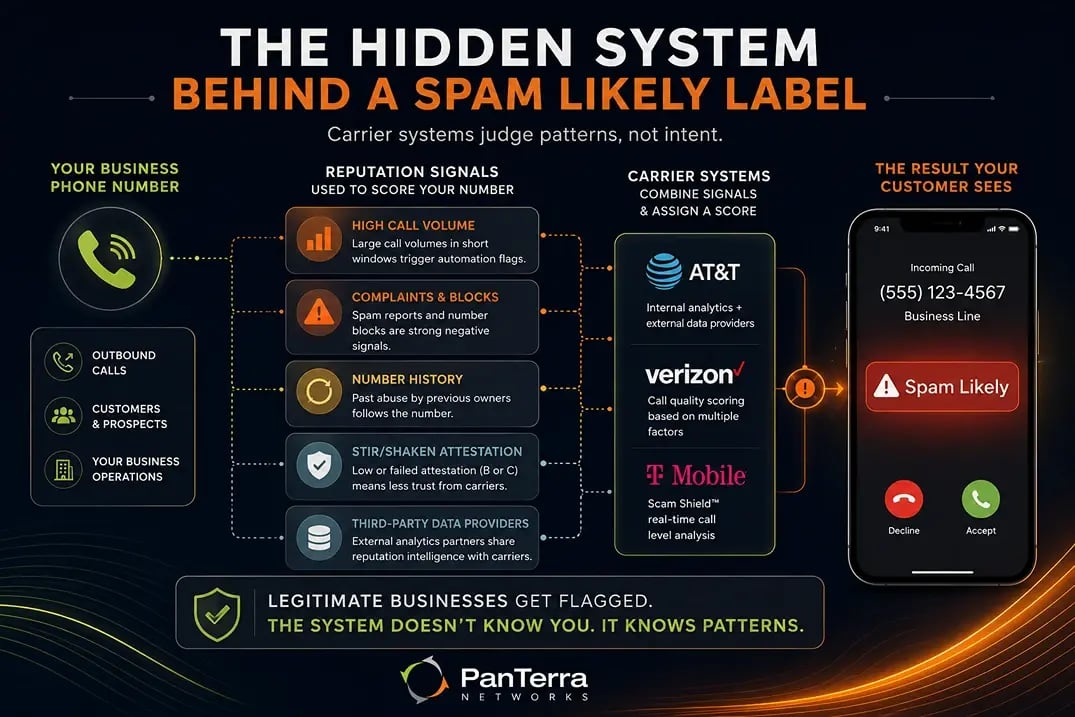
Carrier tracking systems flag numbers based on patterns, not intent. Carriers can label your number "Spam Likely" even if you have never sent a single spam call. Here are the most common causes.
High outbound call volume: Any number that dials a large volume of calls in a short window looks like an autodialer to carrier tracking systems. Sales teams, appointment reminders, and healthcare schedulers are all at risk. The system does not know your calls are real. It sees the pattern and applies a label.
Complaint triggers: When called parties press "report spam" or block a number in their phone, the carrier logs that complaint. A small number of complaints on a high volume of calls can be enough to trigger a flag.
Previous number owner: When you acquire a phone number, you inherit its history. If the previous owner used that number for high-volume outbound campaigns or robocalls, the reputation damage follows the number to you. This is common with recycled business numbers and toll-free lines.
Failed or missing STIR/SHAKEN check: Calls the carrier cannot verify receive a "C" gateway attestation, meaning the carrier cannot confirm the number is really owned by the caller. Calls with low attestation levels face more scrutiny from tracking systems and face a higher risk of getting a label.
Outside data providers: Carriers do not make labeling decisions alone. They rely on analytics partners such as TNS Call Guardian, First Orion, Hiya, and Neustar (now part of TransUnion). Each of these providers maintains its own database of flagged numbers. A label from one provider can appear across multiple carriers at the same time.
How Carrier Algorithms Decide to Flag a Number
In fact, the three major US carriers each use a combination of their own data and outside analytics to decide which numbers to flag. Here is how the decision typically works.
AT&T uses its own internal analytics alongside data from outside providers. Numbers with high complaint rates, unusual calling patterns, or low STIR/SHAKEN attestation are most at risk. AT&T displays labels such as "Possible Fraud," "Telemarketer," and "Spam Likely."
Verizon uses a call quality scoring system. It weighs factors including complaint volume, call duration patterns, call drop rates, and STIR/SHAKEN check. Numbers scoring below a certain threshold receive a visible label on the called party's screen.
T-Mobile's Scam Shield system is among the most aggressive. It displays labels at the call level in real time based on network analytics and reported complaints. T-Mobile also blocks calls it deems high risk, meaning some labeled calls never ring at all.
So the common thread across all three is this: the carriers designed these systems to protect consumers at scale. They make mistakes. Legitimate business numbers get caught in the filters regularly. And the carriers do not proactively notify you when a carrier flags your number.
What STIR/SHAKEN Means for Your Number
STIR/SHAKEN is the FCC-required caller ID authentication framework for voice service providers operating IP networks. Full details are in our UCaaS vs VoIP guide, , but here is what matters most for phone number reputation.
Under STIR/SHAKEN, every outbound call gets an attestation level:
- A attestation: The carrier has fully confirmed that the calling party owns the number being displayed. Highest trust level.
- B attestation: The carrier has verified the caller's account but cannot confirm they are authorized to use that specific number.
- C attestation: The call entered the network through a gateway. No check of the number is possible.
Calls with B or C attestation are not on their own labeled spam. However, they receive more scrutiny from tracking systems. A number with a C attestation and high outbound volume faces a lot more risk than a fully verified A attestation number.
If your UCaaS or VoIP provider cannot deliver an A-level attestation for your numbers, that is a baseline gap to address before anything else.
Step-by-Step: How to Fix a Spam Likely Label
These steps apply whether a carrier just flagged your number or it has carried a label for a while. Work through them in order.
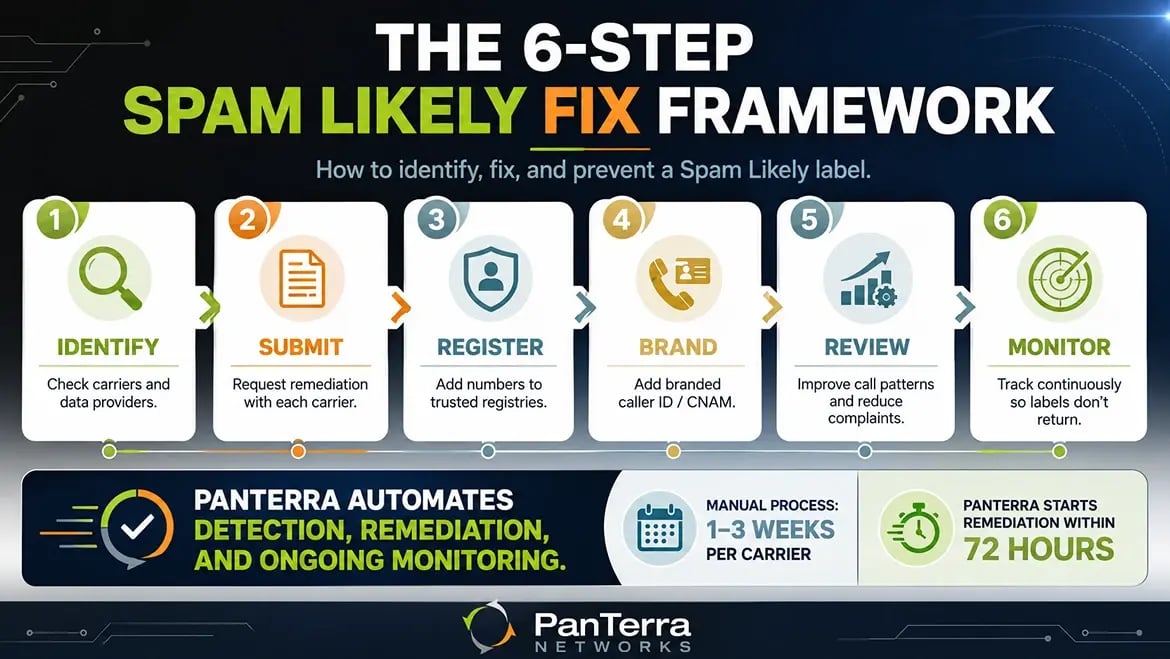
- Identify which carriers and data providers have flagged your number. Check your number at Free Caller Registry (freecallerregistry.com), TNS Call Guardian, First Orion, and Hiya. Each shows its own labeling status on its own. Not every carrier uses the same data provider, so a label with AT&T may not show up on Verizon.
- Submit a remediation request to each affected carrier. AT&T, Verizon, and T-Mobile each have a business portal for reporting wrongly labeled numbers. These processes are manual, separate, and can take several days to weeks. You will need to verify business ownership and explain your calling use case.
- Register your numbers with data providers. Free Caller Registry allows you to register your business numbers with TNS, First Orion, and Hiya in one submission. Registration does not guarantee removal of existing labels, but it creates a verified business record that reduces future risk.
- Add branded caller ID. Registering your business name as the display name through CNAM (Caller ID Name) services ensures your business name appears instead of just the phone number. Some data providers also support branded caller ID as a paid overlay that shows your logo and name on modern smartphones.
- Review your calling practices. If high call volume triggered the label, adjust your outbound patterns. Spread calls across longer time windows. Reduce call drop rates. Ensure calls connect to a live agent or a meaningful message. Analytics systems track these signals over time, and cleaner calling behavior improves your score gradually.
- Track your numbers regularly going forward. A label can return. One complaint burst, a volume spike, or a new data provider adding your number to their list can undo remediation that took weeks to complete. Passive tracking is not enough for any business that depends on outbound calls for revenue.
How PanTerra Automates This Process
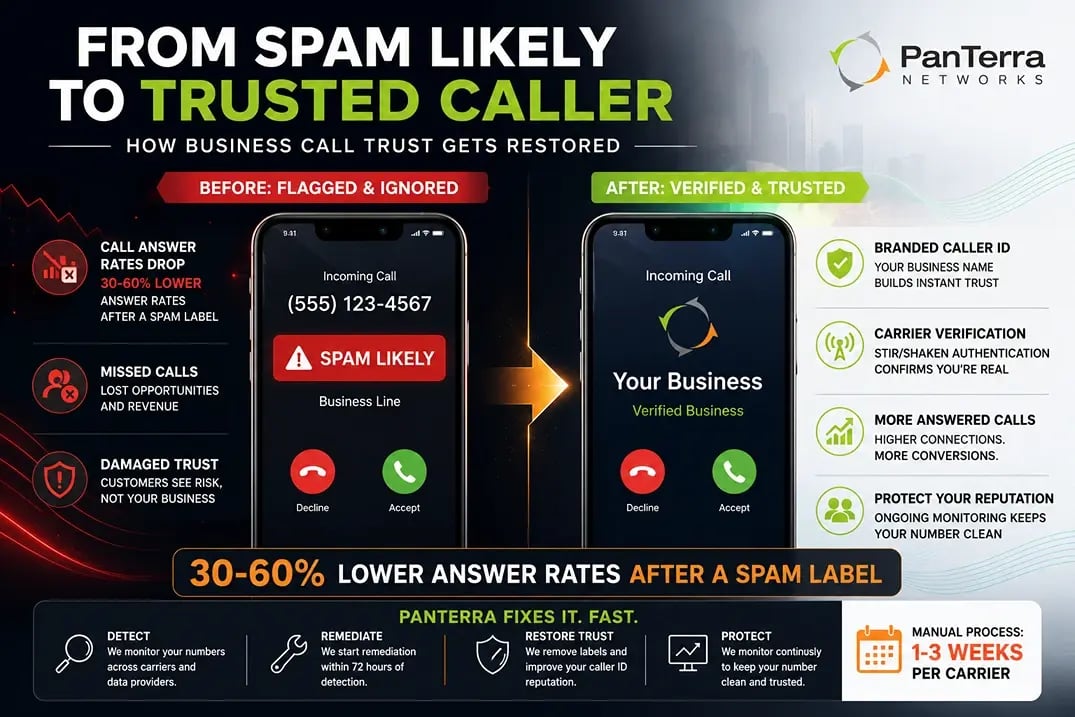
However, for most businesses, the manual process above is not workable. The remediation requests are separate for each carrier. The tracking requires checking multiple platforms. A single new complaint after weeks of clean calling can put the label back.
PanTerra's Phone Number Reputation Management service handles all of this in the platform. For $10 per number per month, PanTerra tracks your numbers across AT&T, Verizon, T-Mobile, and major data providers, including TNS, First Orion, and Hiya. When a spam label appears, PanTerra detects it and starts the remediation process within 72 hours. You do not have to check portals, submit separate requests, or track each carrier on its own.
PanTerra’s branded caller ID feature also helps your business name appear on outbound calls instead of an unknown number, across all major carriers and analytics platforms. This both improves answer rates and reduces the risk of complaints, since called parties can see who is calling before they decide to pick up.
This service is available on every PanTerra plan, including Streams.AI base tiers. For teams that depend on outbound calls, this is not an optional add-on. A "Spam Likely" label on an active sales or service line is a direct revenue problem, and most teams do not notice it until the damage has already accumulated.
For more details on how PanTerra manages number reputation, see the PanTerra reputation management page.
Frequently Asked Questions
Why is my business number showing as Spam Likely if I never sent spam?
Carrier tracking systems flag numbers based on patterns, not intent. High outbound call volume, complaint reports from called parties, low STIR/SHAKEN attestation levels, and inherited reputation from a previous number owner can all trigger a label. Your calls being real does not protect you from the pattern-based filters.
How long does it take to fix a Spam Likely label?
Manual remediation through individual carrier portals typically takes one to three weeks per carrier. The process is separate for each of AT&T, Verizon, and T-Mobile. With PanTerra's automated remediation service, the process starts within 72 hours of detection across all carriers simultaneously.
Will my number get flagged again after I fix it?
Yes, it can. A spike in outbound volume, a new batch of complaint reports, or a new data provider adding your number can trigger the label again. Ongoing tracking is required for any business that depends on outbound calls. PanTerra tracks continuously and restarts remediation on its own if a label returns.
What is the difference between Spam Likely and Scam Risk?
Both labels warn the called party before they answer. "Spam Likely" indicates the tracking system has flagged the number as probably unwanted but not necessarily fraudulent. "Scam Risk" is a more severe label, typically reserved for numbers with high complaint rates or patterns that match known fraud behavior. Both labels reduce answer rates a lot, but "Scam Risk" is harder to remediate.
Does STIR/SHAKEN fix a Spam Likely label?
Not directly. STIR/SHAKEN is a caller ID check framework, not a reputation system. Having an A-level attestation means the carrier can confirm you own your number. However, tracking systems can still label a verified number as spam if calling patterns trigger their filters. STIR/SHAKEN compliance reduces risk and improves your standing with data providers, but reputation management is a separate process.
Can I check if my number is labeled right now?
Yes. Check your number at Free Caller Registry (freecallerregistry.com) to see status across TNS, First Orion, and Hiya. For T-Mobile here, you can check through T-Mobile's business portal. Also, note that labels can vary by carrier, so a clean result on one platform does not mean you are clean on all of them.
.jpg?width=500&height=500&name=Are%20you%20Getting%20a%20Good%20Deal%20(1).jpg)
Comments