Microsoft Teams Phone Setup and the Illusion of Control


Microsoft Teams Phone system setup establishes operational control boundaries that persist for years. These boundaries determine who manages incidents when problems occur. When organizations implement Teams Phone, responsibility is often distributed across multiple parties. This distribution creates structural challenges that surface during outages.
Most Teams Phone troubleshooting complications stem from configuration decisions that split accountability between Microsoft, carriers, and internal IT teams. When no single party owns the full system, issues cannot be resolved independently. Resolution depends on coordination across responsibility lines, which extends downtime during incidents.
Architectural decisions influence operational outcomes more than technical expertise. Understanding how voice, identity, and network layers are separated explains why recovery slows when problems cross ownership boundaries.
Configuration choices ultimately determine who controls what during system failures. By shifting focus from technical setup details to accountability boundaries, IT leaders can make more informed decisions about their communication infrastructure.
Why does Teams Phone troubleshooting create operational complexity?
Teams Phone troubleshooting becomes complex because responsibility is fragmented across multiple domains with no single operational owner.
Ownership fragmentation drives most Teams Phone recovery challenges. Multiple stakeholders share responsibility without clearly defined boundaries. Issues commonly originate across network conditions, user environments, and platform behavior, revealing multiple potential failure points that span different operational domains.
When accountability is split, incidents cannot be resolved end-to-end by any one team. Problems move between internal IT, carriers, and Microsoft support, extending resolution timelines and increasing coordination overhead during outages.
Setup Creates Ownership Boundaries That Limit Recovery Control
Microsoft Teams configuration establishes boundaries between administrative access and actual recovery authority. While IT teams can manage licenses and policies, this access rarely translates into control over platform-level failures.
Changes made during incidents often depend on external systems and propagation processes. Identity and policy updates may take hours to apply across the environment. During outages, this delay creates a gap between user expectations and what IT teams can realistically resolve.
Network Layer Separation Complicates Cross-System Visibility
Teams Phone operates across distinct layers: voice services, identity systems, and network infrastructure. Each layer relies on different monitoring tools and ownership models. No single system provides complete visibility across all components.
When issues cross these layers, coordination requirements increase. Teams must collaborate across organizational silos with partial information. This fragmentation extends escalation paths and slows recovery, even when individual components appear healthy in isolation.
How do setup decisions define incident control boundaries?
Incident control boundaries are defined by Microsoft Teams Phone setup choices that determine which parties can act during outages.
Control boundaries emerge from how Teams Phone is implemented. These boundaries explain why recovery often requires coordination across multiple parties. Each ownership domain operates with different tools, permissions, and response models, which shapes what can be addressed during an incident and what cannot.
When setup decisions distribute control across multiple domains, no single team owns the full recovery path. This structure directly influences resolution speed and operational outcomes during system failures.
Microsoft Controls Platform Recovery Speed
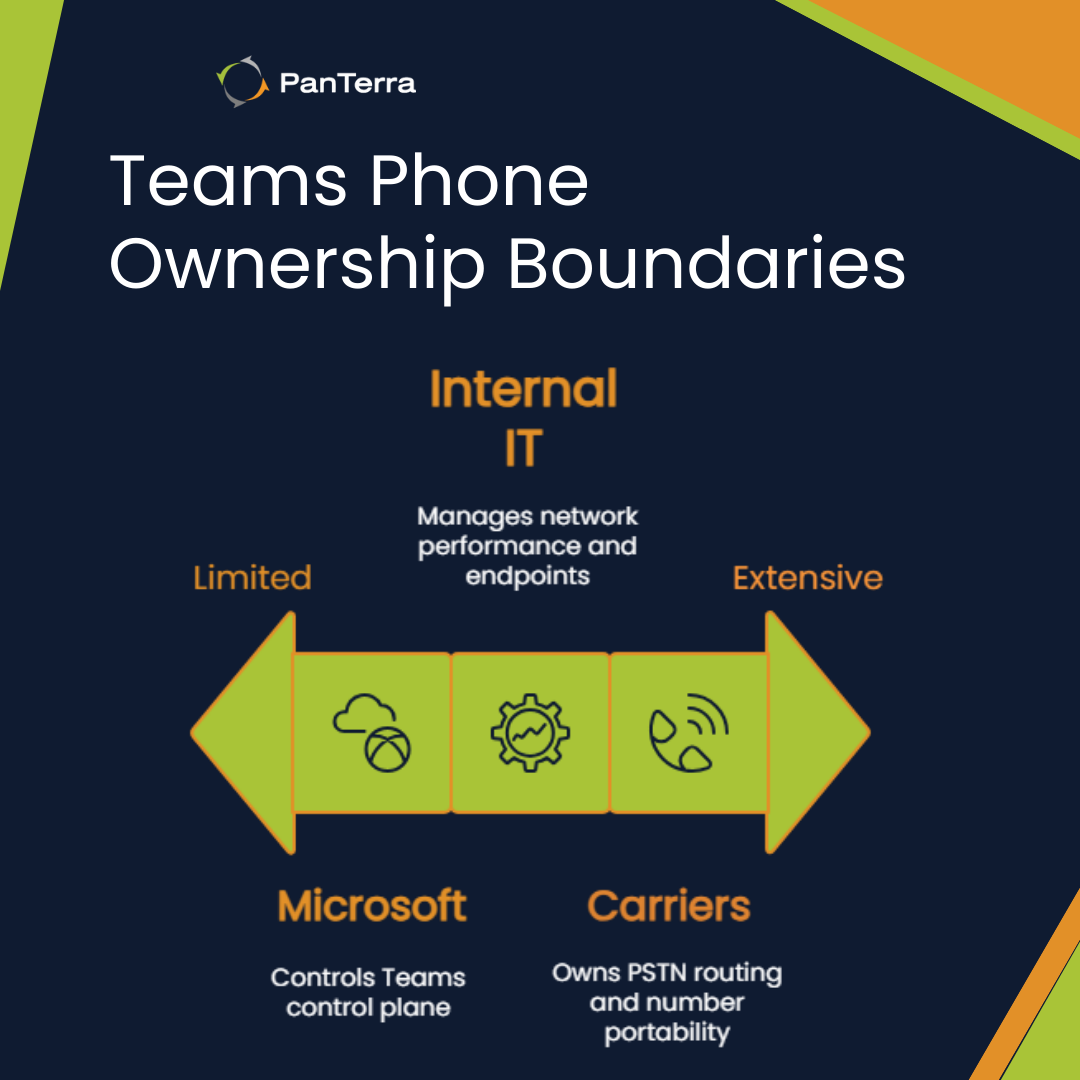
Microsoft owns the Teams platform infrastructure, including the control plane, policy propagation, and identity synchronization. These elements sit outside the direct control of internal IT teams.
During platform-level incidents, recovery timelines are determined by Microsoft’s internal processes. Configuration changes made by administrators may not take effect immediately, limiting the ability to respond in real time. As a result, internal urgency does not necessarily translate into faster resolution.
Carriers own PSTN routing and emergency path reliability
Carriers manage the public telephone network connections that integrate with Teams. This ownership includes number portability, call routing, and emergency calling paths. The selected carrier integration model establishes these control boundaries.
Emergency calling introduces additional constraints. Carriers are responsible for compliance and routing behavior, and visibility into recovery progress is often limited. Resolution timing depends on contractual escalation paths rather than internal troubleshooting efforts.
IT teams manage network performance and user impact
Internal IT teams are responsible for network conditions and endpoint devices. These factors influence call quality, reliability, and user experience, and network issues can appear similar to platform failures.
Endpoints such as headsets, client software, and local connectivity remain under IT control. When issues span platform, carrier, and network layers, IT teams must coordinate across boundaries. This dependency typically extends resolution timelines during incidents.
Why can’t setup testing prevent operational failures?
Setup testing cannot prevent operational failures because it validates configuration correctness, not real-world recovery conditions.
Pre-deployment tests often create a false sense of security. Teams Phone validation typically confirms that core features work under normal conditions, but it does not account for how the system behaves during platform degradation, carrier disruptions, or cross-domain failures.
As a result, organizations may complete implementation with confidence in their setup while remaining unprepared for the operational realities of outages.
Testing validates basic configuration flow
Controlled tests confirm that fundamental components function as expected. These tests verify number assignments, voicemail behavior, calling permissions, and basic routing logic.
Quality checks can also surface audio issues or obvious network constraints. However, these validations occur in stable environments with all services available. They reflect ideal conditions rather than the complexity of live production systems.
Testing cannot simulate real platform failures
Platform-level degradation sits outside the scope of most testing scenarios. Control plane unavailability, identity propagation delays, and carrier routing failures cannot be reliably simulated during setup.
Microsoft’s infrastructure remains opaque during validation. Teams cannot trigger controlled failures within the platform, which means recovery behavior is never exercised in advance. Escalation paths and response timelines remain theoretical until an actual incident occurs.
Multi-party dependencies create unpredictable recovery patterns
Teams Phone recovery depends on coordination between internal IT, Microsoft, and carriers. Each party operates within its own domain, using different tools and escalation processes.
When incidents cross these boundaries, ownership becomes unclear. Issues move between teams as responsibility is reassessed, extending resolution timelines. Without shared visibility across layers, recovery patterns become inconsistent and difficult to predict.
How do architectural choices shape long-term Teams Phone resilience?
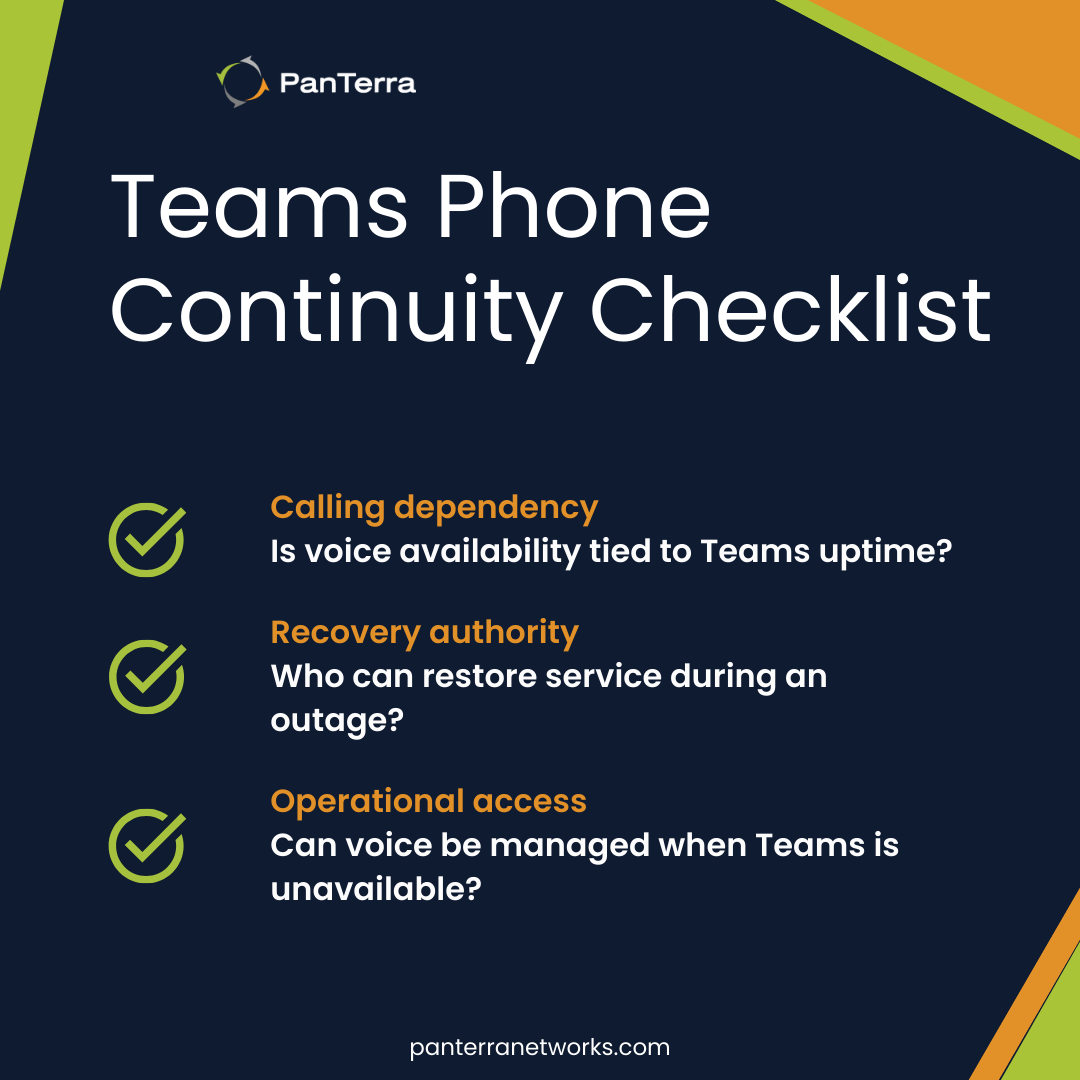
Architectural resilience depends on how clearly operational ownership is defined. Microsoft Teams Phone setup creates structural commitments that persist throughout the system’s lifecycle, determining how incidents are handled and how quickly recovery can occur.
When ownership is fragmented across platform, carrier, and internal IT boundaries, recovery requires coordination rather than control. Each handoff adds delay, reduces visibility, and increases the likelihood of stalled resolution. These bottlenecks are structural, not procedural.
Organizations that evaluate Teams Phone as an architectural decision, rather than a feature configuration, reduce this fragmentation. Approaches that introduce a separate voice layer or independent voice architecture can consolidate operational ownership, simplify escalation paths, and create more predictable recovery behavior when failures occur.
Ultimately, Teams Phone setup creates an illusion of control through administrative access, while actual recovery authority remains distributed across boundaries that no single team can bridge.
Frequently Asked Questions
Who owns Microsoft Teams Phone outages during incidents?
Ownership during Teams Phone outages is distributed across Microsoft for platform recovery, carriers for PSTN routing, and internal IT for network performance, which means no single party has full control over resolution.
Does better configuration improve Teams Phone recovery time?
Better configuration improves normal operation but does not accelerate recovery during platform or carrier outages, where recovery speed is determined by architectural boundaries rather than configuration quality.
Is admin access the same as operational control in Teams Phone?
Administrative access allows configuration changes, but operational control during incidents remains fragmented across multiple external dependencies.
Why can’t IT teams fully resolve Teams Phone issues on their own?
Most Teams Phone incidents span platform, carrier, and network layers that exceed the authority and visibility of internal IT teams.
.jpg?width=500&height=500&name=Are%20you%20Getting%20a%20Good%20Deal%20(1).jpg)
Comments