Microsoft Teams Phone Pricing: Real Costs vs Advertised Rates


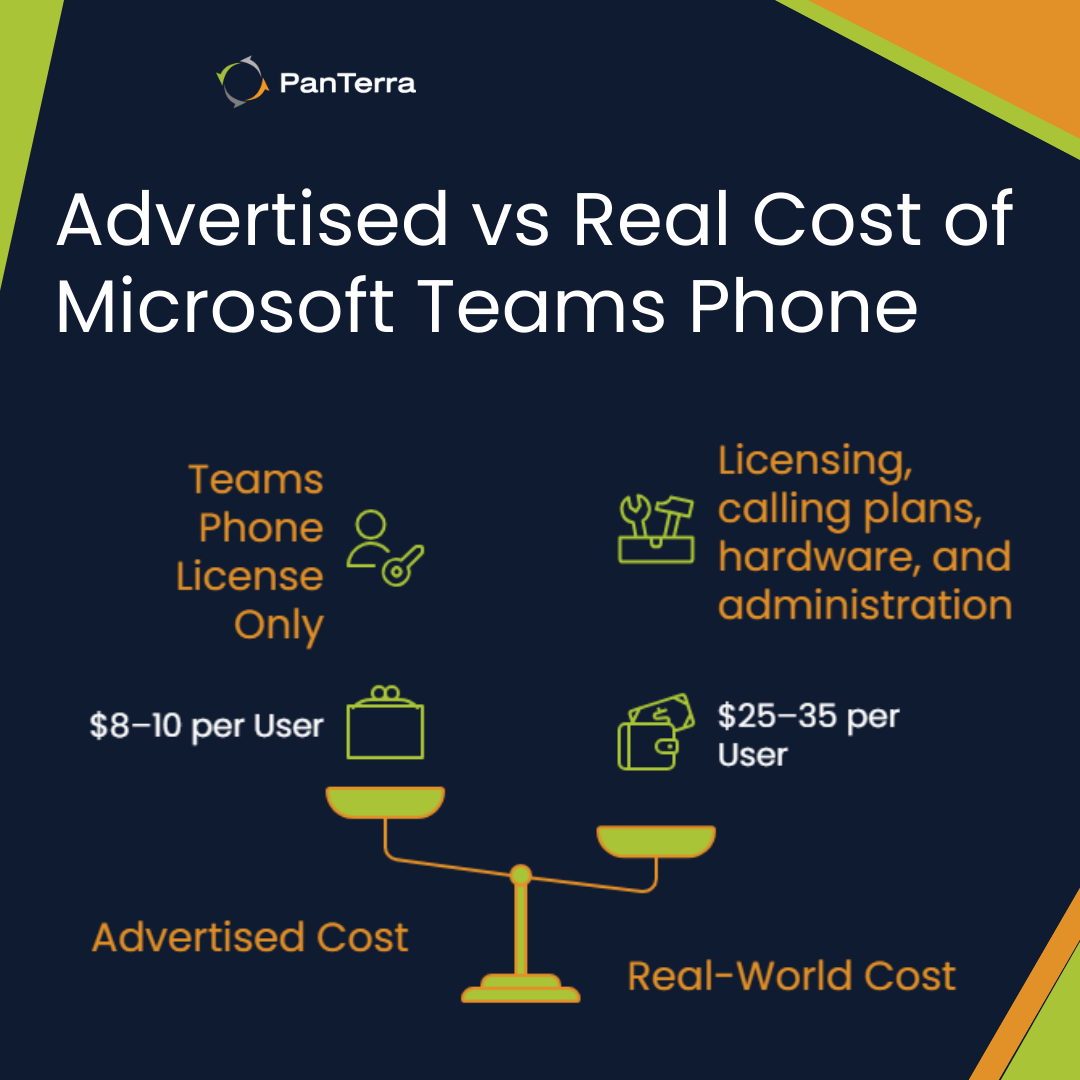
Microsoft Teams Phone pricing often looks simple at first glance. Microsoft promotes Teams Phone as an $8–10 per-user monthly add-on, but real-world deployments rarely stay within that range.
Once organizations account for required Microsoft 365 licenses, calling plans, resource accounts, hardware, and ongoing administration, total costs typically reach $25–35 per user per month. In a 100-user environment, this gap can turn an expected $1,000 monthly budget into $3,500 after deployment.
This article focuses exclusively on Microsoft Teams Phone pricing and total cost of ownership. It breaks down licensing structures, calling plan costs, common hidden expenses, and the operational impact that affects real-world spend during deployment and outages.
The goal is to help IT teams budget accurately and understand not just what Teams Phone costs on paper, but what it actually costs to operate in production before committing.
How do Microsoft Teams outages affect Teams Phone calling and business continuity?
Microsoft Teams Phone is fully dependent on Microsoft Teams availability. When Teams experiences an outage or service degradation, organizations can lose calling, meetings, and administrative access at the same time.
Why Teams Phone availability depends entirely on Microsoft Teams
Teams Phone does not operate as an independent voice layer. All calling functionality is routed through the Microsoft Teams platform, meaning voice, meetings, voicemail access, and call management rely on the same underlying service availability.
When Teams is unavailable, voice services are unavailable as well—even if the organization’s carrier infrastructure remains operational.
Why this dependency creates real cost exposure, not just technical risk
This platform dependency introduces a single point of failure that most Teams Phone pricing models do not account for. Even short outages can interrupt customer-facing communications, internal coordination, and administrative response workflows.
From a cost perspective, lost productivity, missed customer calls, and delayed response times translate directly into operational impact. These costs are real, measurable, and never included in per-user Teams Phone pricing.
What does Microsoft Teams Phone System actually cost per user?
Microsoft Teams Phone System typically costs $25–35 per user per month once licensing, calling plans, add-on features, hardware, and administrative overhead are fully accounted for.
While Microsoft advertises Teams Phone as an $8–10 per-user add-on, real-world deployments rarely remain at that price once all required components are included.
Why advertised Teams Phone pricing rarely reflects real-world costs
Microsoft’s advertised pricing reflects only the Teams Phone license. In practice, organizations must also pay for Microsoft 365 base licenses, calling plans, resource accounts, and ongoing administration. These additional requirements consistently push total monthly costs well beyond the advertised price.
How do Teams Phone license requirements impact total costs?
Teams Phone licensing typically adds $15–25 per user per month on top of base Microsoft 365 subscriptions, depending on whether organizations use E3, E5, and separate calling plans.
Core license components that drive Teams Phone costs
Teams phone license requirements form a complex puzzle with multiple pieces. The foundation starts with Microsoft 365 subscriptions. Since Microsoft's 2025 licensing changes, most plans need an additional Teams Enterprise license. This adds $5.25 per user per month to your costs.
Most organizations need the Teams Phone Standard license ($8 per user per month) unless they have Microsoft 365 E5. E5 plans include Teams Phone capabilities at a premium price point. This creates an important decision point for many IT departments.
Your deployment model affects licensing needs too. Microsoft Calling Plans require both Teams Phone Standard and a calling plan. Operator Connect and Direct Routing need Teams Phone Standard plus telecom services. The MS Teams Connector Seat offers an alternative with simpler licensing.
Actual pricing varies based on contract terms, region, and enterprise agreements, but the following comparison reflects common list-price scenarios used for budgeting.
For cost comparison:
- E3 users pay $36 + $8 (Teams Phone) + $12 (Calling Plan) = $56/user/month.
- E5 users pay $57 + $12 (Calling Plan) = $69/user/month.
The break-even typically occurs around 150 users.
This threshold typically emerges as Teams Phone add-ons, security tools, compliance features, and support overhead accumulate under E3, making the bundled E5 license more cost-efficient at scale.
What hidden costs increase Microsoft Teams Phone total cost of ownership?
Hidden costs typically add $5–15 per user per month to Microsoft Teams Phone pricing through porting fees, support plans, infrastructure, training, and international calling.
Recurring and one-time costs typically excluded from quoted Teams Phone pricing
Another frequently overlooked cost is the operational impact of Microsoft Teams outages. When Teams is unavailable, organizations using Teams Phone are unable to make or receive calls, even if their carrier infrastructure remains operational. For customer-facing teams, even short service interruptions can translate into lost productivity, missed customer interactions, and delayed responses—costs that are rarely included in initial Teams Phone pricing estimates.
The real financial impact of a Microsoft Teams outage
Even a short Microsoft Teams outage can create operational costs that exceed a full year of Teams Phone licensing for many organizations.
In a conservative scenario, a 100-user organization experiences a 3-hour Teams outage during business hours. At a fully loaded internal cost of $50–75 per employee per hour, the productivity impact alone ranges from $15,000 to $22,500.
This estimate excludes missed customer calls, delayed response times, and downstream revenue impact. While outages may be infrequent, this exposure is never reflected in per-user Teams Phone pricing models.
Beyond visible license fees, Teams Phone implementations include several expenses. These costs rarely appear in initial quotes:
- Number porting fees: Moving existing phone numbers to Teams usually costs $35-50 per number. This estimate comes from our experience with multiple carriers.
- International calling: Standard domestic calling plans exclude international calls. These calls incur premium rates when needed.
- Support costs: Microsoft support packages range from basic to premium tiers. They add $5-15 per user per month for adequate coverage.
- Infrastructure requirements: Direct Routing deployments need Session Border Controllers. These often cost $3,000-15,000 plus ongoing maintenance.
- Training expenses: User adoption requires training programs. These typically cost $1,500-3,000 for mid-sized organizations.
One retail company we assisted in 2024 just discovered an unexpected expense. Their Teams Phone implementation required an additional $12,000 in infrastructure upgrades. Their IT team had budgeted only for licenses.
For a 100-user organization, these hidden costs add $5,000–15,000 in Year 1 and $3,000–8,000 annually thereafter, representing an additional $5–15 per user per month.
How much does Microsoft Teams Phone cost in real-world scenarios?
In real deployments, Microsoft Teams Phone typically costs $25–35 per user per month, with higher per-user costs for small organizations and lower costs at enterprise scale.
In addition to licensing and infrastructure, organizations should factor in the cost of service interruptions when modeling real-world Teams Phone spend. While outages may be infrequent, their financial impact often exceeds the monthly cost of voice licenses when measured across productivity loss and customer impact.
Cost scenarios by organization size and deployment complexity
To accurately assess teams phone cost, we recommend a 5-year Total Cost of Ownership analysis. This approach reveals the full financial picture beyond monthly fees. Start by calculating Year 1 costs including implementation and hardware. Then project Years 2-5 with ongoing expenses.
A healthcare organization in the Midwest experienced unexpected cost increases with Teams Phone in 2024. Their initial budget projected $15,000 annually for 100 users. The final cost exceeded $25,000 after accounting for all license components. Many organizations discover these realities too late in their deployment process.
For a 100-user organization, Year 1 Teams Phone costs in fact range $30,000-45,000. Annual follow-up costs run $20,000-30,000 based on PanTerra project data. Organizations typically pay about $25-35 per user per month once all costs are included.
When evaluating options, consider both hard costs and soft benefits. These include simplified administration and reduced IT overhead. The right solution depends on your specific needs and existing investments.
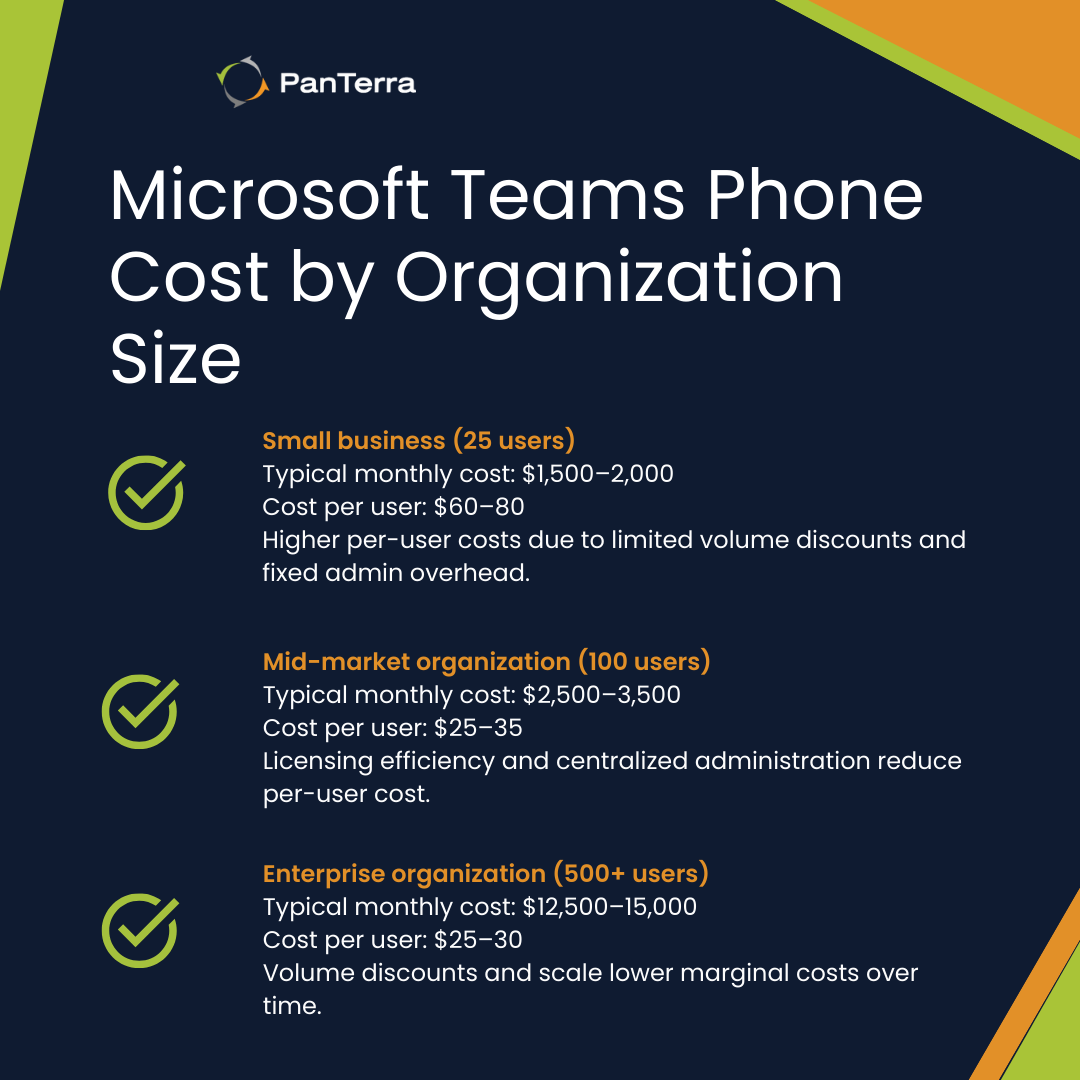
Three scenarios illustrate total costs:
- Small business (25 users): $1,500–2,000 monthly ($60–80 per user)
- Mid-market (100 users): $2,500–3,500 monthly ($25–35 per user)
- Enterprise (500+ users): $12,500–15,000 monthly ($25–30 per user with volume discounts)
How can organizations reduce Teams Phone costs by 30–40%?
Organizations can materially reduce Microsoft Teams Phone total cost of ownership by optimizing licensing, calling plans, and deployment decisions. The following strategies are consistently used in cost-controlled environments.
Cost optimization strategies that reduce Teams Phone total cost of ownership
- Avoid Microsoft E5 upgrade unless you need three or more enterprise features: Organizations can maintain E3 licenses and add Teams Phone separately, enabling Teams calling without E5 license when advanced security, compliance, or analytics features are not required. This approach helps reduce Microsoft Teams voice costs while preserving core calling functionality.
- Choose Operator Connect over Microsoft Calling Plans: Reduces calling costs by $3–5 per user per month while maintaining PSTN connectivity through approved carriers.
- Implement Direct Routing at 200+ users: After amortizing SBC infrastructure, organizations typically save $8–12 per user per month on long-term calling costs.
- Consolidate auto attendants where possible: Each eliminated resource account reduces spend by approximately $5 per month.
- Deploy Teams mobile apps instead of desk phones: Avoids $150–400 per-user hardware purchases, equivalent to $5–11 per user per month when amortized.
- Select regional calling plans unless international usage exceeds 20% of total minutes: Prevents overpaying for global plans, saving approximately $12 per user per month.
- Time license purchases during Microsoft Q4 contract cycles: Annual commitments negotiated during this period often reduce total spend by 10–15%.
- Audit and remove unused licenses on a quarterly basis: Eliminates dormant seats, typically reducing total licensing spend by 5–10%.
At a certain cost threshold, further optimization stops delivering meaningful savings. When Microsoft Teams Phone spend approaches $35 per user per month, most organizations have already exhausted licensing and plan-level adjustments. At that point, reducing total cost of ownership typically requires architectural changes rather than incremental optimization.
- Evaluate bundled calling solutions integrated with Teams when per-user costs exceed $35/month. PanTerra’s Streams AI is one example of an approach that consolidates calling, infrastructure, and support to reduce long-term total cost of ownership.
- Renegotiate carrier rates annually for Operator Connect deployments: Periodic renegotiation commonly yields savings of $2–4 per user per month.
Typical impact: Organizations implementing five or more of these strategies usually reduce Microsoft Teams Phone costs by $10–15 per user per month without changing end-user behavior.
What Microsoft Teams Phone Really Costs When Reliability Is Factored In
Microsoft Teams Phone typically costs $25–35 per user per month once licensing, calling plans, and operational overhead are fully considered.
But at that point, the more important question is no longer just what does it cost? — it’s what happens when it stops working?
Because Teams Phone is fully dependent on Microsoft Teams availability, organizations must factor in not only cost and complexity, but also operational fragility. Outages, even brief ones, affect calling, meetings, and administrative access simultaneously, creating financial exposure that per-user pricing never reflects.
Evaluating Teams Phone purely on monthly license cost misses the broader reality: total cost of ownership includes resilience, continuity, and the ability to maintain communication when systems are under stress.
For teams reaching this cost threshold, the next step is to evaluate whether their voice architecture is optimized for resilience — not just licensing efficiency.
Frequently Asked Questions
What are the real costs of Microsoft Teams Phone System beyond licensing?
Beyond the $8-10 Teams Phone license, organizations pay $12-24 for calling plans, $5-15 for support, $2-5 for phone numbers, and $5/month per auto attendant. Total costs typically reach $25-35 per user monthly, with hidden expenses adding $5-15 per user.
What's the price difference between E3+Teams Phone and E5 licensing?
E3 plus Teams Phone costs $44 per user ($36 + $8), while E5 costs $57 per user with Teams Phone included. The $13 difference becomes worthwhile at 150+ users when organizations need E5's security and compliance features.
When does it make financial sense to switch from E3 plus Teams Phone to E5?
The switch becomes cost-effective when organizations require three or more E5 features beyond Teams Phone, such as advanced security, compliance tooling, or Power BI Pro. At approximately 150 users, the bundled E5 license often costs less than purchasing these capabilities separately on E3.
How do calling plan costs compare across deployment models?
Microsoft Calling Plans cost $12-24/user/month with set minutes. Operator Connect runs $8-15/user/month with flexibility. Direct Routing costs $2-8/user/month plus $5,000-15,000 in SBC infrastructure, breaking even at 200 users.
How do Microsoft Teams outages affect Teams Phone costs?
When Microsoft Teams experiences service disruptions, Teams Phone users may be unable to place or receive calls. While this impact is not reflected in per-user license pricing, organizations often incur indirect costs related to lost productivity and delayed customer communications. Over time, these factors should be considered as part of the total cost of ownership for Teams Phone.
.jpg?width=500&height=500&name=Are%20you%20Getting%20a%20Good%20Deal%20(1).jpg)
Comments