How Voice Architecture Determines Teams Phone Continuity


Microsoft Teams Phone is tightly coupled with the Microsoft Teams platform. When the platform experiences service degradation or outages, calling availability is affected because voice services rely on the same control plane.
The severity of operational impact depends on integration design. Native Teams Phone provides a unified administrative experience but concentrates dependency within Teams itself. Architectures that separate the voice layer while preserving the Teams interface distribute risk differently and behave differently during disruptions.
These structural differences become visible during service interruptions. Some organizations lose inbound and outbound calling entirely, while others maintain voice continuity despite Teams unavailability. The outcome is not determined by features or licensing, but by how voice services are designed.
Evaluating Teams Phone design, therefore, requires looking beyond configuration and cost optimization. Continuity, recovery control, and operational dependency are structural questions, and they surface most clearly when Teams is under stress.
Why does Teams Phone architecture determine resilience during outages?
Microsoft Teams Phone calling availability is directly influenced by how voice services are structurally coupled to the Teams platform during service disruptions.
The effects of architectural coupling on calling availability
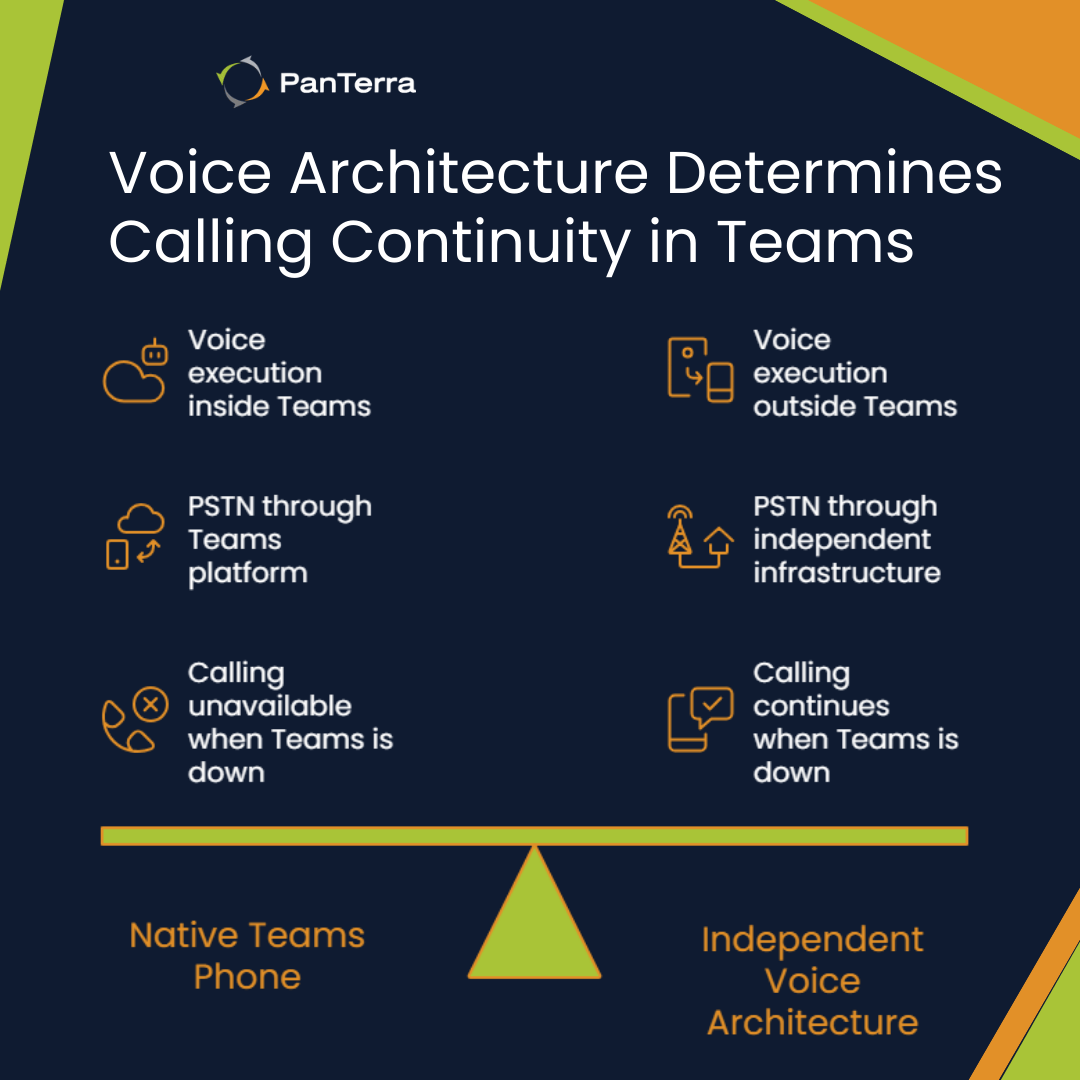
System design determines how Microsoft Teams Phone behaves during service disruptions. In native deployments, voice services are run within the Microsoft Teams control plane. Call signaling, routing, and administrative access depend on the same platform services that power meetings and collaboration.
When the platform experiences service degradation, calling availability is affected because these dependencies are shared. When Teams becomes unavailable, voice services that rely on that control plane are also impacted.
Approaches that separate the voice layer behave differently. Voice traffic is processed by infrastructure that operates independently from the platform, while users continue working inside the Teams interface.
Because call execution does not depend on platform availability, calling can remain operational during Teams outages, even if the user experience temporarily shifts.
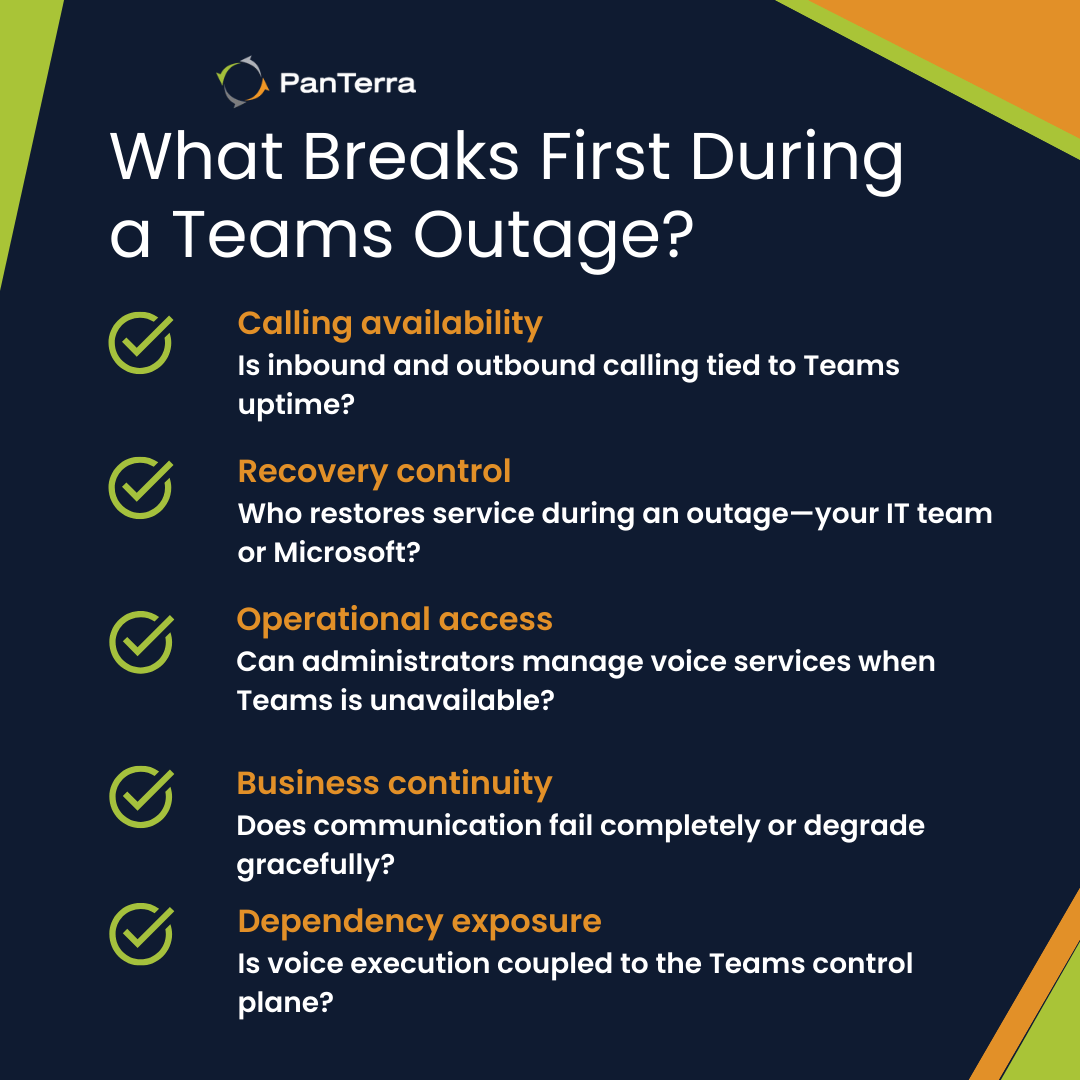
This architectural difference also determines recovery control. In native deployments, restoration timelines are tied to Microsoft’s service recovery, whereas in architectures with an independent voice layer, IT teams retain the ability to maintain or restore calling independently while Teams recovers.
The difference is not uptime percentages, but who controls recovery when disruptions occur.
Where native Teams Phone creates unavoidable bottlenecks
Native Teams Phone centralizes voice execution inside the Microsoft Teams platform. This design choice introduces structural constraints that surface most clearly during outages and service degradation.
Because call signaling, routing, and administrative control depend on the platform control plane, several bottlenecks emerge by design:
- Voice availability is tied to platform service health, regardless of carrier status
- Administrative access is unavailable during Teams-wide disruptions
- Recovery timelines depend on Microsoft’s incident resolution process
- Redundancy exists at the platform level, not at the voice execution layer
- Alternative routing options are limited while the system remains unavailable
These constraints are not the result of misconfiguration or insufficient licensing; t. They stem from how native Teams Phone is architected. Once voice execution is fully coupled to the Teams platform, optimization efforts cannot eliminate the dependency itself.
As a result, native Teams Phone deployments reach a structural ceiling. When Teams is under stress, voice services inherit the same limitations, and IT teams have limited ability to mitigate impact until the platform recovers.
Removing Infrastructure Limitations Through Independent Voice Architectures
Architectures that separate the voice layer from Microsoft Teams remove several constraints inherent to native Teams Phone deployments. Voice execution operates on infrastructure designed specifically for call processing, rather than sharing the Teams collaboration control plane.
This separation changes how capacity, redundancy, and recovery behave during normal operations and outages.
The benefits are:
- Voice processing is distributed across multiple execution environments
- Failover logic operates independently of Teams service availability
- Capacity scales based on call demand, not collaboration load
- Updates and changes to voice services do not require Teams downtime
- Resource allocation for calling is isolated from meetings and messaging
By decoupling voice execution from the Teams platform, these architectures avoid the single dependency that limits native Teams Phone during disruptions.
The Teams interface remains the user workspace, but voice availability is no longer constrained by Teams service health.
The result is not the elimination of outages, but a reduction in their operational impact. When Teams experiences degradation or downtime, calling can continue because the infrastructure responsible for voice execution is not affected in the same way.
How do Teams Phone outages translate into real operational cost?
When Microsoft Teams goes down, native Teams Phone deployments lose calling simultaneously. These platform outages translate directly into productivity losses and service disruptions.
Why outage impact matters more than license pricing
Purchase price is only part of the financial picture. ROI studies indicate that Teams-aligned cloud services can deliver significant return over multi-year periods. These calculations reveal cost drivers that are often overlooked in initial pricing comparisons.
Analyst research has shown that hardware-bound voice systems accumulate higher ongoing maintenance costs over time, while software-based voice architectures reduce per-user operational overhead through centralized management and automation.
In practice, organizations often realize meaningful per-employee efficiency gains as a result.
In Teams Phone environments, infrastructure refresh cycles generate substantial hidden expenses. Hardware-dependent systems typically require large reinvestments every few years to maintain capacity and reliability.
By contrast, software-defined voice architectures shift these costs into ongoing operations, reducing the need for periodic capital outlays and spreading cost more predictably over time.
CAPEX Infrastructure Burden Analysis
Capital expenditure models create financial constraints beyond purchase price.
Hardware-bound voice systems demand:
- Hardware investments that depreciate rapidly
- Dedicated facility space with power requirements
- Specialized maintenance contracts
- Redundant equipment for continuity
- Spare parts inventory management
These requirements lock organizations into long-term commitments regardless of business changes.
Equipment depreciation schedules typically span 3-5 years. Physical infrastructure demands include rack space, power, cooling, and security considerations.
OPEX Model Operational Advantages
Operational expenditure models transform communication costs into predictable monthly expenses.
This approach often eliminates:
- Large upfront investments
- Hardware depreciation tracking
- Physical infrastructure requirements
- Maintenance contract management
- Technology obsolescence risk
Cost analysis shows that software-defined, Teams-aligned voice architectures can significantly reduce monthly operating expenses by removing the need for on-premises hardware management.
By shifting responsibility away from physical infrastructure, IT overhead is reduced, and operational effort is redirected from maintenance tasks to higher-value initiatives.
Why are Teams Phone migrations often underestimated in scope and timeline?
The reason is that migrating voice services into or around Microsoft Teams introduces architectural dependencies that extend beyond licensing and technical configuration.
Factors That Extend Teams Phone Migration Timelines
Communication platform transitions demand architectural planning beyond technical steps. In Teams Phone environments, migration complexity is driven by how voice services are integrated into or decoupled from the Microsoft Teams platform.
Project reviews consistently show that Teams Phone migration timelines are underestimated by 50–75%. While teams often plan for four to eight weeks, complete transitions commonly require three to six months once number porting, user enablement, policy alignment, and operational testing are accounted for.
Business continuity during migration depends on architectural design. When voice services are tightly coupled to Teams from day one, cutover events concentrate risk.
Architectures that allow parallel operation, where voice services are validated independently while Teams remains the user interface, reduce disruption during transition periods.
Where legacy voice architectures slow Teams Phone migration
Legacy, hardware-bound voice architectures introduce structural migration barriers that extend beyond technical configuration:
- Physical hardware removal disrupts facilities and operations
- Number porting introduces fixed external timelines
- User training interrupts daily workflows
- Contract termination clauses delay cutover
- Custom integrations require additional validation
These constraints extend migration timelines regardless of project planning quality. Organizations must account for them explicitly when transitioning voice services into Teams-centric environments.
How Teams-aligned architectures accelerate migration timelines
Architectures designed to operate alongside Microsoft Teams compress migration timelines through structural advantages:
- Remote provisioning replaces on-site deployment
- Parallel operation enables phased cutovers
- Standardized interfaces reduce integration effort
- Virtual training minimizes operational disruption
Organizations can migrate Teams Phone capabilities by department or function, validating voice behavior incrementally while maintaining continuity.
This phased approach reduces risk and allows teams to address architectural dependencies before full production rollout.
How should organizations evaluate Teams Phone architecture decisions over time?
By assessing risk concentration, scalability limits, and compliance pressure as architectural factors not as feature gaps or configuration issues.
Why architecture matters more than features at decision time
Determining when to evolve communication infrastructure requires evaluation beyond feature comparisons. In Teams Phone environments, long-term viability depends on how voice services are architected relative to the Microsoft Teams platform not on incremental configuration choices.
Risk assessment starts with identifying where dependency is concentrated. Native Teams Phone architectures centralize voice execution within the Teams platform, which simplifies administration but concentrates outage impact and recovery control.
Evaluating business impact, therefore, requires understanding how voice availability behaves during service disruptions and who controls recovery timelines.
Scalability considerations follow the same logic. As organizations grow, architectural constraints surface around capacity planning, geographic expansion, and operational resilience.
Architectures that require coordinated platform changes for voice scalability introduce friction that configuration alone cannot resolve.
Compliance pressure adds a third dimension: Rregulatory requirements continue to evolve toward proactive, system-level enforcement.
Voice architectures that depend on tightly coupled platforms may require broader architectural changes to adapt, while more modular approaches allow compliance controls to evolve without full system redesign.
When native Teams Phone architectures become a limiting factor
Native Teams Phone deployments can shift from acceptable to restrictive under specific conditions:
- Compliance requirements exceed what centralized control planes can accommodate
- Remote or hybrid work expands beyond assumptions baked into the original design
- Growth projections outpace the platform’s ability to absorb additional voice load
- Security requirements demand finer-grained operational control
- Operational impact during outages exceeds organizational tolerance
In these scenarios, limitations are architectural rather than technical. Organizations often recognize these inflection points only after experiencing service disruption or loss of control during incidents.
Key criteria for assessing Teams Phone architectural readiness
Evaluating infrastructure readiness usually requires examining these key dimensions:
- Business continuity requirements and recovery time objectives
- User growth projections for 3-5 year horizons
- Geographic distribution of workforce and customers
- Regulatory compliance roadmap for your industry
- IT team capacity for system maintenance
Taken together, these criteria reveal whether the existing Teams Phone architecture aligns with future operational demands.
This assessment provides a structured basis for deciding when architectural change becomes a necessity rather than an optimization choice.
What does choosing a Teams Phone architecture really commit you to?
Choosing a Microsoft Teams Phone architecture is not a short-term configuration decision. It defines how voice services behave under stress, who controls recovery, how business continuity is planned during outages,, and how much operational risk the organization is willing to absorb when the platform is unavailable.
Native Teams Phone simplifies deployment and administration, but it also concentrates dependency within the Teams control plane.
Architectures that separate the voice layer distribute that dependency differently, preserving the Teams interface while changing how continuity and control are handled during disruptions.
This is why Teams Phone decisions cannot be evaluated solely through features, licensing, or optimization tactics. They are architectural commitments that shape resilience, ownership, and long-term operational confidence.
The question is no longer whether Teams Phone works, but whether its underlying architecture aligns with your organization’s tolerance for disruption and need for control.
Next steps? Evaluate which Teams Phone integration architecture matches your continuity, recovery, and operational ownership requirements before committing to a deployment model.
Frequently Asked Questions About Microsoft Teams Phone Architecture
Why does Teams Phone architecture matter during outages?
Because calling availability depends on how tightly voice services are coupled to the Microsoft Teams platform. Architecture determines whether calling fails completely or continues independently during disruptions.
How does native Teams Phone differ from independent voice architectures?
Native Teams Phone routes voice through the Teams control plane. Independent architectures separate voice execution while preserving the Teams interface, reducing dependency on Teams availability.
Does optimizing licenses or configuration improve outage resilience?
No. Licensing and configuration affect cost and features, but they do not change the architectural dependency that determines continuity during Teams outages.
Who controls recovery when Teams experiences service disruption?
In native Teams Phone deployments, recovery depends on Microsoft’s service restoration. Architectures with an independent voice layer allow IT teams to retain operational control during incidents.
When should organizations reassess their Teams Phone architecture?
When outage impact, recovery timelines, or loss of operational control exceed the organization’s tolerance for disruption.
.jpg?width=500&height=500&name=Are%20you%20Getting%20a%20Good%20Deal%20(1).jpg)
Comments