What Happens to Your Calls During a Microsoft Teams Outage


A Microsoft Teams outage is no longer a rare event that IT teams plan for theoretically. Since August 2023, Microsoft Teams has experienced over 112 documented outages — averaging one significant disruption every four to five days. For most businesses, a Teams messaging outage is an inconvenience. For businesses running their phone system through Teams Phone, the same outage means no calls in, no calls out, no customer contact.
This article explains exactly what happens to external calling during a Teams outage depending on how your calling is configured, and what a real continuity plan looks like for organizations that can't afford to lose phones when Microsoft has a problem.
TL;DR — Key Takeaways
- Microsoft Teams has logged 112+ outages since August 2023, averaging one every 4–5 days.
- Organizations using native Teams Phone (Microsoft Calling Plans or Operator Connect without independent failover) lose external calling entirely during a full Teams outage.
- Direct Routing organizations with a local SBC can maintain calling if survivability is configured — but only if it's been set up deliberately.
- The July 9, 2025 Teams outage took down calling for most of a business day across North America.
- Automatic failover to independent calling infrastructure is the only way to guarantee continuity — not a procedure, but architecture that detects the outage and reroutes in under 60 seconds.

What Actually Happened on July 9, 2025
The July 2025 Teams outage started mid-morning and disrupted calling for businesses across North America and EMEA for most of the business day. Organizations relying on Teams Phone Standard with Microsoft Calling Plans lost inbound and outbound PSTN calling entirely. Internal Teams calls were intermittently available; external calls to client phone numbers, supplier lines, and customer service queues stopped routing.
For businesses in healthcare, legal, financial services, and field operations — where a missed call isn't just an inconvenience but a compliance risk or revenue loss — a full business day without phones is a material incident.
The July 2025 outage wasn't unusual in length or severity. According to Microsoft's service health and continuity documentation, service incidents occur when hardware, software, or network failures affect service delivery — and recovery timelines depend on the nature and scope of the failure.
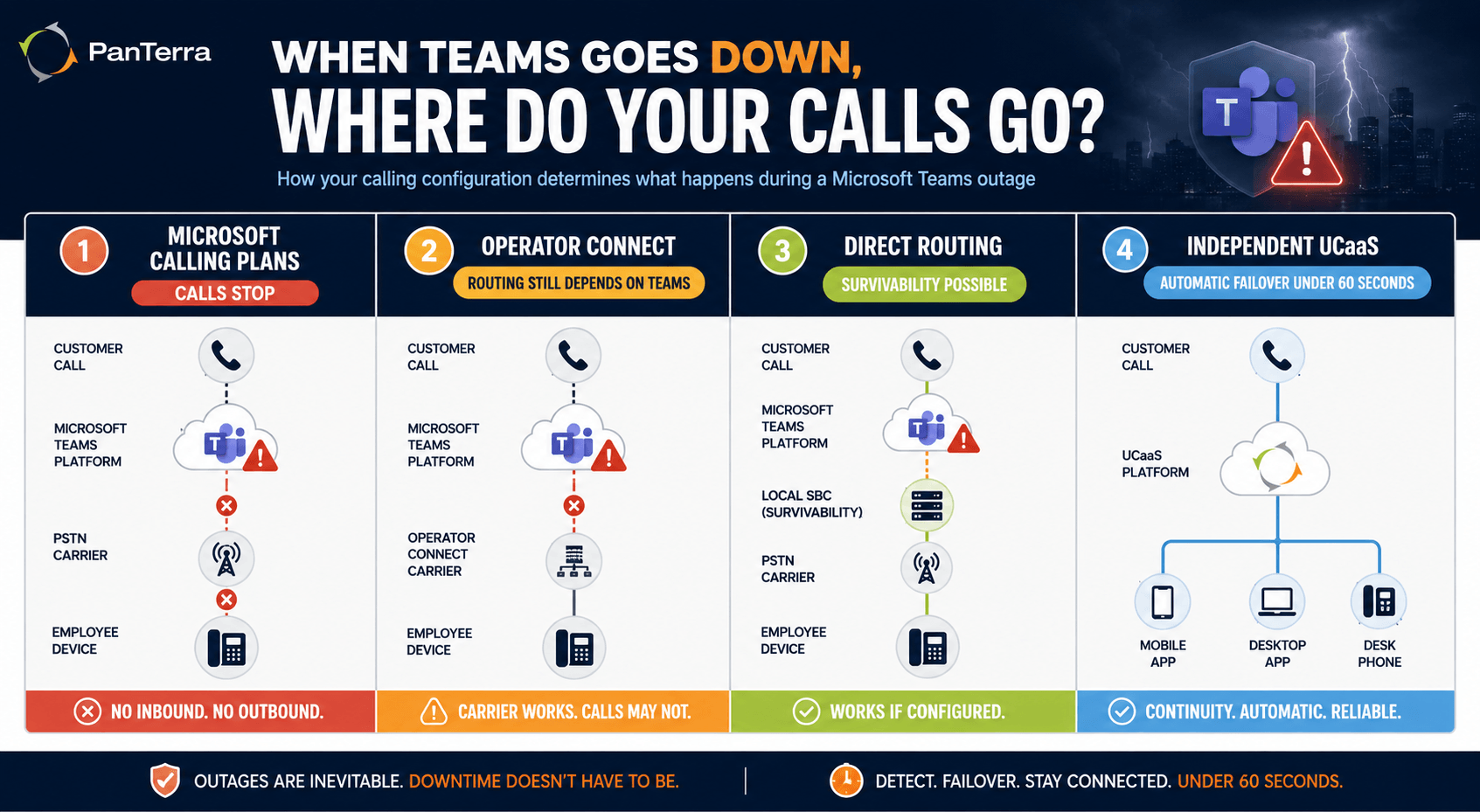
How Outages Affect Calling by Configuration
Not every Teams outage stops every call. What happens depends on how your PSTN connectivity is set up.
Microsoft Calling Plans — Most Vulnerable
Businesses using Microsoft as their PSTN carrier are fully dependent on Microsoft's cloud infrastructure for both Teams and calling. When Teams has a service incident, calling goes down with it. There is no separate calling infrastructure to fall back to.
Operator Connect — Depends on the Provider
Operator Connect uses a Microsoft-certified carrier for PSTN connectivity, but call routing still passes through Microsoft's Teams infrastructure. Most Operator Connect configurations don't include independent failover. A Teams platform outage that affects call routing will stop calls even when the carrier's network is healthy.
Direct Routing — Survivability Is Possible but Not Automatic
Organizations using Direct Routing with a local Session Border Controller have the option to configure survivability — a local SBC that can route calls independently if Microsoft's cloud becomes unreachable. But survivability requires deliberate configuration. A Direct Routing setup without it configured behaves like a Calling Plan setup during a Teams outage.
UCaaS with Independent Infrastructure — Most Resilient
UCaaS platforms running on infrastructure independent of Microsoft's cloud can detect Teams unavailability and automatically reroute calls within seconds — to mobile apps, desktop softphones, or desk phones — without IT intervention. This is the only configuration that provides genuine continuity during a full Teams platform failure.
What a Continuity Plan Actually Looks Like
Most of the 'continuity plans' I see are really procedures — a list of steps someone has to execute manually after the outage starts. A real continuity plan for Teams calling is infrastructure-based, not procedure-based.
Procedure-Based (and Why It Fails)
IT team monitors Microsoft service health, detects the outage, notifies department heads, who instruct staff to use personal mobile phones. Staff attempt to find customer callback numbers. Calls are missed, voicemails pile up, customers reach no one. This plan requires humans to detect the problem and improvise during an event that may be happening at 8 AM on a Monday when half the team is commuting.
Infrastructure-Based (What Actually Works)
PanTerra's Streams AI for Microsoft Teams monitors Teams availability in real-time. When the platform detects Teams unavailability, automatic failover initiates within under 60 seconds. All routing shifts to Streams mobile apps, desktop apps, or IP desk phones. No manual steps. No IT intervention required. When Teams comes back online, routing automatically switches back.
According to PanTerra's launch announcement, Streams AI runs on PanTerra's independent carrier-grade infrastructure — not Microsoft's Azure — which means a Microsoft cloud disruption doesn't touch the calling layer.
Building Your Teams Outage Response
If you're not yet on independent calling infrastructure, these four steps reduce your exposure while you evaluate options:
- Check your current calling configuration. Determine whether you're on Microsoft Calling Plans, Operator Connect, or Direct Routing — that tells you exactly how vulnerable you are.
- Identify your highest-risk calling scenarios. Customer service lines, patient intake, sales inbound — wherever a missed call has a direct business cost.
- Test what actually happens during an outage. Verify whether your Direct Routing SBC has survivability configured. Find out before an incident, not during one.
- Evaluate independent calling infrastructure. Review Microsoft Teams phone system alternatives for the full range of options. For a deeper look at the continuity architecture question, see What Microsoft Teams continuity actually looks like.
Frequently Asked Questions
What happens to Microsoft Teams calls during an outage?
It depends on how your PSTN calling is configured. Organizations on Microsoft Calling Plans lose external calling entirely — calls stop routing until Microsoft resolves the incident. Direct Routing organizations with survivability configured can maintain calling via a local SBC. UCaaS platforms with independent infrastructure can automatically failover in under 60 seconds with no manual steps required.
How many Microsoft Teams outages have there been?
Microsoft Teams has logged over 112 documented outages since August 2023, averaging approximately one significant disruption every four to five days. These incidents range from brief performance degradation to multi-hour platform failures affecting calling, messaging, and meetings across entire regions.
Can Direct Routing keep calls running during a Teams outage?
Yes, if survivability is configured. Direct Routing with a local SBC and survivability mode enabled can route calls independently of Microsoft's cloud. However, survivability requires deliberate setup — it's not on by default. Organizations using Direct Routing without survivability lose external calling during a Teams platform outage just like Calling Plan users.
What is the fastest way to protect calls during a Microsoft Teams outage?
Automatic failover via independent calling infrastructure is the fastest solution because it requires no human intervention. Platforms that detect Teams unavailability in real time reroute calls to mobile apps, desktop apps, or desk phones within 60 seconds — before most users even know the outage has started.
Does Operator Connect protect against Teams outages?
Generally no. Operator Connect uses a certified carrier for PSTN connectivity, but call routing still flows through Microsoft's Teams infrastructure. A Teams platform outage that disrupts call routing will affect Operator Connect users even when the carrier network is functioning normally.
.jpg?width=500&height=500&name=Are%20you%20Getting%20a%20Good%20Deal%20(1).jpg)
Comments