What Microsoft Teams Continuity Actually Looks Like (And Why It's a Conversation Most IT Teams Aren't Having Yet)


On July 9, 2025, Microsoft Teams Went Down for Most of a Day
The outage started at 22:20 UTC. By morning, it had spread across Microsoft Teams, Exchange Online, and Microsoft 365. Restoration took approximately 19 hours. For most of those hours, organizations running their phone system on Microsoft Teams Phone could not reliably make or receive calls.
That was not the only one. December 19, 2025: Teams messaging delays under incident TM1200517. June 2025: a routing configuration issue that disrupted Teams and Exchange. March 2025: a global Outlook outage. The pattern is consistent enough that anyone running mission-critical communications on a single cloud vendor should plan for it as recurring, not a one-time anomaly.
The real question is the one most IT teams have not asked yet: when Microsoft Teams goes down, what happens to your phone system?
If your answer is "we lose calling for the duration" — and for most organizations on Teams Phone today, that is the honest answer — that is a continuity gap, not a feature gap. It deserves more weight in your business phone system evaluation than it usually gets.
TL;DR
Microsoft Teams Phone ties voice availability directly to Teams service availability. As multiple outages throughout 2025 made clear, when Teams goes down, calling, auto attendants, and call queues go down with it. Streams.AI for Microsoft Teams runs inside the Teams interface but on independent infrastructure, so when Teams is unavailable, voice, SMS, fax, auto attendants, and call queues seamlessly transition to PanTerra's apps and IP phones.
Key takeaways:
- Microsoft 365 had multiple multi-hour outages in 2025, including a 19-hour July disruption.
- Teams Phone is a Teams-dependent service. When Teams is unavailable, phone is unavailable.
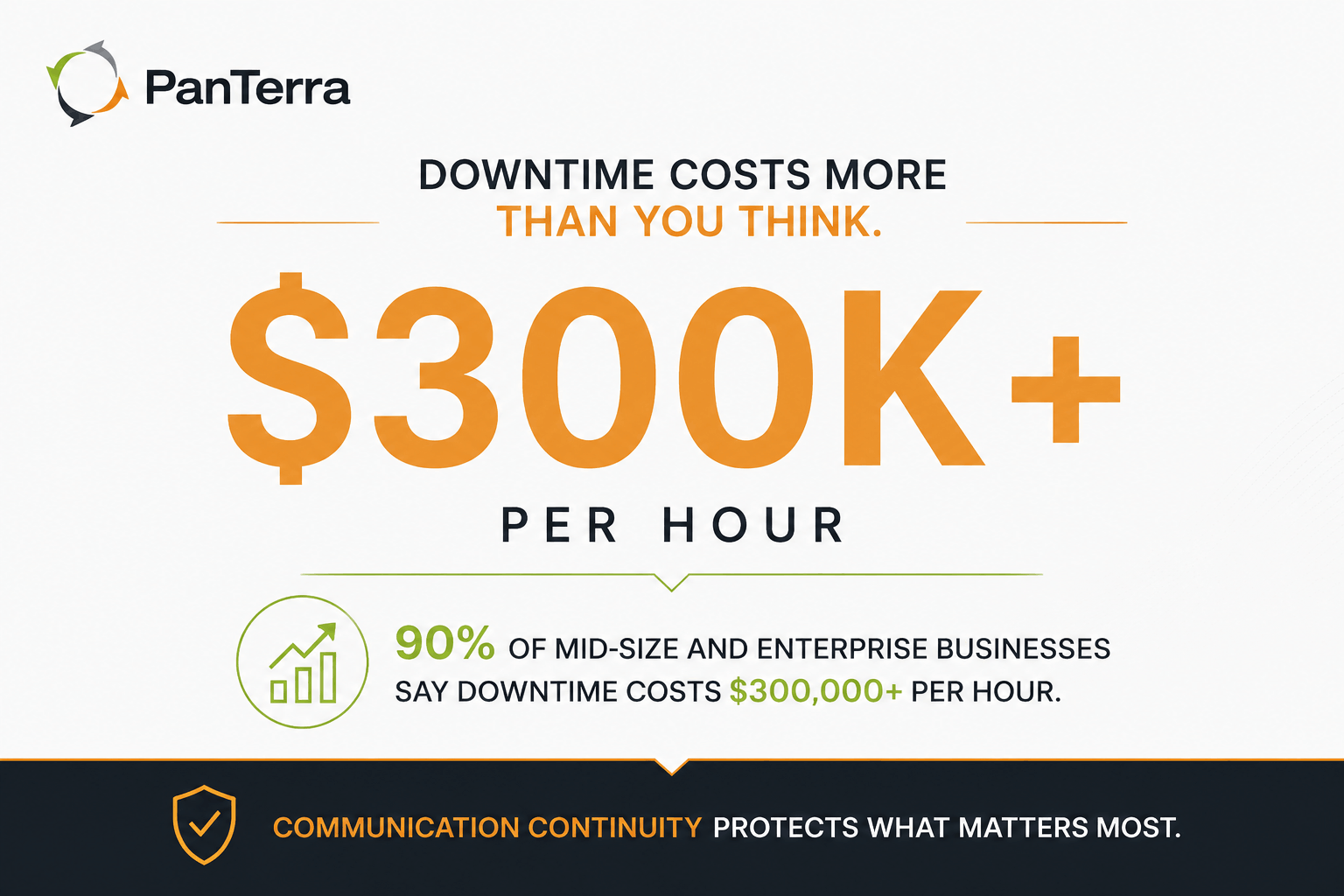
- ITIC puts hourly downtime above $300,000 for 90% of mid-size and large enterprises.
- Continuity is an architectural question. Independent infrastructure beats dependent infrastructure when one is down.
- Most Teams Phone evaluations skip continuity. The five questions in this article surface it.
The Continuity Gap Most IT Teams Are Underestimating
If you run your phone system on Microsoft Teams Phone, your voice service is a Microsoft Teams service. Calls go through the Teams client, authenticated through Microsoft's identity layer, routed through Microsoft's infrastructure. Microsoft's service health portal generally shows green. But during the July, June, and December 2025 outages, Teams Phone customers experienced disruption to inbound and outbound calling, auto attendants, and call queues alongside the chat and meeting issues.
When you choose Teams Phone, you are making your phone system dependent on the same infrastructure that runs your meetings, your chat, and your email. One outage, multiple failure points. In real business terms: if your operations cannot tolerate a four-hour or nineteen-hour gap in voice service, your continuity model needs to handle the case where Microsoft Teams is the thing that broke.
Failure Modes: What Stops Working When Teams Goes Down
Different outages produce different failure patterns. Here is what each takes offline if your phone is tied to Teams — and what stays running on independent infrastructure.
|
Failure mode |
What stops working with Teams Phone |
What stays running on independent infrastructure |
|---|---|---|
| Authentication / identity outage (Entra ID failure) | All Teams sign-in fails. No calling, no chat, no meetings. Call queues and auto attendants stop. | Voice, SMS/MMS, fax, queues, auto attendants — accessed through provider's apps with separate auth. |
| Routing or configuration error (e.g., June 2025 traffic management) | Service degrades unpredictably. Some calls connect, others fail. Telemetry lags reality. | Calling stays available — routing is independent from Microsoft's traffic layer. |
| Service-specific Teams outage (e.g., December 2025 TM1200517) | Teams chat and calling affected. Meetings may continue degraded; phone often does not. | Phone, fax, SMS continue normally via provider's apps and IP phones. |
| Regional Microsoft 365 disruption | Localized blackout on Teams calling for the affected geography. | Service unaffected — independent infrastructure does not share a regional failure domain. |
| Extended multi-service outage (e.g., July 2025, 19-hour event) | Voice unavailable for the duration. Customer-facing operations go silent or scramble to cell phones. | Continuous voice and messaging throughout. Same apps, numbers, and call routing. |
The trade-off worth understanding: Teams Phone is not a bad product. It is a product whose continuity is structurally tied to a platform that has demonstrated multi-hour outages multiple times in a single year. That is a continuity model decision, not a feature comparison.
What Continuity Actually Costs
The continuity conversation gets concrete when you put numbers on it.
ITIC's 2024 Hourly Cost of Downtime research, surveying over 1,000 organizations, puts hourly downtime above $300,000 for 90% of mid-size and large enterprises. Forty-one percent put it at $1 million to over $5 million. For top verticals — banking, healthcare, manufacturing, retail, transportation — the average exceeds $5 million per hour.
Apply that to a 19-hour outage. The math is the part most IT continuity discussions skip. What businesses actually need to evaluate is not whether outages will happen — they will — but what they cost, and whether that cost is underwritten by the architecture you chose. For TCO comparisons, see PanTerra pricing and plans.
Five Questions That Reveal Whether Your Teams Phone Continuity Model Holds Up
When I am walking through this with an IT director, these are the five questions that surface whether continuity has actually been planned for or just assumed.
1. If Microsoft Teams is unavailable, can our customers still reach us by phone?
"We have cell phones" is not a continuity model. It is a manual workaround that does not preserve auto attendants, call queues, voicemail, or your business numbers.
2. What is our business numbers' fallback path?
If Teams Phone is your DID provider and Teams is down, what answers your published numbers? In most Teams Phone deployments, the answer is "nothing reaches us until Teams comes back."
3. How does fax continuity work?
Teams Phone does not natively support fax. Most organizations bolt on a separate fax service — fine, but it should be documented, not discovered during an outage.
4. What does our internal communication look like when Teams is the thing that's down?
Teams chat and Teams meetings run on the same platform as Teams Phone. If Teams is down, you have lost three communication modalities at once — not just one.
5. Is our voice continuity model independent of the platform we use day-to-day?
This is the architectural question. Independent infrastructure means the failure of one platform does not take voice with it. Dependent infrastructure means it does.
These are the same operational lens a Gartner-aligned business continuity evaluation would apply to any other mission-critical service. They rarely get applied to Teams Phone, because Teams Phone is usually evaluated as a feature inside Microsoft 365 rather than as the customer-facing voice system it is.
What "Independent Infrastructure" Looks Like Inside Teams
The conversation I have most often: "We picked Teams because everyone is already in it. We don't want to make people leave Teams to make a call." That is reasonable. The user-experience case for keeping voice inside Teams is real.
The question is whether the voice platform behind the Teams interface has to be Microsoft's. Streams.AI for Microsoft Teams operates inside the Teams interface while running on independent infrastructure. Day-to-day, your users stay in Teams. Continuity-wise, your voice service is not tied to Teams availability.
When Teams becomes unavailable, Streams.AI transitions users to PanTerra's desktop app, mobile app, and IP phones. Voice, SMS/MMS, fax, call routing, auto attendants, and call queues remain available because they were never running on Teams — they were running alongside it.
In real business terms: same Teams interface for users, different continuity model for the business.
FAQ
Why does Teams Phone go down when Teams goes down?
Teams Phone is a service inside Microsoft Teams. It depends on the same identity layer (Entra ID), the same routing infrastructure, and the same service stack. When any of those have an outage, Teams Phone is affected.
How often does Microsoft 365 actually have outages?
Across 2025, Microsoft 365 had at least four publicly documented multi-hour disruptions, including a 19-hour July incident. The full history is on Microsoft's service health portal.
Does keeping voice independent mean leaving Microsoft Teams?
No. Streams.AI for Microsoft Teams runs inside the Teams interface. Users continue working in Teams. The voice infrastructure underneath operates independently.
What counts as "mission-critical" for voice continuity?
For healthcare, legal, home care, professional services, and any customer-facing operation, voice availability typically meets the threshold. The test is whether a multi-hour gap in inbound calling materially affects revenue, patient safety, or service delivery.
What This Adds Up To
This is not a Microsoft critique. Microsoft runs reliable, large-scale infrastructure. The point is architectural: when your phone system depends on the availability of one platform, and that platform has multiple multi-hour outages a year, your continuity model needs to account for it.
If you are evaluating Teams Phone today, walk through the five questions with your team. The answers will tell you whether your continuity model is a real model or an assumption.
Read the full launch in the PanTerra newsroom, or learn more on the Streams.AI platform page.
.jpg?width=500&height=500&name=Are%20you%20Getting%20a%20Good%20Deal%20(1).jpg)
Comments