Why Listening Beats Talking in Business Communication


The Vendor That Talks the Most Is Rarely the One That Listens
There is a pattern I see consistently in UCaaS vendor evaluations. The vendor with the most polished marketing — the most impressive demo, the longest feature list, the most case studies — frequently turns out to be the most frustrating to work with after the contract is signed.
The trade-off worth understanding: the vendors that stay good to work with spent time listening before they started selling. They asked what was broken in your current setup. They asked what your team actually used versus what they were supposed to use. They asked what a win looked like at month twelve — before they told you what their platform could do.
The real question for any communications platform evaluation is not just what the vendor builds. It is how they built it — and whether their product roadmap reflects what their customers actually said they needed.
That is the frame PanTerra's CEO Artie Chang has used since building the company. His principle: listen first, build second. Businesses do not need more communication features. They need platforms that solve the problems their customers have actually described.
TL;DR
"Customer-centric" is one of the most overused phrases in enterprise software marketing. It is also one of the most testable during an evaluation — if you know what questions to ask. The test is not in the marketing materials. It is in how the vendor responds to documented feedback, how fast they move on features customers have requested, and how their support operates after go-live.
Key takeaways:
- McKinsey research on customer experience finds that companies that listen and personalize outperform peers by 40% in revenue growth. The same principle applies to vendors building tools for their customers.
- Salesforce State of the Connected Customer consistently finds that 80% of customers say the experience a company provides is as important as its products or services.
- Customer-centricity in a UCaaS vendor shows up in specific, testable ways: review responsiveness, roadmap transparency, support behavior after the first invoice, and how quickly documented bugs become resolved.
- Most evaluations test features and pricing. The evaluation questions in this article test how the vendor behaves — which predicts post-deployment experience more accurately than any demo.
- Verified buyer reviews on G2's customer engagement software category are among the most reliable sources for post-deployment vendor behavior data.
What "Listening" Actually Looks Like in a Product
Customer-centricity is not a philosophy statement. It shows up in the product.
A vendor that listens to customers builds integrations based on where their customers actually work — not where the vendor thinks they should work. They build reporting that surfaces what customers ask about, not what looks good in a demo. They build mobile experiences that match how field teams actually use phones, not how a product manager imagined they would.
PanTerra has operated this way since 2001. The Streams.AI platform was not designed by a product committee projecting features onto a whiteboard. It was built incrementally against what business customers — healthcare administrators, multi-location operations teams, sales leaders — kept describing as broken in their existing phone systems.
In real business terms: a vendor that listens builds less you do not use and more of what you actually needed. The platform feels intuitive because it was shaped by people who use it to run real operations.
How to Test "Customer-Centric" Claims During an Evaluation
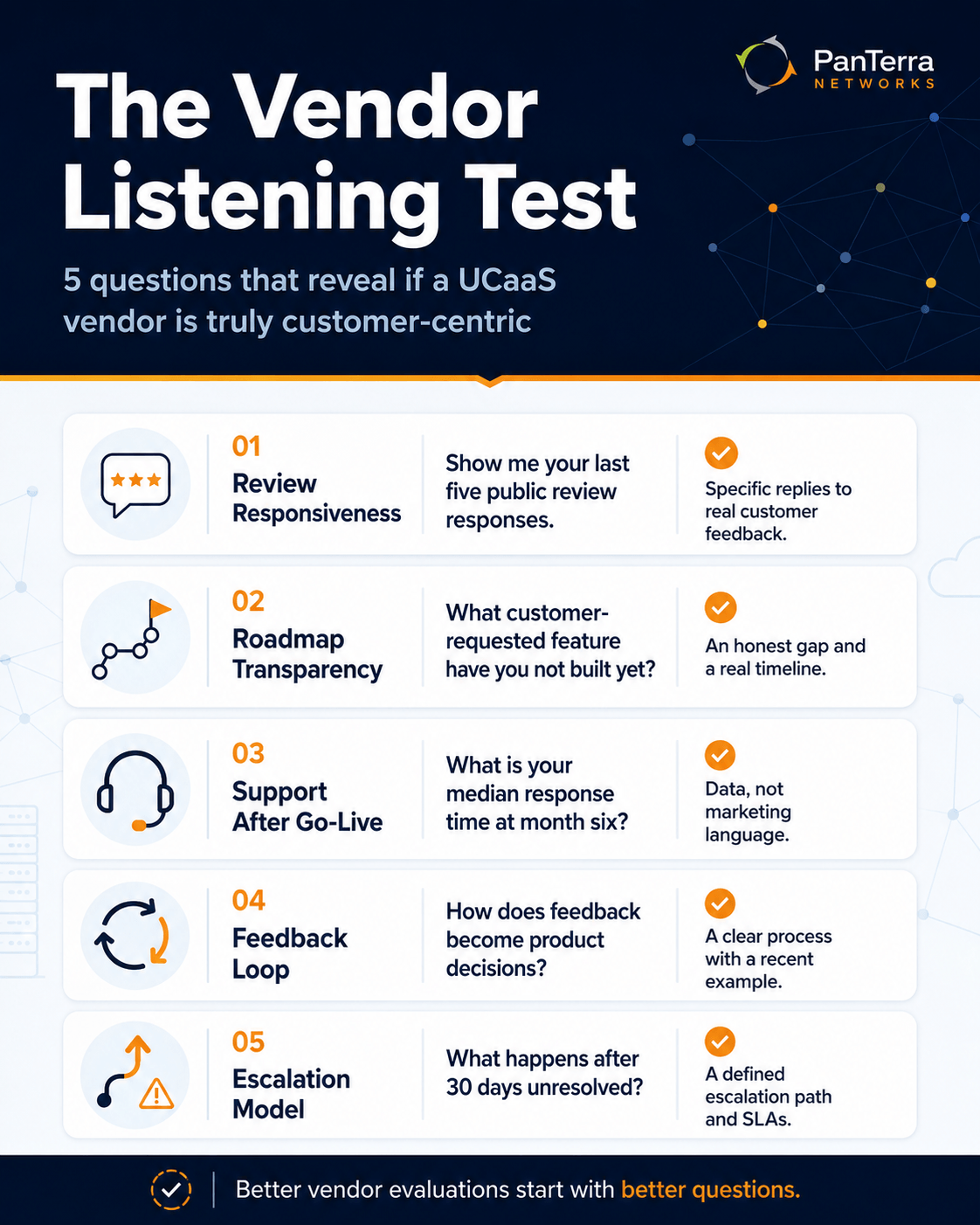
Here are the five questions that separate vendors who talk about customer-centricity from those who demonstrate it. Each is designed to produce a specific, verifiable answer — not a sales narrative.
|
Test |
What to ask |
What a genuine answer looks like |
|---|---|---|
|
Review responsiveness |
"Can you show me the last five customer reviews you responded to on TrustRadius or G2?" |
Public, specific responses to real feedback — not generic thank-you replies |
|
Roadmap transparency |
"What is the most significant feature your customers have requested that you have not yet built, and what is the timeline?" |
An honest answer with specifics — vendors who listen know exactly what their gap list says |
|
Support behavior after go-live |
"What is your median first-response time for production issues at month six, not during onboarding?" |
Data, not marketing language. Bonus: ask for a reference account at month twelve |
|
Feedback loop |
"How do customer-submitted feature requests become product decisions? Can you walk me through a recent example?" |
A real process with a named outcome — not a vague "we have a feedback portal" |
|
Escalation model |
"When a customer has a recurring issue that support has not resolved in 30 days, what happens?" |
A named escalation path with defined SLAs — not an implication that escalations do not happen |
The trade-off worth understanding: vendors that have built genuine feedback loops tend to be more honest about their limitations during a sales process. That can feel less impressive than a highly polished pitch — but it is a stronger signal of what post-contract partnership looks like.
Why This Matters for Platform Longevity
A UCaaS platform you sign today will shape how your team communicates for three to five years. Feature parity across the major vendors is higher than it has ever been. What differentiates over a multi-year contract is not the feature list at signing — it is how the platform evolves and how the vendor responds when things go wrong.
Vendors that listen build better version two. They close the gaps their customers identified. They accelerate the integrations their customers actually use. They build the reporting their ops team actually needed. Vendors that talk build version two based on what they thought was impressive.
What businesses actually need to evaluate is whether the vendor they are considering has a track record of that responsiveness — and whether the evidence for it is in the public record of their customer reviews, not just in what they say during a sales call.
The why PanTerra page covers the specific ways listening has shaped the Streams.AI platform — from the compliance-first architecture built for healthcare customers to the mobile-first design built for distributed teams.
FAQ
How do you evaluate vendor responsiveness during a trial?
File a support ticket for something non-critical but specific. Track the response time, whether the response actually addressed what you asked, and whether the person who responded had context about your deployment. That is a more accurate signal than any SLA document.
Is customer-centricity testable before you sign?
Yes — through the public record. G2 and TrustRadius reviews often describe post-deployment support and responsiveness in detail. Read reviews that are 6 to 18 months old, not just the most recent ones. Patterns emerge over time that a single demo cannot reveal.
What should you ask references that vendors provide?
Ask them: "What was the most frustrating moment in your first six months, and how did the vendor respond?" Every deployment has friction. How the vendor handled that friction is the most predictive data you can collect from a reference call.
Does PanTerra publish its response to customer reviews?
Yes. Public responses to verified reviews on TrustRadius and G2 are part of the brand's ongoing commitment to review transparency. Checking those responses before you start an evaluation is a reasonable first step.
What This Adds Up To
Communications platforms are long-term relationships. The vendor you choose will shape your team's daily experience for years. What businesses actually need to evaluate is the evidence behind the claim. The evaluation that focuses entirely on features and pricing tends to produce the same result every few years: another migration.
The evaluation that includes "does this vendor listen and respond to what customers actually say?" tends to produce longer, better relationships. The questions in this article are designed to help you answer that before you sign — not after.
Learn more about how PanTerra has built its platform around customer feedback at the why PanTerra page.
.jpg?width=500&height=500&name=Are%20you%20Getting%20a%20Good%20Deal%20(1).jpg)
Comments