M&A Communication Chaos: How to Consolidate After Mergers — And Come Out Unified


You closed the acquisition. The deal made strategic sense on paper, and the synergies were real. Then IT opened the hood and found three separate phone systems, two collaboration platforms, four regional carrier contracts, and a collection of homegrown integrations that only two people understood — and both of them left during the transition.
This is the M&A communication reality the deal memo never covers. Every acquired company arrives with its own vendor stack, its own telecom contracts, and its own patched-together integrations. Left unaddressed, the result is a Frankenstein setup where customers get bounced between disconnected phone numbers, employees can't transfer calls across divisions, and IT spends half its time managing platforms instead of supporting the business.
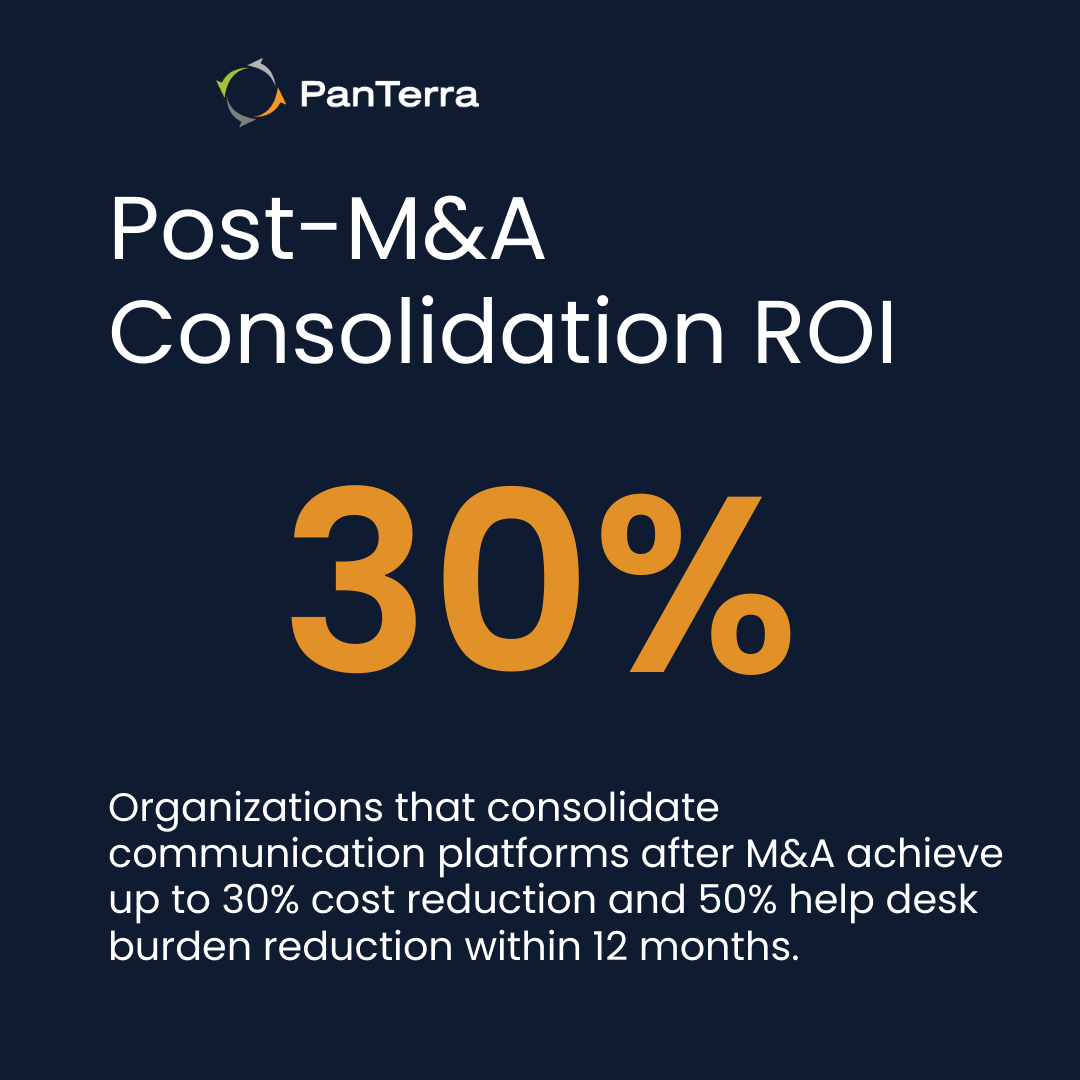
The good news: communication consolidation is one of the highest-ROI moves a post-merger organization can make — delivering 20–40% cost reduction and 30–50% reduction in IT support burden. The question isn't whether to consolidate. It's how to do it decisively, without dragging the organization through months of parallel-system limbo.
PanTerra's onboarding team has navigated this exact challenge across hundreds of organizations running Avaya, Mitel, ShoreTel, Cisco, and virtually every other legacy platform. This article walks through what causes M&A communication fragmentation, why it hurts the business, and what a confident consolidation actually looks like.
Post-merger communication fragmentation is predictable, measurable, and solvable. Organizations that consolidate onto a single platform achieve 20–40% cost savings and 30–50% help desk burden reduction. PanTerra Streams.AI — which eliminates SIP trunk infrastructure entirely — is purpose-built for exactly this consolidation, backed by an onboarding team with proven migration playbooks for Avaya, Mitel, ShoreTel, Cisco, and other legacy platforms.
Key Takeaways
-
Every acquisition adds vendor stacks, legacy contracts, and custom integrations — the Frankenstein setup builds one deal at a time
-
Fragmented systems block cross-team collaboration, degrade customer experience, and multiply IT support burden exponentially
-
Vendor consolidation delivers 20–40% cost reduction and 30–50% help desk burden reduction through unified platform management
-
PanTerra eliminates SIP trunk infrastructure entirely — removing a major hidden cost and point of complexity carried over from legacy environments
-
A well-prepared full cutover outperforms months of parallel-system operation — the key is front-loading discovery, configuration, and training
-
PanTerra's onboarding team brings proven migration playbooks built from hundreds of Avaya, Mitel, ShoreTel, and Cisco consolidations
Who This Is For
Best for: IT leaders managing communication platforms across 2+ acquired companies, Operations and CFO teams evaluating post-merger technology consolidation ROI, Integration teams inheriting Frankenstein setups from serial acquisitions.
Not ideal for: Organizations with a single, already-unified communication platform, Pre-acquisition due diligence teams — platform assessment happens post-close, Organizations seeking consolidation without any discovery or planning investment.
Top use cases:
-
Eliminating Frankenstein setups inherited from serial acquisitions (3+ platforms running simultaneously)
-
Reducing vendor management overhead across multiple telco providers and platform contracts
-
Restoring cross-team collaboration after directory fragmentation and presence invisibility
-
Cutting communication costs through contract consolidation and volume licensing leverage
-
Unifying customer experience across acquired divisions with inconsistent IVR, hold music, and routing
How M&A Creates Communication "Frankenstein Setups"
Nobody plans a Frankenstein communication environment. It happens one acquisition at a time. The company that looked clean in due diligence reveals itself post-closing: Zoom licenses with 18 months remaining, a RingCentral contract signed three months before acquisition, Cisco infrastructure that still works fine, and Microsoft Teams rolled out to one division but nowhere else.
Each of these platforms made sense for the organization that chose it. Together, they create operational chaos for the organization trying to run as one company.
The Inherited Technology Debt Problem
Legacy contracts persist because early termination penalties often exceed the short-term cost of running parallel systems. What finance projected as immediate consolidation collides with contractual reality — three platforms running simultaneously while legal negotiates exit terms and IT plans migration sequencing. The longer this goes on, the more expensive it becomes in hidden costs: duplicated licensing, fragmented IT overhead, and productivity lost to cross-platform friction.
Integration assumptions made during deal structuring rarely survive contact with technical reality. The acquiring team assumed unified directories would take two weeks. The acquired company's on-premises PBX has a custom LDAP implementation that needs to be rebuilt from scratch. The CRM integration that powers the sales team's workflow? Built on a proprietary connector that no longer has a maintainer. These are the details that turn a 90-day consolidation plan into an 18-month headache.
A unified business communication strategy addresses these inherited complexities through systematic platform assessment before migration begins.
Where PanTerra Comes In
PanTerra's onboarding team has seen every variation of this inherited complexity. They bring a structured discovery process that surfaces contractual constraints, integration dependencies, and platform gaps before migration begins — turning what feels like chaos into a sequenced, manageable plan.
When "Patched Together In-House Solutions" Multiply
Every acquired company has integrations nobody fully documented. A custom API linking their on-premises PBX to Salesforce. Scripts syncing Teams presence status with a legacy phone system. A nurse call integration running on non-standard SIP headers. These work — until the person who built them leaves, which often happens during the uncertainty between deal announcement and close.
The institutional knowledge that kept these integrations running walks out the door, and what remains is code running on a server that three people know exists and nobody remembers how to access. Multiply this across two or three acquisitions and the IT team is no longer managing a communication platform — they're archaeologists.
PanTerra Streams.AI replaces this accumulated complexity with a unified, API-driven architecture. More importantly, PanTerra's onboarding team audits every integration dependency before cutover — so nothing gets discovered live on go-live day.
The Multi-Vendor Carrier Nightmare
Three acquisitions often means three regional carrier contracts: AT&T for the Northeast operation, Verizon for the Southeast, Level 3 for the Midwest. Each made sense in isolation. Together they create billing reconciliation nightmares, incompatible DID porting processes, and a support structure where troubleshooting a call quality issue means coordinating three carriers that each insist the problem is on someone else's network.
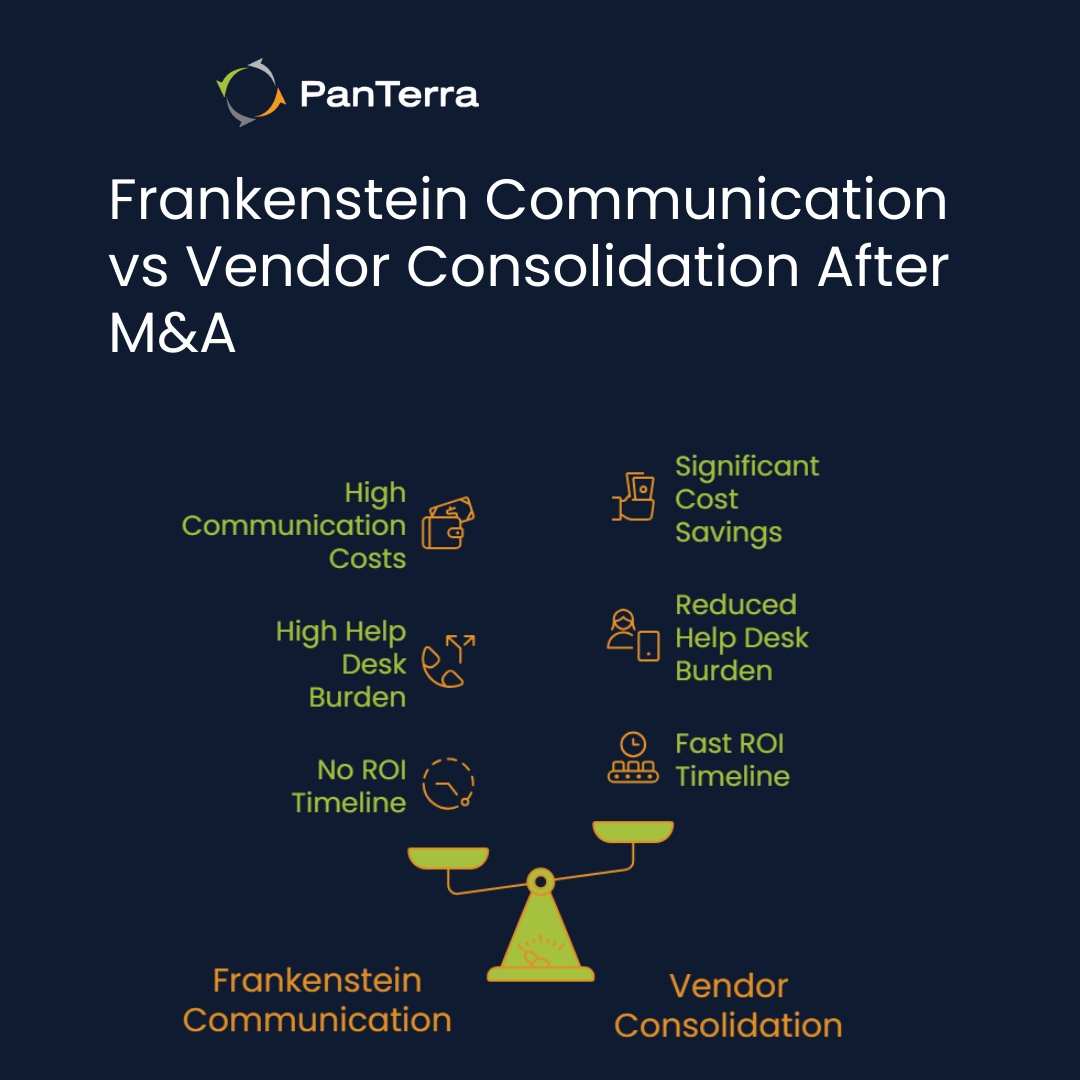
PanTerra eliminates this problem at the root. Streams.AI replaces legacy SIP trunk infrastructure entirely — no carrier contracts to reconcile, no multi-carrier porting complexity, no finger-pointing between providers when call quality degrades. One platform. One support relationship. One invoice.
PanTerra's SIP Trunk Elimination
Most consolidation projects still leave organizations managing SIP trunk contracts across multiple carriers. PanTerra removes this layer entirely. Streams.AI is a fully managed cloud architecture — the carrier complexity that persists in most legacy environments simply doesn't exist on PanTerra
Why "Fragmented Communications from M&As" Kills Productivity
The business case for the merger promised synergies. Fragmented communication systems are what prevent those synergies from materializing. Every time a sales rep in Division A can't reach the product specialist who transferred from the acquired division, every time a transferred call drops between incompatible systems, every time IT spends three hours troubleshooting a call quality issue across three carrier networks — that's synergy evaporating in real time.
Cross-Team Collaboration Breaks Down
Division A standardized on Teams three years ago. Division B deployed Slack as part of their startup culture. Neither platform sees presence status from the other, so employees send messages into a void while their counterpart appears available in one system but is actually in a meeting in another. Directory fragmentation means three separate contact lists with duplicate entries, outdated information, and no authoritative source of truth.
Meeting scheduling forces participants to maintain accounts across multiple platforms and install software they'd never chosen. Marketing wants to brief the combined sales organization — but half the team is on Zoom and the other half is on WebEx. The meeting either happens twice or someone gets a worse experience. Neither outcome is acceptable once you're supposed to be operating as a single company.
Customer Experience Takes the Hit
Customers who called the acquired company's number for years continue using it — but internal routing treats them differently from customers calling the parent company's main line. Inconsistent hold music, different IVR voice talent, wildly different estimated wait times calculated by incompatible systems. Call transfers between Cisco and Microsoft Phone drop 15–30% of the time because the platforms handle call state differently. The customer hears ringing, then silence, then disconnection — and has to call back and explain their situation from the beginning to a new agent with no record of the first interaction.
None of this is acceptable in a single-platform environment. All of it is routine in a fragmented post-merger setup. The customer doesn't know or care that the company just completed an acquisition. They just know the service got worse.
IT Support Burden Multiplies Exponentially
Each platform requires specialized expertise. One IT team member holds Cisco certification. Another spent six months learning Teams admin. A third specializes in Zoom configurations. Routine requests require routing to specific people rather than any available technician — creating bottlenecks and coverage gaps that didn't exist before the acquisition.
Troubleshooting complexity multiplies when issues span vendors and nobody can determine ownership. An executive can't join a video call from their mobile device. Is it a Teams issue? A VPN issue? A carrier issue? A device configuration issue? Isolating root cause requires testing across multiple platforms and coordinating with multiple vendor support organizations that each insist the problem is somewhere else.
Training duplication compounds everything. New hires from the acquired company need training on the parent company's platform. Parent company employees moving to acquired divisions need training on legacy systems. Documentation across four platforms uses different terminology for the same features. The Cisco guide calls it a "hunt group." RingCentral calls it a "call queue." Teams calls it an "auto attendant." Same concept, three vocabularies, guaranteed confusion.
The Business Case for Post-M&A Communication Consolidation
Communication consolidation isn't just an IT cleanup project. It's one of the most concrete, measurable value-creation opportunities in the post-merger integration playbook. The ROI is real and it compounds over time.
Single Platform, Single Dashboard: What That Actually Means
One admin portal. One set of security policies applied uniformly across the entire organization. One consistent user interface that employees learn once and use everywhere — regardless of which division they're in, which office they work from, or which device they're on. PanTerra's unified communications platform delivers this unified experience with the Admin AI portal giving IT full centralized control across every location.
Unified reporting makes questions answerable that fragmented environments can't touch: How many video minutes did the organization consume last quarter? Which divisions generate the highest call volumes? What percentage of customer calls resolve on first contact versus requiring transfers? These insights don't exist when data lives in five incompatible systems. They emerge immediately when the organization runs on one platform.
Cost Reduction Through Contract Consolidation
The math is direct. An organization with 500 users split 100/150/250 across three vendors pays per-user rates appropriate to those smaller populations. Consolidating those same 500 users under PanTerra unlocks enterprise-tier pricing — delivering 20–40% per-user cost reduction versus three mid-market rates running simultaneously. Research on enterprise integration strategies confirms that unified platform approaches consistently outperform fragmented multi-vendor environments in total cost of ownership.
Redundant subscription elimination cuts waste immediately: video conferencing licensed in three platforms when users only need it in one, collaboration features duplicated across systems, storage and administration overhead that exists purely to maintain platform compatibility. These costs disappear the moment consolidation completes.
Vendor management overhead is the hidden cost nobody puts in the ROI model. Five separate contract negotiations annually on staggered renewal schedules. Five separate support relationships to manage. Five separate procurement cycles. Consolidating to PanTerra means one contract, one renewal, one support escalation path — and a vendor relationship where your full user population creates real negotiating leverage.
| Metric | Fragmented (3 vendors) | Consolidated (PanTerra) |
|---|---|---|
| Per-user cost | 3x mid-market rates | 20–40% reduction |
| Help desk burden | Multi-platform specialist bottlenecks | 30–50% ticket reduction |
| Admin portals | One per platform (3–5) | One unified dashboard |
| SIP trunk contracts | Multiple carriers, separate billing | Eliminated entirely |
| Vendor negotiations | 5 separate annual renewals | One contract, full leverage |
| Security policy management | Varies by platform and division | Uniform across entire organization |
Security and Compliance: The Risk You Can't Ignore
Fragmented communication environments create fragmented security postures. Multi-factor authentication, encryption standards, access controls, and password requirements vary by division based on which platform they inherited. SOC 2, HIPAA, and GDPR compliance requires demonstrating consistent controls organization-wide — which is nearly impossible to prove when data lives across five systems with different logging capabilities and audit trails.
Platform consolidation reduces attack surface, simplifies audit procedures, and enables consistent policy enforcement across the entire organization. External auditors review one system instead of sampling across multiple platforms. Patch management becomes coordinated deployment instead of verifying compatibility across dissimilar systems on different release cycles. This isn't a soft benefit — it's a material reduction in compliance risk.
M&A Consolidation Is Unique — Here's What Makes It Different
Post-merger communication consolidation isn't the same as a standard PBX migration. The technical complexity is real, but the human dynamics add a layer that most IT plans underestimate. Understanding these factors upfront is what separates a consolidation that sticks from one that stalls.
Cultural Dynamics: The 'Losing Organization' Problem
Acquired teams often experience platform migration as one more signal that their ways of working didn't matter. Their Cisco system worked fine. They knew its features, trusted its reliability, and built workflows around it for years. Being told to migrate to a different platform — the acquiring company's platform — feels less like technology modernization and more like subordination. Organizational transformation research shows how change management failures amplify integration costs when cultural dynamics are underestimated.
This isn't irrational, and dismissing it creates passive resistance that undermines adoption. The right approach is to acknowledge it directly: the goal of consolidation isn't to erase what worked, it's to give the combined organization capabilities that neither company had independently. PanTerra's onboarding team has worked through this dynamic across hundreds of post-merger migrations. They know how to bring acquired teams into the process rather than delivering a fait accompli that breeds resentment.
The most effective consolidations position the new platform as genuinely new for everyone — not an upgrade for the acquiring company and a forced migration for the acquired. When both organizations are learning PanTerra together, the cultural dynamic shifts from "we lost" to "we're all starting fresh."
PanTerra's Approach to Multi-Team Onboarding
PanTerra's onboarding team delivers role-specific training across all acquired entities simultaneously, with dedicated support for each user group. The process is designed to make every team feel like a first-class participant in the migration — not an afterthought. When acquired employees have the same quality onboarding experience as the parent company, the cultural resistance drops dramatically.
Technical Migration Across Dissimilar Systems
Migrating from multiple legacy platforms simultaneously introduces complexity that standard single-platform migrations don't face. Data format incompatibilities between systems require structured mapping before migration begins. Custom integrations need to be rebuilt on the target platform before any users cut over — not after. The CRM screen pop that the sales team depends on, the building management integration, the healthcare nurse call system: all of these need validated replacements in PanTerra before go-live day.
User provisioning at scale also reveals edge cases that pilot testing misses. Bulk import processes that work perfectly for standard accounts fail on the 15% of users who have non-standard configurations. Identifying and resolving these exceptions before the full cutover — not during it — is what keeps go-live day calm.
PanTerra's onboarding team owns this technical sequencing. They've built migration playbooks specifically for Avaya, Mitel, ShoreTel, and Cisco environments that map known complexity points to pre-built solutions. The IT team reviews and approves; PanTerra does the heavy lifting.
Why a Prepared Full Cutover Beats Prolonged Parallel Operation
The instinct in complex consolidations is to run parallel systems for as long as possible — migrating one division at a time over 6 to 12 months. This feels cautious. In practice, it extends the fragmentation that consolidation is supposed to eliminate, adds months of duplicated licensing costs, and creates a sustained period of user confusion as different teams operate on different platforms.
A prepared full cutover — all locations, all users, on a defined date — is cleaner and faster when the preparation is done correctly. The cost savings begin immediately. The unified collaboration capability is available organization-wide from day one. The IT team manages one platform instead of maintaining two simultaneously while trying to migrate between them.
The preparation is what makes the difference. Discovery complete. Configuration validated. Integrations rebuilt and tested. Users trained before go-live, not after. That's not a big-bang risk — that's a disciplined execution.
The PanTerra Post-M&A Consolidation Process
PanTerra's approach to post-merger consolidation is built around one principle: no surprises at cutover. Every phase is designed to surface and resolve complexity before it can affect the business on go-live day.
Step 1: Discovery and Platform Audit
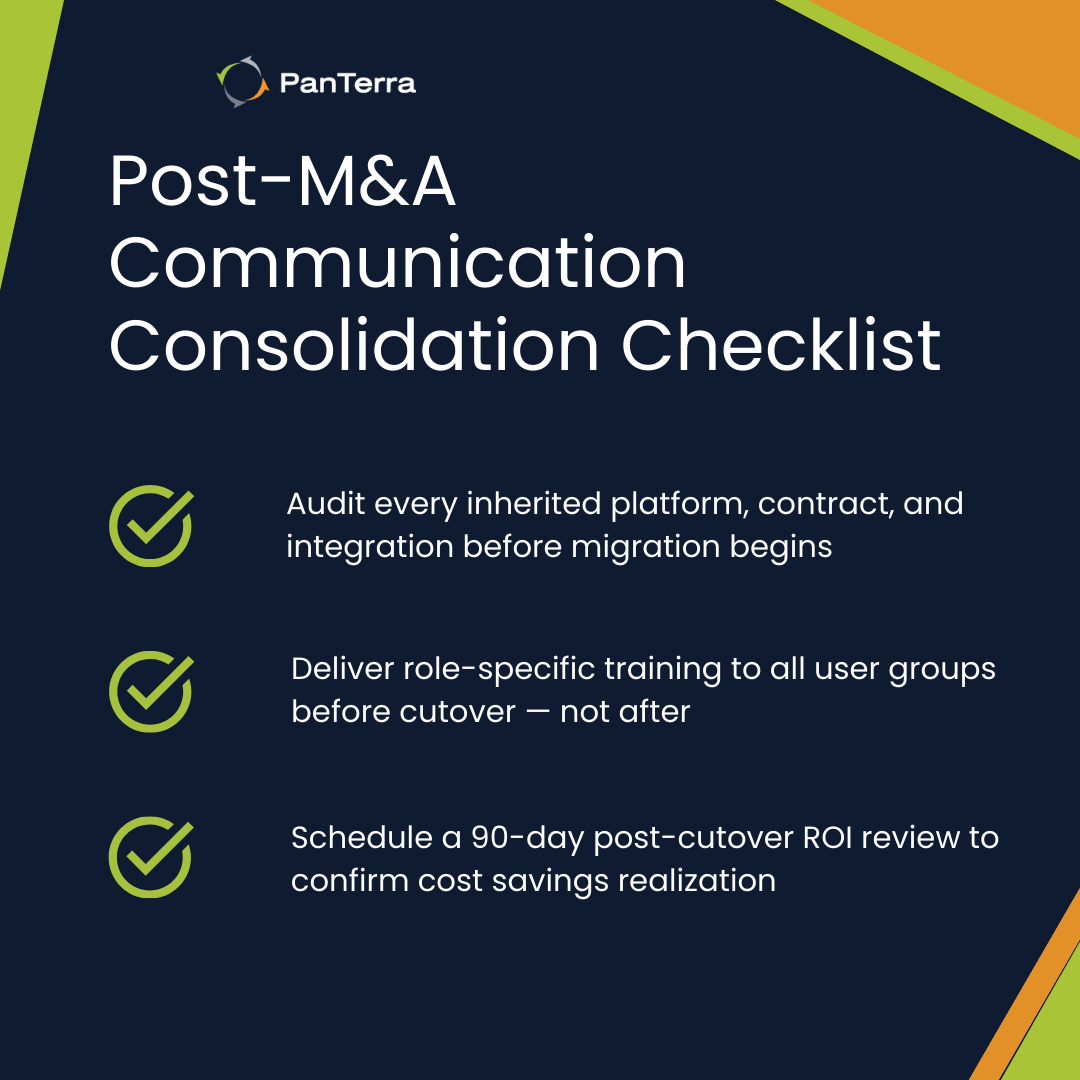
PanTerra's onboarding team conducts a structured audit across all inherited environments: every platform in use, every active contract and its termination terms, every integration dependency, every analog device, every custom routing rule. This isn't a questionnaire — it's a working session where PanTerra's team brings their institutional knowledge of legacy platform architectures to identify what your IT team may not even know to look for. A platform consolidation roadmap begins here — with full visibility across every inherited environment.
Feature usage analysis typically reveals that 40–60% of configured capabilities across legacy platforms are unused artifacts from workflows that no longer exist. Stripping those out simplifies the target configuration significantly and accelerates the consolidation timeline.
Step 2: Configuration and Integration Rebuild
Every validated requirement from discovery gets built into your Streams.AI environment before any users are involved. Hunt groups, IVR menus, auto-attendants, call recording rules, CRM integrations, directory synchronization — all configured, tested, and signed off by your team before go-live is scheduled. PanTerra's team manages the build; your IT team reviews and approves.
This phase is also where SIP trunk elimination happens. PanTerra's team coordinates the transition away from legacy carrier infrastructure, removing the multi-vendor carrier complexity from the equation entirely before cutover day.
Step 3: Pre-Cutover Training Across All Entities
Training is delivered before the cutover date, not after. PanTerra's onboarding team provides role-specific training for every user group across all acquired entities — receptionists, sales teams, customer service reps, executives, IT administrators. Documentation is tailored to your specific configuration, not a generic platform guide.
Acquired teams receive the same quality onboarding as the parent company. This is deliberate: equal treatment during training is one of the most effective tools for reducing the cultural resistance that derails post-merger technology adoption.
Step 4: Cutover Day
With discovery complete, configuration validated, integrations rebuilt, and users trained, cutover day is execution — not discovery. All locations transition simultaneously on the defined date. PanTerra's team is available for real-time support throughout the transition window. The Frankenstein setup is retired. PanTerra Streams.AI is live organization-wide. Done.
Step 5: Post-Cutover Stabilization
The first 30–90 days are active stabilization. PanTerra monitors call quality metrics, tracks feature utilization across all divisions, and responds to configuration refinement requests. Routing rules get tuned based on real usage patterns. Integrations get adjusted as teams discover edge cases. The communication platform migration process doesn't end at go-live — PanTerra's team stays engaged through full stabilization.
Within 90 days of cutover, organizations on PanTerra are comparing a single invoice against the stack of carrier and platform bills they used to receive. The 20–40% cost reduction isn't a projection anymore — it's a line item.
Post-M&A Consolidation Readiness Checklist
-
☐ Engage PanTerra's onboarding team for a structured discovery audit across all inherited environments
-
☐ Inventory all active communication platform contracts and their termination terms
-
☐ Map every analog device across all locations: fax machines, door entry systems, elevator phones, paging systems
-
☐ Document every integration across all acquired platforms: CRM, ERP, building management, healthcare systems
-
☐ Identify which custom integrations have no living documentation or maintainer
-
☐ Complete feature usage analysis — expect 40–60% of configured capabilities to be unused legacy artifacts
-
☐ Define the cutover date and communicate it across all entities before training begins
-
☐ Deliver role-specific training to all user groups before the cutover date — not after
-
☐ Ensure acquired entities receive equivalent onboarding quality to the parent company
-
☐ Brief IT and help desk teams across all locations on first-week support scenarios
-
☐ Schedule a 90-day post-cutover ROI review to confirm cost savings realization
How to Measure Consolidation Success
| Metric | Target | Timeframe |
|---|---|---|
| User adoption rate | 90%+ active usage | 90 days post-cutover |
| Help desk ticket reduction | 30–50% decrease | 6 months post-cutover |
| Communication cost savings | 20–40% reduction | 12 months post-cutover |
| Transferred call drop rate | Near-zero cross-platform failures | Immediate post-cutover |
| Employee satisfaction (pulse survey) | Cross-division collaboration rated "improved" or better | 60 days post-cutover |
.jpg?width=500&height=500&name=Are%20you%20Getting%20a%20Good%20Deal%20(1).jpg)
Comments