What an AI Receptionist Costs in 2026 (vs. Hiring vs. a Live Answering Service)


An ai receptionist costs less per month than a part-time employee and more per month than voicemail. That is the easy part of the answer.
The useful part is that comparing it to either one on monthly price alone leads to the wrong decision, because the options fail in different ways and the cost of failure is where the real money sits. This guide gives you three lines to fill in for your own business — what you pay, what you pay when volume moves, and what unanswered calls are costing you.
TL;DR
Four options handle inbound calls and they price on different logic: voicemail (free, answers nothing), an in-house receptionist (fixed cost, partial coverage), a live answering service (per minute, scales with your success), and an ai receptionist (flat platform fee, near-flat as volume grows). The comparison that matters is not monthly price — it is monthly price plus what happens when volume doubles plus the cost of the calls nobody answered. That third line is usually the largest number and appears on no invoice.
Key Takeaways
- Use fully loaded cost for an in-house receptionist — salary plus payroll tax, benefits, equipment. The intuition is usually low by a wide margin.
- A live answering service bills per minute, so a successful marketing campaign arrives as an invoice increase in the same month it arrives as calls.
- AI receptionist pricing stays close to flat within a tier because the marginal cost of another simultaneous call is near zero.
- Model the missed-call cost: missed calls × share that were genuine opportunities × average customer value × inbound close rate.
- Callers who reach voicemail often do not leave a message, which means your missed-call count understates the lost opportunity rather than overstating it.
- The realistic comparison for most businesses is not full replacement — it is an AI receptionist for transactional volume plus people for calls that need people.
Who This Is For
Best for: anyone building a business case for automated call answering · businesses comparing an AI receptionist against hiring or an answering service · finance and operations leaders who need a defensible model rather than a vendor quote.
Not ideal for: teams looking for a single headline price — the honest answer requires your own numbers · organizations evaluating outbound dialing costs, which is a separate category.
Top use cases: justifying spend internally · choosing between three options with different pricing logic · quantifying what missed calls already cost you.
What Are You Actually Comparing?
Four options, four pricing logics.
Voicemail costs effectively nothing and answers nothing. Worth including because many businesses are using it by default rather than by decision.
An in-house receptionist is a salary plus payroll tax, benefits, and the workstation. Handles judgment well, works fixed hours. Every call outside those hours is voicemail.
A live answering service — a virtual receptionist staffed by people — usually bills per minute or per call against a monthly minimum. Human judgment on a variable-cost basis.
An ai receptionist is usually a flat platform fee, sometimes tiered by usage. Instant, simultaneous, always-on coverage on a fixed-cost basis.
The pricing models matter as much as the prices, because they behave differently when volume changes — and volume always changes.
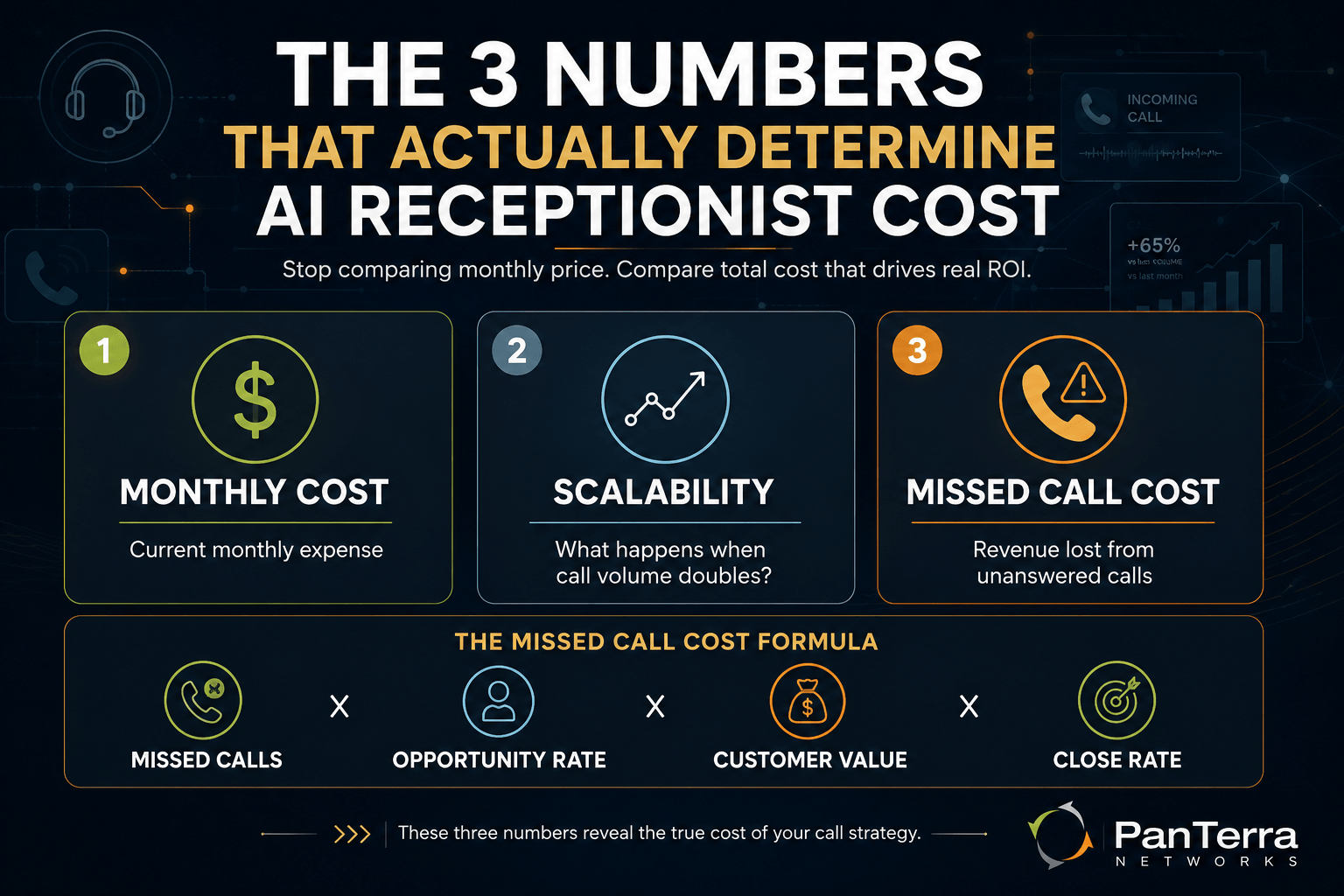
How Do You Compare Them? The Three-Line Cost Model
☐ Line 1 — Monthly cost at current volume. The invoice number.
☐ Line 2 — What happens when volume doubles. The line most comparisons skip.
☐ Line 3 — The cost of calls you do not answer. The largest number, on no invoice.
Line 1 — The Monthly Cost at Your Current Volume
For an in-house receptionist, use fully loaded cost: salary plus employer payroll taxes plus benefits plus equipment, divided by twelve. The fully loaded figure is typically well above the salary line and it is the only honest comparison.
For a live answering service, take your actual monthly call minutes, not the plan minimum. Most businesses exceed included minutes in at least some months, and overage rates usually exceed the base rate.
For an ai receptionist, take the platform fee at the tier covering your volume.
Line 2 — What Happens When Volume Doubles
An in-house receptionist does not scale. Double the volume and calls queue, get missed, or need a second hire. The cost is a step function: flat until suddenly it is not.
A live answering service scales linearly. Double the minutes, roughly double the bill. Understand this clearly: a successful campaign, a seasonal peak, or a product recall all arrive as an invoice increase in the month they arrive as calls.
An ai receptionist scales close to flat within a tier. You may cross into a higher tier; you will not see a bill tracking call volume line for line.
Run this at your realistic peak month, not your average. Averages hide the months that hurt.
Line 3 — The Cost of the Calls You Do Not Answer
Missed calls per month × share that were genuine opportunities × average customer value × inbound close rate. Run this once. For most businesses the figure is large enough to settle the decision on its own — and it appears on no vendor quote.
Two things to know while building this line. Callers who reach voicemail frequently do not leave a message; they call the next business on the list, which means your missed-call count understates the loss. And the distribution matters more than the total — calls missed at lunch and after 5pm cluster in exactly the windows where someone with an urgent need is shopping.
This is why the comparison cannot be made on monthly price. An option that costs more per month and answers every call frequently costs less in total than one that costs less and answers eighty percent.
What Does an In-House Receptionist Actually Cost?
Worth its own section because the intuition is usually low.
Start with the market salary for the role. Add employer payroll taxes. Add benefits if you offer them. Add the workstation, phone, and software. Divide by twelve.
Then adjust for coverage. A full-time receptionist covers roughly forty hours of a week containing one hundred and sixty-eight. If your customers call outside those hours — and in most industries a meaningful share do — you are paying full-time cost for partial coverage, and the remaining hours fall to voicemail or an after-hours option you also pay for.
None of this argues against hiring. A receptionist who knows your customers, handles a difficult conversation well, and does five other jobs between calls is genuinely valuable. It argues for pricing the role honestly in the comparison.
When Does a Live Answering Service Cost Less?
At low volume, and it is a real advantage.
If you take a small number of calls a month and each matters, paying per minute for a person to handle them well can be cheaper than any platform fee, and better than software at handling nuance. The per-minute model is genuinely efficient at the low end.
The crossover comes faster than most businesses expect, because it is driven by minutes rather than calls. Long calls, calls involving holding, and calls where the service takes a detailed message consume minutes quickly. If your calls average several minutes and volume is more than modest, run line 1 carefully.
What Does an AI Receptionist Not Cover?
A fair comparison includes what you are not getting.
It does not handle a caller who is upset in a way requiring a person. It does not sell. It does not exercise judgment about an unusual situation. It does not build a relationship with a repeat customer the way someone who recognizes their voice does.
Practically, the realistic comparison is not "AI receptionist instead of people." It is "AI receptionist for the transactional volume, people for the calls that need people." Build line 1 for that combination — it is a more accurate number and a more defensible one internally.
What Should Be Included in the Price?
Ask specifically, because these change the real cost materially:
- Setup and configuration — one-time, sometimes significant
- Changes after launch — whether editing a flow, script, or hours is self-service or a support request. This is the difference between a fixed cost and a recurring one.
- Integrations — whether calendar, CRM, and helpdesk connections are included. An AI receptionist that cannot reach your calendar cannot book, which removes most of the value.
- Call volume limits — what happens at the tier boundary and what overage costs
- Numbers and minutes — whether telephony is bundled or billed separately
- Contract term — whether the quoted rate requires an annual commitment
Frequently Asked Questions
How much does an AI receptionist cost per month?
Pricing is typically a flat monthly platform fee, sometimes tiered by call volume, with call volume affecting the total far less than it would on a per-minute service. Ask what is included in the tier — integrations and configuration changes are the two items most often billed separately.
Is an AI receptionist cheaper than hiring a receptionist?
On monthly cost, substantially — a fraction of a fully loaded part-time salary. The fairer comparison accounts for what each covers: a full-time hire covers around forty hours a week, while software covers all one hundred and sixty-eight.
Is an AI receptionist cheaper than a live answering service?
It depends on volume. At low volume, per-minute human answering can be cheaper. As volume rises the flat-fee model wins, and the crossover arrives faster than most businesses expect because it is driven by minutes rather than call count.
How do I calculate what missed calls are costing us?
Multiply missed calls per month by the share that were genuine opportunities, by your average customer value, by your inbound close rate. Your phone system reports the first number; you can estimate the rest closely.
Does an AI receptionist replace our staff?
Usually not. The setup that works for most businesses is an AI receptionist handling informational and transactional calls, with people taking judgment calls and live sales conversations. Model the combination rather than a full replacement.
What hidden costs should we ask about?
Setup fees, whether post-launch changes are self-service or billed, whether integrations are included, what happens when you exceed a volume tier, whether telephony is bundled, and whether the quoted rate requires an annual commitment.
.jpg?width=500&height=500&name=Are%20you%20Getting%20a%20Good%20Deal%20(1).jpg)
Comments