Voicemail to Text: How Voicemail Transcription Works and What to Look For

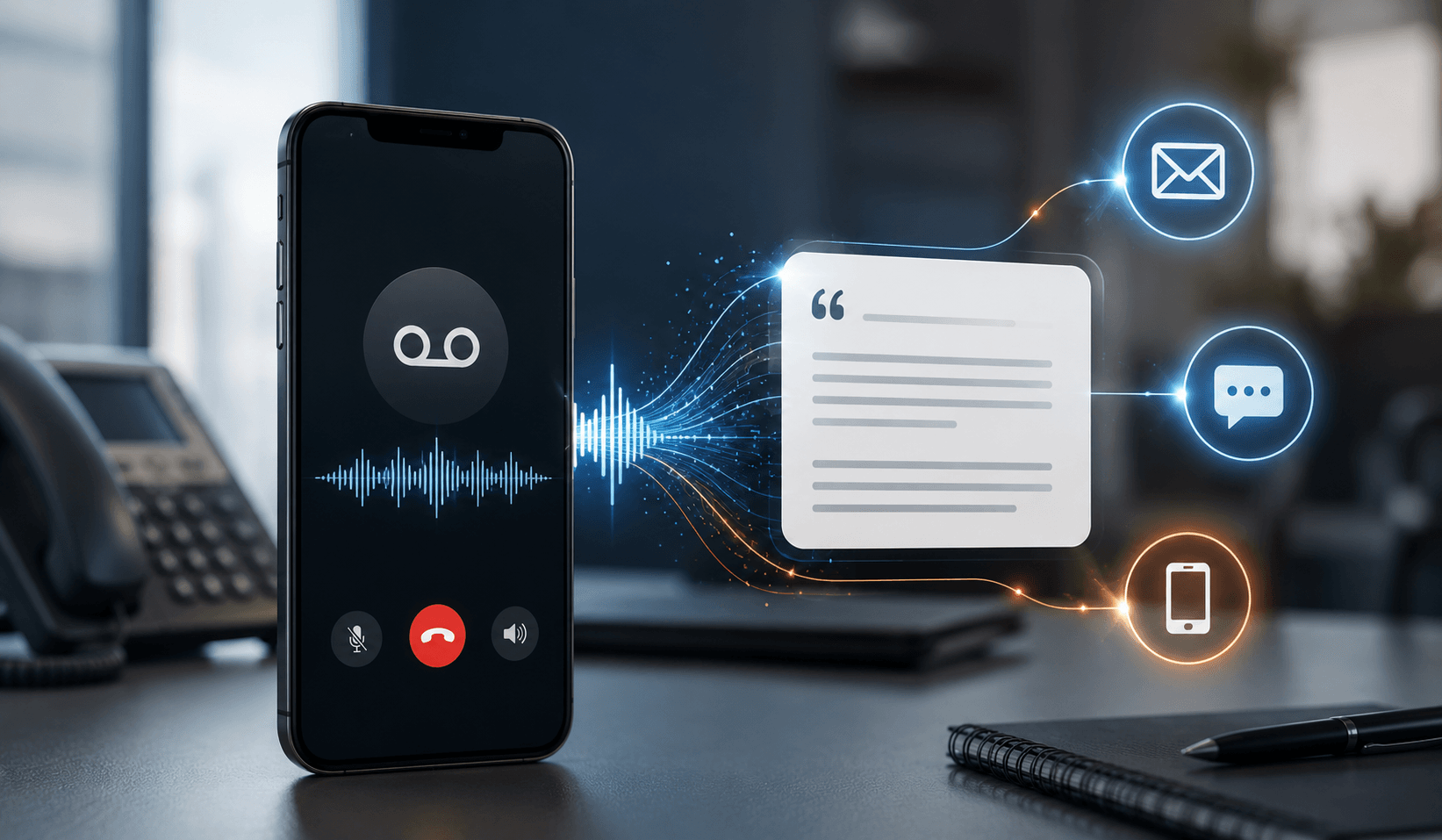
Voicemail to text converts a voice message into readable text, so the message can be scanned in a few seconds instead of played in real time. That is the whole idea, and the reason it matters is arithmetic: a 40-second voicemail takes 40 seconds to hear and about four seconds to read.
For an individual, that is a convenience. For a team fielding dozens of messages a day, it changes which messages get dealt with at all. Voicemails that go unheard for hours are the ones that turn into a second call, and then a complaint.
This covers how transcription actually works, why accuracy varies so widely between providers, and the five things worth checking before committing to one.
Key Takeaways
- Voicemail to text converts a voice message to readable text using automatic speech recognition, delivered by email, SMS, or inside the communication application.
- Accuracy is not a single number. It varies enormously with audio quality, accent, background noise, and whether the caller was on a mobile in a car.
- Most transcription failures are audio failures. The recognition model is rarely the limiting factor.
- If your organization handles regulated information, where transcription is processed matters more than how accurate it is.
- The five checks: audio access, delivery routing, retention alignment, name and number handling, and what happens on failure.
Who This Is For
Best for: Teams where voicemail volume is high enough that listening is a real time cost, sales, support, reception, professional services. Anyone evaluating a phone system where voicemail handling has become a complaint.
Not ideal for: Individuals with a handful of messages a week, where the native handset feature is fine. Organizations under a regulatory regime that prohibits third-party processing of voice content, start with the regulation, not the feature.
Top use cases:
- Triaging inbound sales voicemail by urgency, especially where AI voicemail adds classification on top
- Making voicemail searchable months later
- Letting people handle messages from environments where audio is not practical
- Reducing the delay between a message arriving and someone acting on it
What Is Voicemail to Text?
Voicemail to text is a service that converts a recorded voice message into written text using automatic speech recognition, then delivers that text to the recipient. The audio recording is normally retained alongside the transcript rather than replaced by it.
Delivery takes three common forms, and most providers support more than one: as an email with the transcript in the body and the audio attached, as an SMS containing the transcript, or as text displayed inside the phone application next to the message itself. That third form is usually called visual voicemail, and it is the one that keeps the transcript, the audio, and the ability to call back in a single place.
The terms "voicemail to text," "voicemail transcription," and "voicemail transcription service" are used interchangeably. There is no meaningful technical distinction between them.
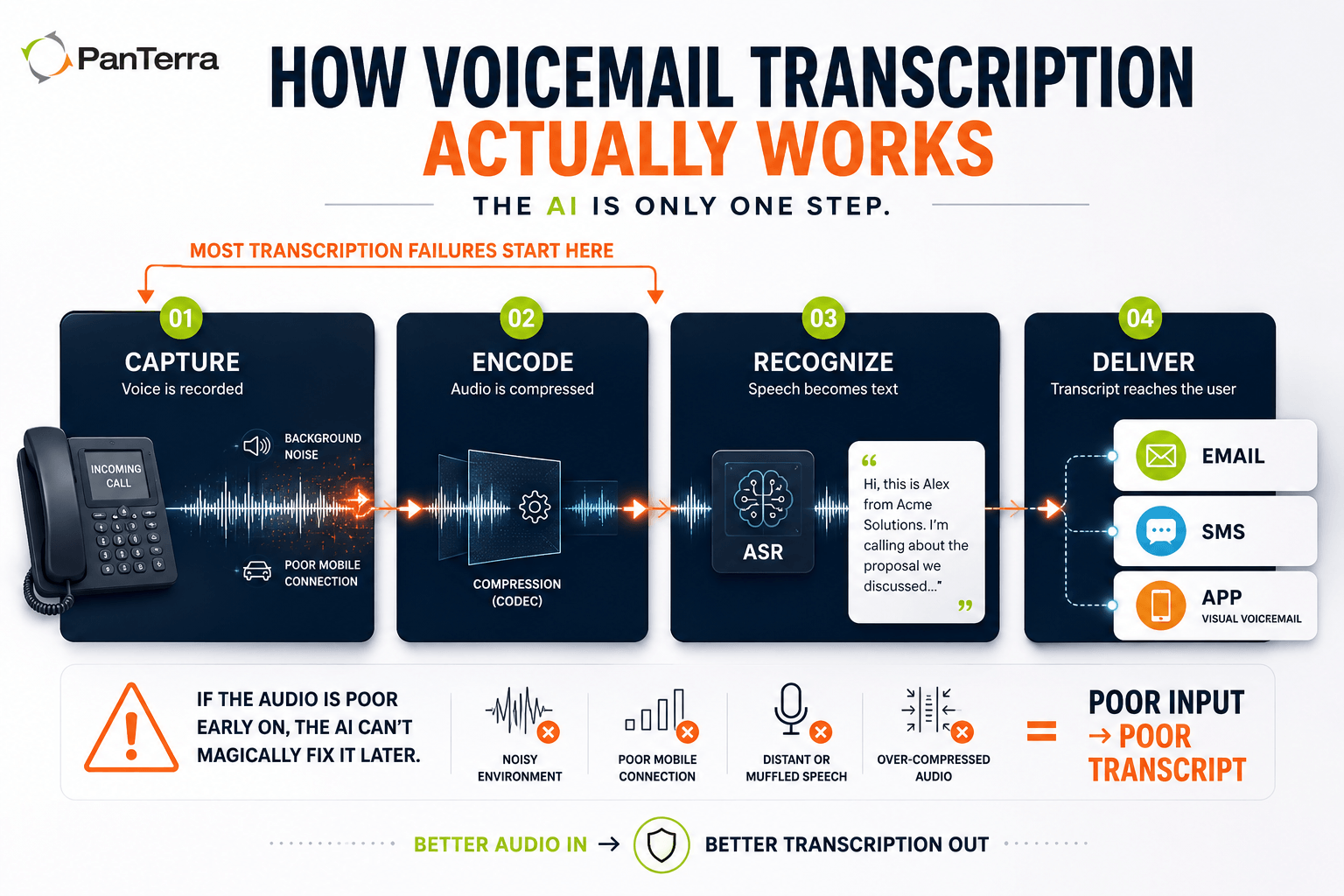
How Does Voicemail Transcription Actually Work?
Four steps, and understanding them explains almost every accuracy problem people encounter.
- Capture. The caller's audio is recorded when the call reaches voicemail. What gets captured is telephone-band audio, a narrow frequency range, historically about 300 Hz to 3,400 Hz, which is enough for intelligibility and considerably less than what speech recognition models are typically trained on.
- Encoding. The recording is compressed for storage. The codec used determines how much of the original signal survives. This is a decision the platform made, usually years ago, and it sets a ceiling on everything downstream.
- Recognition. An automatic speech recognition model converts audio to text. Modern systems handle this well when the input is clean, and degrade steeply when it is not.
- Delivery. The transcript is routed to the recipient by the configured channel.
The important consequence is that step 3 gets blamed for problems created in steps 1 and 2. A transcript of a caller on a hands free kit in traffic will be poor no matter which recognition model processes it, because the information was never in the recording.
How Accurate Is Voicemail Transcription?
Accurately enough to triage; not always accurately enough to quote.
That distinction is the practical one. If you are reading a transcript to decide whether a message is urgent and who should handle it, current transcription is reliably good enough. If you are relying on it to capture a phone number, a spelling, or a commitment word for word, it is not, and you should be listening to the audio for those.
Vendors quote accuracy figures, and the figures are not comparable between vendors because they are measured on different material. A number produced on clean studio recordings tells you nothing about performance on a voicemail left from a parking lot. Any published accuracy claim without a stated test set is best read as marketing rather than specification.
What actually drives accuracy
Five factors, in roughly descending order of impact:
Background noise. The single largest determinant. Traffic, wind, and open plan office noise degrade recognition more than any other variable.
Connection quality. A message left over a poor mobile connection has already lost audio information before it was recorded.
Speaking rate and clarity. Fast, mumbled, or overlapping speech is harder for a model in the same way it is harder for a person.
Accent and dialect. Recognition quality varies by accent, reflecting the distribution of the training data. This has improved substantially and is not solved.
Vocabulary. Company names, product names, and industry terms are frequent failure points unless the system has been given them.
Notice that four of the five are properties of the caller and the call, not of the provider. This is why switching providers often produces less improvement than expected, you have changed step 3 in a chain where the loss occurred in steps 1 and 2.
Why your transcription is wrong
The most common specific failures, and what each one indicates:
A transcript that is broadly right but garbles names and numbers is working normally. That is the expected behavior of a general recognition model on proper nouns and digit strings.
A transcript that is wrong throughout usually indicates an audio problem, check whether the calls in question arrived over a particular route or from a particular carrier.
A transcript that stops partway through usually indicates a duration limit, either on the recording or on the transcription itself. Worth checking, because it is a configuration setting rather than a quality problem.
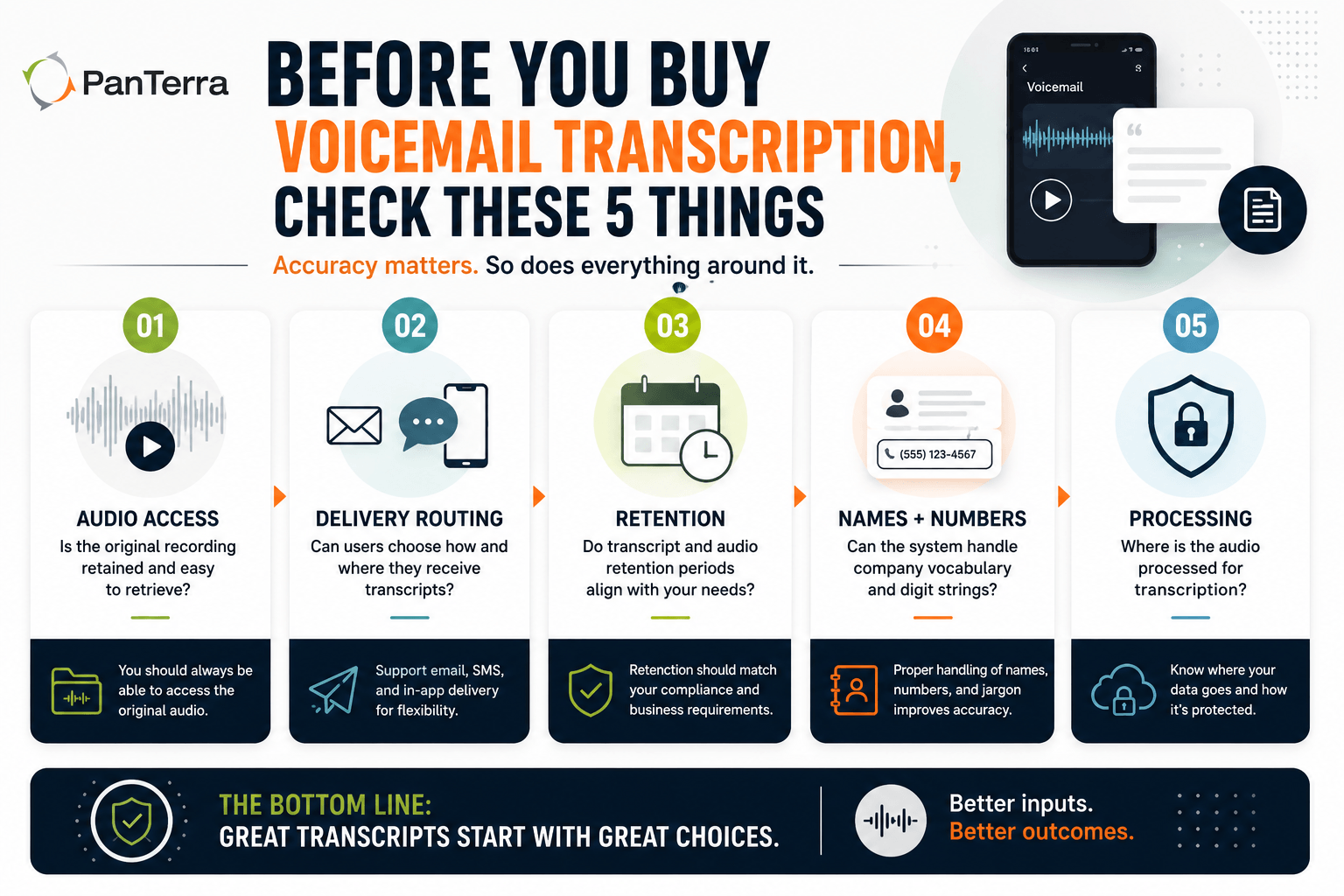
The Five Checks Before You Commit
Feature lists in this category are close to identical. These five are where products actually differ.
1. Is the original audio always retained and accessible?
Transcription is an aid, not a replacement. Any system that discards the recording once transcribed has removed your ability to verify anything, and the first time a transcript is disputed you will want the audio.
Confirm the audio is retained, for how long, and that retrieving it does not require an administrator.
2. Where does the transcript go, and can that be routed?
Email, SMS, and in-application delivery each suit different roles. A field technician wants SMS. A support queue wants the transcript inside the application where the callback happens.
The check is whether delivery is configurable per user rather than set globally. Global-only delivery forces a compromise on everyone.
3. Does transcript retention match audio retention?
This one is missed constantly. If audio is retained 90 days and transcripts 30, then at day 45 you have a message that exists but cannot be searched, and search was the reason for transcribing it.
Confirm both figures, and confirm they can be aligned.
4. How does it handle names, numbers, and company terms?
Ask whether the system supports a custom vocabulary or dictionary, a list of company names, product names, and staff names the recognizer is told to expect. For any organization whose name is not a common word, this is the difference between transcripts that are useful and transcripts that are irritating.
Ask separately how phone numbers are handled. Digit sequences are a known weak point, and some systems apply specific post-processing to them.
5. Where is the audio processed, and does that matter to you?
For most organizations this is a footnote. For organizations handling health, financial, or legal information, it is the first question rather than the fifth.
Voice content that reaches a third-party transcription service is voice content leaving your platform. Confirm whether transcription happens within the provider's own infrastructure or is subcontracted, what agreements cover it, and whether the audio is retained by that third party for model training. That last point in particular is worth getting in writing.
If your organization operates under a regulatory regime governing recorded communications, resolve this question with your compliance function before evaluating anything else on this list.
Is Voicemail to Text Secure?
The transcript inherits the sensitivity of the message. A voicemail containing account details becomes a text containing account details, and the text is easier to forward, screenshot, and search.
Three practical considerations:
Delivery channel. A transcript delivered by SMS sits in a mobile message store with whatever protection that device has. A transcript in the communication application sits behind the application's authentication. These are materially different exposure profiles for the same content.
Search. Transcription makes voicemail searchable, which is the main benefit and also a new exposure, and the same consideration applies to call transcripts. Content that was effectively unfindable in an audio archive becomes retrievable by keyword.
Third-party processing. Covered in check 5. The question is whether audio leaves the platform, and if so, under what terms.
None of these makes voicemail to text unsuitable. They make it a feature that should be configured deliberately rather than switched on by default.
Where Voicemail to Text Falls Short
Two honest limitations.
It does not fix voicemail volume. If the underlying problem is that too many calls go unanswered, transcription makes the resulting messages faster to process without addressing why they exist. The answer-rate problem is a routing and staffing question.
It is not a record. Transcripts are approximations, and treating one as a verbatim record of a commitment is a mistake that surfaces at exactly the wrong moment. Where the precise wording matters, the audio is the record and the transcript is the index.
40 seconds versus four. A typical business voicemail runs around 40 seconds and takes that long to hear. The same message reads in roughly four. For one person that is a convenience; across a team fielding thirty messages a day it is the difference between voicemail being triaged in the morning and being triaged tomorrow.
Pre-purchase checklist
☐ Confirmed the original audio is always retained and directly accessible to the recipient
☐ Confirmed transcript delivery is configurable per user, not global-only
☐ Confirmed transcript retention matches audio retention
☐ Confirmed custom vocabulary support for company, product, and staff names
☐ Asked specifically how digit strings and phone numbers are handled
☐ Established where audio is processed, whether it is subcontracted, and whether it is retained for training
☐ Checked recording and transcription duration limits
☐ Chosen the delivery channel deliberately against the sensitivity of typical message content
☐ Confirmed any accuracy figure quoted came with a stated test set
Frequently Asked Questions
What is voicemail to text?
Voicemail to text converts a recorded voice message into readable text using automatic speech recognition, then delivers it by email, SMS, or inside the phone application. The original audio is normally kept alongside the transcript rather than replaced by it. "Voicemail transcription" and "voicemail transcription service" mean the same thing.
How accurate is voicemail transcription?
Accurate enough to triage a message, not always accurate enough to quote from. Accuracy varies with background noise, connection quality, speaking clarity, accent, and specialized vocabulary, four of which are properties of the caller rather than the provider. Vendor accuracy figures measured on clean recordings do not predict performance on a voicemail left from a car.
Is voicemail to text secure?
The transcript inherits the sensitivity of the original message and is easier to forward, screenshot, and search than audio was. The main considerations are delivery channel, the new searchability of previously buried content, and whether audio is processed by a third party. It is a feature to configure deliberately rather than enable by default.
Can you get voicemail as a text message or email?
Yes, both are standard delivery options, alongside display inside the phone application. The useful check is whether delivery is configurable per user rather than set globally, since a field technician and a support queue want different channels.
Why is my voicemail transcription wrong?
Broadly correct text with garbled names and numbers is normal behavior for a general recognition model on proper nouns and digit strings. Text that is wrong throughout usually indicates an audio problem rather than a recognition problem. Text that stops partway through usually indicates a duration limit, which is a configuration setting.
Does voicemail transcription work with accents?
Yes, with variation. Recognition quality differs by accent because it reflects the distribution of the training data behind the model. This has improved considerably and is not solved. If a specific accent is common among your callers, test with real recordings rather than relying on a vendor demonstration.
If voicemail volume is the actual problem rather than voicemail length, the routing question is the one worth answering first. For how voicemail works within a cloud phone system, see cloud-based voicemail.
.jpg?width=500&height=500&name=Are%20you%20Getting%20a%20Good%20Deal%20(1).jpg)
Comments