What $40K Daily in Healthcare Communication Savings Actually Looks Like (And What It Means for Your Practice)


A Number Worth Taking Apart
$40,000 per day. That figure came out of a recent data session between PanTerra Networks and Five9 on AI-powered healthcare calls. Healthcare practices using AI-driven patient communication are saving up to that amount daily — while improving care at the same time.
Most practice administrators who see that number ask the same question: where does it come from?
It is not one thing. The $40,000 comes from five operational gaps that stack on top of each other across a busy healthcare practice. Understanding each one is what makes the number useful — not just citable.
This article breaks down each mechanism. The research behind it. What the math looks like at different practice sizes.
TL;DR
AI-powered healthcare calls reduce costs through five mechanisms: missed appointment reduction, routine call handling, faster handle times, after-hours coverage, and compliance overhead. Savings scale with patient volume — one location might see $2,000 to $4,000 per day. A multi-location system can reach $40,000 or more. HIPAA-compliant tools are the prerequisite. Every tool in the stack needs to be verified.
Key takeaways:
- Patient no-shows cost the US healthcare system $150 billion annually. AI reminders and self-scheduling tools can cut no-show rates by 29% — turning empty slots back into revenue.
- Poor provider communication drives 31.5% of patient no-shows. Multi-channel AI outreach addresses this directly.
- AI auto-summary alone cuts handle time by 33%, per Five9 data from the PanTerra/Five9 healthcare webinar.
- MGMA's January 2025 data shows 22% of medical groups improved no-show rates last year — the ones using patient communication tools.
- HIPAA and HITECH compliance is not optional for AI in healthcare. Every tool that touches patient data needs a BAA and must meet the HIPAA Security Rule.
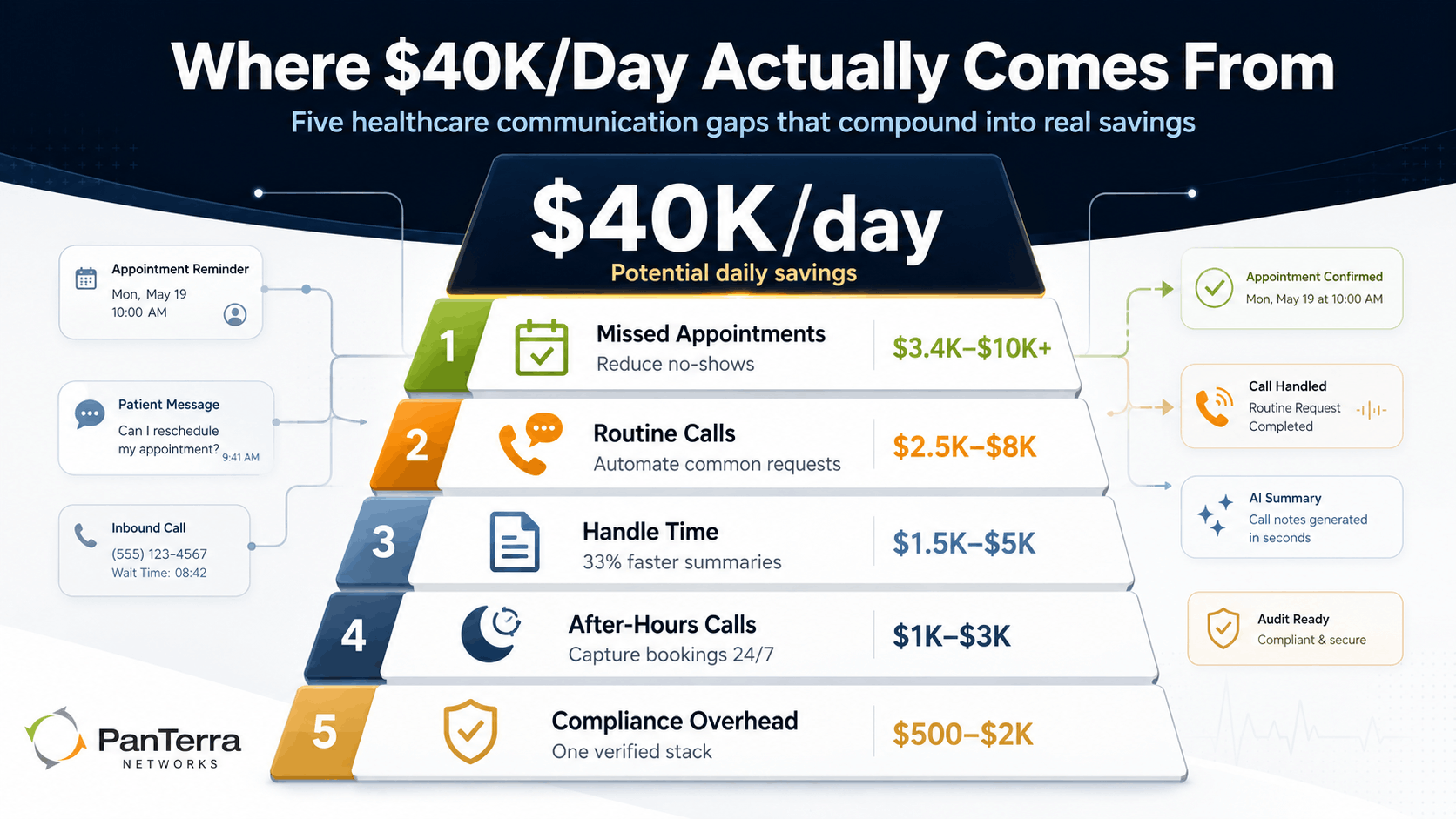
Where the $40K Comes From: Five Mechanisms
The savings figure works best as a daily multiplier — five categories, each with its own driver, each growing with patient volume.
|
Savings category |
What currently happens |
How AI changes it |
Daily savings range |
|---|---|---|---|
| Missed appointments | National no-show rate averages 17%. Each empty slot costs a physician around $200. A 100-provider system loses 170+ slots daily. | AI sends multi-channel reminders. Patients self-schedule and reschedule 24/7. Self-scheduling tools cut no-show rates by 29%. | $3,400–$10,000+ depending on provider count and no-show rate |
| Routine call handling | Front desk handles refill requests, appointment confirmations, and general questions — 6 to 10 minutes per call. 30–40% of daily calls are routine. | AI handles routine calls end-to-end: refill in under 2 minutes, appointment confirmation with SMS, general questions via NLP. Staff handles clinical calls only. | $2,500–$8,000 for a 10-location system |
| Handle time reduction | Average call handle time includes hold, wrap-up notes, and transfer steps. AI auto-summary is not in most clinical call centers today. | AI auto-summary cuts handle time by 33% (Five9 data). Applied to hundreds of calls per day, the savings stack up fast. | $1,500–$5,000 for systems with 200+ agent calls daily |
| After-hours call capture | Calls after hours go to voicemail. Patients hang up. Appointments are not booked. Callbacks pile up the next morning. | AI answers 24/7. Same experience as business hours. Appointments scheduled, urgent calls triaged, context stored for next-day review. | $1,000–$3,000 in recovered bookings and reduced morning backlog |
| Compliance overhead | Every tool used with patient data needs its own HIPAA review, BAA, and audit log setup. Manual compliance work eats admin hours daily. | One HIPAA and HITECH-compliant platform. AES-256 encryption, SOC 2 Type II, BAAs, and one audit log for the full stack. One review covers everything. | $500–$2,000 in admin time and audit prep; more in breach-risk value |
The trade-off worth understanding: these five categories are not separate — they compound. A practice that cuts no-shows, automates routine calls, and captures after-hours bookings sees the same front desk staff shift from callbacks to clinical work. That multiplier is what pushes the daily total from $4,000 at one location toward $40,000 across a multi-location system.
What This Looks Like in Practice: Multi-Location Healthcare
The $40,000/day figure applies most directly to organizations running multiple locations on a shared communications infrastructure. The operational challenge at that scale — separate routing, separate staff, separate compliance reviews per location — is where the compounding becomes visible.
One of our customers, Chris Bonilla at Arc Health, described the platform architecture challenge in a way I hear often from multi-location healthcare groups. Arc Health is a private equity firm running multiple healthcare franchise brands. His description:
"PanTerra's multi-tenant architecture let us keep every franchise as a completely separate PBX on the platform, while our IT team can jump in and manage any account from a single pane of glass. No workarounds, no duct tape — it just works the way our organization actually operates."
— Chris Bonilla, Arc Health
The layer that AI communication adds on top of that architecture is what makes the efficiency gains scalable. Each location routes calls through the same AI receptionist. Appointment reminders go out from the same platform. The auto-summary reduces handle time at every location. Compliance is verified once for the whole stack. The savings mechanisms in the table above apply across every patient interaction volume in the system simultaneously.
What This Means for Your Practice
The $40,000/day is a ceiling — it reflects large multi-location systems with high patient volume. A single-location practice sees smaller numbers. The same five drivers apply. The daily total scales with how many patients your system touches each day.
The fastest way to estimate your range: start with two questions.
What share of your daily calls are routine? Refill requests, confirmations, billing questions, and directions are typically 30 to 50 percent of inbound calls in primary care settings. That is your automation opportunity.
What is your no-show rate, and what does each empty slot cost? At $200 per unused slot and a 17% national average, a 50-appointment practice loses $1,700 per day before the first patient arrives. Reminders and self-scheduling — cutting no-shows 29% — bring that back toward $1,200.
Add after-hours bookings. Add the 33% handle-time reduction across 100 calls per day. The number is different for every practice — but the five mechanisms are the same.
FAQ
Does AI in patient communication require HIPAA compliance?
Yes — every AI tool that touches patient data is subject to HIPAA. Each tool needs its own Business Associate Agreement (BAA) and must meet the HIPAA Security Rule. PanTerra's Streams.AI platform was built HIPAA and HITECH-compliant from day one — AES-256 encryption, SOC 2 Type II, and BAAs included with every deployment.
Does the $40K/day apply to small practices?
No — not directly. The figure is from a data session covering multi-location systems with high patient volume. A single-location practice will see a smaller number. The five mechanisms are the same; the daily total reflects your patient volume.
Can AI-handled calls really match a live agent's experience?
The Five9 data showed that NLP eliminates "press 1" menus. Patients speak naturally. The AI understands intent, routes the call, and hands off with full context when a live agent is needed. The caller never has to repeat themselves.
What does the handoff to a human agent look like?
Luna AI — PanTerra's AI receptionist, part of the Streams.AI platform — uses built-in handoff logic. When a call needs live judgment, it routes to the best available agent with the full conversation preserved. No cold transfers. No repeated intake questions.
What This Adds Up To
The $40,000/day is a real number — not a best case. It is a realistic ceiling for multi-location healthcare systems running AI across full patient call volume. In real business terms: smaller practices see smaller absolute numbers, but the same five mechanisms apply.
What businesses actually need to evaluate is not whether the headline applies to them — it is which of the five categories is causing the most daily drag right now. Start there.
For the full details of the PanTerra and Five9 data session, see the original announcement. For HIPAA-compliant platform specifics, the Streams.AI HIPAA-compliant VoIP page covers the compliance setup in detail.
.jpg?width=500&height=500&name=Are%20you%20Getting%20a%20Good%20Deal%20(1).jpg)
Comments