Why Answer Rates Are Quietly Killing Mid-Market Outbound — And What Reputation Protection Actually Does

The Answer Rate Problem Is Getting Worse — and Most Teams Are Blaming the Wrong Thing
Cold call connect rates have dropped to 3 to 10 percent in 2025. Quality sales conversations per day fell 55 percent since 2014. Eighty-seven percent of Americans do not answer calls from unknown numbers.
Sales leaders see the numbers and reach for the usual fixes: better scripts, different times of day, more reps on the phone. Those things help at the margins. They do not fix the core problem.
The real question is whether your calls are getting through at all. Not whether your pitch is landing — whether the phone is actually ringing on the other end.
A 2025 Pew Research study found that 8 in 10 U.S. adults generally ignore unknown callers. A 2025 Google survey found that 31 percent of people missed at least one important call because it was incorrectly labeled as spam. That is not a sales problem. That is an infrastructure problem. And it is getting worse as carriers continue to refine their spam-detection systems.
PanTerra's own data shows that when a business number gets spam-labeled, answer rates can drop by 40 to 60 percent. On a team making 500 calls a day, that is 200 to 300 conversations that never happen. Not because anyone hung up. Because the call was flagged before the phone ever rang.
TL;DR
Carrier spam-detection systems now screen billions of calls per day. Legitimate business numbers get flagged when calling patterns trigger their algorithms. Most guides tell you to "register your numbers" — but that only addresses one stage of the problem. Carrier-level reputation protection monitors and remediates flags across all three major carriers on an ongoing basis. PanTerra recently launched Phone Number Reputation Management and Streamlets call-flow automation as add-ons to the Streams.AI platform.
Key takeaways:
- Spam-labeled numbers see answer rates drop 40 to 60 percent — not from message rejection, but from calls never connecting.
- STIR/SHAKEN, the carrier authentication framework deployed in 2021, requires number registration. But registration is a baseline, not ongoing protection.
- Carrier spam databases are updated daily. A clean number today can be flagged tomorrow if call patterns shift.
- Reputation Management monitors AT&T, Verizon, and T-Mobile continuously. Most spam labels are remediated in 2 to 3 business days.
- Streamlets call-flow automation is included with every Streams.AI seat — no additional license. Enterprise alternatives typically charge $50 to $75 per user per month for the same capability.
How a Legitimate Call Gets Flagged
Most sales leaders think spam flags happen to robocallers. That is not how carrier scoring works.
Carriers analyze every call on their network. They look at call volume, calling patterns, complaint data, and authentication signals. When a number triggers enough criteria — even from normal business activity — it gets scored as potential spam. The label goes on before the phone rings.
Carrier systems are tuned to be aggressive. It is better, from their standpoint, to block a few legitimate calls than let spam through. The baseline for "suspicious" has also shifted. What looked like normal sales volume five years ago now triggers flags because high-volume dialing is harder to distinguish from mass-spam operations.
The result: outbound reps do everything right. The calls do not get through anyway.
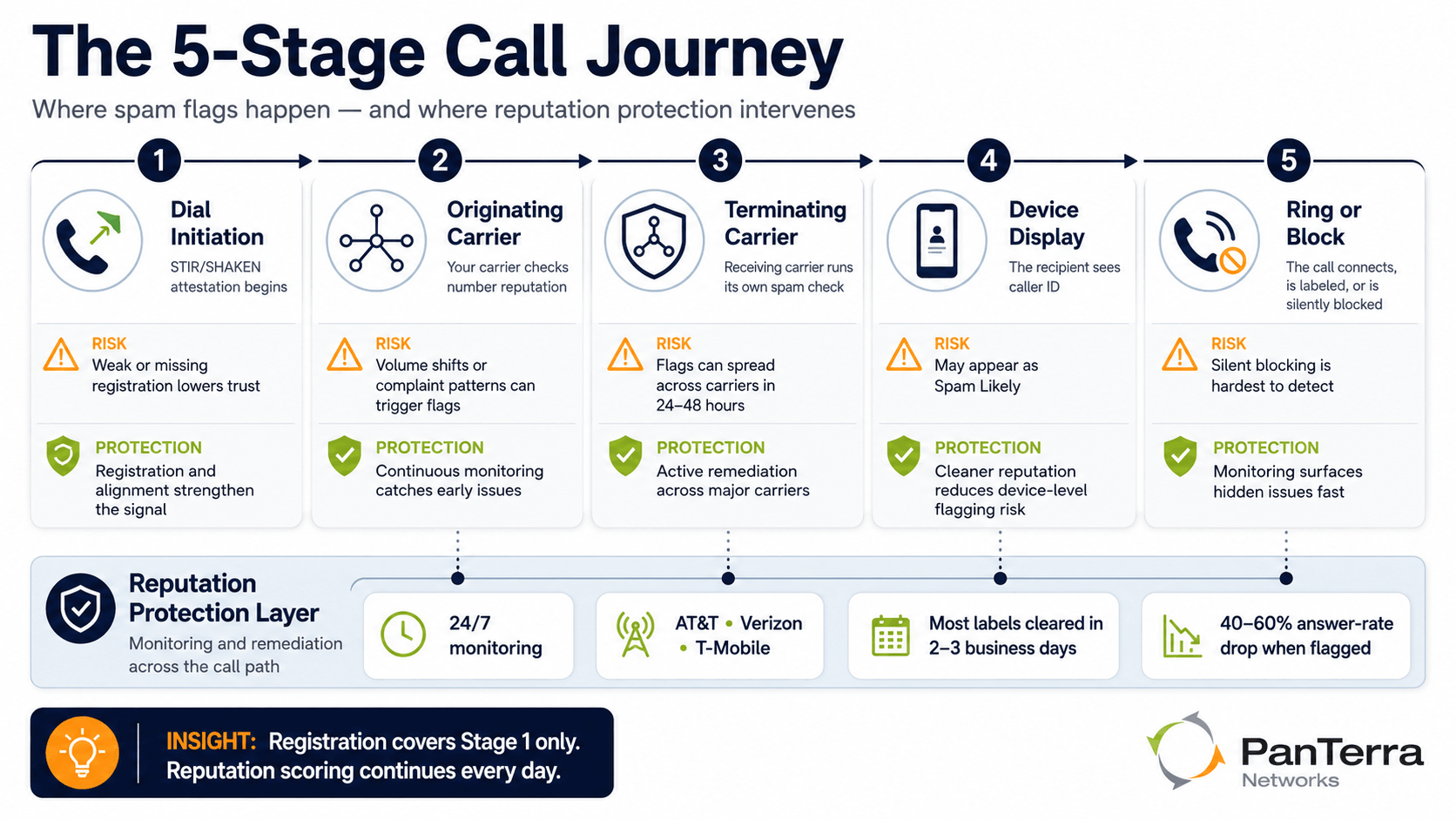
The Call Journey: Where Flags Get Applied and Where Protection Intervenes
Most guides stop at "register your numbers." That covers one stage. Here is what happens across all five.
|
Stage |
What happens |
Where spam flags are applied |
What reputation protection does |
|---|---|---|---|
| 1. Dial initiation | Your number and caller ID are transmitted with a STIR/SHAKEN attestation score | Weak or missing attestation signals potential spam. Numbers not registered with carriers get the lowest trust score. | KYC-based registration and STIR/SHAKEN alignment sets a strong attestation signal from the first dial |
| 2. Originating carrier | Your carrier checks your number's reputation in its internal database | High call volumes, complaint data, or pattern changes trigger spam classification here — before the call even leaves your carrier | Continuous monitoring catches flags at your originating carrier early, before they spread |
| 3. Terminating carrier | The receiving carrier runs its own spam check using shared carrier databases | A flag at one carrier can propagate to AT&T, Verizon, and T-Mobile within 24 to 48 hours | Active remediation with all three major carriers removes labels within 2 to 3 business days |
| 4. Device display | iOS or Android displays the caller ID — with or without a "Spam Likely" label | Device-level labeling is driven by carrier signals. iOS 26 call screening adds another filter layer. | Cleaner carrier-level reputation reduces the chance of device-level flagging. No tool fully controls the device screen. |
| 5. Ring or block | The call either connects, rings with a spam label, or gets blocked silently | Silent blocking is the hardest to detect. Your reps hear a normal ring. The prospect never hears anything at all. | Monitoring dashboards surface silent blocking so teams can act before a whole campaign is affected |
The trade-off worth understanding: most "register your numbers" advice addresses Stage 1 only. It is the right starting point — without proper STIR/SHAKEN registration, you cannot get a strong attestation score. But carrier reputation scoring runs continuously. A clean number can be flagged tomorrow if calling patterns shift. That is the gap reputation monitoring fills.
What Ongoing Reputation Management Actually Does
Registration is a one-time step. Reputation management is an ongoing process.
Phone Number Reputation Management monitors your numbers across AT&T, Verizon, and T-Mobile 24/7. When a spam label appears, remediation triggers automatically. Most labels are cleared in 2 to 3 business days. The cost is $10 per number per month. For a 100-number fleet, that comes to over $6,000 in annual savings versus managing this through typical third-party services.
In real business terms: a spam label that sits for two weeks while a rep wonders why nothing is landing is a sales capacity problem. A label that is detected and remediated in 72 hours is a routine maintenance event.
What businesses actually need to evaluate is not whether they have registered their numbers. It is whether they have ongoing visibility into what carriers are scoring those numbers right now — and what happens automatically when a flag appears.
Streamlets: The Call-Flow Automation Part
Reputation protection keeps calls getting through. Streamlets changes what happens when they do.
Streamlets is a visual call-flow automation platform — a drag-and-drop builder for IVR workflows, conditional routing, and call-handling logic. No software development required. It ships with every Streams.AI seat at no added cost.
Enterprise contact center platforms typically charge $50 to $75 per user per month for equivalent automation as a premium add-on. The three-year savings for a 50-user organization come to $117,000 by including Streamlets instead of paying those per-seat fees.
The practical value for mid-market outbound teams: build routing logic that matches how your team actually works — priority queues, skills-based routing, time-based rules — without a developer or a support ticket. When G2 reviews of call-flow platforms flag admin complexity as the most common pain, changing call logic in hours rather than weeks is a real edge.
FAQ
Is number registration enough to protect answer rates?
Registration addresses Stage 1 — it sets a baseline STIR/SHAKEN attestation. But carrier reputation scoring runs continuously. A registered number can still get flagged when calling patterns change. Ongoing monitoring and remediation close the gap.
How long does it take to remediate a spam label?
Most labels across AT&T, Verizon, and T-Mobile are remediated in 2 to 3 business days. Without active monitoring, a label can persist for weeks — carriers do not proactively notify you when your number gets flagged.
Is Streamlets only for large contact centers?
No. Streamlets works for any team building IVR workflows or call routing — from a small outbound sales team's after-hours flow to a multi-location call queue. It ships with every Streams.AI seat and requires no development background.
What does this cost, and how does it compare?
Reputation Management is $10 per number per month for 24/7 multi-carrier monitoring and auto-remediation — over $6,000 in estimated annual savings versus third-party alternatives for a 100-number fleet. Streamlets is included with every Streams.AI seat at no added cost.
What This Adds Up To
Answer rates are not a script problem or a timing problem. For many mid-market sales teams, they are an infrastructure problem. Carrier spam-detection is tuned to be aggressive, and legitimate outbound numbers get caught in the filter with no notification.
The fix has two parts. First, ongoing reputation monitoring that catches and remediates flags before they drag campaigns. Second, call-flow automation that reduces the per-call cost of getting through once the number is clean.
Both are now available as part of the Streams.AI platform. The full launch details are in the PanTerra newsroom.
.jpg?width=500&height=500&name=Are%20you%20Getting%20a%20Good%20Deal%20(1).jpg)
Comments