How an AI Receptionist for Small Business Stops Revenue Loss from Missed Calls


An AI receptionist for small business is an automated phone system that answers calls, captures caller information, takes messages, and routes inquiries to the appropriate staff member without requiring a full-time employee.
For small businesses operating without dedicated reception staff, these systems ensure every call is answered 24/7—preventing lost revenue when prospects call competitors instead of waiting for a callback. By automating routine call handling, AI receptionists transform customer accessibility from a staffing constraint into a competitive advantage.
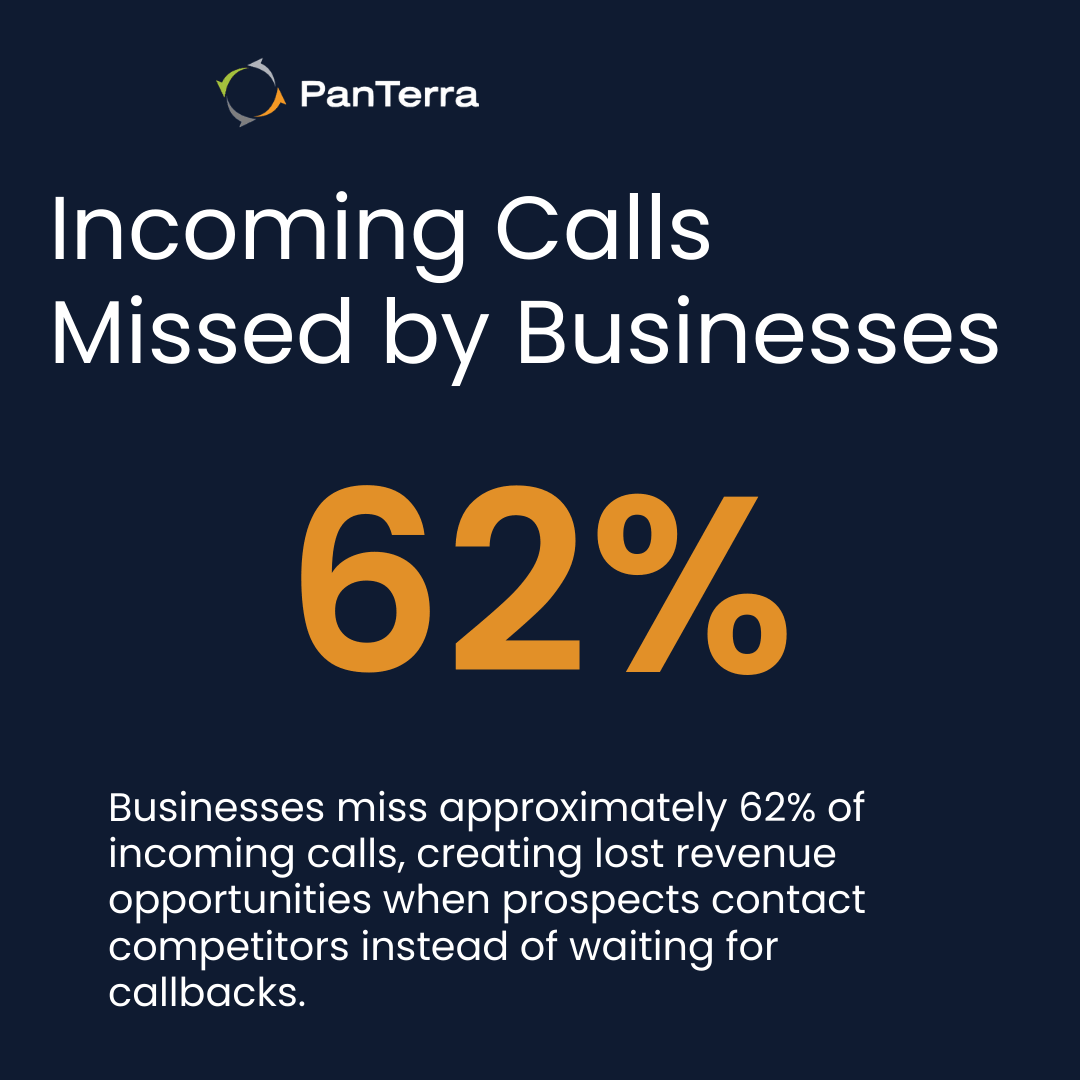
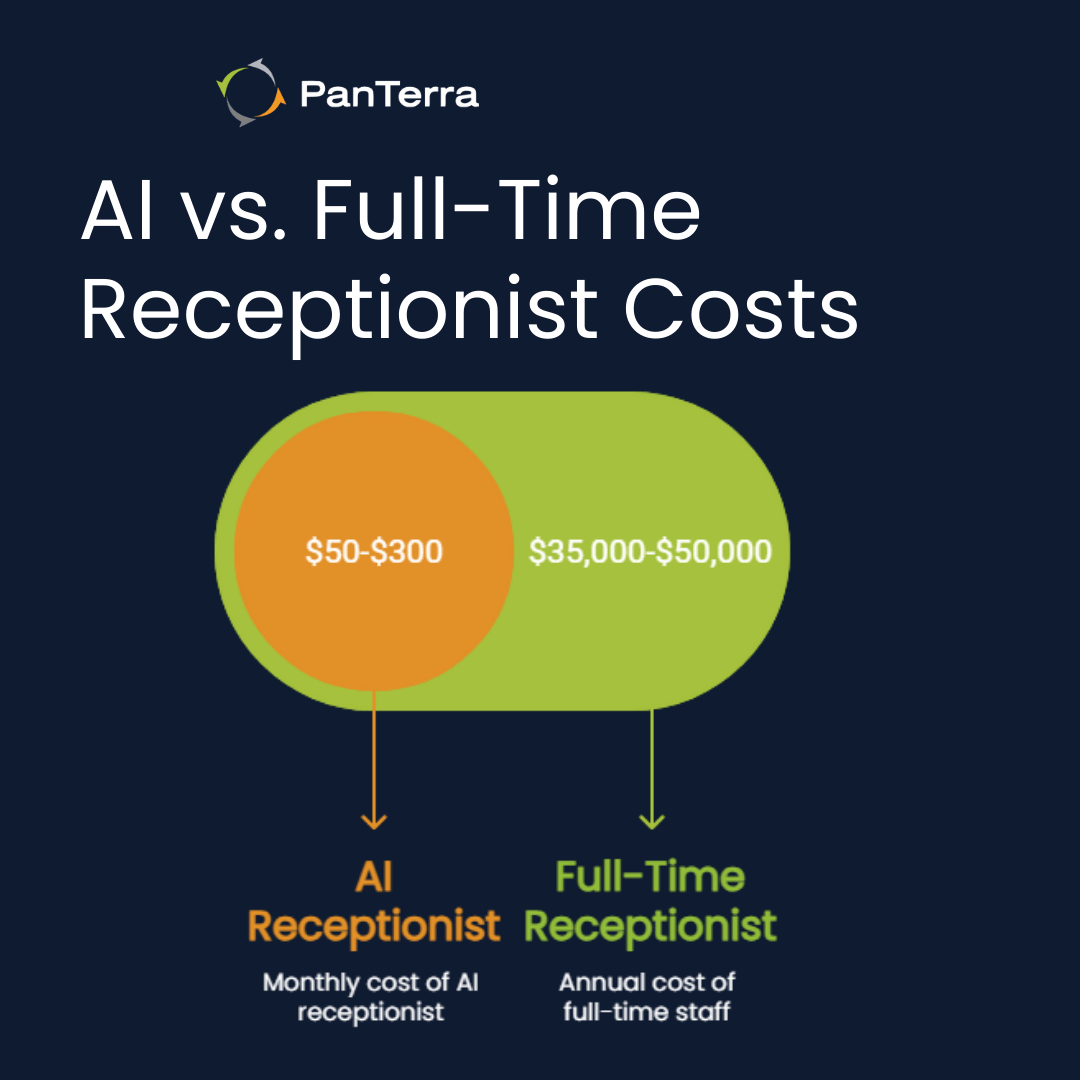
Research indicates businesses miss approximately 62% of incoming calls, with conversion rates dropping dramatically when response times exceed the first hour. Small businesses competing against larger companies with dedicated reception teams face a professionalism gap that artificial intelligence can close without the $35,000-$50,000 annual cost of full-time staff.
Small businesses lose 60-80% of prospects who don't receive callbacks within one hour, as buyer urgency decays and competitors become more attractive than delayed follow-up. AI receptionists answer every call 24/7, capture caller information, take messages, and route inquiries to appropriate staff—providing coverage that would require three full-time employees at a fraction of the cost while eliminating revenue loss from accessibility gaps.
What Is an AI Receptionist for Small Business?
An AI receptionist for small business is an automated phone assistant that answers calls and manages routine customer interactions without requiring a full-time employee. Typical capabilities include:
-
answering inbound calls automatically
-
capturing caller information and contact details
-
routing calls to the appropriate person or department
-
taking messages and sharing call summaries with staff
Small businesses use AI receptionists to ensure every call is answered, reduce staffing costs, and prevent revenue loss caused by missed inquiries.
Key Takeaways
-
Missed calls create permanent revenue loss when prospects call competitors instead of waiting
-
Full-time receptionists cost $35,000-$50,000 annually with unavoidable coverage gaps during breaks and off-hours
-
AI receptionists provide 24/7 coverage at $50-300/month regardless of call volume
-
Hybrid models route 70-80% of routine calls through automation while escalating complex situations to humans
-
AI receptionists capture caller information and share call details with staff so teams can follow up quickly
Who This Is For
-
Best for: Solo practitioners, service businesses, and small teams (5-50 employees) handling 50-500 calls monthly without dedicated reception staff
-
Not ideal for: Enterprises requiring multilingual support across dozens of departments or businesses in highly regulated industries with complex compliance requirements
-
Top use cases: Appointment scheduling for service businesses, lead capture for sales teams, after-hours inquiry handling, simultaneous call management during volume spikes
The Real Cost of "I'll Call Them Back Later"
The assumption that missed calls represent delayed opportunities rather than lost revenue depends on a business dynamic that no longer exists in competitive markets. When a prospect calls and receives no answer, the psychological clock begins counting down toward the moment they abandon your business entirely in favor of an available alternative.
When Missed Calls Mean Lost Customers (Not Just Delayed Ones)
Missed calls create permanent revenue loss when prospects call competitors instead of waiting for callbacks. Customer engagement research shows customer drop-off rates reach 60-80% after 1 hour without response, and 90%+ after 24 hours, as buyer urgency decays and alternatives become more attractive than delayed follow-up. The first-responder advantage in competitive markets means the business that answers first often wins the customer, regardless of whether they offer the best product or lowest price.
Revenue Leakage You Can't See in Your CRM
Revenue leakage from missed calls never appears in CRM reports because these prospects never become logged leads. When calls go unanswered, businesses lose not just the immediate opportunity but also the ability to measure how many potential customers called, what they needed, or which competitors captured them during callback delays. If your business receives 100 logged inquiries monthly with 20% conversion, but 62% of calls go unanswered (industry average), you're potentially missing 163 additional calls monthly representing invisible opportunity cost.
Customer Perception When Calls Go Unanswered
Unanswered calls signal to customers that a business is either too small to handle inquiries, too disorganized to manage basic communication, or doesn't value their time—perceptions that create trust deficits small businesses can't afford when competing against larger, more accessible competitors. Professionalism signals in first contact moments determine whether prospects categorize your business as "established and reliable" or "struggling and overwhelmed" before you ever deliver service.
Why Hiring a Full-Time Receptionist Isn't the Only Solution
The default response to missed call problems—hiring a full-time receptionist—solves accessibility challenges while creating cost, coverage, and scalability constraints that make it infeasible for many small businesses.
The Receptionist Cost Equation (Salary + Benefits + Turnover)
Full-time receptionist costs typically range from $35,000-$50,000 annually when factoring base salary, payroll taxes (7.65%), benefits (20-30% of salary), initial training time (2-4 weeks), and turnover replacement costs (3-6 months of productivity loss when positions turn over every 18-24 months on average). A receptionist earning $40,000 annually actually costs the business $50,000-$52,000 when employer-side taxes and benefits are included.
Coverage Gaps Even With Full-Time Staff
Single-person reception creates unavoidable coverage gaps: 8+ hours daily when staff are off-duty, 30-60 minute lunch breaks, 10-15 vacation days annually, 5-10 sick days per year, and inability to handle simultaneous calls during volume spikes—resulting in 40-50% of business hours without live coverage even with full-time staff. A receptionist working 9am-5pm Monday-Friday provides zero coverage for evening calls, weekend inquiries, or early-morning prospects in different time zones.
When Reception Becomes a Bottleneck (Not Just a Cost)
Human-only reception becomes a growth bottleneck when call volume spikes exceed one person's capacity (typically 40-60 calls per 8-hour shift), when seasonal businesses face 2-3x volume fluctuations, when business growth outpaces hiring speed, or when multi-location operations require coordinated coverage that's prohibitively expensive with full-time staff at each site.
What AI Receptionists Actually Do
AI receptionists are sometimes referred to as AI phone answering services, virtual receptionists, or automated call assistants. While traditional virtual receptionist services rely on human agents to answer calls, AI receptionists use natural language processing to understand caller requests, capture information, and route inquiries instantly—allowing businesses to handle high call volumes without expanding staff.
AI receptionist capabilities center on automating routine communication workflows that don't require human judgment, empathy, or expertise—freeing businesses to provide 24/7 accessibility without the cost structure of round-the-clock human staffing.
Call Screening and Intelligent Routing
AI receptionist call screening uses natural language processing to recognize caller intent ('I need technical support' vs. 'I want to place an order'), assess urgency based on keywords and tone, route calls to appropriate departments or individuals, and filter spam/robocalls—decisions made in 3-5 seconds without human intervention. Unlike rigid phone tree menus requiring button presses, modern AI receptionists conduct natural conversations where callers speak freely.
Information Capture and Message Handling
AI receptionists capture caller information such as name, phone number, and the reason for the call through conversational prompts. This information can then be shared with staff as call summaries or messages, allowing teams to review inquiries and follow up with customers.
By collecting essential details during the call, businesses gain visibility into customer inquiries even when staff are unavailable, helping teams prioritize follow-ups and respond more efficiently.
After-Hours Coverage and 24/7 Availability
AI receptionists provide 24/7 coverage at flat monthly costs (typically $50-300/month regardless of call volume), handling night/weekend inquiries, serving customers across multiple time zones, and maintaining holiday availability—capabilities that would require 3+ full-time staff working rotating shifts at $100,000+ combined annual cost. The economics of continuous coverage shift dramatically from prohibitively expensive to easily affordable when automated systems replace human shift workers.
When AI Can't "Take Information on My Behalf" (Limitations to Know)
AI receptionist limitations become apparent in situations requiring emotional intelligence, nuanced judgment, deep domain expertise, or authority to make exceptions to established rules.
Complex Problem-Solving and Empathy Requirements
AI receptionists struggle with emotional distress calls requiring empathy, multi-step troubleshooting that demands contextual memory across exchanges, complaint de-escalation that needs apology authority, and nuanced judgment calls (like prioritizing a frustrated VIP customer over established queue rules)—situations where human emotional intelligence and decision-making authority remain superior. When a customer calls upset about a service failure, the appropriate response involves understanding emotional context and making judgment calls that may require deviating from standard policies.
Industry-Specific Terminology and Context
Industry-specific AI receptionist limitations include medical terminology recognition (differentiating 'angina' from 'anxiety'), legal jargon comprehension ('habeas corpus' vs. 'corpus delicti'), technical product knowledge ('API integration' vs. 'SDK implementation'), and regulatory compliance constraints (HIPAA-compliant call handling, attorney-client privilege protocols)—domains requiring specialized training beyond general AI capabilities.
The Hybrid Model (AI + Human Escalation)
Hybrid AI receptionist models route 70-80% of routine calls through automation (appointment scheduling, basic FAQs, information capture) while escalating 20-30% of complex calls to human staff—achieving 50-70% cost reduction compared to full human coverage while maintaining service quality for situations requiring empathy, expertise, or decision authority. Customer experience automation statistics demonstrate that properly designed hybrid systems satisfy customer expectations while dramatically reducing operational costs.
Evaluating AI Receptionist Solutions for Your Business
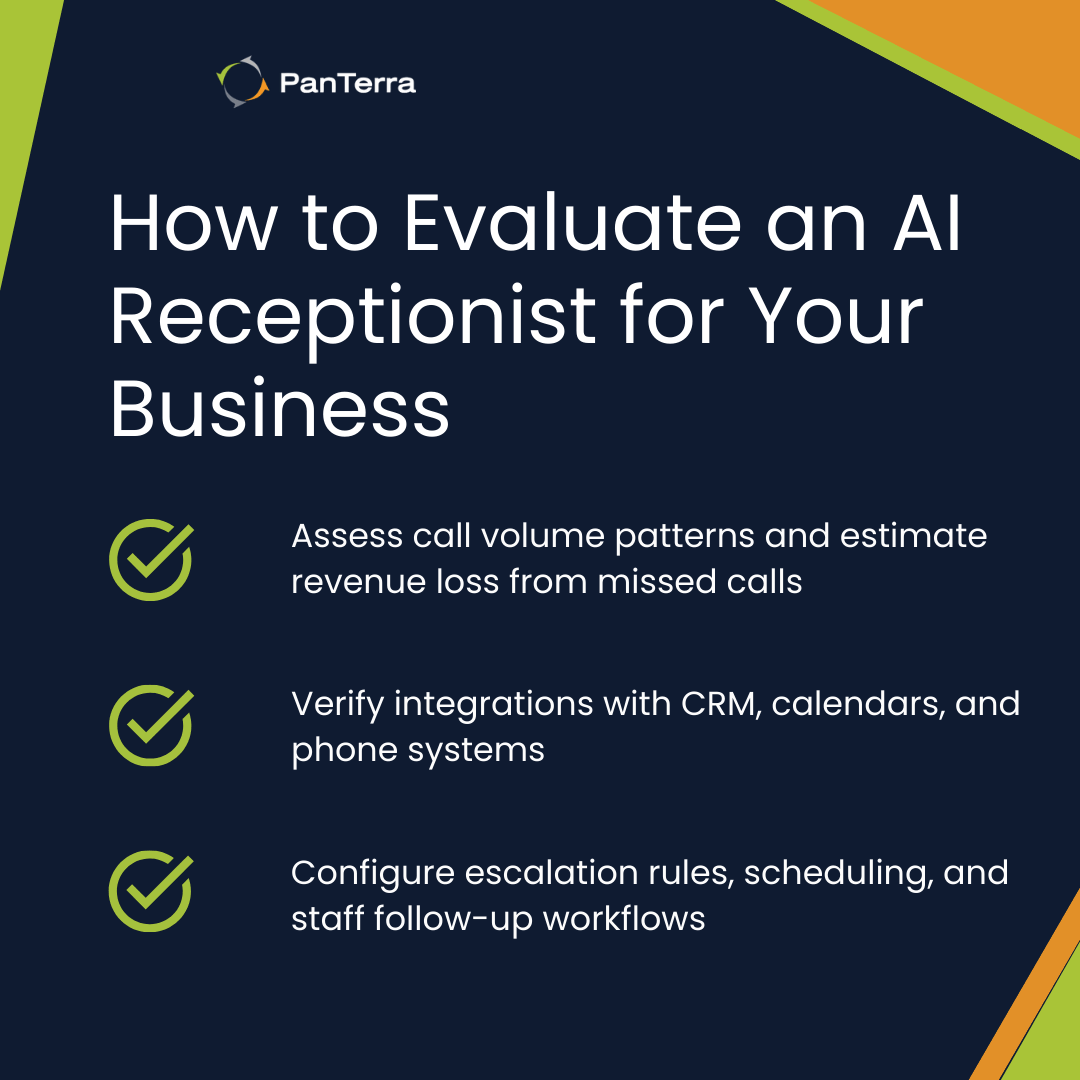
Selecting an AI receptionist requires matching solution capabilities to your business's specific call patterns, integration requirements, and quality standards.
Volume and Complexity Matching
AI receptionist volume matching requires evaluating monthly call capacity (entry solutions handle 1,000-5,000 calls/month, enterprise platforms scale to 50,000+ calls/month), concurrent call handling (1-10 simultaneous conversations), and complexity thresholds—simple FAQ bots vs. sales qualification systems that capture detailed lead information and assess buying intent. Mismatching solution capacity to actual needs creates either over-investment in enterprise-grade platforms or under-investment in entry-level systems that buckle under volume stress.
Aligning AI receptionist capacity with real call patterns is also part of broader customer engagement strategies for growing businesses. When communication systems scale alongside demand, companies can capture more opportunities, reduce missed inquiries, and maintain consistent responsiveness even during peak call periods.
Integration Requirements With Existing Systems
AI receptionist solutions should be evaluated based on how well they fit into existing communication workflows. Businesses should consider phone system compatibility, call routing capabilities, reporting visibility, and how easily staff can access captured caller information to manage follow-ups.
Voice Quality and Natural Language Understanding
AI receptionist voice quality evaluation measures accent recognition accuracy (US regional accents, international English speakers), background noise tolerance (call centers, retail environments, outdoor locations), conversation flow naturalness (avoiding robotic speech patterns, handling interruptions gracefully), and error recovery capability (rephrasing questions when callers misunderstand, gracefully escalating when conversation fails). AI-powered call handling technology has advanced significantly, but quality varies dramatically across vendors.
For small businesses that can't afford $35,000-$50,000 annually for full-time reception staff, AI receptionists provide 24/7 coverage at $50-300/month—a 90%+ cost reduction while eliminating coverage gaps from lunch breaks, vacations, sick days, and after-hours periods.
Solutions like PanTerra’s Luna AI receptionist help small businesses answer every call automatically, capture caller information, and route inquiries to the right team without requiring dedicated reception staff. These systems ensure inquiries are captured even when staff are unavailable, allowing teams to review call details and follow up quickly.
When evaluating AI receptionist solutions, prioritize platforms that provide clear call summaries, reliable routing, and easy access to captured caller information so teams can follow up quickly.
Discover how PanTerra's Luna AI receptionist helps small businesses capture every customer opportunity.
Frequently Asked Questions
Q: How do AI receptionists help small businesses stop losing revenue from missed calls?
A: AI receptionists answer every call 24/7, capture caller information, take messages, and route inquiries to appropriate staff—eliminating revenue loss from prospects who call competitors when businesses don't answer. Small businesses lose 60-80% of prospects who don't receive callbacks within 1 hour; AI receptionists respond instantly regardless of time or call volume.
Q: How much does an AI receptionist cost compared to hiring full-time staff?
A: AI receptionists cost $50-300/month for 24/7 coverage, compared to $35,000-$50,000 annually for full-time reception staff (salary, taxes, benefits, training). AI solutions provide 90%+ cost savings while eliminating coverage gaps from lunch breaks, vacations, sick days, and after-hours periods that leave businesses unreachable 40-50% of the time.
Q: What can't AI receptionists do that requires human staff?
A: AI receptionists struggle with emotional distress calls requiring empathy, multi-step troubleshooting needing contextual memory, complaint de-escalation requiring apology authority, and industry-specific expertise (medical terminology, legal jargon, technical product knowledge). Hybrid models route 70-80% of routine calls to AI while escalating 20-30% of complex situations to human staff.
.jpg?width=500&height=500&name=Are%20you%20Getting%20a%20Good%20Deal%20(1).jpg)
Comments