VoIP for Law Firms: What Legal Offices Need From a Phone System in 2026

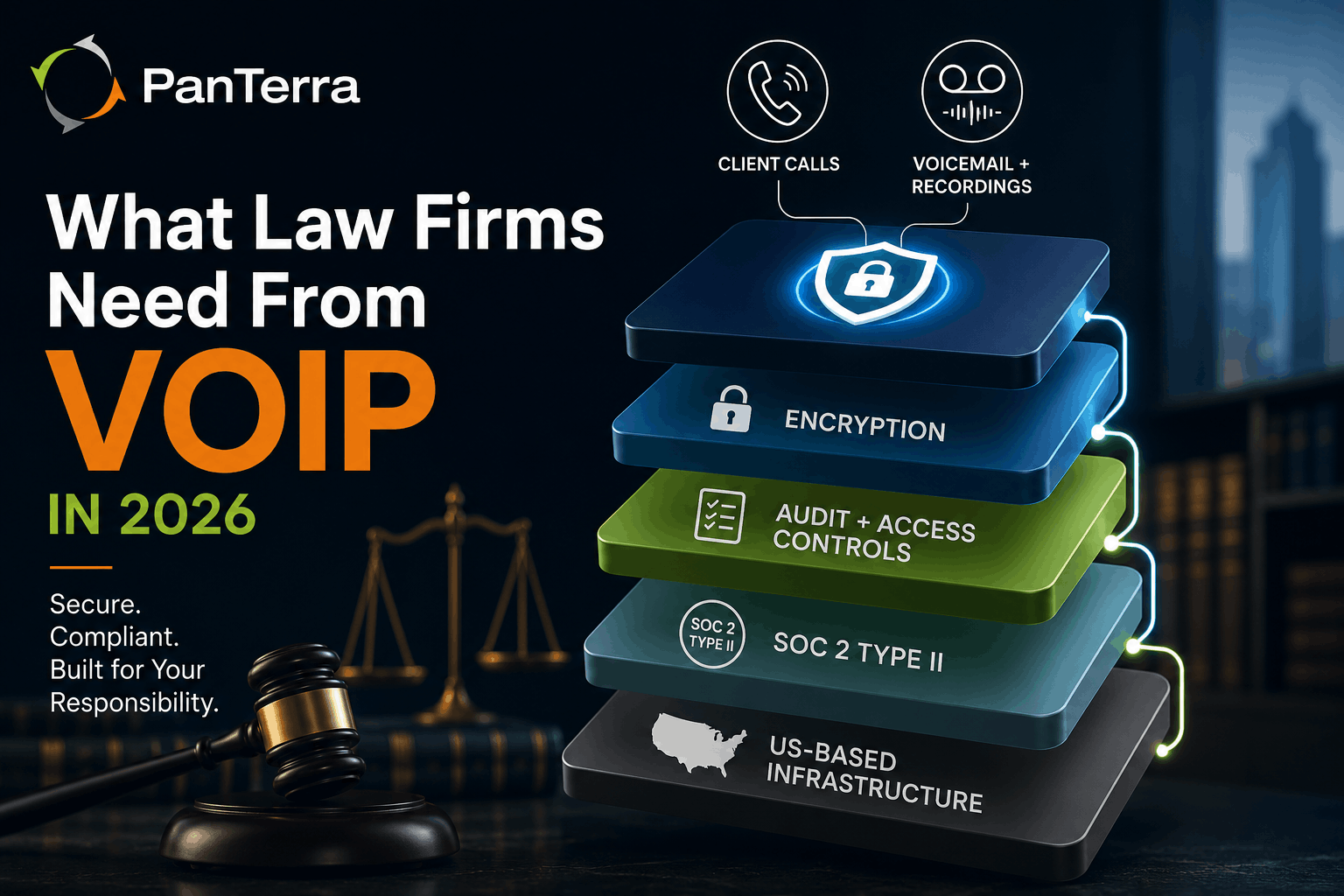
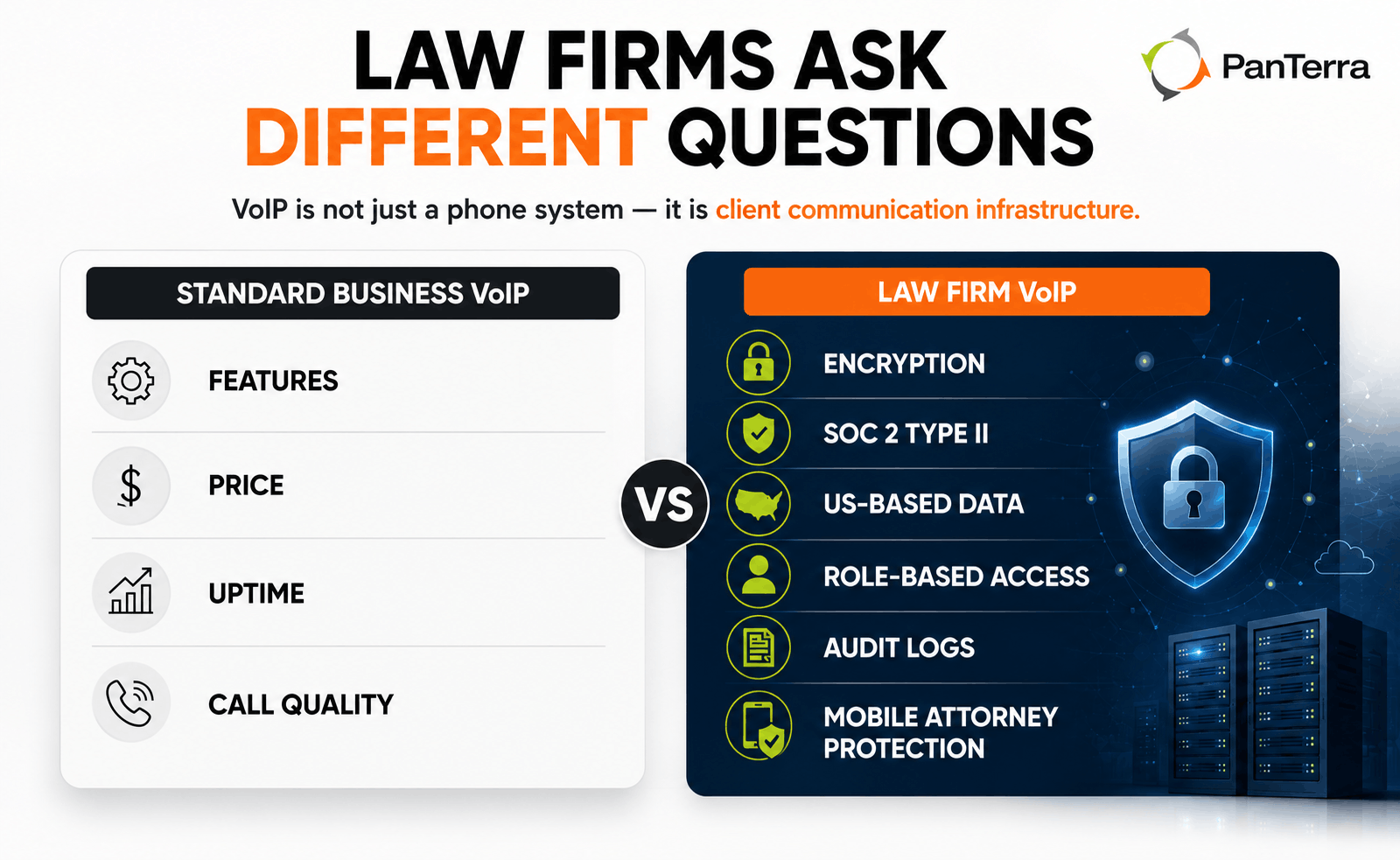
A standard business phone system evaluation asks: Does it have the features we need? Is the price right? What is the uptime SLA?
A law firm phone system evaluation asks all of that: and then asks a set of questions that most UCaaS vendors have never been asked before. Where does call data physically reside? Is voicemail content encrypted at rest? Can we produce audit logs of who accessed a recorded client call and when? Does this system create any exposure to attorney-client privilege claims?
Law firms are not just buying a communications tool. They are buying infrastructure that sits directly inside their professional responsibility obligations. ABA Model Rule 1.6 requires attorneys to make reasonable efforts to prevent the inadvertent or unauthorized disclosure of, or unauthorized access to, information relating to the representation of a client. The phone system is not peripheral to that obligation — it is one of its primary vectors.
This guide covers what that means for VoIP selection, what the relevant ethical rules actually require, and what to verify before deploying any UCaaS system in a legal environment.
TL;DR: Key Takeaways
- ABA Model Rule 1.6 requires reasonable efforts to prevent unauthorized disclosure of client information, including information communicated by phone, voicemail, call recordings, and transcripts.
- ABA Model Rule 1.1 Comment 8 makes technology competence an ethical duty. As of 2026, 40+ states have adopted this standard. An attorney who does not understand the security posture of the phone system handling client communications may be violating this rule.
- The confidentiality duty covers all information learned during the representation: broader than attorney-client privilege, which applies only in litigation and discovery contexts.
- Four non-negotiable technical requirements: end-to-end encryption (TLS for signaling, SRTP for call audio), SOC 2 Type II certification, data location transparency (US-based servers), and role based access controls with audit logging.
- Law firms handling healthcare-related matters (personal injury, workers' comp, healthcare law) may also be subject to HIPAA for certain communications.
- Mobile attorneys calling clients from courthouses or remote locations expose personal cell numbers without a proper UCaaS system, creating both a professionalism problem and a confidentiality risk.
- PanTerra Streams.AI is SOC 2 Type II certified, encrypts all communications in transit and at rest, operates on US-based Tier 4 infrastructure, and includes call recording with full audit logging on all plans.
Who This Is For
- Best for: Managing partners, firm administrators, and legal IT directors at law firms of any size evaluating or upgrading a business phone system — particularly firms with multi-location footprints, remote attorneys, or matters involving regulated information (healthcare, financial services, government).
- Not ideal for: Solo practitioners on consumer-grade systems with no call recording, no voicemail storage, and no remote client communication. The privilege exposure profile is different at that scale.
- Top use case: Selecting a UCaaS platform that satisfies the firm's ABA Rule 1.6 reasonable safeguards obligation while providing the call quality, mobile access, and multi-site management capabilities law firm operations actually need.
What ABA Rules Actually Require From a Phone System
Most law firm technology decisions reference ABA Model Rule 1.6 without reading it carefully. The rule does not require perfect security. It requires reasonable efforts — and what counts as reasonable has been materially clarified by ABA guidance, state ethics opinions, and the technology competence amendment to Rule 1.1.
ABA Model Rule 1.6: Confidentiality of Information. The rule requires attorneys to make reasonable efforts to prevent the inadvertent or unauthorized disclosure of, or unauthorized access to, information relating to the representation of a client. The scope of “information relating to the representation” is deliberately broad: it covers not just privileged attorney-client communications but all information learned during the professional relationship, regardless of source. For a phone system, this means any call that touches client matters is subject to reasonable safeguard requirements, including calls, voicemails, call recordings, and AI-generated transcriptions.
ABA Model Rule 1.1 Comment 8: Technology Competence. In 2012, the ABA amended the competence rule to add that providing competent representation includes keeping abreast of the “benefits and risks associated with relevant technology.”
As of 2026, 40+ states have adopted Comment 8 or an equivalent, making technology competence an enforceable ethical standard in nearly every jurisdiction. An attorney who does not understand the security posture of the cloud phone system handling client communications is not merely making a poor IT decision. That attorney may be violating Rule 1.1.
The confidentiality duty is broader than privilege. Attorney-client privilege is an evidentiary protection that applies in litigation and discovery contexts: it protects certain communications from compelled disclosure. The Rule 1.6 confidentiality duty is broader: it applies to all information relating to the representation, in all contexts, whether or not the information would technically qualify as privileged. A call recording that is not privileged in the evidentiary sense is still subject to the confidentiality obligation if it relates to a client matter.
The Four Non-Negotiable Technical Requirements
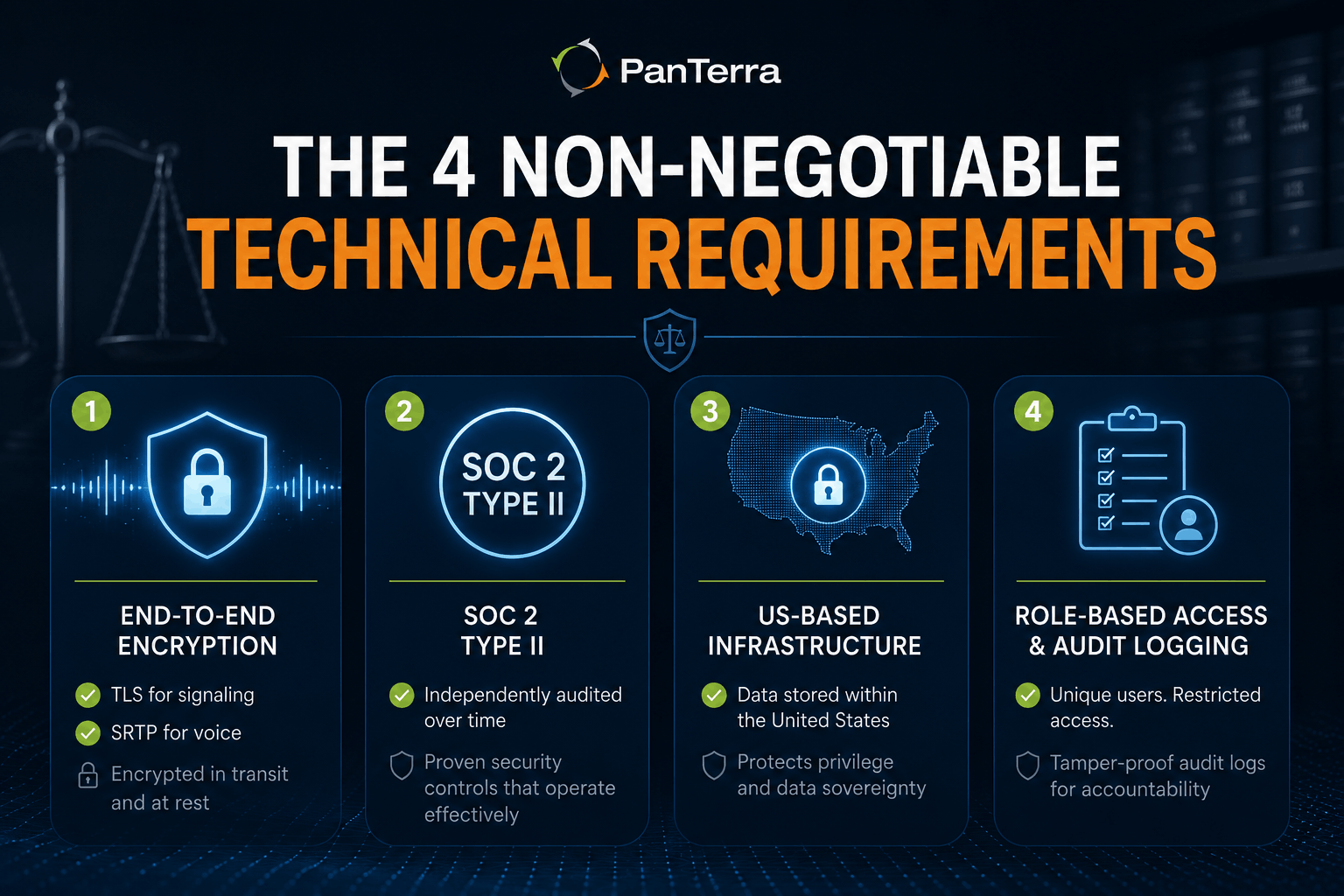
Based on the ABA guidance on technology competence and the professional responsibility requirements of Rule 1.6, four technical capabilities must be present in any VoIP system a law firm deploys.
1. End-to-End Encryption for All Communications
Encryption must cover both layers of the call:
- TLS (Transport Layer Security): encrypts the signaling layer — the call setup and control messages
- SRTP (Secure Real-Time Transport Protocol): encrypts the actual voice packets, the audio content of the call
A system using TLS for signaling but not SRTP for call audio is only partially encrypted. The call content itself travels unprotected. For law firms, this means the actual attorney-client conversation may be interceptable in transit. Encryption at rest is equally important: voicemails, call recordings, transcripts, and messages stored on the platform must be encrypted in storage. Ask any prospective provider specifically what encryption standard they use for stored voice content.
2. SOC 2 Type II Certification
SOC 2 Type II is the independent audit standard that verifies how a service provider manages and protects customer data over a sustained period, typically six to twelve months. Unlike SOC 2 Type I (which evaluates controls at a single point in time), Type II evaluates whether those controls actually operated effectively over time. For law firms evaluating cloud phone systems, SOC 2 Type II provides independent verification that the provider's security controls have been tested by an outside auditor: not self-reported.
3. Data Location Transparency and US-Based Infrastructure
The location of the servers storing call data affects which legal frameworks govern access to that data. Cloud data stored outside the United States may be subject to foreign government access requests and jurisdictions where attorney-client privilege may not be recognized in the same way.
For domestic law firms, the relevant question is: can the provider specifically identify where call recordings, voicemails, and transcripts are stored, and confirm that location is within the United States? A provider that cannot answer this question, or whose infrastructure runs on shared hyperscaler cloud services with global data distribution, cannot provide the data sovereignty assurance law firm clients may require.
4. Role-Based Access Controls and Audit Logging
ABA guidance and the reasonable efforts standard of Rule 1.6 together require that access to client communications data is controlled and documented:
- Each user must have a unique login (no shared credentials)
- Access to call recordings and voicemails must be restricted through role based controls
- The system must log who accessed which recording or voicemail, and when
- Audit logs must be tamper proof and exportable for compliance review
Audit logging becomes directly relevant when privilege disputes arise, when a firm faces a bar complaint, or when a client questions whether their communications were properly protected.
The Mobile Attorney Problem
Remote hearings, hybrid depositions, and virtual client meetings are now standard in legal practice. So is the scenario where a junior associate calls a client from the courthouse steps using their personal cell phone because the call is pressing.
The personal number exposure problem. The client now has the associate's personal cell number in their call history. The client may use it to contact the associate directly, bypassing the firm's intake system and the matter's assigned attorney. The associate's personal number cannot be monitored, recorded, or managed by the firm for matter documentation purposes.
The confidentiality exposure problem. The personal cell phone is not subject to any of the firm's security controls. Call recordings are not available for matter documentation. If the associate leaves the firm, the call history goes with them.
A properly deployed UCaaS platform solves both problems with the mobile softphone application. When an associate calls a client from the firm's Streams.AI mobile app, the outbound caller ID displays the firm's number, not the personal cell. The call travels through the firm's encrypted communications infrastructure. The associate's personal number remains private. For multi-location and remote-attorney firms, this is a risk management and privilege protection requirement.
Additional Compliance Considerations for Specific Practice Areas
Healthcare law, personal injury, and workers' compensation. Law firms that handle matters involving protected health information (PHI) may be subject to HIPAA as a Business Associate if they receive PHI from covered entities in the course of legal representation. A UCaaS platform used for healthcare-related legal matters should be HIPAA compliant with a Business Associate Agreement available. Our complete guide to HIPAA-compliant VoIP covers the full compliance framework.
Financial services regulatory work. Law firms handling matters subject to FINRA, SEC, or banking regulations for institutional clients may have communication recordkeeping requirements beyond Rule 1.6 that apply to how client conversations are documented.
Multi-state practices. Technology competence standards under Rule 1.1 Comment 8 and state ethics opinions on cloud storage vary by jurisdiction. The ABA framework is a baseline; state bar ethics opinions may impose additional or different requirements.
The Cybersecurity Risk Profile of Law Firms
Law firms are explicitly high-value targets for cyberattacks. Cybercriminals target law firms because they hold confidential financial data, medical records, intellectual property, and case strategy files.
Law firms also face high-stakes time pressure that ransomware exploits: a litigation firm cannot pause mid-trial while systems are restored, and a criminal defense firm faces constitutional speedy trial obligations that create additional leverage.
The average ransomware demand targeting professional services firms exceeded $1.2 million in 2025. The average cost of a professional services breach exceeds $4.7 million. The phone system is a potential attack vector: call recordings can be accessed if the platform is compromised, VoIP credentials can be used for fraudulent calls, and call metadata can be used in social engineering attacks. A law firm's phone system vendor has access to communications that could compromise client privilege if breached, which makes the vendor's security certifications a due diligence question, not a nice-to-have.
VoIP for Law Firms: Questions to Ask Any UCaaS Vendor Before Deploying
Before signing any UCaaS contract for a law firm deployment, get written answers to these questions.
Encryption
- What encryption protocol do you use for voice call signaling?
- What protocol for call audio in transit?
- How are voicemails, call recordings, and transcripts encrypted at rest?
- What encryption standard applies to messages and file transfers?
Data Location
- Where, specifically, are call recordings and voicemails stored?
- Are those servers located in the United States?
- Can you provide documentation of data residency?
Access Controls
- Does the system require unique user IDs for every individual?
- Can we configure role based access to call recordings and voicemail?
- How do we revoke access when an attorney or staff member departs?
Audit Logging
- What call access logs does the system maintain?
- Who accessed which recording, and when? How long are logs retained?
- Can we export logs for compliance review? Are logs tamper proof?
Security Certifications and Breach Response
- Are you SOC 2 Type II certified? When was the last audit?
- What is your breach notification timeline and process?
- Do any third parties have access to call recording or voicemail content? Are those parties also SOC 2 certified?
How PanTerra Streams.AI Addresses Law Firm Requirements
PanTerra's Streams.AI platform addresses the core requirements that distinguish law firm UCaaS evaluation from standard business phone selection.
Encryption: TLS for call signaling, SRTP for call audio in transit. All stored content: voicemails, call recordings, messages, and file transfers, encrypted at rest using AES-256.
Infrastructure: PanTerra builds and operates its own proprietary Tier 4 US data center infrastructure. All call data resides in US-based facilities. No hyperscaler cloud dependency.
SOC 2 Type II: Certified. Independent audits verify PanTerra's security controls against the framework most relevant to law firm vendor due diligence.
Access controls: Role based access controls for all users. Unique user IDs required. Immediate access revocation when personnel depart. Full access logging for call recordings and voicemails.
Mobile application: The Streams.AI mobile app routes all attorney calls through the firm's UCaaS infrastructure, displaying the firm's number as caller ID. Personal cell numbers remain private.
Uptime: 99.999% SLA backed by Tier 4 infrastructure. For law firms with active litigation or arbitration deadlines, communication downtime is a professional responsibility concern.
HIPAA/HITECH: Certified across all channels for firms handling healthcare-related matters, with a BAA included at no additional cost. See our HIPAA compliant VoIP guide for the full compliance framework.
Review PanTerra pricing for plan details. If your firm is migrating from an existing phone system, PanTerra's cloud migration team handles the transition at no additional cost.
Frequently Asked Questions
Does a law firm need a special phone system, or will any VoIP work?
Any VoIP system a law firm deploys must be evaluated against ABA Rule 1.6's reasonable efforts standard. A system lacking end-to-end encryption, US-based data storage, SOC 2 Type II certification, and role based access controls with audit logging would be difficult to defend as reasonable under that standard. Law firms do not necessarily need a system marketed specifically for legal use — they need a system whose security architecture can withstand the scrutiny of a bar ethics opinion or a privilege dispute.
What is the ABA's technology competence requirement?
ABA Model Rule 1.1 Comment 8, amended in 2012, requires that competent legal representation includes understanding the “benefits and risks associated with relevant technology.” As of 2026, 40+ states have adopted this standard or an equivalent, making it an enforceable ethical duty in most jurisdictions. For phone systems, this means attorneys should understand how calls are encrypted, where call data is stored, and who can access it. An attorney who cannot answer these questions about their own phone system may be at risk under Rule 1.1.
Can client calls be recorded legally by a law firm?
Yes, subject to jurisdiction-specific wiretapping laws and client disclosure requirements. Most U.S. states are one party consent states, meaning recording with the knowledge and consent of one party (typically the attorney) is lawful. A smaller number of states require all party consent. From a platform perspective, call recordings must be stored with the same encryption, access controls, and audit logging as any other client confidential material.
Are law firms subject to HIPAA?
Law firms are not Covered Entities under HIPAA, but may be Business Associates if they receive PHI from a Covered Entity in the course of providing legal services — common in personal injury, workers' comp, and healthcare law. When a law firm qualifies as a Business Associate, its communication systems handling PHI must meet HIPAA technical safeguard requirements. See our HIPAA compliant VoIP guide for what that means in practice.
What is SOC 2 Type II and why does it matter for law firm phone systems?
SOC 2 Type II is an independent audit standard that evaluates whether a service provider's security controls operated effectively over a sustained period, typically six to twelve months. Unlike self-reported security claims, SOC 2 Type II means an outside auditor has tested whether the controls actually work as described. For law firms, SOC 2 Type II certification is the primary verification mechanism when vetting a UCaaS vendor's security posture.
How does a UCaaS system protect attorney personal cell numbers?
A UCaaS platform with a mobile softphone application allows attorneys to make and receive calls through the firm's business number from their personal smartphones. The outbound caller ID displays the firm's number, not the personal cell. The personal cell number is never disclosed to clients, opposing counsel, courts, or any other call recipients. This protects personal privacy, maintains the firm's professional caller ID, and ensures all calls are subject to the firm's documentation and recording controls.
What happens to call recordings if an attorney leaves the firm?
In a properly configured UCaaS system, call recordings are stored on the platform under the firm's account, not the individual attorney's account. When an attorney departs, the administrator can immediately revoke that attorney's access while the recordings remain accessible to authorized firm personnel. The recordings are the firm's records, not the attorney's personal records. This is a significant operational risk with consumer-grade systems, where call records may live on a personal account that departs with the attorney.
Does PanTerra offer call recording for law firms?
PanTerra Streams.AI includes call recording on Business Plus plans and above. Recordings are encrypted at rest using AES-256 and stored on PanTerra's US-based Tier 4 infrastructure. Access is controlled by role based permissions configured by the firm administrator. A full audit log tracks who accessed which recording and when. See PanTerra pricing for plan details.
.jpg?width=500&height=500&name=Are%20you%20Getting%20a%20Good%20Deal%20(1).jpg)
Comments