Legacy PBX Replacement: The Questions to Answer Before You Pick a Path


Most organizations running a legacy PBX do not have a cutover problem. They have a path problem. They have not yet decided which of four replacement paths they are on, and they find out after the contract is signed, when the path has already been chosen for them by whoever sold them something.
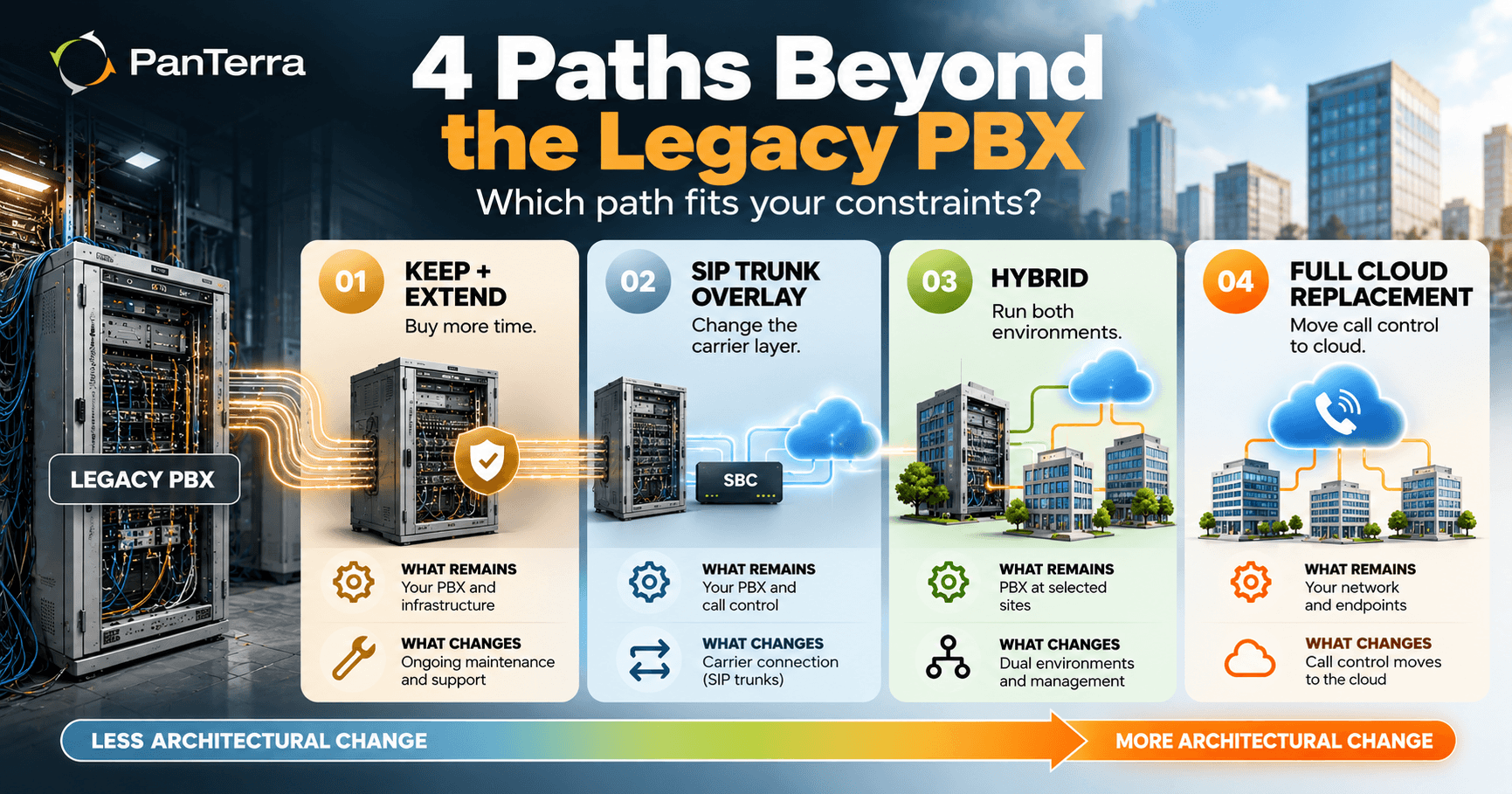
I have been in the room for a great many of those decisions, on both sides of the table. PBX replacement is not one decision. It is a choice among four paths, and the four are not equally
good for any given building, budget, or set of circuits. This article covers what each path actually commits you to, and the questions that settle which one fits.
It deliberately does not cover how to run the cutover itself. That is a separate problem. Once you have picked a path, our article on why "lift and shift" PBX migrations fail is where that conversation starts.
Key Takeaways
- There are four paths, not two: keep and extend, trunk overlay, hybrid, or full replacement.
- Compare costs beyond the first term. The lowest initial monthly rate does not always produce the lowest cost over the full period.
- A SIP trunk overlay changes how your calls reach the public network while the PBX stays in place. Any added capabilities depend on the PBX, the gateway, the software, and the scope of integration.
- Hybrid is a real answer for real constraints, and it costs you two of everything: two dial plans, two support paths, and two sets of expertise.
- The question that decides more projects than any other is what else is plugged into that PBX. Find out before you pick.
Who This Is For
- Best for: anyone who owns a legacy PBX and has been told it needs replacing, especially across more than one site.
- Not ideal for: organizations already on a cloud platform. This article is about what to do with hardware you still run.
Path 1: Keep the PBX and Extend Its Life
This is the path nobody puts in a proposal, and sometimes it is the right one.
What you are buying is time. If the hardware works, your organization can still support it, and nothing on the roadmap forces an immediate change, extending its life can be a legitimate decision rather than a failure to decide. It may also be easier to reverse than a migration, although the real cost of reversing depends on support contracts, carrier changes, and work already committed.
What you take on is a support risk that grows as the equipment ages. For discontinued systems, replacement parts, vendor support, and qualified technicians all become harder to find. Carrier network changes also create a dependency outside your control, so check the applicable carrier notices and service status for every address that still relies on legacy facilities.
What to ask a vendor proposing this path
A maintenance provider recommending an extension is selling you support. That is fine, as long as the terms are honest.
Good answer: the support status of your specific model, where replacement parts and expertise will come from, and who can support the system if the primary specialist is unavailable.
Warning answer: "The system has years left in it," with no date attached, or a support contract that does not say what happens when a part cannot be found.
Path 2: Overlay SIP Trunks on the Existing PBX
This path replaces the carrier side and keeps the call control. The PBX stays, and the lines feeding it become SIP trunks, usually through a gateway or a session border controller that translates between the two.
It is popular because it is genuinely useful and because it is easy to sell. It typically reduces what you pay to carry calls, it moves you off circuits that are being retired, and it does not require anyone to learn a new phone system. Dial plans stay. Handsets stay. Training is unnecessary.
A trunk overlay keeps call control on your existing PBX. If your reasons for change include remote workers, reporting, or remote administration, verify whether the PBX, its software, the border controller, or the integrations can actually deliver them. Changing trunks alone does not add capabilities your call control system lacks. Include maintenance of the gateway or border controller in your evaluation.
This path can also become permanent by accident. Organizations add trunks as an interim step toward replacement, the savings arrive, the urgency fades, and four years later the interim step is still there with the same aging PBX behind it.
What to ask a vendor proposing this path
Good answer: which features of your current PBX will and will not work over SIP trunks, the model of the gateway or border controller and who maintains it, and an explicit statement that call control stays on your hardware.
Warning answer: a description of the overlay as "modernizing your phone system," or a monthly saving presented without any mention of the equipment being introduced.
Path 3: Hybrid, With the PBX Kept at Some Sites
In a hybrid design, most locations move to the cloud while one or a few keep the existing PBX. Organizations adopt this path because of constraints rather than preferences, and the constraints are usually real.
There are three legitimate reasons a hybrid design makes sense. One site has analog or specialized dependencies that are expensive or risky to move. One site still has time remaining on an equipment lease. Or one site relies on a capability the proposed replacement has not yet demonstrated for that workflow.
The cost is duplication, and it is larger than it looks on a diagram: two dial plans that have to agree with each other, two administrative interfaces, and two support relationships, with a seam between them where a problem can sit for a week while each side says the fault belongs to the other. The expertise problem from Path 1 does not go away, either. It simply applies to fewer sites, which makes it harder to justify keeping anyone trained.
Hybrid is also the path most often sold as temporary and most likely to become permanent. If you choose it, write down what would have to be true for the remaining PBX to come out, and who will review that. Otherwise the hybrid design becomes your architecture for good.
What to ask a vendor proposing this path
Good answer: how extension dialing works between the two environments, who owns the seam when a call crosses it, and what the remaining PBX does that the platform cannot.
Warning answer: treating hybrid as a phase rather than a design, or being unable to say where a fault that crosses both environments gets reported.
Path 4: Full Replacement With a Cloud Platform
The PBX comes out. Call control moves to a platform someone else operates, reached over your network.
A cloud replacement changes your equipment, your administration, your capacity, and where some of the responsibility for resilience sits. Both cloud and premises designs depend on the network. A PBX on site may keep internal calls working during an internet outage, while external calls over SIP still depend on connectivity. Test the actual internal and external calling paths, and the recovery options, at each site.
The honest case for this path is not that it costs less. Sometimes it does and sometimes it does not. The case is that it removes one category of problem, hardware you own aging in a closet, and replaces it with another: a service relationship you have to manage. Whether that is a good trade depends on which kind of problem your organization handles better. In my experience, most organizations with more than a few sites are better at managing a relationship than at maintaining aging hardware, but you should make that judgment honestly for your own team.
What to ask a vendor proposing this path
Good answer: what the platform needs from your network at each site, what happens to calls when a site loses connectivity, and which of your current PBX features have a direct equivalent and which do not.
Warning answer: a general promise of "full functionality" in response to the feature question, or treating the network requirements as something to assess after signing.
The Question That Decides More Projects Than the Path Does
Before you choose, find out what else is plugged into that PBX.
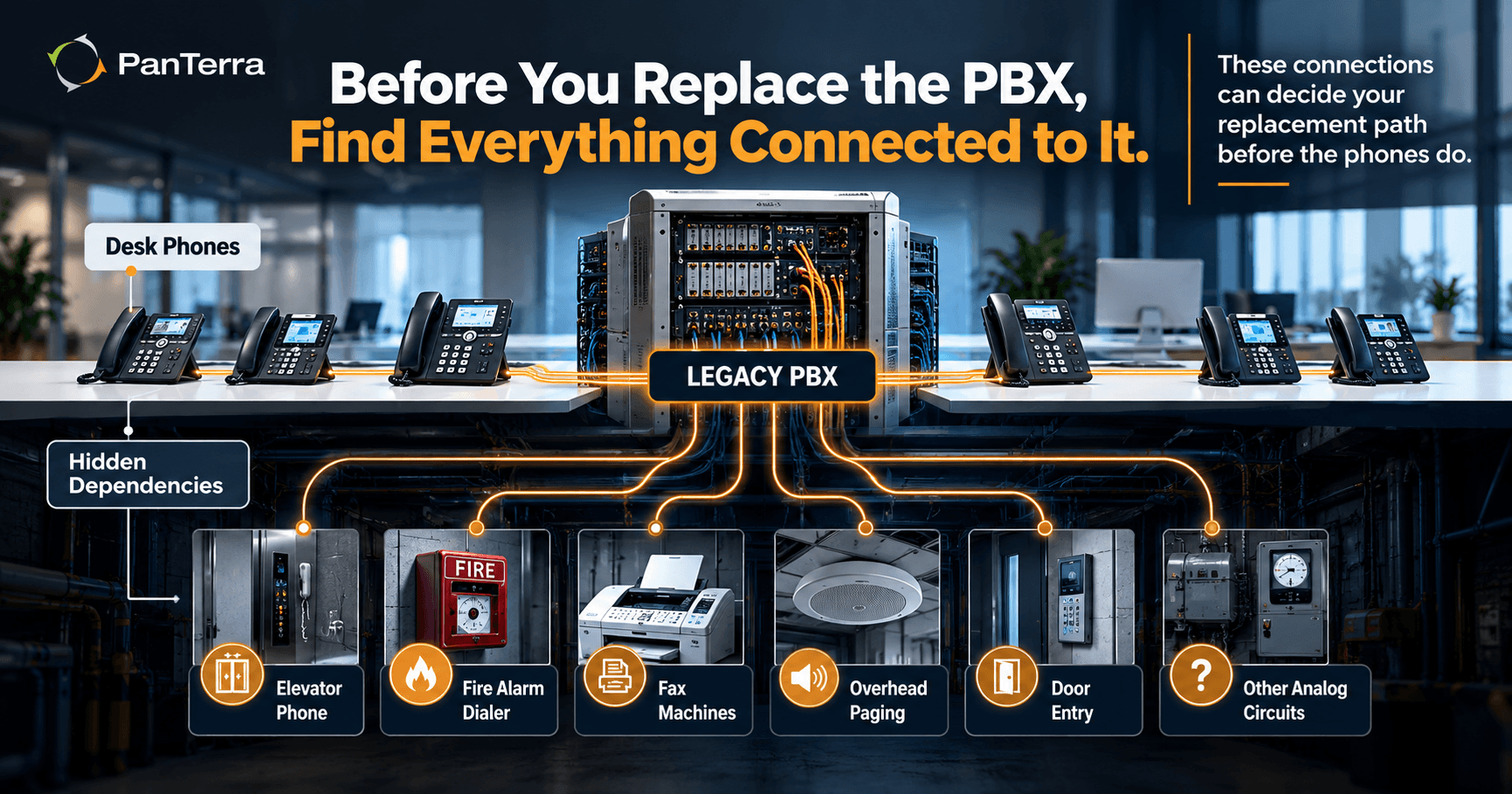
Inventory every circuit with a special purpose: elevator phones, fire alarm communicators, fax machines, paging, door entry, and devices tied to building systems. Some may use analog ports on the PBX, while others run on separate carrier lines. Do not assume they all sit behind the PBX or are already within the scope of the project.
These circuits matter because they can change the path entirely. A site with many analog or life safety dependencies needs a documented answer for each circuit before a full replacement is approved. That may favor a hybrid design, a separate workstream for analog replacement, or another staged approach, depending on the equipment and local requirements.
Do two things about it, in this order. First, walk the building and inventory every analog port in use, what is connected at the other end, and who owns that system. Second, settle how those circuits will be served under each path you are considering. That question has real options and real tradeoffs, covered in our guide to comparing POTS replacement offers and in the broader picture of what copper retirement means for buildings.
An inventory done in the first week changes which path you pick. The same inventory done after signing is why projects stall.
The Questions That Apply to Every Path
There are five, regardless of which direction you lean.
- What is still physically connected to the PBX, and who owns each of those systems? This was covered above, and it comes first for a reason.
- What does this cost over three years, not one? Include equipment, support, carrier charges, licenses, and the internal time each path consumes. Ask every vendor to present costs over the same three years, in the same format, so the comparison is real. Current plan details are on the PanTerra pricing page.
- Who in our organization can administer this on the second day? Not the vendor. You. If the answer is one person on any path, that is a finding about the path.
- What does this path commit us to, and what would it cost to reverse? Extending, a trunk overlay, a hybrid design, and full replacement each create different switching costs. Ask for the contractual, technical, and operational steps required to change direction later, rather than accepting a label that any path is simply reversible or irreversible.
- Which features are we actually trying to gain? Write them down before the demonstrations begin. Plenty of PBX replacement projects are justified by capabilities nobody recorded, which means nobody can tell afterward whether the project delivered them.
Ask all five of every vendor, including us. I would rather lose a deal to an honest comparison than win one that falls apart in the second year.
Frequently Asked Questions
What is PBX replacement?
PBX replacement is the decision about what to do with a private branch exchange, the hardware on your premises that switches your organization's calls, when it reaches the end of its useful life. There are four paths: extend the existing hardware, keep it and move the carrier side to SIP trunks, keep it at some sites in a hybrid arrangement, or remove it and move call control to a cloud platform.
Is replacing a PBX the same as a PBX migration?
Not quite, and the distinction is useful. PBX replacement is the choice of path. PBX migration is what you do once the path is chosen: moving numbers, extensions, routing, and users onto the new arrangement. Choosing the path is a procurement question. Executing it is an implementation question, and the two involve different people.
Can you keep an existing PBX and still get modern features?
Only some of them. SIP trunks change how calls reach the PBX, but call control stays on the existing system. New capabilities may require new PBX software, gateways, integrations, or replacement, depending on the model. Do not assume that changing trunks alone adds features your current call control system does not support.
What usually gets missed in a PBX replacement project?
Analog circuits and circuits with a special purpose are easy to miss: elevator phones, fire alarm communicators, fax lines, overhead paging, door entry, and devices tied to building systems may be connected through analog ports or separate carrier lines. Inventory them before choosing a path, because they can change the design of the migration entirely.
How do you compare quotes for different replacement paths?
Compare the same cost categories over the same period across every proposal: equipment, support, carrier charges, licenses, implementation, and internal work. Include at least one renewal or hardware refresh where possible. A trunk overlay keeps the costs and dependencies of the PBX, but whether it costs more or less overall depends on the actual quotes and the period you are planning for.

Comments