Omnichannel Contact Center: What It Means and How to Evaluate One


An omnichannel contact center handles customer conversations across voice, email, SMS, chat, and social in a way that treats them as one continuous conversation rather than separate tickets.
That last clause is the entire distinction, and it is the one most vendors blur. Supporting five channels is multichannel — common, and not particularly hard. Omnichannel means the customer who chats, calls an hour later, and texts the next day is recognized as the same person with the same open issue at every step.
TL;DR
Most platforms marketed as omnichannel are multichannel with a shared inbox. The difference is whether channels share one customer record, one interaction history, and one routing engine. You can separate them in about ten minutes of a demo using the Continuity Test below. Beyond that, the evaluation should cover which channels you actually need, how routing works across them, how compliance applies per channel, and — for Microsoft organizations — how the platform fits the environment agents already work in.
Key Takeaways
- Multichannel means you can be reached five ways. Omnichannel means the five ways know about each other.
- Run the Continuity Test live in a demo. It cannot be faked on a slide and it eliminates a surprising share of the market.
- More channels is not better. Every channel you enable is one you must staff, monitor, and maintain a standard on.
- Compliance requirements apply per channel. A platform that satisfies them on voice alone has not satisfied them.
- Microsoft Teams belongs in the evaluation as a platform integration and agent workflow environment — not as a channel alongside voice and SMS.
- Per-channel metrics stop telling the truth once channels are connected. Measure resolution, not contacts.
Who This Is For
Best for: teams shortlisting contact center platforms · organizations whose customers already reach them on several channels informally · anyone who has been told a platform is omnichannel and wants to verify it.
Not ideal for: single-channel voice operations with no plans to add channels · teams looking for implementation guidance rather than selection criteria.
Top use cases: vendor demos and shortlisting · writing evaluation criteria · diagnosing why a current platform feels disconnected.
What Is the Difference Between Multichannel and Omnichannel?
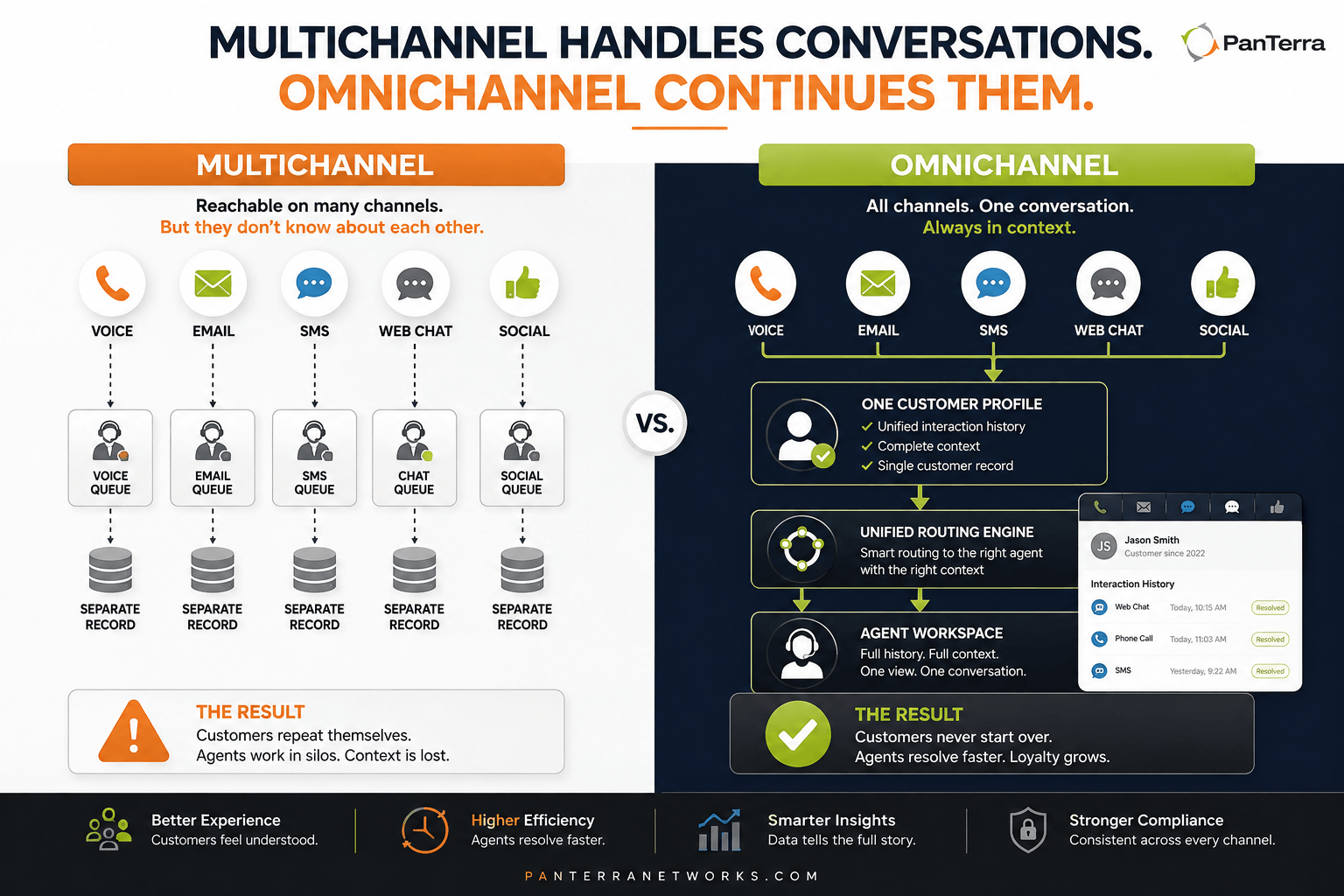
Multichannel means the contact center can receive contacts on several channels. Each channel has its own queue, its own agents, sometimes its own software, and its own record. The customer can reach you five ways. The five ways do not know about each other.
Omnichannel means channels share one customer record, one interaction history, and usually one routing engine. A contact is not a ticket in a channel; it is an event in an ongoing relationship.
The symptom of a multichannel setup pretending otherwise is familiar to anyone who has been a customer: you explain your situation on chat, get told to call, and explain it again from the beginning. The agent is not being unhelpful. They cannot see it.
How Do You Test Whether a Platform Is Genuinely Omnichannel? The Continuity Test
Ask a vendor to demonstrate this exact sequence, live. Not on a slide.
☐ Step 1. A customer starts a chat describing an issue. The chat ends unresolved.
☐ Step 2. The same customer calls, from the number on their account, twenty minutes later.
☐ Step 3. Watch the agent's screen when the call connects:
- ☐ Is the customer identified automatically, or does the agent ask for details the system already has?
- ☐ Is the chat transcript visible without searching — on the screen the agent is already looking at?
- ☐ Does the issue carry a status, with what was already tried visible?
☐ Step 4. Have the agent resolve it, then have the customer send an SMS the next day referencing the same problem:
- ☐ Does the SMS land with the same history attached?
- ☐ Does it route to the same agent or team, or start a new queue entry with no context?
A platform passing all five points is genuinely omnichannel. One passing two or three is multichannel with good reporting — which may still be the right purchase, but you should know which you are buying and price it accordingly.
Which Channels Do You Actually Need?
More channels is not better. Every channel you enable is a channel you have to staff, monitor, and maintain a quality standard on.
Look at where customers already contact you, including routes you never formalized — a mobile number receiving texts, a social account someone checks occasionally, a personal email that became a support address.
Then ask two questions of each candidate:
Does it match how customers want to reach us for this kind of issue? Urgent and complex favors voice. Simple and asynchronous favors messaging. Documentation-heavy favors email.
Can we staff it to a standard we would be proud of? An abandoned chat widget or unanswered social channel does more damage than not offering it. Half-supported channels are worse than absent ones.
How Does Routing Work Across Channels?
This is where omnichannel gets operationally difficult, and where evaluations should spend their time.
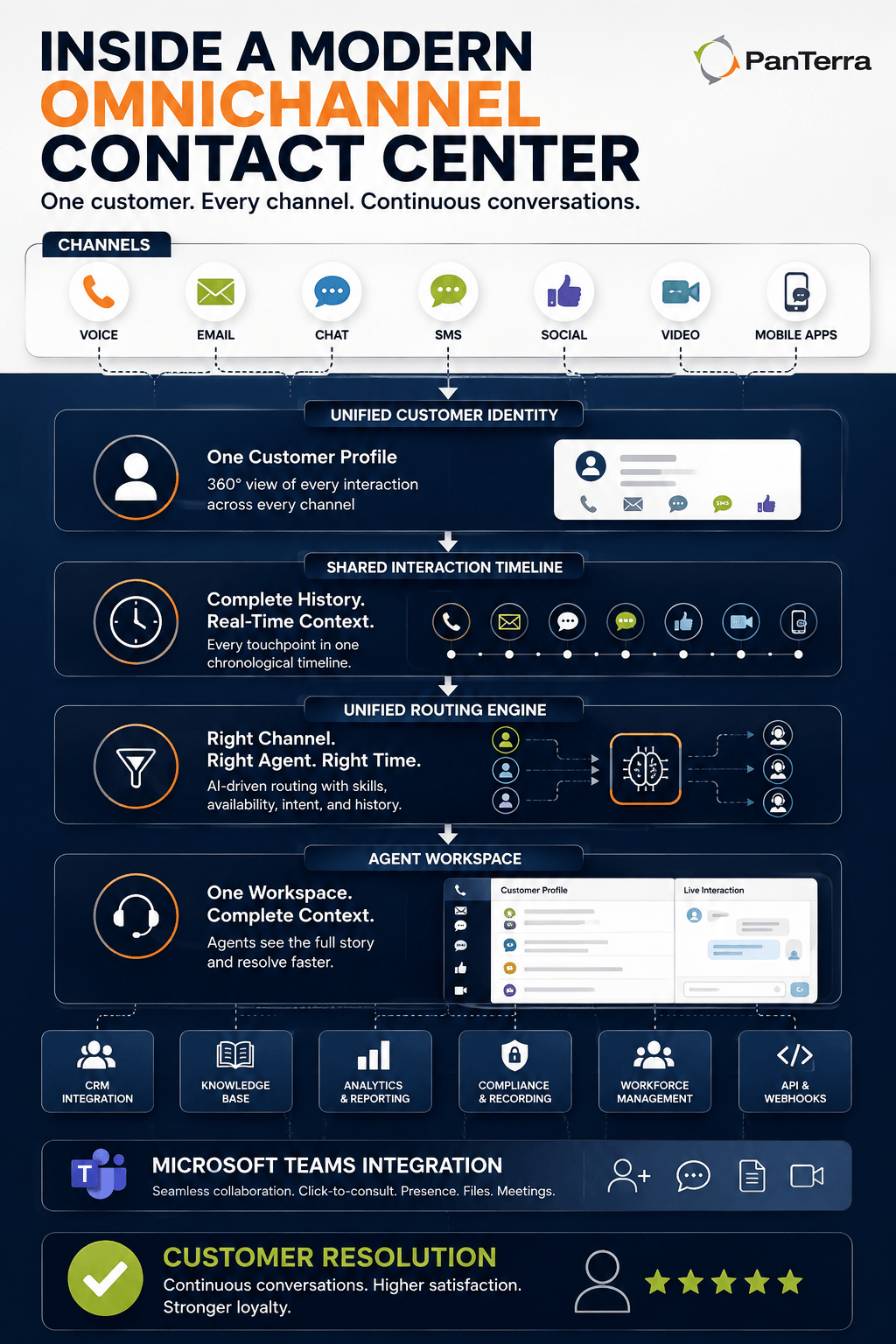
Unified queueing. Contacts from all channels enter one routing engine rather than separate per-channel queues. Without this, voice backs up while chat agents sit idle.
Concurrency rules by channel. An agent handles several chats simultaneously and exactly one call. The platform needs to understand this rather than treating every contact as equivalent load. Ask how concurrency is configured and whether it differs by agent.
Channel switching mid-conversation. Can an agent move a customer from chat to voice without losing the thread? This happens constantly in practice, and platforms handle it very differently.
Priority across channels. Whether a high-value customer's email can outrank a routine call, and how that is configured.
What Should You Ask About Security, Compliance and Data Handling?
Omnichannel expands the surface area. Every channel is another place customer data lives, and the more channels you add the more places a requirement must be satisfied.
- Where is interaction data stored, and for how long? Retention should be configurable and applied consistently across channels.
- Are recordings and transcripts encrypted at rest and in transit? Ask about both, and which channels are covered.
- Who inside your organization can access what? Role-based access should extend to interaction history, not just platform settings.
- Can data be redacted or deleted on request? Increasingly a legal requirement, and difficult to retrofit.
- If you are in healthcare, does the provider sign a Business Associate Agreement covering every channel you plan to use? A BAA covering voice while your team texts patients leaves the channel you use most casually uncovered. Ask whether it is included in the plan or gated behind a tier or separate process — that answer varies more between providers than you would expect.
Financial services, legal, and education have their own equivalents. The principle holds: compliance applies per channel, and a platform satisfying it on voice alone has not satisfied it.
How Should Microsoft Teams Fit Into This?
Teams is not a channel in the sense that voice, SMS, chat, email, and social are channels. Your customers are generally not contacting you through Teams.
Teams belongs under platform integrations and agent workflow — the environment your people work inside, rather than a route customers arrive through. That distinction changes what you ask for.
For an organization running on Microsoft, the relevant questions are:
- Can agents handle contact center work without leaving Teams, or do they run two applications side by side all day?
- Does presence stay consistent, so an agent on a contact center call shows as busy in Teams rather than available?
- Does calling and messaging work inside the Microsoft environment, and what specifically is required to make that work?
- When Teams has a service problem, what happens to customer calls?
That last question is the one most evaluations miss. If customer-facing calling depends entirely on one platform being available, an outage stops being an internal inconvenience and becomes a customer-facing failure. Ask what continuity looks like and get a specific answer.
What Metrics Change in an Omnichannel Setup?
An issue that touched chat, voice, and SMS is one resolution and three contacts. Reporting that counts contacts will make a well-handled issue look like a failure — and will make your best-performing team look like your worst.
Measure resolution, not contacts. Track total resolutions across channels.
Track the customer journey, not the interaction. Time to resolution across the whole issue beats handle time on any single contact.
Watch channel switching as a signal. Customers repeatedly moving from chat to voice usually means chat is not resolving what it should — invisible in per-channel reporting.
Read first contact resolution carefully. In an omnichannel setup, FCR should be measured against the issue, not the channel.
This is where contact center analytics stops being a reporting function and becomes an operational one — the data only helps if it is assembled at the level of the customer's problem rather than the channel's queue.
What Does This Cost to Get Right?
The pricing question that matters is not the per-seat rate. It is which of these are included and which are add-ons.
Ask whether each channel is licensed separately, whether the unified customer record is standard or a premium tier, whether CRM and calendar integrations are included, and whether cross-channel analytics is part of the platform or a separate product. Platforms with attractive headline pricing frequently place the omnichannel part — the shared record — in a higher tier, which means the base price buys multichannel.
Frequently Asked Questions
What is an omnichannel contact center?
An omnichannel contact center handles customer conversations across voice, email, SMS, chat, and social while treating them as one continuous conversation — shared customer record, shared history, and usually one routing engine across all channels.
What is the difference between multichannel and omnichannel?
Multichannel means you can be reached on several channels, each with its own queue and record. Omnichannel means those channels share a customer record and history, so a customer who switches channels does not start over.
How can I tell if a platform is really omnichannel?
Run the Continuity Test: start a chat, then call from the same account twenty minutes later and watch the agent's screen. If the customer is not identified automatically and the chat transcript is not visible without searching, it is multichannel.
How many channels should a contact center offer?
Only the ones you can staff to a standard you would be proud of. An abandoned chat widget or unanswered social account damages the experience more than not offering that channel at all.
Does omnichannel change how we measure performance?
Yes. Per-channel metrics mislead once channels are connected. Measure resolutions rather than contacts, track time to resolution across the whole issue, and treat repeated channel switching as a signal that one channel is underperforming.
Is Microsoft Teams a contact center channel?
Not usually — customers rarely contact you through Teams. Teams belongs in an evaluation as a platform integration and agent workflow environment, which matters for organizations whose staff already work inside Microsoft all day.
.jpg?width=500&height=500&name=Are%20you%20Getting%20a%20Good%20Deal%20(1).jpg)
Comments