Why Business Communication Stack Costs Are Draining Your Budget


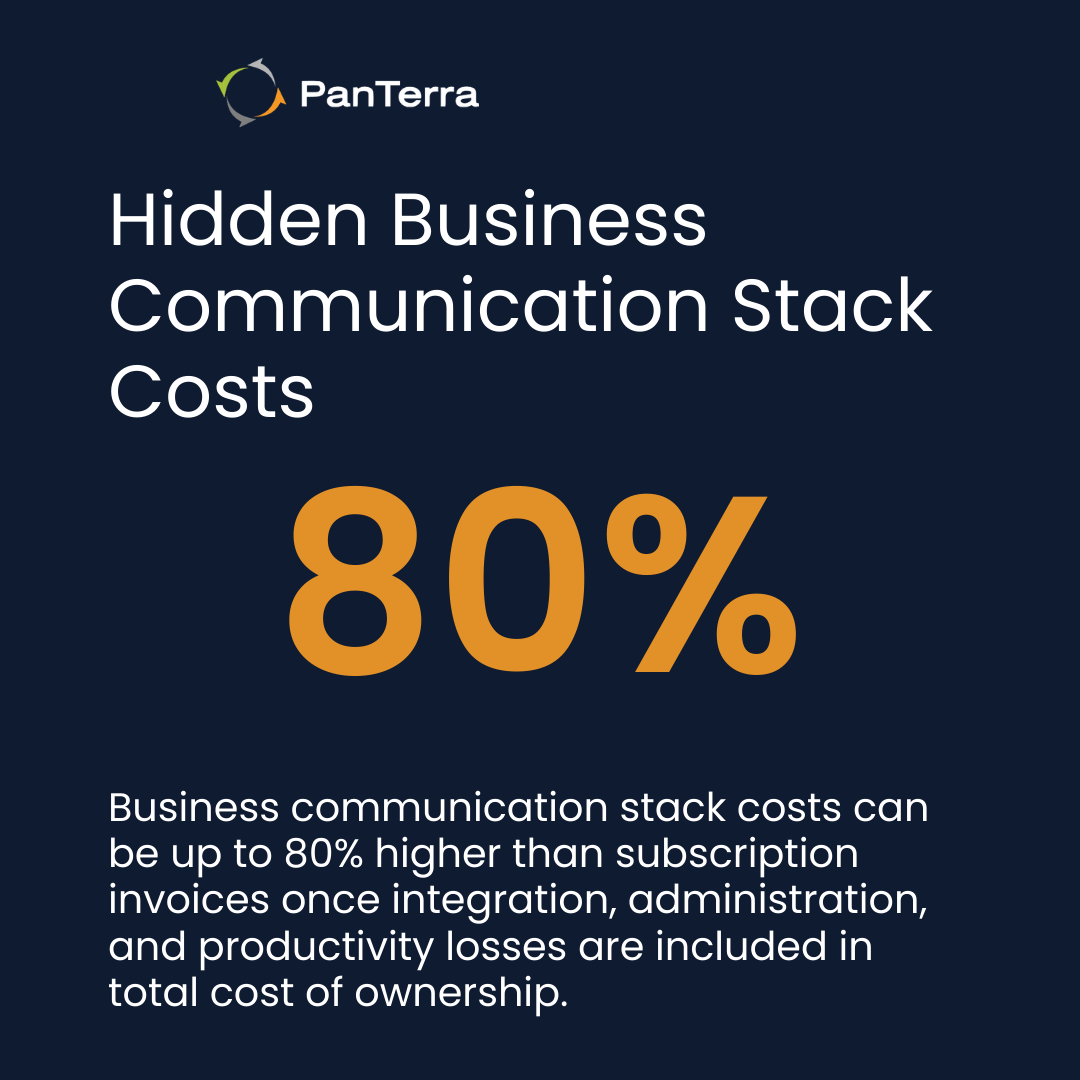
Every month, your finance team reviews communication platform invoices—Slack, Zoom, Microsoft Teams, maybe a phone system provider. The line items look reasonable. But those invoices don't tell the whole story. Behind each subscription sits a web of hidden expenses: middleware connecting disconnected tools, IT staff managing multiple dashboards, employees wasting 30 minutes daily switching between platforms. What appears as $60 per user per month on paper costs closer to $150 when you account for integration tax, administrative overhead, and productivity loss. Business communication stack costs extend far beyond subscription fees, creating total cost of ownership that catches organizations off guard.;
Business communication stack costs include direct subscriptions ($45-200/user/month across 3-4 platforms), integration expenses ($5-20/user/month for middleware and API maintenance), administrative overhead ($10-30/user/month from multi-platform management), and productivity loss ($15-40/user/month from context switching)—totaling $75-290/user/month actual TCO, 30-80% higher than invoice costs alone.
Key Takeaways
- Total communication platform costs exceed invoiced subscriptions by 30-80% due to hidden expenses
- Integration tax from middleware, APIs, and custom connectors compounds as platform count increases
- Context switching wastes 15-30 minutes daily per employee, costing $2,000-4,000 annually in lost productivity
- Licensing overlap creates 60-70% feature duplication when paying for capabilities across multiple tools
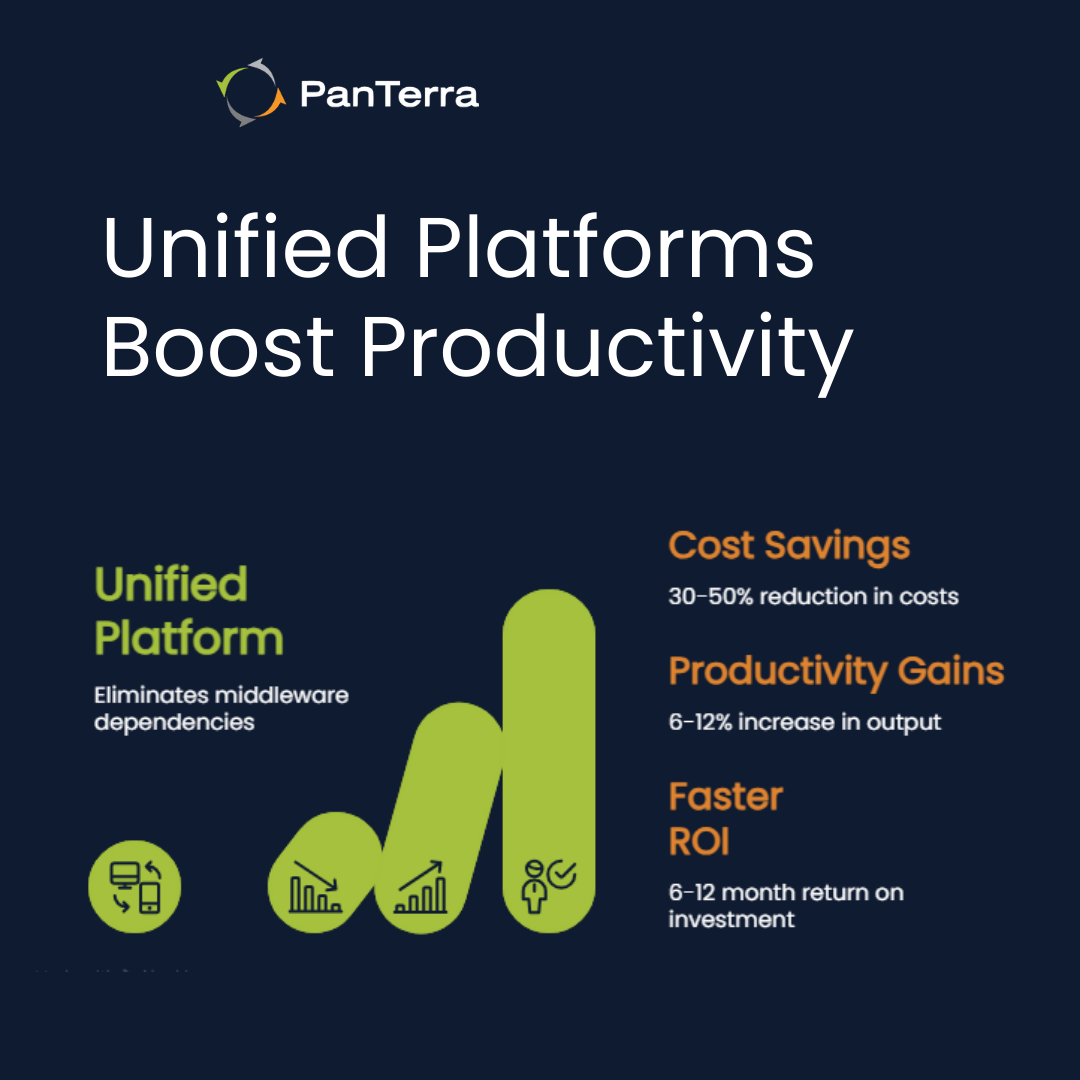
- Consolidation delivers 30-50% cost savings with 6-12 month ROI for organizations managing 3-4+ platforms
Who This Is For
- Best for: Mid-market and enterprise organizations managing 3-4+ communication platforms experiencing budget pressure, licensing complexity, or user complaints about tool confusion
- Not ideal for: Small businesses under 20 users with simple communication needs, or organizations with specialized workflows requiring industry-specific compliance tools
- Top use cases: IT leaders evaluating platform consolidation ROI, finance teams auditing communication technology spend, operations managers addressing productivity loss from fragmented tools
The True Cost of Managing Multiple Communication Platforms
Managing multiple communication platforms costs more than expected—but most organizations only see the subscription fees. The real expense hides in integration complexity, administrative burden, and countless small inefficiencies that compound daily. Business communication stack costs (also called communication platform TCO, tool sprawl expenses, or UCaaS fragmentation costs) include direct subscriptions, integration expenses, administrative overhead, and productivity loss.
Direct Costs Beyond Subscription Fees
Direct communication platform costs include per-user subscriptions ($15-50/user/month per tool across 3-4 platforms = $45-200/user/month total), overage charges for storage and call minutes beyond base plans, enterprise support contracts requiring 20-30% premium for SLA guarantees, and annual price escalation of 5-15% at renewal from multiple vendors simultaneously.
A 100-person organization paying $50 per user monthly across three platforms faces $5,000 in base subscriptions. Add enterprise support premiums ($1,000-1,500 monthly), storage overages ($200-400), and international calling charges ($150-300), and the monthly bill climbs to $6,850 before accounting for any integration or productivity costs. Annual price increases hit all three vendors simultaneously—a 10% increase across the board adds $6,000 yearly without adding a single new capability.
Hidden Integration Expenses
Integration expenses arise from middleware subscriptions ($30-600+/month for Zapier or Make), API maintenance requiring developer time when vendors change endpoints, custom connector development (8-40 hours per integration initially), and quarterly version compatibility testing to prevent breakage across 3-4 platforms—costs compounding as tool count increases.
When your video conferencing platform doesn't talk to your phone system, and neither integrates natively with your CRM, you turn to middleware. Zapier starts at $30 monthly but quickly scales to $200-600 as automation needs grow and task limits force tier upgrades. Custom connectors bring their own burden—connecting four platforms requires six bidirectional integrations minimum. At 20 hours average development time per connector, that's 120 hours of engineering work upfront, plus ongoing maintenance when vendors update APIs quarterly.
Administrative Overhead Across Platforms
Administrative overhead includes IT staff managing multiple dashboards (2-5 hours weekly per platform), credential management across systems (password resets, SSO configuration, MFA setup for each tool), user provisioning requiring separate accounts in 3-4 platforms for onboarding, and cross-vendor troubleshooting when issues span multiple systems without clear ownership.
Each platform has its own admin portal, security model, user hierarchy, and permission structure. When an employee joins, IT creates four accounts. When they leave, IT must remember to deactivate four accounts—and inevitably, one gets missed, creating security exposure. Troubleshooting multiplies the burden. "Video isn't working" could mean a Zoom configuration issue, network bandwidth problem, Teams calendar conflict, or browser compatibility gap. Research on enterprise platform complexity confirms that with no single vendor owning the full communication experience, diagnosis takes hours instead of minutes.
Licensing Overlap and Feature Redundancy
Hidden costs beyond monthly invoices stem from architectural inefficiency—paying multiple vendors for capabilities that overlap 60-70% while none delivers a complete solution. Licensing overlap occurs when organizations pay for duplicate capabilities across multiple platforms (video conferencing in 3 tools, messaging in 4 systems)—creating 60-70% feature redundancy multiplied across per-user subscriptions.
Paying for the Same Features Multiple Times
Feature redundancy occurs when organizations pay for video conferencing in Zoom ($15/user/month), Microsoft Teams (M365 $12.50+/user/month), and Google Meet ($12/user/month), messaging in Slack ($7.25+/user/month) and Teams, file sharing across Dropbox, Google Drive, and OneDrive—creating 60-70% capability overlap multiplied across 100+ users.
Consider a typical mid-market setup: Zoom for video because "the quality is better," Slack for messaging because "Teams feels clunky," Microsoft 365 because "we need Office apps," and a separate phone system. For 150 users, that's 450 video licenses, 450 messaging accounts, and 600 file storage subscriptions—all providing essentially the same core capabilities. Each "best of breed" decision adds another subscription, another login, another place to check for messages, and another layer of feature duplication that compounds total cost without proportionally increasing communication effectiveness.
The Middleware Subscription Trap
Middleware subscriptions start affordable ($30-50/month) but escalate as automation needs grow—task limits force tier upgrades ($200-600+/month), workflow dependencies create vendor lock-in, and integration counts multiply (connecting 4 platforms requires 6 bidirectional integrations minimum), driving recurring costs that exceed individual platform subscriptions.
Organizations adopt middleware thinking it's a temporary bridge. Two years later, they're dependent on 40+ Zaps automating everything from new user provisioning to meeting recording distribution. The Starter plan ($30/month) worked initially, but now they're on the Professional tier ($600/month) because workflows consume 50,000 tasks monthly. Canceling middleware would break dozens of business processes.
PanTerra's single-platform architecture eliminates middleware dependencies entirely by providing native integration across voice, video, messaging, and file sharing. When every communication capability runs on unified infrastructure, there's no middleware subscription, no integration task limits, and no recurring costs connecting disconnected tools.
Underutilized Licenses Draining Budget
Underutilized licenses accumulate when organizations maintain subscriptions for inactive users (departed employees, seasonal contractors), purchase higher feature tiers than needed (enterprise plans when standard suffices), face seasonal workforce fluctuations without flexible licensing, and lack usage visibility across 3-4 platforms to identify optimization opportunities—typically 15-30% waste.
License audits consistently reveal ghost accounts—former employees still consuming seats months after departure, contractors hired for three-month projects whose annual licenses renew automatically, users provisioned during rapid growth who never actually adopted the platform. Feature tier mismatches compound the waste. Teams purchase enterprise plans because one department needs advanced analytics, forcing every user onto the premium tier even when 80% need only basic features.
Productivity Loss from Fragmented Communication
Productivity loss from context switching represents the largest hidden cost category—harder to quantify than subscriptions but devastating when calculated across an entire workforce. Context switching cost is productivity loss (15-30 minutes daily per employee) from deciding which platform to use, switching between apps, and reconstructing fragmented conversations—equivalent to $2,000-4,000 annually per employee in lost output.
Context Switching Tax on Employee Time
Context switching costs organizations 15-30 minutes daily per employee from deciding which platform to use (Slack for quick questions, Teams for meetings, email for formal communication), physically switching between apps dozens of times daily, and reconstructing fragmented conversation threads across tools—equivalent to $2,000-4,000 annually in lost productivity per $50,000 employee.
Your sales team receives customer inquiries via email, coordinates internally through Slack, holds video calls in Zoom, and stores files in Google Drive. Every customer interaction requires four context switches minimum. Each switch takes 30-60 seconds for the app to load, plus 2-3 minutes to rebuild mental context. Research on operational efficiency research demonstrates that for a 100-person organization, 20 minutes daily per employee equals 33 hours of organizational capacity lost daily to communication infrastructure inefficiency.
Information Silos Slowing Decision-Making
Information silos emerge when conversation history splits across platforms (project decisions in Slack, meeting recordings in Zoom, specifications via email), files scatter across Google Drive, Dropbox, OneDrive, and email attachments, and institutional knowledge becomes trapped in platform-specific threads inaccessible after tool changes or contract expirations—delaying decisions requiring historical context.
Six months into a product development cycle, your team needs to understand why a specific technical decision was made. The conversation actually happened across all three platforms—initial discussion in Slack, technical deep-dive during a Zoom call, and final approval via email. Reconstructing that decision requires searching three platforms and watching a 45-minute recording to find a 5-minute segment. Organizations exploring unified business communication strategies recognize that when all communication lives in a single platform with unified search, finding historical context takes 30 seconds instead of 30 minutes.
Training Burden for New Employees
Multi-platform training requires 2-4 hours per tool (8-16 hours total for 4 platforms), delays new employee productivity to 2-3 weeks instead of 3-5 days with unified systems, increases help desk tickets by 30-50% from tool confusion, and requires maintaining separate documentation for each platform including version-specific updates.
New employee onboarding reveals the full scope of communication complexity. Day one includes Slack training, Zoom training, Teams training, and phone system training. Each platform has different interfaces, keyboard shortcuts, mobile apps, and unwritten norms about when to use which tool. Three weeks in, the new hire is still asking "Should I Slack this or email it?" and missing messages because they forgot to check one platform.
When Consolidation Makes Financial Sense
Managing multiple platforms costs more than expected, but consolidation isn't always the right answer. Understanding when fragmentation creates unacceptable cost versus when platform diversity serves legitimate business needs requires evaluating total cost of ownership against organizational context.
Calculating Your Total Cost of Ownership
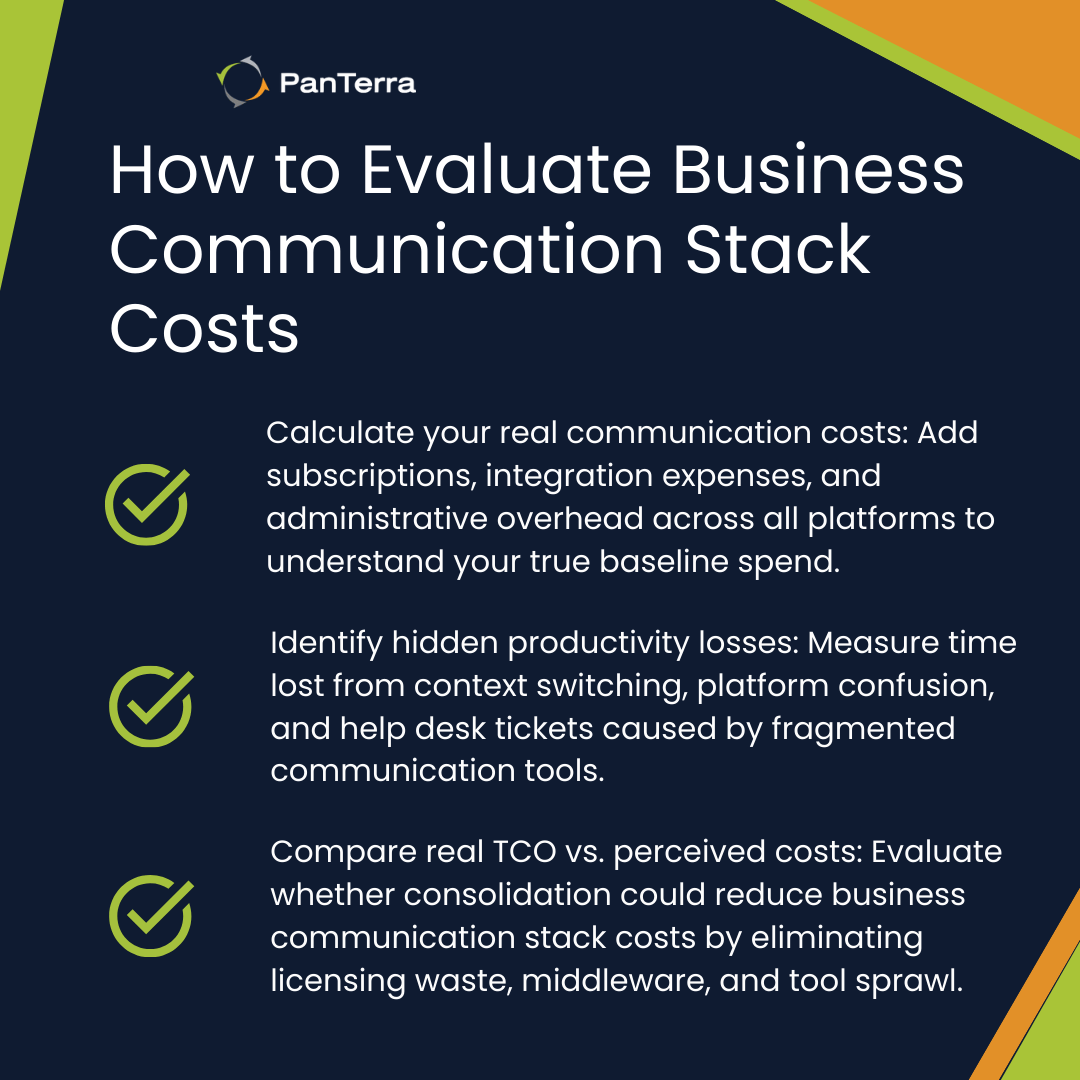
Total communication cost per user = (direct subscriptions $45-200/user/month + integration expenses $5-20/user/month + administrative overhead $10-30/user/month + productivity loss $15-40/user/month) ÷ user count = $75-290/user/month actual TCO versus $45-200 perceived cost from invoices—revealing 30-80% hidden expense premium from fragmentation.
Most organizations track subscription costs religiously but never calculate the full TCO. Start with your invoices: add every communication-related line item. Then add integration costs: middleware subscriptions, developer time maintaining custom connectors. Add administrative overhead: IT time managing platforms. Finally, estimate productivity loss: 20 minutes daily per employee × 20 working days × $0.40/minute (based on $50K salary).
For a hypothetical 100-person organization, the calculation reveals actual TCO of $160/user/month versus $80/user/month in invoiced subscriptions—a 100% hidden cost premium. The Communication Platform TCO Evaluation Framework systematizes this analysis across five dimensions: direct costs, integration tax, administrative overhead, productivity loss, and training burden.
ROI Signals for Platform Consolidation
Platform consolidation ROI signals include persistent user complaints (weekly help desk tickets asking 'which tool for what?'), IT staff spending more time managing platforms than strategic initiatives, licensing audits revealing 20%+ waste from redundant features or inactive users, and security gaps from shadow IT when departments adopt unauthorized tools to bypass complexity.
When your help desk receives weekly tickets asking "Should I message this person in Slack or Teams?" or "Where did that file go?", you're seeing the visible tip of organizational friction. When your IT director reports spending 15 hours weekly on platform administration instead of infrastructure modernization, you're losing strategic capacity to operational overhead. Shadow IT provides the clearest signal—when departments start using WhatsApp for customer communication because "it's easier than figuring out which official tool to use," platform complexity has become unsustainable.
PanTerra's unified communications platform addresses these signals by eliminating the architectural fragmentation that creates them. When managing 3-4 fragmented communication platforms, organizations experience 30-80% higher total cost of ownership than unified alternatives due to licensing overlap, integration expenses, and productivity loss—making consolidation financially compelling for most businesses beyond 50 users.
When Multiple Platforms Still Make Sense
Multi-vendor communication stacks remain viable when specialized workflows demand unique capabilities (broadcast-quality video production, industry-specific compliance tools), regulatory constraints mandate particular vendors (government contracts, healthcare certifications), or mature integration infrastructure minimizes overhead through dedicated staff, robust APIs, and unified interfaces masking backend complexity.
Broadcast media companies legitimately need specialized video production tools that unified communication platforms can't match. Healthcare organizations operating under strict HIPAA requirements may need certified platforms for specific workflows. Government contractors facing FedRAMP or DoD compliance mandates encounter vendor constraints that limit consolidation options.
The key differentiator isn't platform count—it's whether the complexity serves genuine business requirements or merely reflects historical accumulation without strategic intent. Organizations with mature integration infrastructure—dedicated integration engineers, robust API management, unified single-sign-on—can manage multi-vendor complexity that would overwhelm organizations without those capabilities.
Discover how PanTerra's unified communications platform eliminates tool sprawl and reduces total communication costs by 30-50% by exploring our unified communications approach.
.jpg?width=500&height=500&name=Are%20you%20Getting%20a%20Good%20Deal%20(1).jpg)
Comments