Your Biggest 2026 Security Risk? Your Own Locations


Your biggest communications security risk in 2026 is fragmentation between locations. Each disconnected system creates a blind spot. The fix starts with one move: consolidate visibility first, then scale.
Simple setups became inconsistent fast. Different versions, processes, and access rules slowed coordination. Issues surfaced late. Information moved unevenly across locations.
These trends are shaping IT planning for 2026.
Teams are reviewing their cross-site architecture. They're finding fragmentation where they didn't expect it.
The sections that follow break down what 2025 revealed and how teams can use those lessons to build a stronger structure for the year ahead.
What security risk shows up when you scale to multiple locations?
Fragmentation. Every location that runs on a different system creates a blind spot and a new point of exposure.
The Fragmentation Reality
The Utah-based Korean BBQ chain Cupbop began with standard practices. Each location managed its own phone system. Regional managers used whatever tools worked. Corporate assumed email would suffice for coordination.
At 64 locations across multiple states, the cracks showed up fast. Every site operated with different software versions, separate logins, and inconsistent protocols. Operations teams acknowledged they lacked real-time visibility into daily activities.
Issues at individual locations reached corporate hours later. Sometimes days. Managers spent hours reconciling information instead of running operations.
Why does growth increase security exposure across locations?
Because every new site adds another system, another login, and another gap to manage.
This pattern repeated across the industry in 2025. Multi-location businesses consistently reported increased operational challenges, with system fragmentation as the common denominator.
Each new location adds operational burden. Additional passwords require management. Systems are updated separately. Gaps emerge where human error creates exposure. The urgency to open locations quickly leads to temporary solutions that become permanent.
Many multi-location teams discover version sprawl like this, sometimes over a dozen versions running at once. The inconsistency created both security gaps and operational friction. A single, unified setup avoids this kind of version drift entirely.
The Compound Effect of Disconnection
When they analyzed fragmentation, they found real operational drag. Managers couldn't compare cross-location performance. Corporate lacked trend visibility. Strategic decisions relied on incomplete data.
The core issue became clear: disconnected systems prevent unified oversight. Problems develop undetected until they require major intervention. Consolidated organizations regain real-time visibility across locations and catch issues earlier.
Healthcare's $4M Consolidation Success
These healthcare results come from a 2025 PanTerra–Five9 session on multi-location fragmentation.
US Radiology's Revenue Recovery
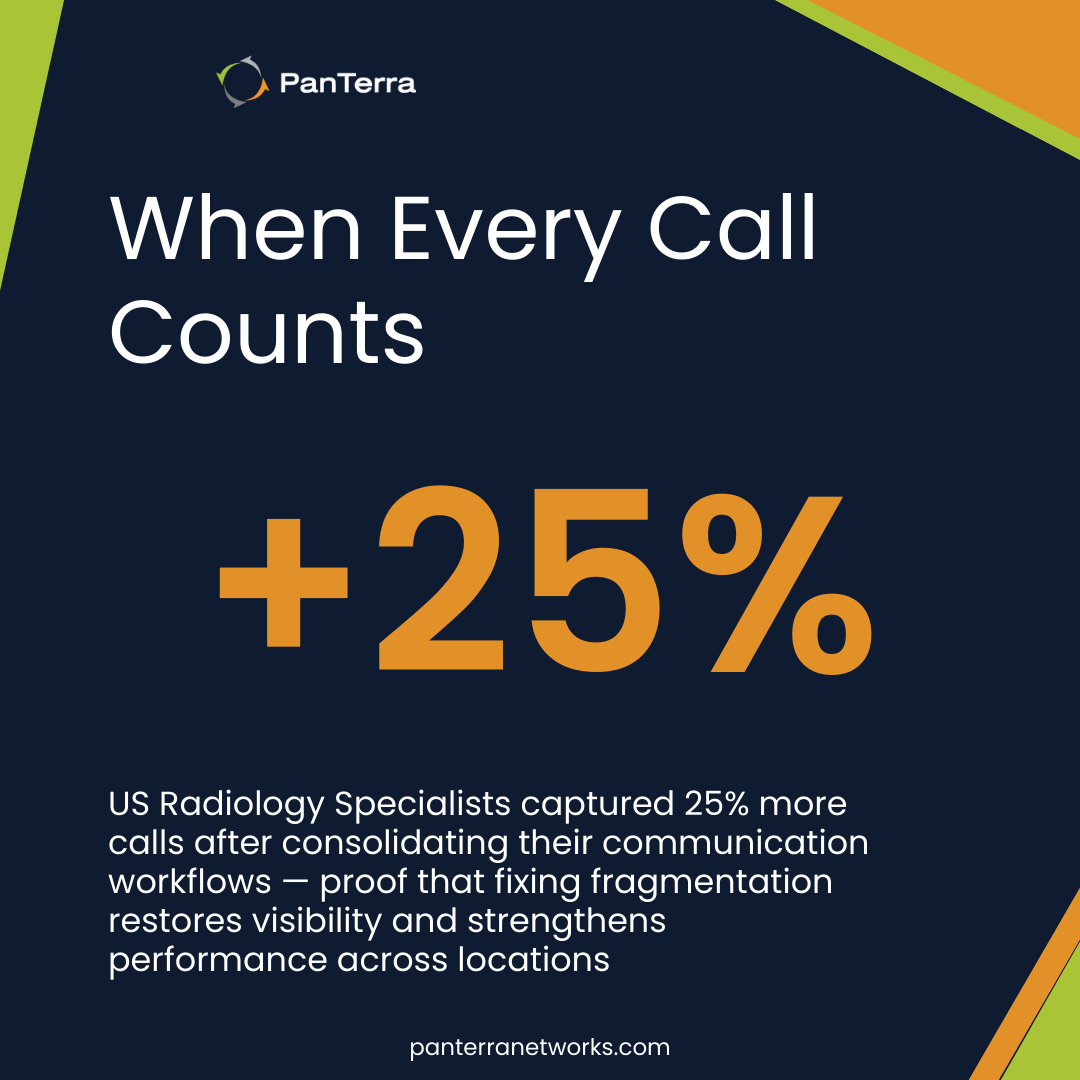
US Radiology Specialists faced similar multi-site challenges and chose consolidation. By unifying their communication infrastructure, they recovered $4M in previously lost revenue.
They also captured 25% more calls after consolidating their systems, restoring visibility across locations and reducing missed interactions.
Their approach eliminated communication silos completely. Moving to a platform with native Epic integration closed operational gaps. No middleware requirements. No data transfers between systems. No synchronization delays.
"We consolidated from 23 different communication tools to one unified system," their CTO reported.
“The consolidation removed dozens of handoffs and gaps that had been created over time.”
Single-system platforms keep every location on the same version and access rules, which removes version drift.
Penn Medicine's Operational Transformation
Penn Medicine shows what consolidation changes in practice. Their previous configuration included five different patient contact methods, each with separate infrastructure and protocols.
After consolidation, outcomes moved fast. Call abandonment decreased from 35% to 20%, and data consistency improved across all departments.
Other healthcare organizations using similar consolidation approaches, like Exact Sciences, automated work equivalent to 15 full-time positions.
Integration method matters. Solutions with direct integration capabilities—such as PanTerra's Epic connectivity—eliminate middleware dependencies common in healthcare operations. Removing integration layers cuts handoffs and closes gaps.
Direct Integration Advantages
Healthcare examples highlight why 2026 requires reconsidering integration approaches. Each API connection, data synchronization, and third-party bridge adds operational overhead. Middleware may appear convenient, but introduces unnecessary complexity.
US Radiology's direct Epic integration shows the alternative. Data flows without intermediate processing. No synchronization conflicts. No version mismatches. No unexplained gaps.
Direct integration reduces both operational risk and technical complexity. This principle extends beyond healthcare; any organization managing multiple locations faces similar integration challenges.
How do you audit multi-location communications security for 2026?
Start with three checks: single-dashboard visibility, consistent versions across sites, and role-based access everywhere.
Consolidation and Visibility Assessment
Begin your 2026 evaluation by documenting communication systems. More than three separate platforms indicates fragmentation risk. Verify whether all locations appear on a single management dashboard. Multiple logins suggest structural vulnerability.
Assess version consistency across sites. Mixed software versions create security vulnerabilities and operational inconsistencies. Organizations using unified platforms maintain consistent updates automatically, eliminating version-based risks.
Evaluate real-time visibility capabilities. Can management instantly view call volumes, system status, and activity across locations? Delayed visibility means delayed problem response.
Access Control Structure
Multi-location businesses often discover access control gaps during audits. Roles lack proper segmentation. Permissions persist after position changes. Temporary staff retain unnecessary system access.
Implement structured role-based controls. Each user should access only role-required resources. Voice biometrics and multi-factor authentication represent 2026 baseline requirements, not optional features.
Review permission inheritance processes. Position or location changes should trigger automatic permission adjustments. Manual permission management increases error probability.
Deployment and Scale Considerations
Deployment velocity affects security posture. Pressure for rapid location onboarding creates procedural shortcuts. These expedient solutions often become permanent fixtures.
Measure deployment timelines carefully. Secure activation should complete within 24 hours. Your platform should let you bring a new site online in under 24 hours with the same security setup.
Evaluate whether security protocols remain consistent across growth. Initial locations often receive thorough security attention while later additions receive abbreviated setup. Consistent standards must apply regardless of expansion phase.
Strategic Actions for Q1 2026
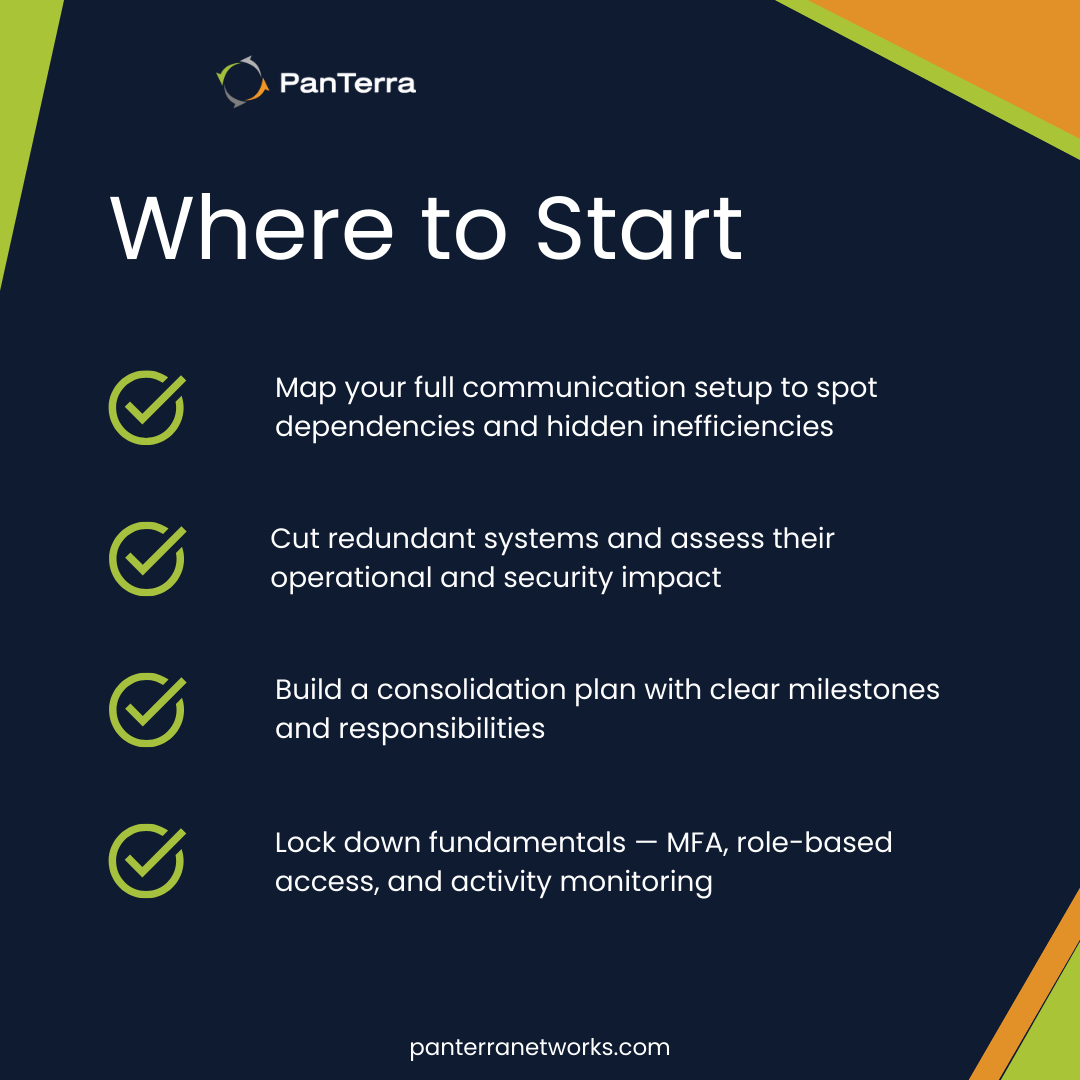
January provides optimal timing for architecture evaluation. Document your complete communication infrastructure, including every system, integration, and data pathway. This mapping reveals operational dependencies and redundancies.
- Identify system duplication immediately. Redundant platforms increase complexity without adding capability. Calculate the combined impact of operational inefficiency and security risk. Many organizations uncover operational costs they weren’t fully tracking.
- Create a consolidation roadmap with specific milestones. Set retirement dates for redundant systems. Assign clear ownership for each consolidation phase. Unifying communications removes gaps baked into multi-system setups.
- Implement fundamental controls before addressing complex issues. Deploy multi-factor authentication across all systems by February 1. Eliminate shared credentials completely. Establish activity monitoring for administrative functions.
- Present consolidation as operational improvement, not just risk reduction. The healthcare examples demonstrate that unified communications deliver quantifiable benefits beyond security. Efficiency gains show up alongside security gains, which strengthens the business case.
The evidence from 2025 is conclusive: fragmentation creates vulnerability. Your security posture reflects your most disconnected system. Organizations succeeding in 2026 will prioritize unified infrastructure over sophisticated point solutions.
If you want clarity on your gaps, we can help. PanTerra offers a simple, no-pressure assessment. Schedule your complimentary review.
FAQ
What is the biggest communications security risk for multi-location companies in 2026?
Fragmentation. Disconnected systems create blind spots and inconsistent controls.
How many communications systems indicate fragmentation risk?
More than three separate platforms across locations is a strong warning sign.
Why is middleware a security concern in multi-location setups?
Each added integration layer creates handoffs, version drift, and new failure points.
What should you check first in a 2026 security audit?
Single-dashboard visibility, consistent versions, and role-based access everywhere.
Should you consolidate before adding automation or AI?
Yes. Consolidation creates the patterns automation needs to work safely.
.jpg?width=500&height=500&name=Are%20you%20Getting%20a%20Good%20Deal%20(1).jpg)
Comments