HIPAA Compliant Answering Service: What That Phrase Can and Cannot Mean


Search for a HIPAA compliant answering service and every result on the first page will tell you it is one. Some present it as a feature. A few present it as a certification, with a badge.
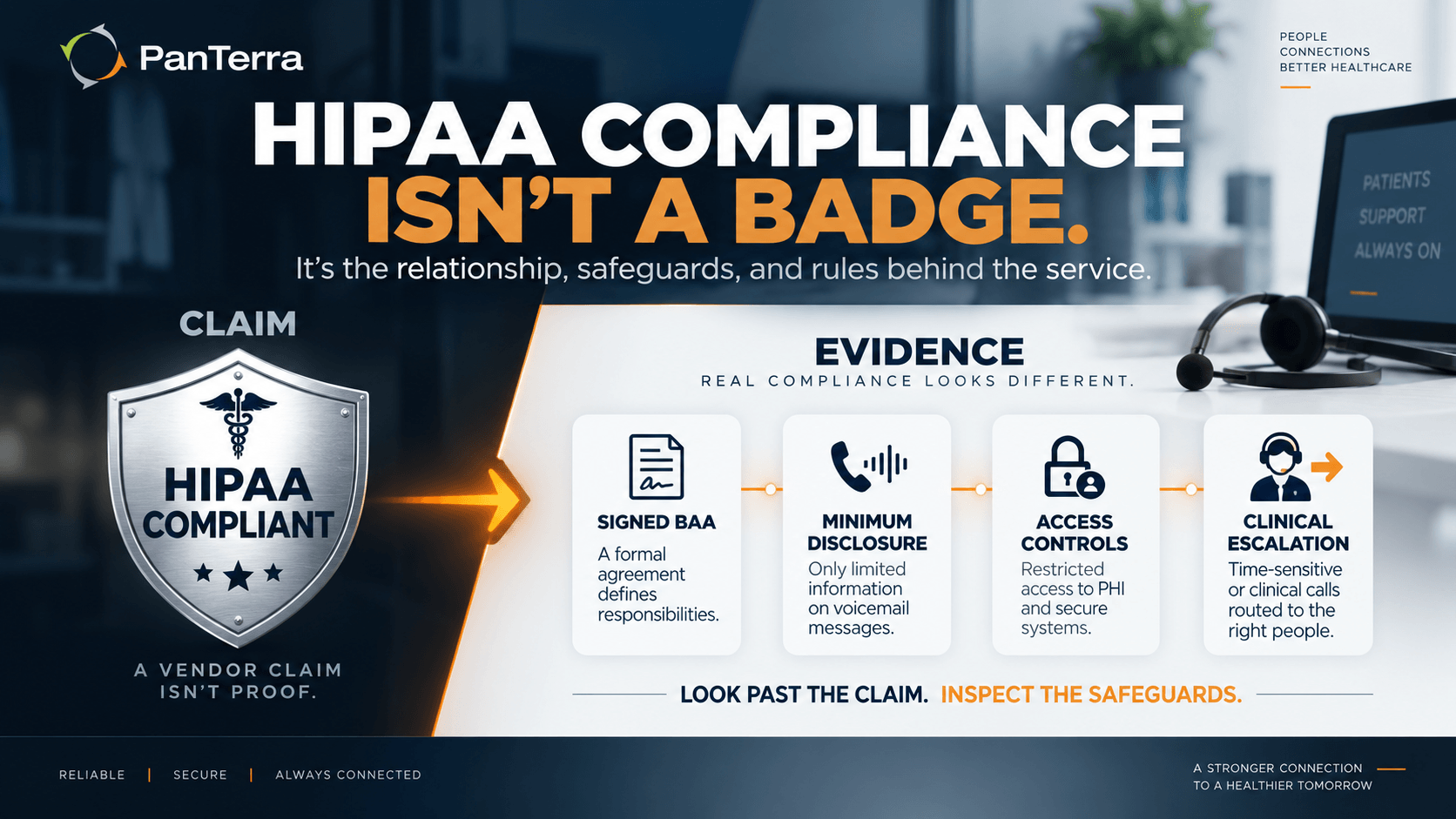
There is no such certification — and that is not a technicality. It changes what you should ask every HIPAA compliant answering service on your shortlist.
TL;DR
A HIPAA compliant answering service is not a product category with a certifying body behind it. HHS does not recognize private HIPAA certifications and says so directly. For a HIPAA compliant answering service, compliance is a property of the relationship you set up: a signed business associate agreement, real safeguards, and a service that limits what it says. The two questions that actually separate vendors are whether the BAA is included or gated behind a plan tier, and what the service reads aloud on a voicemail. Federal guidance answers the second question specifically.
Key Takeaways
HHS does not endorse or recognize private HIPAA certifications, and says a certification does not absolve you of your legal obligations. A vendor badge is marketing, not proof.
Any HIPAA compliant answering service handles PHI, which makes the vendor a business associate. The BAA is the thing that matters, not the badge.
Ask whether the BAA is included in the plan you were quoted or gated behind a higher tier. This is the question that changes the real price.
Federal guidance gives a HIPAA compliant answering service its voicemail rule directly: limit what is disclosed, and consider leaving only a name, a number, and what is needed to confirm an appointment.
Patients can ask you to contact them by a different method or at a different number, and you have to accommodate a reasonable request. Your answering service has to be able to honor that.
No HIPAA compliant answering service can make your practice compliant on its own. Compliance sits with you, and the service is one of your safeguards.
Who This Is For
Best for: multi-site practices and group practices evaluating a HIPAA compliant answering service · compliance officers and practice leaders who own the risk rather than the phone system · organizations whose current service has never produced a BAA on request.
Not ideal for: anyone looking for a vendor ranking, because this article deliberately does not provide one · organizations evaluating a phone platform rather than an answering service, which is a different purchase · single-person practices, which sit outside the scope of this guide.
Top use cases: overnight and weekend patient call coverage from a HIPAA compliant answering service · overflow during clinic hours · appointment confirmations and reschedules · message capture with escalation to a clinician · one consistent patient-call standard across several sites.
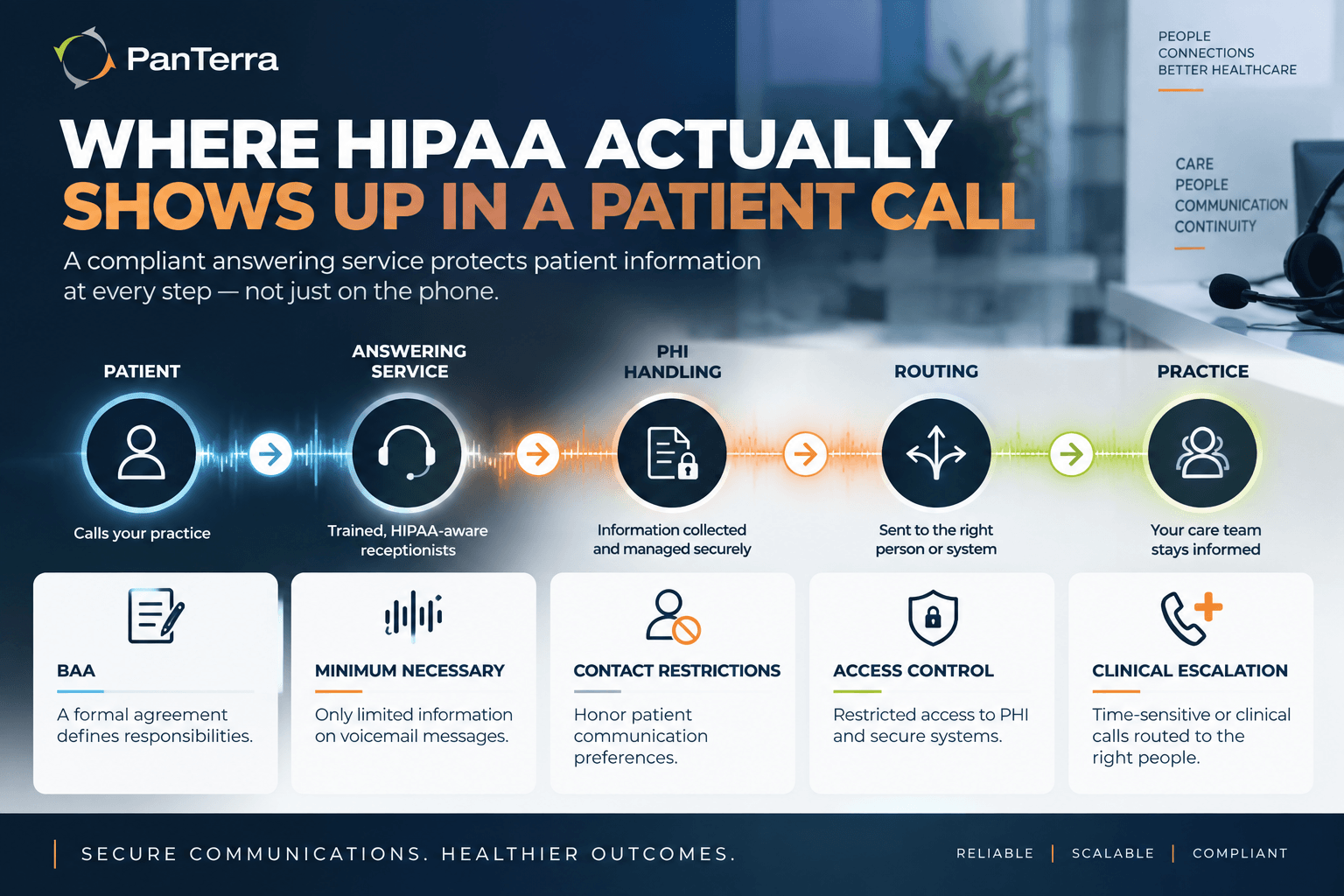
What Is a HIPAA Compliant Answering Service?
Start with what the underlying service is, because in the phrase HIPAA compliant answering service the adjective is doing a lot of work.
An answering service answers patient calls in place of your own front desk, then books, confirms, routes, takes a message, or escalates. A HIPAA compliant answering service runs in one of two forms. A virtual receptionist service routes calls to a remote team of people working from a script you supply, usually billed per minute or per call. An ai receptionist answers in software, works out what the caller wants in plain speech, and acts on the rules you configured, usually for a flat monthly fee. The Cluster A pillar works through that category split in full.
Now the adjective. A HIPAA compliant answering service, properly understood, is one you have set up so that the arrangement meets your obligations. That is a description of a relationship, not a description of a product, and it is why two practices can buy the same HIPAA compliant answering service with different results. One of them signed a BAA and configured what the service may say. The other did not.
That is why "HIPAA compliant" on a vendor page tells you almost nothing on its own. It is a claim about the vendor's capability, made by the vendor, with no outside body standing behind it.
Is There a HIPAA Certification?
No, and HHS has said so in writing for more than a decade.
In HHS FAQ 2003, dated 26 July 2013, HHS addresses whether organizations must certify their compliance with the Security Rule standards. Covered entities are not required to certify. The rule requires periodic evaluation, which can be done internally or by an outside party. And then the part worth reading twice:
HHS "does not endorse or otherwise recognize private organizations' 'certifications'" regarding the Security Rule, and such certifications "do not absolve covered entities of their legal obligations."
HHS adds that an outside certification does not prevent it from finding a violation in a later investigation.
Read against the search results for this term, that is a striking gap. The market sells a certification the regulator explicitly does not recognize. None of this means a vendor calling itself a HIPAA compliant answering service is lying, or that third-party assessments are worthless. It means the badge is not the evidence. The evidence is the agreement and the safeguards, and you have to go look at them.
What to do with a compliance badge. Treat it as an invitation to ask two questions rather than as an answer. Who performed the assessment, and what was in scope? A badge covering a vendor's corporate network tells you nothing about the call handling you are buying.
Why Is the Vendor a Business Associate?
A HIPAA compliant answering service is a business associate because of what the call contains, not because of what the vendor calls itself.
A business associate, in HHS's words, is a person or organization that "performs certain functions or activities" for a covered entity "that involve creating, receiving, maintaining, or transmitting PHI." A HIPAA compliant answering service does exactly that. The patient's name, the fact that they called your practice, and whatever they said about their condition are all protected health information.
For a while there was a real argument about automated tools. Federal guidance has closed it. OCR's Business Associates page, content last reviewed on 30 July 2026, lists among its examples a third-party AI chatbot on a provider's patient portal providing "services involving the patient's PHI such as symptom assessment, medical reminders, and appointment scheduling." Whether the thing answering is a person or software, the analysis lands in the same place.
So the BAA is the load-bearing document, and there are three questions to ask about it. Will you sign one? Is it included in the plan you just quoted me, or does it sit behind a higher tier? And which parts of the service does it cover? Put all three to every provider on your list, PanTerra included. The second question is the one that changes the real price of a HIPAA compliant answering service, and it is the one least likely to be answered on a pricing page.
The narrow exception is the conduit. A service that only carries a call and retains nothing may fall outside business associate status. In practice almost nothing does. If the service records, transcribes, summarizes, or stores anything at all, it is not a conduit.
What May the Service Say on a Voicemail?
This is the most common thing a HIPAA compliant answering service does with PHI, and federal guidance answers it directly. Most vendor pages never mention the guidance at all.
HHS FAQ 198 addresses whether a provider may leave messages for patients at home, on an answering machine or with a family member. The answer is yes, with limits. A covered entity should "limit the amount of information disclosed on the answering machine," and HHS suggests considering "leaving only its name and number and other information necessary to confirm an appointment, or ask the individual to call back." Where a family member takes the message, the entity must use professional judgment that the disclosure is in the individual's best interest and limit what is disclosed. Both rest on 45 CFR 164.510(b)(3).
Translate that into a configuration for a HIPAA compliant answering service and it becomes concrete:
☐ A confirmation left on a voicemail carries the practice name, a callback number, and the minimum needed to confirm. Not the procedure, not the provider's specialty, not the reason for the visit.
☐ A message taken from a caller is captured and routed, not summarized back to anyone who answers the phone at that number later.
☐ A callback script should ask to speak with the patient before saying anything about the appointment.
☐ A family member on the line is a judgment call your staff makes, not a rule your answering service can apply from a script. Route it.
There is a second right in that FAQ that vendor pages almost never surface. Under 45 CFR 164.522(b), if a patient asks to be contacted by a different means or at a different location, a covered entity must accommodate reasonable requests. A patient can tell you not to call their home number, or not to leave voicemails at all. That is not a preference you may lose in a vendor's system. Ask any HIPAA compliant answering service how a per-patient contact restriction is recorded, where it lives, and what stops it being overwritten at the next sync.
What Does the Service Never Get to Decide?
The questions above are about how a HIPAA compliant answering service handles information. This one is about clinical judgment, and it is a separate limit that applies whatever the BAA says.
A HIPAA compliant answering service may capture and route, and may answer a question you have already published. It may not tell a patient what their symptom means or whether it can wait. In most states that is the practice of medicine or dentistry, and a BAA has nothing to say about it. The practice-side detail is in our medical virtual receptionist guide, and the dental version, where the front desk does symptom triage constantly, is in the dental virtual receptionist guide.
The overnight version of the same problem is worth its own attention, because a stranger at 2 a.m. is where scripts get improvised. Our guide to the after hours answering service covers the escalation design.
What Does a HIPAA Compliant Answering Service Cost?
A HIPAA compliant answering service comes in two pricing shapes, with one line item specific to healthcare.
A staffed service usually bills per minute or per call against a monthly floor, so a busy month costs more, and overnight minutes often cost more than daytime ones. Ask for the overage rate.
An ai receptionist usually carries a flat monthly fee with volume tiers, so the bill moves far less with call volume. What moves it instead is integration scope and the number of sites.
The healthcare-specific line item is the BAA. If signing one requires moving up a tier, that upgrade is part of the price of a HIPAA compliant answering service and belongs in the comparison. A plan that looks cheaper and then gates the agreement is not cheaper for a covered entity.
Deliberately absent: a market rate range. There is no published range for this category that survives a source check, and the figures in circulation trace back through vendor marketing citing other vendor marketing. Ask any vendor who quotes you one for the base and the method. Our companion piece on what an AI receptionist costs models both shapes against a real call volume.
What Should You Ask Every Provider?
Eight questions to put to every HIPAA compliant answering service on your list, PanTerra included. Get the answers in writing.
Will you sign a BAA, is it included in this quote, and what does it cover? Three answers, not one.
What does the service record, transcribe, or store, for how long, and who can reach it? A recording is PHI from the moment it exists.
What exactly is left on a voicemail? Ask for the script, not a description of the script.
How is a per-patient contact restriction recorded and enforced? See the 45 CFR 164.522(b) point above.
What happens when a caller describes a symptom? You want immediate escalation with the description passed on intact.
Who performed your security assessment, and what was in scope? If the answer is a badge, the scope question is the follow-up.
How is access granted and revoked for the people or systems handling our calls? For a staffed service, ask about the day someone leaves.
Can I hear a recording of a real patient call? Demos are written. Patients are not.
Frequently Asked Questions
What is a medical answering service?
A medical answering service answers patient calls in place of a practice's own front desk, then books, confirms, routes, takes a message, or escalates to a clinician. It runs either as a remote team of people working from the practice's script or as software that answers and acts on its own. Because it handles protected health information, a medical answering service makes the vendor a business associate under HIPAA either way, which is what people are asking about when they search for a HIPAA compliant answering service.
What is a medical office answering service?
The same thing described at the level of a single office rather than an organization. The distinction people usually mean is scope: whether the service covers one location's overflow and after-hours calls or standardizes patient call handling across several sites. The compliance analysis does not change with scope.
Does an answering service need to be HIPAA compliant?
If it answers patient calls, the arrangement has to meet your HIPAA obligations, which means a signed business associate agreement and appropriate safeguards. What does not exist is a certification that makes the service itself compliant. HHS does not recognize private HIPAA certifications and has said so since 2013. Compliance is something you establish and document, not something you buy pre-attached.
What does a HIPAA compliant answering service do differently?
In practice, four things. A HIPAA compliant answering service signs a BAA. It limits what it says on voicemails and callbacks to the minimum needed. It records and retains only what it has told you it records, with access controls you can inspect. And it routes anything clinical to a person instead of answering it. A vendor that cannot describe all four in specifics is describing a badge rather than a practice.
How much does a medical answering service cost?
The two pricing shapes apply as they do anywhere: per minute or per call against a monthly floor for a staffed service, or a flat monthly fee with volume tiers for software. The healthcare-specific question is whether the business associate agreement is included in the plan you were quoted or gated behind a higher tier, because that upgrade is part of the real price.
How does an answering service work?
Calls to your number forward to the service, either all the time or outside the hours you set. A staffed service delivers them to a remote team following your script. Software answers in place of a person, interprets the request in ordinary speech, and applies the rules you configured. Either way the service follows an escalation path you wrote, deciding what it handles and what reaches a clinician.
How do you choose an answering service for a practice?
Start with the BAA questions and the voicemail script, because those two rule vendors out faster than anything on a feature list. Then check the clinical limit: what the service does when a caller describes a symptom. Only after those should price and coverage hours enter the comparison, since a cheaper service that improvises on a patient call is not cheaper.
Can a vendor make our practice HIPAA compliant?
No. Compliance obligations sit with the covered entity, and a vendor is one of your safeguards rather than a substitute for them. A HIPAA compliant answering service can make compliance easier to achieve and easier to document, and a bad one can make it much harder, but no purchase transfers the obligation. Any vendor promising otherwise has told you something useful about how carefully they read the rule.
Where this article describes published federal guidance, it is a description of those sources rather than legal advice. HIPAA obligations depend on your organization's circumstances and state law may add requirements, so confirm your position with counsel or your privacy officer.

Comments