Dental Virtual Receptionist: What a Practice Can Safely Automate


A practice shopping for a dental virtual receptionist is usually trying to solve a counting problem. Calls arrive during hygiene visits, at lunch, and after five. Nobody is free to pick up. The fix looks obvious.
What decides whether a dental virtual receptionist works is narrower than the demo suggests — and it is not what the thing can book. It is what it is allowed to say when a patient calls in pain.
TL;DR
A dental virtual receptionist is any setup where someone other than your own front desk answers patient calls. In dental the term covers two very different things: software that answers and acts, and a remote person working your phones. Both touch protected health information, so both are business associates under HIPAA. The hard limit on either model is clinical. For any dental virtual receptionist, booking, confirming, moving, and routing a call are clerical tasks. Telling a caller what a symptom means is the practice of dentistry in most states, whoever or whatever says it.
Key Takeaways
In dental, "virtual receptionist" is vague in a way it is not in other fields. Much of what ranks for the term is offshore staffing, not software. Confirm which one a vendor sells before you compare prices.
Federal guidance now names an AI tool doing symptom assessment, reminders, and booking as a business associate. That settles a question that was open two years ago.
Triage is the line, not the technology. Most state practice acts treat professing to judge an oral condition as the practice of dentistry, which puts symptom reading outside what any dental virtual receptionist may do.
A remote worker outside the United States does not escape HIPAA, and the setup widens what your risk analysis has to cover.
Insurance questions, not price, are where dental calls stall most. A dental virtual receptionist that cannot answer one well will not win the visit back.
The federal rule on AI voices attaches to the calls your system places, not to the calls it answers.
Who This Is For
Best for: multi-site and group practices weighing a dental virtual receptionist because call volume peaks while chairs are full · dental support organizations making front-desk handling the same at every site · practices where after-hours pain calls land in voicemail.
Not ideal for: a single chair with low call volume, where a per-call human service stays cheap · practices that want outbound recall campaigns, which is a separate category · any practice hoping to hand off clinical triage, which no product can take on.
Top use cases: nights and weekend cover for pain calls · new patient calls during treatment hours · insurance and coverage questions · confirmations and reschedules · one routing pattern across every site.
What Is a Dental Virtual Receptionist?
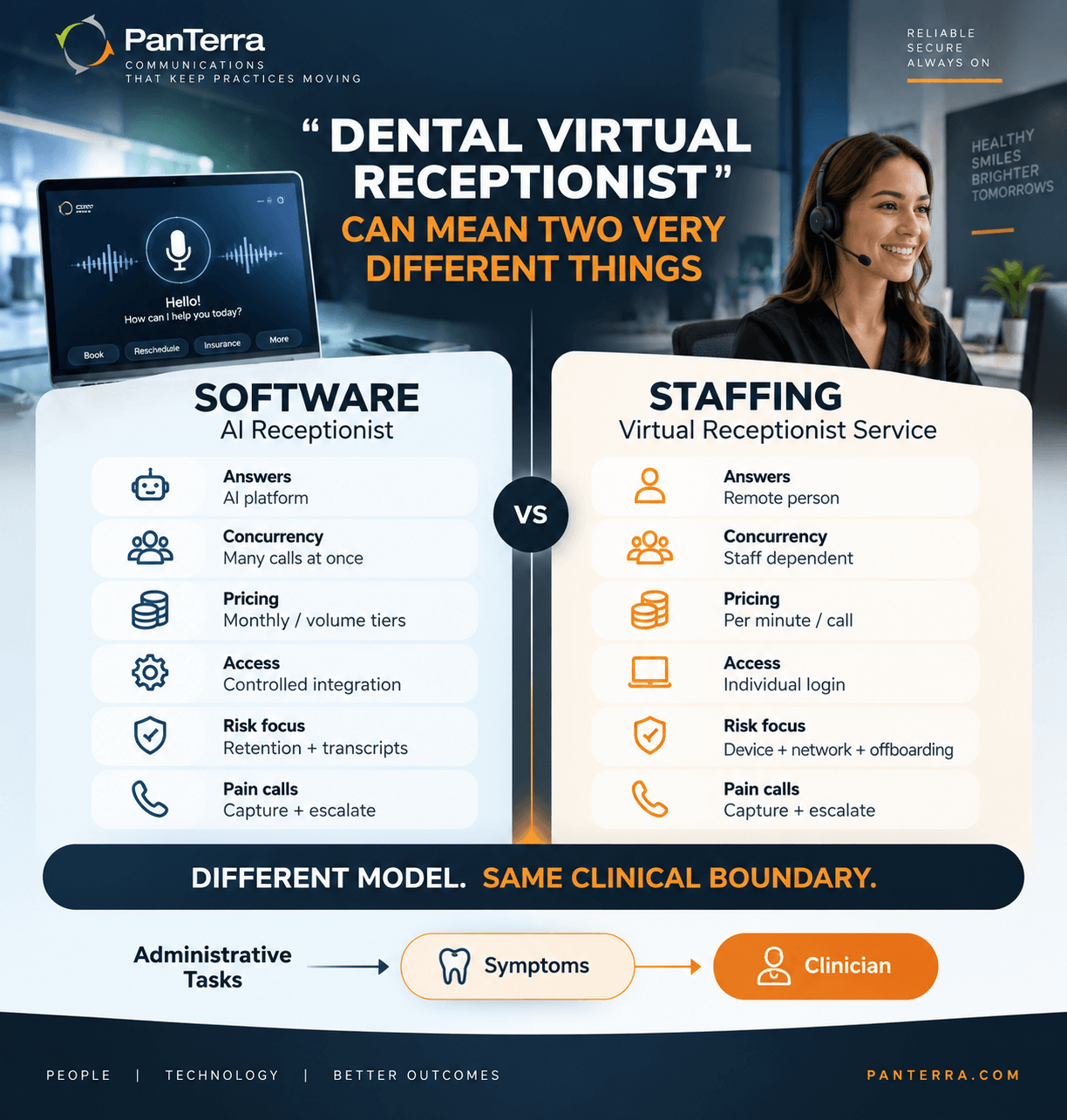
A dental virtual receptionist is any service that answers your patient calls in place of your own front desk. In practice the category splits in two, and the split matters more in dental than almost anywhere else.
An ai receptionist is software. It answers on the first ring, works out what the caller wants in plain speech, then acts. It books into your schedule, confirms or moves a visit, takes a message, answers a published question, or hands the call to a person. Twelve Monday morning calls all get answered, because there is no queue.
The other kind of dental virtual receptionist is people. Your calls route to a remote team who answer in your practice name and follow a script you supply. You are renting the seat rather than automating it, and the bill usually runs per minute or per call. The Cluster A pillar works through that category split in full.
Now the wrinkle that is specific to dental. Search the term and much of what comes back is offshore staffing: firms that put a remote person on your phones, and often on your practice software too. They rank for the same phrase as the software vendors. A practice weighing a flat monthly fee against an hourly rate is not weighing two versions of one thing, and the compliance questions are not the same. Ask a vendor plainly which model they run before anything else.
|
Software (ai receptionist) |
Staffing (virtual receptionist service) |
|
|---|---|---|
|
Who answers |
The platform |
A remote person |
|
Answer speed |
Instant on every call |
Depends who is on shift |
|
Calls at once |
Not a real limit |
Capped by staff on shift |
|
Pricing shape |
Flat monthly fee, volume tiers |
Per minute or per call |
|
Cost when volume doubles |
Close to flat within tier |
Roughly doubles |
|
Business associate under HIPAA |
Yes |
Yes |
|
Reach into your practice software |
Setup you control |
One person's login |
|
Added risk questions |
Retention, transcripts, scope |
Device, network, place, off-boarding |
|
Handles a pain call |
Captures it and escalates |
Captures it and escalates |
The term is doing double duty. On page one for this phrase, four of the top fifteen results are staffing firms and several more are dental software platforms. Nothing on that page tells a buyer these are different purchases.
Does HIPAA Apply to a Dental Virtual Receptionist?
Yes, and the reasoning is short.
A business associate, in HHS's words, is a person or an organization that "performs certain functions or activities" for a covered entity "that involve creating, receiving, maintaining, or transmitting PHI." A dental virtual receptionist does exactly that. The patient's name, the fact of the visit, and whatever they said about their mouth are all PHI.
For years there was a real argument about whether an automated booking tool crossed that line. Federal guidance has closed it. OCR's Business Associates page, content last reviewed on 30 July 2026, lists among its examples a third-party AI chatbot on a provider's patient portal that provides "services involving the patient's PHI such as symptom assessment, medical reminders, and appointment scheduling."
Read that example twice if you run a dental practice. Symptom assessment is the thing your front desk does most. Patients do not call to describe a clerical need. They call because something hurts, and they want to know whether it can wait.
So the vendor behind your dental virtual receptionist is a business associate. Ask for the Business Associate Agreement. Then ask two follow-up questions that vendors answer very differently. Is the BAA included in the plan you are being quoted, or does it sit behind a higher tier? And which parts of the service does it cover? Put both to every provider on your list, PanTerra included. A vendor who treats the request as odd has told you something.
The narrow exception is the conduit. A service that only carries the call and keeps nothing may fall outside business associate status. Almost nothing does. If the service records, transcribes, sums up, or stores anything at all, it is not a conduit.
Where Is the Line on What a Dental Virtual Receptionist Can Say?
This is the question that decides your setup, and it has nothing to do with whether the dental virtual receptionist is software or a person.
Most state practice acts define the practice of dentistry broadly enough to catch symptom reading. Nevada's statute is typical and unusually blunt. Under NRS 631.215(1)(c), a person practices dentistry if they evaluate or diagnose, or profess to evaluate or diagnose, "any of the diseases, disorders, conditions or lesions of the oral cavity, maxillofacial area or the adjacent and associated structures."
Read the words "professes to evaluate." They do the work. A dental virtual receptionist does not need to be right, or clinical, or sure to cross the line. Saying "that sounds like an abscess, you should come in today" is professing to evaluate an oral condition. So is "that is probably just sensitivity, it can wait until your cleaning."
Practice acts are state law and the wording varies, so check your own. The shape holds nearly everywhere. Clerical handling can be handed off. Clinical judgment cannot.
Here is what that means when you build the call flow.
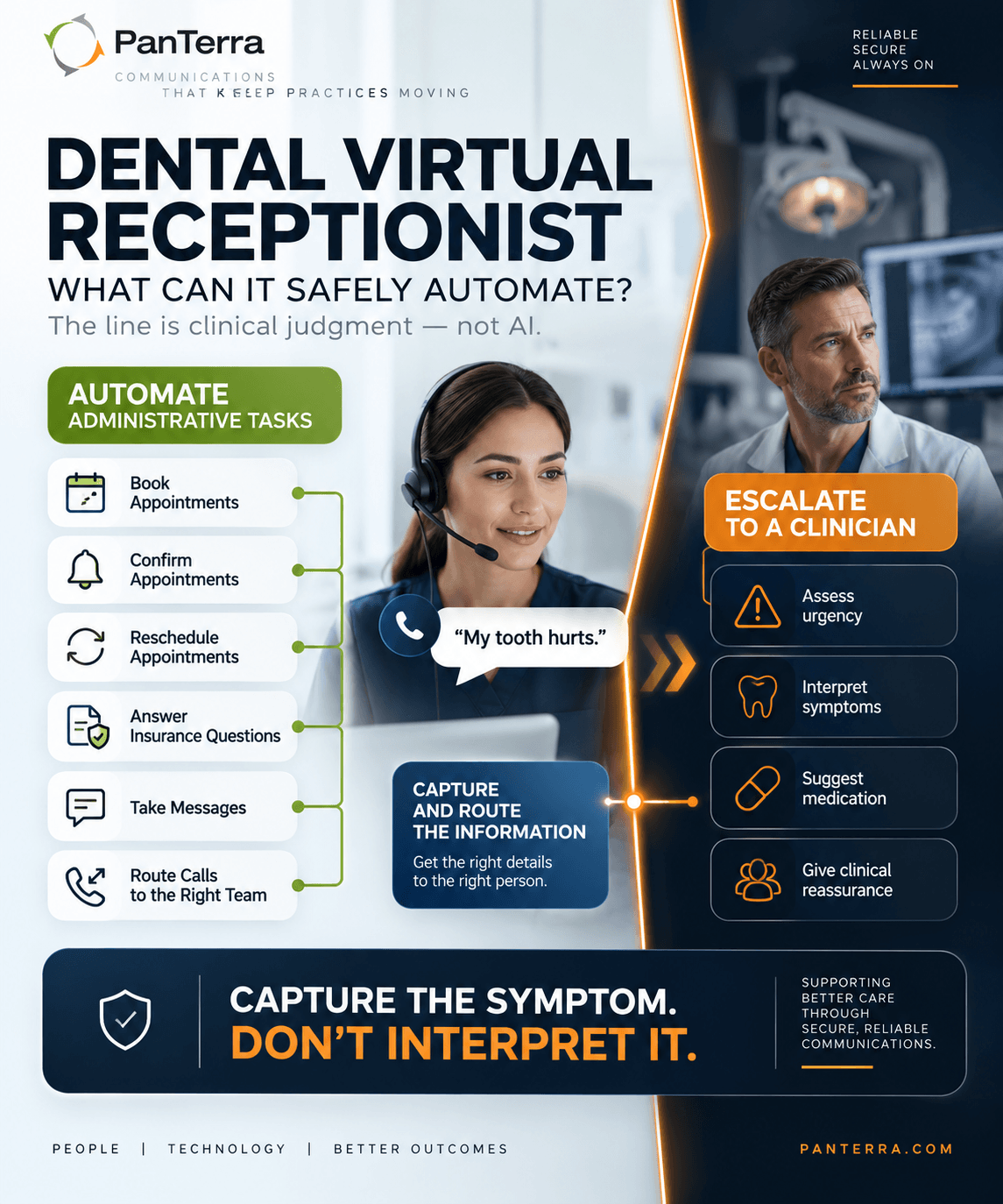
☐ Safe to automate. Booking, cancelling, moving, and confirming a visit. Taking a message. Giving hours and location. Transferring to a named person. Answering a published question about which plans you take or how new patients are seen.
☐ Safe to automate with care. Taking down a symptom word for word and passing it on. Writing down what the patient said is clerical. Reacting to it is not.
☐ Never automate. Deciding whether a symptom is urgent. Telling a patient what a symptom probably is. Advising them to wait. Suggesting a medicine. Offering any comfort about a clinical condition.
☐ Must escalate. Anything the patient frames as pain, swelling, bleeding, or injury. The dental virtual receptionist's job is to capture it and route it fast, not to size it up.
The practical move is to write the escalation path first and the booking logic second. Most practices do it the other way round and find the gap in week one.
What Does the Call Data Show?
One dental source publishes both its base and its method, which is why it is the only figure here.
Patient Prism's Dental Patient Access Report, published on 2 July 2026, looked at more than 11.5 million patient calls across 8,280 dental practice and dental support organization sites during 2025. It found 1,445,814 patients walked away without a visit booked, and more than 890,000 never got a callback. The reasons-not-booked shares came from 1,163,398 sorted opportunities.
Two things in that are worth acting on.
The callback figure is a coverage problem, not a judgment problem. Roughly nine hundred thousand people raised a hand and were never called. That is the work a dental virtual receptionist absorbs without a hiring decision, because there is no queue and no lunch hour.
The report also finds insurance the top barrier to booking, outweighing price objections by more than eleven to one. That should change how you judge a vendor. An insurance question is clerical, so a dental virtual receptionist may answer it, but only if it has been given the right answer. Ask how the system knows which plans you take, how that list is kept current, and what it says when a caller names a plan that is not on it. "I'll have someone call you back" is a worse answer than it sounds, given the callback number above.
You will see other dental missed-call figures quoted widely. Most trace back through vendor blogs citing other vendor blogs and end nowhere. Ask any vendor who quotes you a number for the base and the method, and drop the number if they cannot produce both.
What Changes If the Dental Virtual Receptionist Is Offshore?
If the dental virtual receptionist is a remote person rather than software, three things change.
HIPAA still applies in full. Where the person sits has no bearing on business associate status, and a BAA is required either way.
Your risk analysis widens. You now have a named individual reaching your practice software from a network and a device you do not control. Ask how access is granted and withdrawn, whether screens can be captured or recordings saved on that device, and what happens the day that person leaves.
Enforcement gets harder, and it is worth saying out loud. A BAA is a contract, and a contract is only as good as your ability to enforce it. That is a question for your counsel rather than for a vendor, and it belongs in the decision.
None of this makes the model wrong. Plenty of practices run it well. It makes the model different from software, which is the point the search results hide.
Does the AI Voice Rule Apply to a Dental Virtual Receptionist?
Mostly not, and the difference is often stated wrong.
In Declaratory Ruling FCC 24-17, adopted 2 February 2024 under CG Docket 23-362, the FCC confirmed that the Telephone Consumer Protection Act's limits on an "artificial or prerecorded voice" reach current AI tools that sound like human voices. Calls using them "require the prior express consent of the called party to initiate such calls absent an emergency purpose or exemption."
The operative word is initiate. The ruling governs calls your system places, not calls it answers. A patient who dials your practice and reaches a dental virtual receptionist is not inside it.
The moment it does apply is the callback. If your system rings patients for reminders, recalls, or follow-ups in an AI voice, you are placing those calls and consent rules attach. Ask a vendor which direction their product works in, and how consent is captured and logged for anything outbound.
What Should You Ask Before You Commit?
Seven questions, in the order that rules vendors out fastest.
Which model are you selling, software or staffing? Everything below turns on the answer.
Will you sign a BAA, is it in this quote, and what does it cover? Ask every vendor. Get it in writing.
What does the system do when a caller describes pain? You want a fast escalation with the description passed on intact. Anything that looks like assessment is a fail.
How does it know which insurance plans we take, and who keeps that current? Given where dental calls stall, this decides whether it wins visits back or just logs them.
Can it write to our schedule, and which system? A dental virtual receptionist without calendar access moves work around rather than removing it.
What is kept, for how long, and who can reach it? Recordings and transcripts are PHI from the moment they exist.
Can we hear a real patient call rather than a demo script? Demos are written. Patients are not.
For the cost side of that shortlist, our piece on what an AI receptionist costs works through both pricing models.
Frequently Asked Questions
What does a dental virtual receptionist do?
A dental virtual receptionist answers inbound patient calls in place of your front desk, then books, confirms, moves, routes, or takes a message. It may answer published questions about hours, location, and which plans you take. It does not read symptoms or decide whether a patient needs to be seen urgently.
Is a dental virtual receptionist HIPAA compliant?
A dental virtual receptionist can be run in a compliant way, but no product makes your practice compliant on its own. Because it handles PHI, the vendor is a business associate and a signed Business Associate Agreement is required. Ask whether the BAA is in the plan you were quoted, and which parts of the service it covers.
Can an ai receptionist tell a patient whether a toothache is an emergency?
No, and that is a legal limit rather than a product limit. Most state practice acts treat professing to evaluate or diagnose an oral condition as the practice of dentistry. The receptionist should capture the description word for word and escalate it to a clinician at once.
How much does a dental virtual receptionist cost?
The two models price differently, which makes a headline comparison misleading. Human services usually bill per minute or per call against a monthly floor, so a busy month costs more. Software usually carries a flat monthly fee with volume tiers, so cost moves far less with call volume. Our companion piece on what an AI receptionist costs works through both.
How do virtual receptionist services handle data security and compliance?
Ask any dental virtual receptionist vendor for specifics rather than assurances. Whether a BAA is signed and what it covers, what gets recorded or transcribed, how long it is kept, who can reach it, and how access is withdrawn. If the vendor puts a remote person on your systems, add device and network controls and off-boarding to that list.
Is a dental virtual receptionist different from a medical one?
The HIPAA analysis is the same, and the clinical limit has the same shape, with the boundary set by dental practice acts rather than medical ones. The call mix differs. Dental volume skews to insurance questions and pain calls, which is why insurance accuracy and the escalation path carry more weight in a dental decision. Our medical virtual receptionist buyer's guide covers the practice-side requirements in full.
Can a dental virtual receptionist handle callers who do not speak English?
Many services offer two or more languages, and quality varies sharply between models. Ask which languages are covered, whether cover runs all the time or only in certain hours, and to hear a real call in the second language. For a human service, ask whether the bilingual team is the same team.
Where this article describes published federal guidance and state statute, it is a description of those sources rather than legal or clinical advice. Dental practice acts are state law and differ in wording and scope, so confirm the rule in the states where you operate.

Comments