After Hours Answering Service: Designing the 2 a.m. Decision

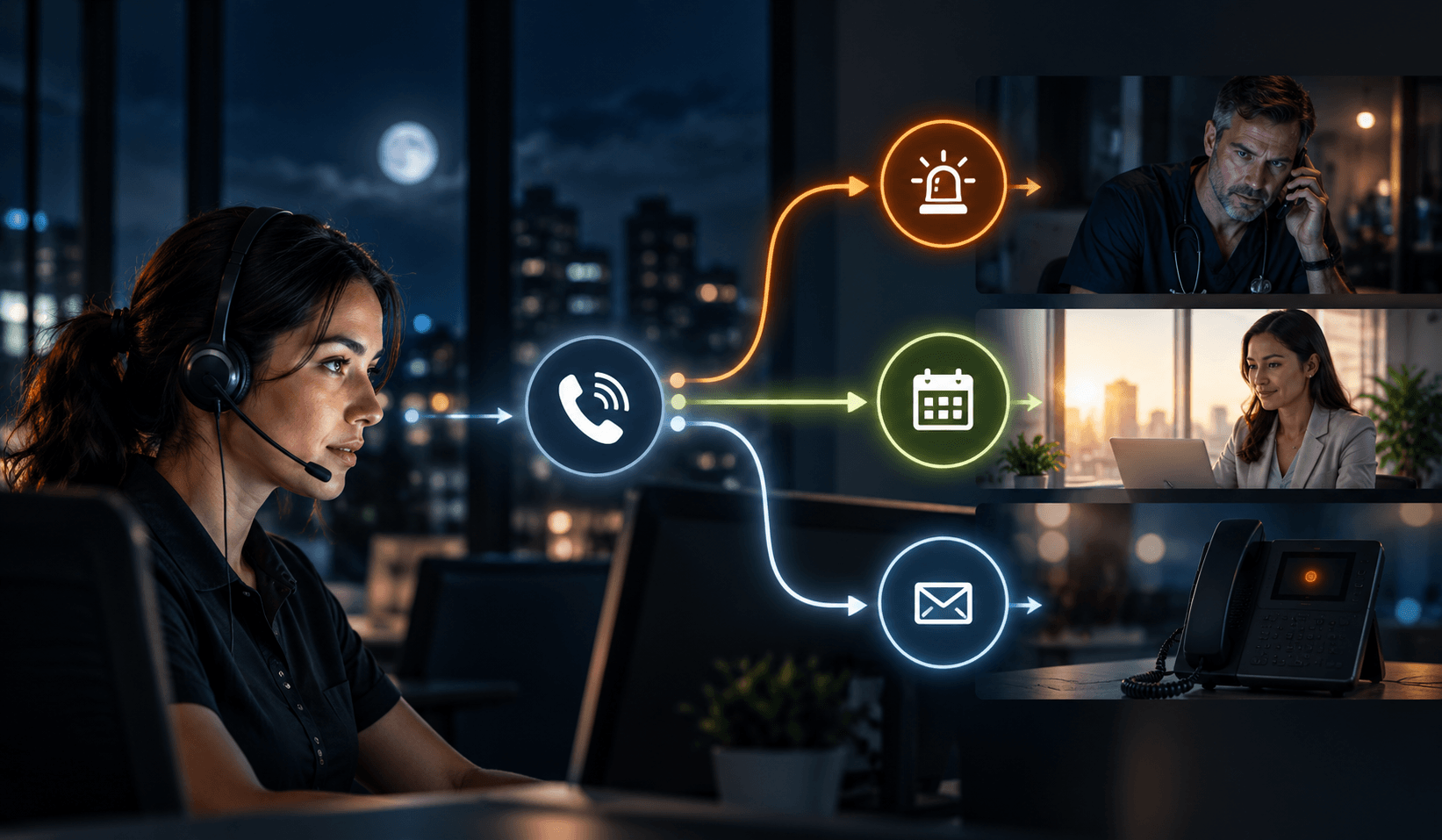
An after hours answering service is one of the easiest things in communications to buy and one of the easiest to get wrong. The purchase feels like buying coverage. Somebody answers the phone at night, so the calls stop going to voicemail.
That is not what you are buying from an after hours answering service — what you are buying is a decision rule for 2 a.m., applied by someone who has never met you, to a caller you cannot hear. If the rule is not written down, the service will invent one.
TL;DR
An after hours answering service answers your calls outside business hours, either through a remote team of people following your script or through software that answers and acts. The thing that determines whether it works is not the answering. It is the escalation tree: which calls wake someone up, which wait for morning, and who decides. Write that tree before you shop for an after hours answering service, because no vendor can write it for you. In healthcare the after hours answering service handles protected health information, which makes the vendor a business associate, and the on-call callback is where the federal AI voice rule attaches.
Key Takeaways
You are buying a decision, not coverage. An after hours answering service that answers every call and escalates everything is as broken as voicemail, just more expensive.
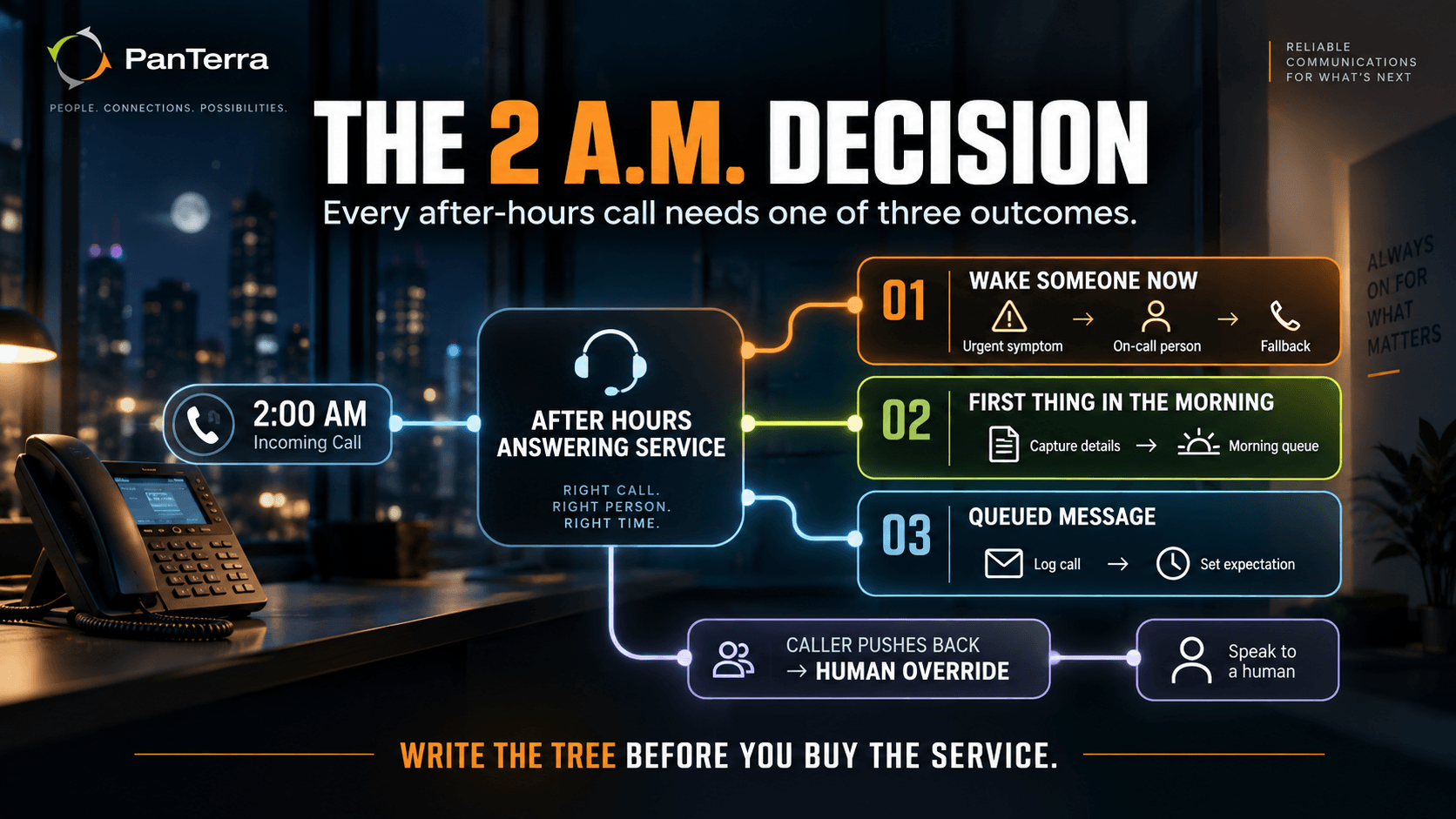
Write the escalation tree first. Three tiers is usually enough: wake someone now, first thing in the morning, or a queued message.
Test your after hours answering service from outside, at night. The call you bought the system for is almost never the call anyone has placed as a test.
In healthcare, the vendor is a business associate. Ask for the BAA, ask whether it is included or gated behind a tier, and ask what it covers.
The federal rule on AI voices attaches to the call the system places, not the call it answers. That makes your on-call callback the regulated moment.
There is no defensible published figure for what a missed overnight call is worth. Ask any vendor who quotes you one for the base and the method.
Who This Is For
Best for: multi-site regulated organizations weighing an after hours answering service because calls do not stop when the office closes · operations leaders who own a rotation and want fewer unnecessary wakeups · practices and firms where the overnight call mix is mostly urgent-or-not triage.
Not ideal for: organizations with no genuine overnight urgency, where a clear voicemail greeting and a morning callback is honest and sufficient · anyone looking for outbound dialing or campaign automation, which is a different category · single-person companies, which sit outside the scope of this guide.
Top use cases: overnight and weekend coverage · holiday and closure coverage · overflow call answering during daytime spikes · escalation to a clinical or maintenance rotation · one consistent overnight pattern across several sites.
What Is an After Hours Answering Service?
An after hours answering service is any arrangement where someone other than your own staff answers your calls outside business hours. It comes in the same two forms as everything else in this category.
One kind of after hours answering service routes your overnight calls to a remote team who answer in your organization's name, work from a script you supply, and reach whoever is on call by the method you specify. Billing usually runs per minute or per call against a monthly floor.
The other kind of after hours answering service is software, an ai receptionist. It answers the call, works out what the caller wants in plain speech, and acts on the rule you configured: log it, answer a published question, or escalate. It answers on the first ring and does not queue, which matters more overnight than during the day, because overnight volume tends to arrive in clusters rather than evenly. The Cluster A pillar works through that category split in full.
A word on "24/7," which is how most of this is sold. Continuous coverage is a staffing claim, not a quality claim. Ask what happens on the overnight shift specifically: how many people are on it, whether the script differs from the daytime one, and what the handoff to the person on call actually looks like at three in the morning.
Nobody has written this guide. Positions one through twelve on the target search results page for this term are almost entirely state and city landing pages from staffed answering-service companies, several of them the same domain repeated across different states. There is no design guide on that page. That is unusual for a term at this volume, and it tells you something: the category sells overnight coverage and has very little to say about how to configure it.
Why Do After-Hours Services Fail?
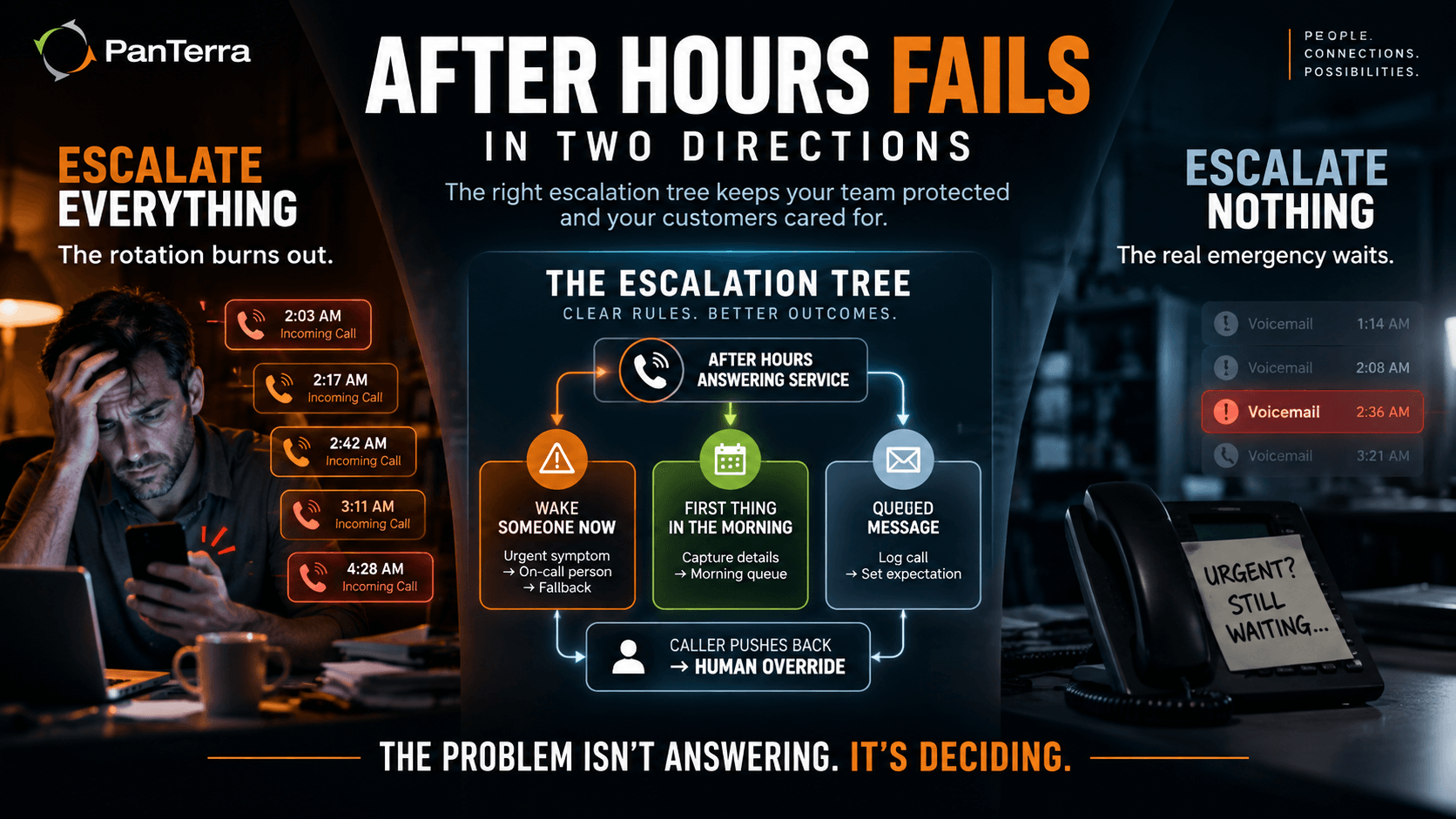
An after hours answering service fails in exactly two directions, and both are configuration failures rather than product failures.
The service escalates everything. Every call wakes someone. Within a month the person on call stops answering on the first ring, then stops answering, and you are back to voicemail with an invoice attached. This is the more common failure and the more expensive one, because it burns the rotation.
The service escalates nothing. Everything becomes a morning message. The genuine emergency waits nine hours. You will not discover this from a report; you will discover it from a complaint.
Both come from the same root cause. The vendor asked what your emergencies are during onboarding, somebody answered from memory in one short call, and that became the rule. An after hours answering service applies your definition of urgent with total consistency, which is only a good thing if the definition is any good.
How Do You Build the Escalation Tree?
This is the part to do before you talk to a single after hours answering service vendor. It takes an afternoon and it is the whole product.
- Pull a month of overnight calls. Not a report from a vendor, your own call records. Include the ones that rang out.
- Sort each into one of three tiers. Wake someone now. First thing in the morning. Queued message, no callback promised. Resist adding a fourth tier; the third is where ambiguity goes to hide.
- Write the tier-one list as symptoms, not categories. "Emergency" is not a rule. "Caller reports chest pain," "no heat and the outside temperature is below freezing," "caller says water is coming through a ceiling" are rules. A stranger at 2 a.m. can apply a symptom. They cannot apply a category.
- Name the person, the method, and the fallback. Who is woken, by what channel, and what happens if nobody answers within a stated number of minutes. The fallback is the part most scripts omit, and it is the one that matters at 3 a.m.
- Write the override. Any caller who escalates after being classified goes to a person, regardless of tier. This single line prevents most of the complaints the category generates.
- Decide what the caller hears. Especially in tier three. "Someone will call you back" and "we have logged this and the office opens at eight" are very different promises, and the second one is usually the honest one.
- Test it from outside the office, at night, quarterly. Place the call yourself. Time the callback. Read what the on-call person received.
☐ Tier one, wake someone. Written as observable symptoms, with a named person, a channel, a time limit, and a fallback.
☐ Tier two, morning. Logged with enough detail that the morning shift does not have to call back to find out what the call was about.
☐ Tier three, queued. With an honest greeting about when a human will see it.
☐ The override. Any caller who pushes back gets a person. No exceptions, no tier.
What Should the After Hours Answering Service Never Decide?
The tree above tells an after hours answering service how to route. It does not license it to answer, and in regulated fields that distinction is the whole ballgame. Overnight is exactly when a stranger is most likely to improvise, because the caller is distressed and there is nobody to ask.
The rule that travels across every vertical: an after hours answering service may capture and route, and may answer a question you have already published. It may not exercise professional judgment. Where the line sits is set by someone other than your vendor.
Healthcare. A service answering patient calls handles protected health information, which makes the vendor a business associate under HIPAA. Ask for the Business Associate Agreement, ask whether it is included in the plan you are quoted or gated behind a higher tier, and ask what it covers. Ask every vendor, PanTerra included. Then ask the overnight-specific question: what does the service say on a voicemail, and what does it read back when confirming? Our medical virtual receptionist guide covers the practice-side requirements in full.
Property management. Overnight is when maintenance calls arrive, so this is the vertical where an after hours answering service earns its place fastest, and there is a second constraint on top of it. Federal regulation reaches oral statements and makes the housing provider liable for what its agent says. See the property management answering service guide.
Any regulated field. The test is simple. If the answer requires a licensed person during the day, it requires one at night. An after hours answering service that gets more permissive after dark is a liability, not a convenience.
Does the AI Voice Rule Apply Overnight?
Yes, and overnight is where it bites, because the overnight pattern is built on callbacks.
In Declaratory Ruling FCC 24-17, adopted 2 February 2024 under CG Docket 23-362, the FCC confirmed that the Telephone Consumer Protection Act's limits on an "artificial or prerecorded voice" reach current AI tools that sound like human voices. Calls using them "require the prior express consent of the called party to initiate such calls absent an emergency purpose or exemption."
The operative word is initiate. A caller who dials you at 2 a.m. and reaches software is outside the ruling, because the caller placed the call.
The regulated moment is the callback. If your after hours answering service rings the caller back in an AI voice, or rings whoever is on call, or sends an automated message in the morning, those are calls your system places. Ask a vendor which direction their product works in, how consent is captured and logged, and whether the emergency exemption is something they rely on. That last answer is worth hearing in full, because it is a legal position rather than a feature.
What Does an After Hours Answering Service Cost?
An after hours answering service prices differently overnight in a way it does not during the day, and the two models diverge.
A staffed service usually bills per minute or per call against a monthly floor, and overnight minutes often cost more than daytime minutes, because the shift is harder to fill. Ask for the overnight rate specifically rather than the blended one, and ask for the overage rate, which is where the surprise lives.
An ai receptionist usually carries a flat monthly fee with volume tiers, and overnight hours cost the same as any other hour, because there is no shift to staff. That is the structural argument for software on the night shift, and it holds whatever else is true.
Deliberately absent here: a market rate range, and any figure for what a missed overnight call is worth. Neither survives a source check. The numbers in circulation trace back through vendor marketing citing other vendor marketing. Measure your own instead: count the overnight calls that rang out last month and how many of them came back the next day. The ones that never came back are your number, and it is the only one that should decide this. Our companion piece on what an AI receptionist costs models both pricing shapes against real volume.
What Should You Ask a Vendor?
Eight questions to put to any after hours answering service, in the order that rules vendors out fastest.
Which kind of after hours answering service is this, software or staffing? Everything below turns on it.
Show me how my escalation tree gets into your system. If the answer is a form during onboarding and nothing after, you cannot change the rule when it turns out to be wrong.
Who is on the overnight shift, and does the script differ from the daytime one? Ask about the shift, not the coverage claim.
What is the fallback when nobody answers? And the fallback after that.
How is the override handled? A caller who insists on a person should get one without arguing with a script.
What does the service commit to on availability, and where is that written? Ask for the contractual commitment and the published exclusions rather than a number in a deck. A figure in a sales conversation that does not appear in the agreement is not a commitment.
Does it place outbound calls, and how is consent captured? See the section above.
Can I hear a recording of a real overnight call? Daytime demos tell you nothing about the night shift.
Frequently Asked Questions
What is an answering service?
An answering service answers inbound calls on your behalf when your own staff cannot, then routes the call, takes a message, answers a published question, or escalates to whoever is on call. It runs either as a remote team of people working from your script or as software that answers and acts on its own. An after hours answering service is the same thing scoped to the hours your office is closed.
How does an answering service work?
Calls to your number forward to the service outside the hours you set. A staffed service delivers them to a remote team working from your script. Software answers in place of a person, interprets the request in ordinary speech, and applies the routing rule you configured. Either way an after hours answering service follows an escalation tree you wrote, deciding which calls reach someone immediately and which wait.
How much does an answering service cost?
The two models price differently, so compare shapes rather than headline numbers. A staffed service usually bills per minute or per call against a monthly floor, often at a higher rate overnight, with a separate overage rate above the plan. Software usually carries a flat monthly fee with volume tiers, and overnight hours cost the same as any other hour. Ask for the overnight rate specifically, not the blended one.
How much is an after hours phone answering service?
There is no published market range that survives a source check, so treat any quoted figure as a starting point for questions rather than a benchmark. What moves the price of an after hours answering service on a staffed quote is your overnight call volume, your average call length, and the overnight rate. What moves it on software is integration scope and the number of sites.
What are the advantages of an after hours answering service?
Three, in order of how much they matter. With an after hours answering service in place, genuine emergencies reach a person instead of a voicemail box. Your rotation stops being woken by calls that could have waited, which is what keeps the rotation working. And overnight handling becomes consistent across every site, rather than depending on which number the caller happened to dial.
How do you choose an answering service?
Write your escalation tree first, then shop for an after hours answering service against it. Most of the selection criteria people use, including price and coverage hours, are far less predictive than whether the vendor can implement your tree and let you change it later. Then check whether your field limits what the service may say, because in regulated industries that limit decides the configuration before any feature does.
How much does a medical answering service cost?
The same two pricing shapes apply to a medical after hours answering service, with one addition worth budgeting for: ask whether the Business Associate Agreement is included in the plan you are quoted or gated behind a higher tier. A plan that looks cheaper and then requires an upgrade to sign a BAA is not cheaper for a healthcare organization.
Which answering services handle after hours escalation properly?
Rather than a vendor list, use a test. Ask any after hours answering service to walk through what happens when nobody answers, and then what happens after that. A vendor that can describe two fallbacks and a time limit for each has thought about the night shift. A vendor that answers with a coverage percentage has not.
Where this article describes published federal guidance and a federal ruling, it is a description of those sources rather than legal advice. Requirements vary by field and by state, so confirm your position with counsel.

Comments