Bilingual Virtual Receptionist: Why Bilingual Is Not the Same as Qualified


Most organizations shopping for a bilingual virtual receptionist are solving an obvious problem. Callers ring in speaking Spanish, nobody on the front desk speaks Spanish, and those calls end badly or not at all.
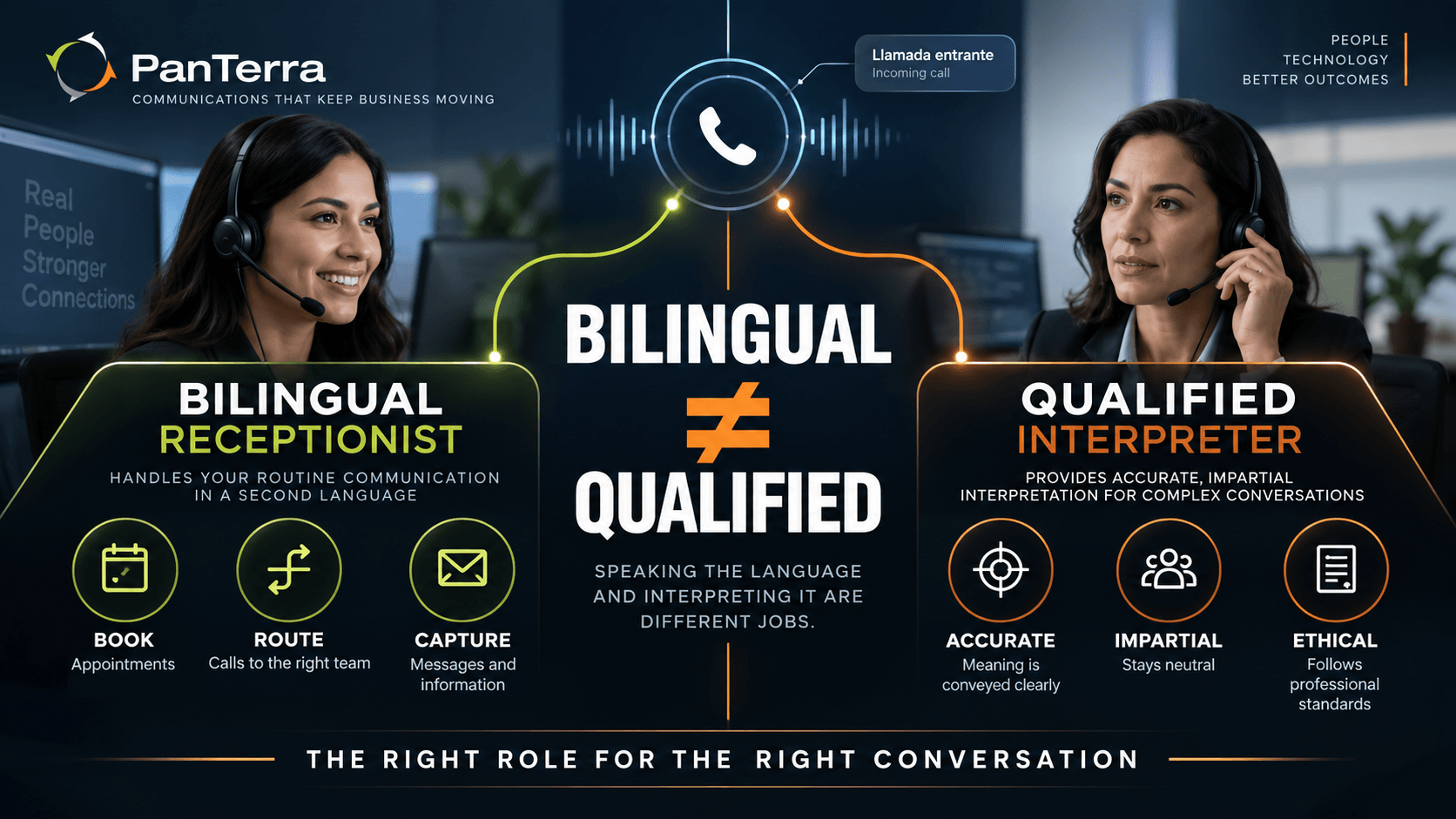
A bilingual virtual receptionist fixes that — in healthcare it may not fix what the law asks you to fix. The rule does not ask whether your receptionist is bilingual. It asks whether the interpreter is qualified.
TL;DR
A bilingual virtual receptionist answers your calls in a second language, either through a remote team that includes speakers of that language or through software that handles the call in the caller's language. For most organizations that is a question of service quality. For a healthcare organization it sits next to a legal duty. 45 CFR 92.201 requires reasonable steps to give callers who do not speak much English real access, and where interpreting is needed, a qualified interpreter. Bilingual and qualified are different standards. Buy the receptionist for the front desk call, and keep a separate interpreter path for the conversation that needs one.
Key Takeaways
Bilingual describes the languages a person speaks. Qualified describes a tested ability to interpret well and stay neutral, plus a trained code of ethics. The rule uses the second word.
Language help has to be free to the caller, accurate, and timely. A service the caller pays for does not count.
You cannot require someone to bring their own interpreter, and you cannot lean on a minor child to interpret except temporarily in an emergency.
An ai receptionist that speaks a second language can take a booking in the caller's language. It is not an interpreter, and treating it as one is the mistake to avoid.
Ask whether a bilingual virtual receptionist covers every hour or only some. Part of the day is the most common gap between the claim and the service.
The language question and the scope question stack. A bilingual virtual receptionist may not read a symptom in any language.
Who This Is For
Best for: multi-site regulated organizations weighing a bilingual virtual receptionist because a real share of calls arrive in a second language · healthcare organizations that need the language path and the interpreter path to be different things · practices and firms whose current coverage is one bilingual staff member and a lot of hope.
Not ideal for: organizations looking for a translation service for documents, which is a different purchase · anyone wanting a vendor ranking, which this article deliberately does not provide · single-person companies, which sit outside the scope of this guide.
Top use cases: appointment booking and confirmations in the caller's language · routing and message capture in the caller's language · overnight and weekend coverage in a second language · one consistent language standard across several sites · a clean handoff from a receptionist who speaks the language to a qualified interpreter.
What Is a Bilingual Virtual Receptionist?
A bilingual virtual receptionist is any setup where the person or system answering your calls can handle them in a language other than English. It arrives in two shapes.
One kind of bilingual virtual receptionist is people. Calls route to a remote team that includes speakers of the language you need, working from a script you supply. Ask which languages, during which hours, and whether that team is the same team.
An ai receptionist handles the call in software. Modern systems recognize the caller's language and continue in it, so coverage does not depend on who is on shift. That is the structural advantage, and it comes with a limit covered below. The Cluster A pillar works through the category split in full.
"Multilingual" usually means more than two languages, and in practice it means a vendor has interpreter capacity rather than native speakers on staff for each one. Worth asking which it is, because the answer changes what the caller experiences.
What Does the Regulation Actually Require?
Here a bilingual virtual receptionist stops being a service choice and becomes a legal one. The gap is wider than most buyers expect.
45 CFR 92.201 requires covered entities to take reasonable steps to provide real access for callers who do not speak much English. Language assistance services must be "free of charge, be accurate and timely, and protect the privacy and independent decision-making ability" of the individual. Where interpreting is needed, the entity must offer a qualified interpreter.
The definition is the part that matters. A qualified interpreter is a person who has shown real skill in English and at least one other language, who can interpret "effectively, accurately, and impartially," and who follows "generally accepted interpreter ethics principles including client confidentiality."
Read those three requirements against a job description for a bilingual receptionist and the divergence is obvious. Speaking a language well is the first of the three and not the other two. Interpreting well under pressure is a trained skill. Staying neutral cuts against the instinct of a helpful employee, who will summarize, soften, and explain. And that code is trained, not picked up from a script.
So a bilingual virtual receptionist can be useful and still leave the duty unmet. The rule sets limits that a loose setup tends to break.
☐ You cannot require the individual to provide their own interpreter. Asking a patient to bring someone who speaks English is not a language access program.
☐ You cannot rely on an unqualified adult accompanying the person, except in an emergency. The friend in the waiting room is not the plan.
☐ You cannot use a minor child to interpret, except temporarily in an emergency. This one is common and it is not permitted.
☐ Remote interpreting has quality requirements. Video and audio remote interpreting must be delivered in real time with high-quality transmission, and the people using it have to be trained on it.
☐ It has to be free to the individual. A service the caller pays for does not meet the duty.
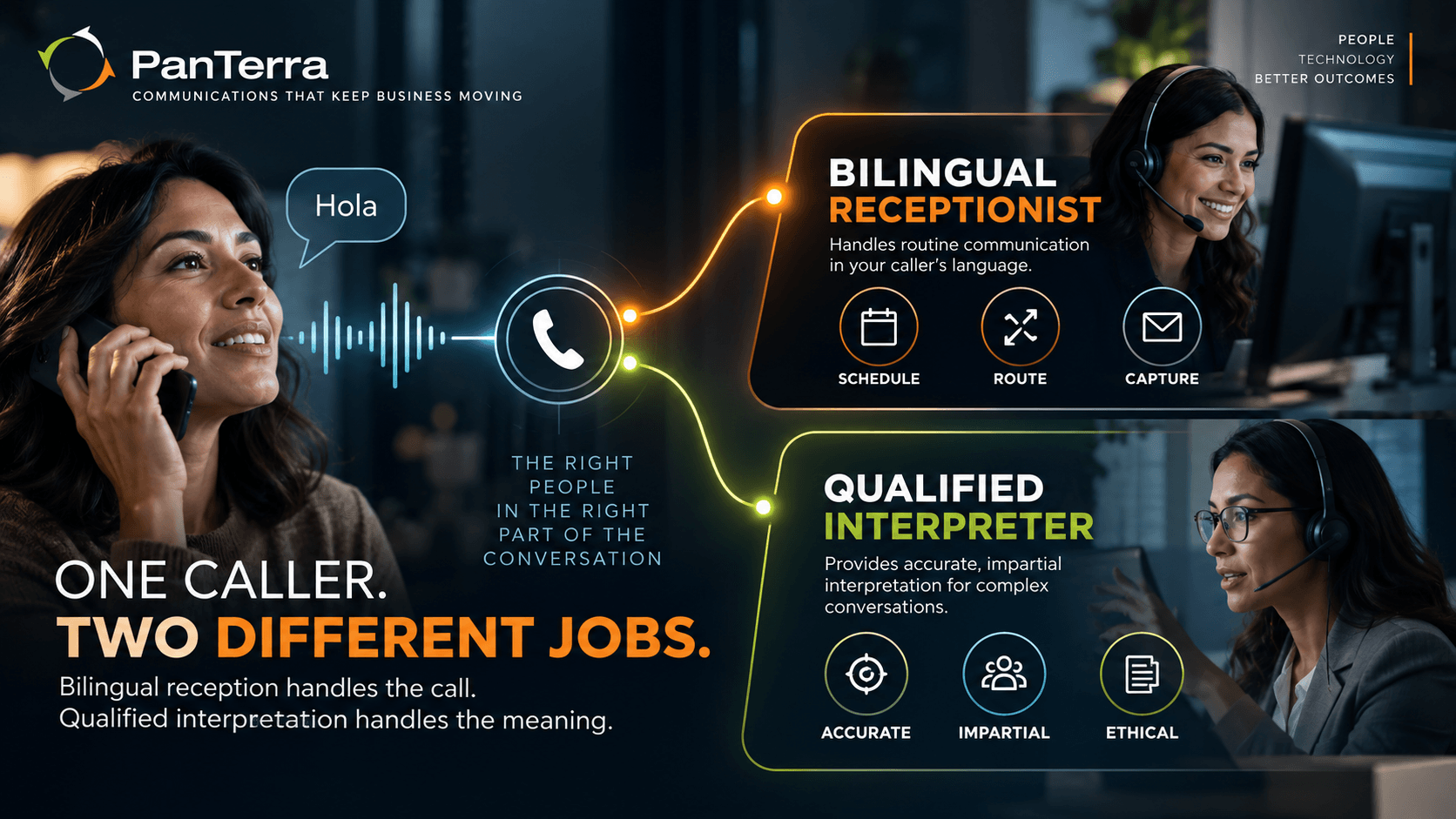
None of that argues against buying a bilingual virtual receptionist. Buy it for what it does. It handles the front desk call well in the caller's language. Keep a separate, written interpreter path for the conversations that need one. HHS publishes sample language access procedures that assume exactly this structure: a telephone interpreter service on file, with staff trained to reach it.
The gap in one sentence. Your bilingual virtual receptionist can book the appointment in Spanish. It is the clinical conversation that follows, and any moment where meaning has to be carried accurately between two people, that needs a qualified interpreter.
Can an AI Receptionist Be the Interpreter?
The category will be asked this over and over. The honest answer is the useful one.
A software bilingual virtual receptionist is doing something real. It answers on the first ring in the caller's language. It does not depend on which staff member is on shift. It covers every hour at the same cost. For a booking, a reschedule, a routing decision, or a published question, that is a genuinely better experience than a caller being put on hold while someone looks for help.
What it is not is a qualified interpreter. Nobody has tested its skill, it is not bound by interpreter ethics, and "impartially" is not a property you can currently evidence about a model's output to a regulator. Any vendor telling a healthcare buyer that a bilingual virtual receptionist meets a Section 1557 duty is making a claim they cannot support. A buyer who relies on it inherits the problem.
The defensible position, and the one to configure: use the ai receptionist for the routine call in the caller's language, and route to your interpreter path the moment the conversation needs interpreting rather than answering. That is a routing rule you can write down, test, and show someone. Ask any bilingual virtual receptionist vendor how the handoff works. Ask what the caller hears. Ask whether the system can be set not to attempt a conversation it should route.
What Should You Ask About Language Coverage?
Feature claims about a bilingual virtual receptionist are unusually soft, so the questions have to be specific.
Which languages, exactly? A list, not "multilingual."
Continuous or during certain hours? This is the most common gap between the claim and the service. Second language cover that ends at 6 p.m. is a partial purchase, and for a staffed service it is the norm rather than the exception.
Is the second language team the same team? For a staffed service, calls in that language are sometimes routed to a smaller or outsourced pool with a different script and different quality.
How does the system detect the caller's language? And what happens when it gets it wrong, which it will.
Can I hear a real call in the second language? Not a demo. Ask for a recording, and if you do not speak the language, have someone who does listen to it.
What is the handoff to a qualified interpreter? What triggers it, what the caller hears, and whether the context carries over.
Is anything translated in writing? Appointment confirmations and message summaries are often produced in English regardless of the call language, which surprises people after go-live.
For healthcare, will you sign a BAA, is it included in this quote, and what does it cover? Ask every vendor, PanTerra included. Our HIPAA compliant answering service guide covers what that claim can and cannot mean.
Where Does the Clinical Limit Sit?
The language question and the scope question stack, and they run separately.
A bilingual virtual receptionist may capture and route, and may answer a question you have already published, in any language it supports. It may not tell a caller what a symptom means or whether it can wait, in English or in Spanish. In most states that is the practice of medicine or dentistry, and language coverage does not change it.
This matters more than it sounds, because the pull runs the other way. A caller who has finally reached someone who speaks their language will ask more. A helpful receptionist will want to answer. Write the escalation rule for the second language path as tightly as for the English one. Our medical virtual receptionist guide covers the practice-side requirements, and the after hours answering service guide covers the escalation design, which is where calls in that language most often go wrong overnight.
Frequently Asked Questions
Who offers bilingual or multilingual virtual receptionist support?
Most staffed services offer Spanish. Fewer offer more languages, usually through interpreter capacity rather than staff who speak them. Most software platforms now handle several languages. Rather than a vendor list, which goes stale within a quarter, ask any bilingual virtual receptionist three questions: which languages exactly, during which hours, and can I hear a real recorded call in that language.
Are there virtual receptionist services that offer bilingual support?
Yes, and the useful follow-up is what "support" covers. Ask whether the second language is available continuously or only during certain hours, whether the calls in that language go to the same team as the English ones, and whether written output such as message summaries and appointment confirmations is produced in the call language or in English.
Is a bilingual virtual receptionist the same as an interpreter?
No, and in healthcare that gap carries legal weight. Federal regulation asks for a qualified interpreter, defined as someone who has shown real skill, can interpret effectively, accurately, and impartially, and follows interpreter ethics, including keeping what they hear private. Speaking a language well meets the first part only. A bilingual virtual receptionist is a front desk service. An interpreter is a separate role held to a separate standard.
Does an AI receptionist satisfy language access requirements?
Treat that as unproven and set it up that way. An ai receptionist can handle a routine call in a second language, which is a real improvement over a caller waiting on hold. Nobody has tested its skill, and it is not bound by interpreter ethics, so it should not be relied on as the qualified interpreter for a conversation that requires one. The safe setup uses a bilingual virtual receptionist for the front desk call and routes to an interpreter for anything else.
What is an answering service?
An answering service answers inbound calls on your behalf when your own staff cannot, then routes the call, takes a message, answers a published question, or escalates. It runs either as a remote team of people working from your script or as software that answers and acts on its own. A bilingual version of either is the same service with second language cover attached.
How does an answering service work?
Calls to your number forward to the service, either continuously or outside the hours you set. A staffed service delivers them to a remote team following your script, routing calls in that language to a speaker of that language. Software answers in place of a person, detects the caller's language, continues in it, and applies the routing rules you configured.
How much does a bilingual answering service cost?
A bilingual virtual receptionist comes in the same two pricing shapes. A staffed service bills per minute or per call against a monthly floor. Software carries a flat monthly fee with volume tiers. Second language cover is often an extra on a staffed quote and often included with software, so ask where the language sits in the price.
How much does a bilingual receptionist make?
That question is about employment rather than about buying a service, and pay varies widely by market and by whether the role includes interpreting duties. If you arrived here comparing hiring against outsourcing, the more useful comparison is in our guide to what an AI receptionist costs, which models a staffed service and software against a real call volume.
Where this article describes published federal regulation, it is a description of those sources rather than legal advice. Section 1557 and its implementing regulation have been subject to rulemaking and litigation, requirements vary by the type of entity and by state, and you should confirm your position with counsel or your compliance officer.
.jpg?width=500&height=500&name=Are%20you%20Getting%20a%20Good%20Deal%20(1).jpg)
Comments