Why Answer Rates Are Quietly Killing Mid-Market Outbound — And What Phone Number Reputation Management Actually Does

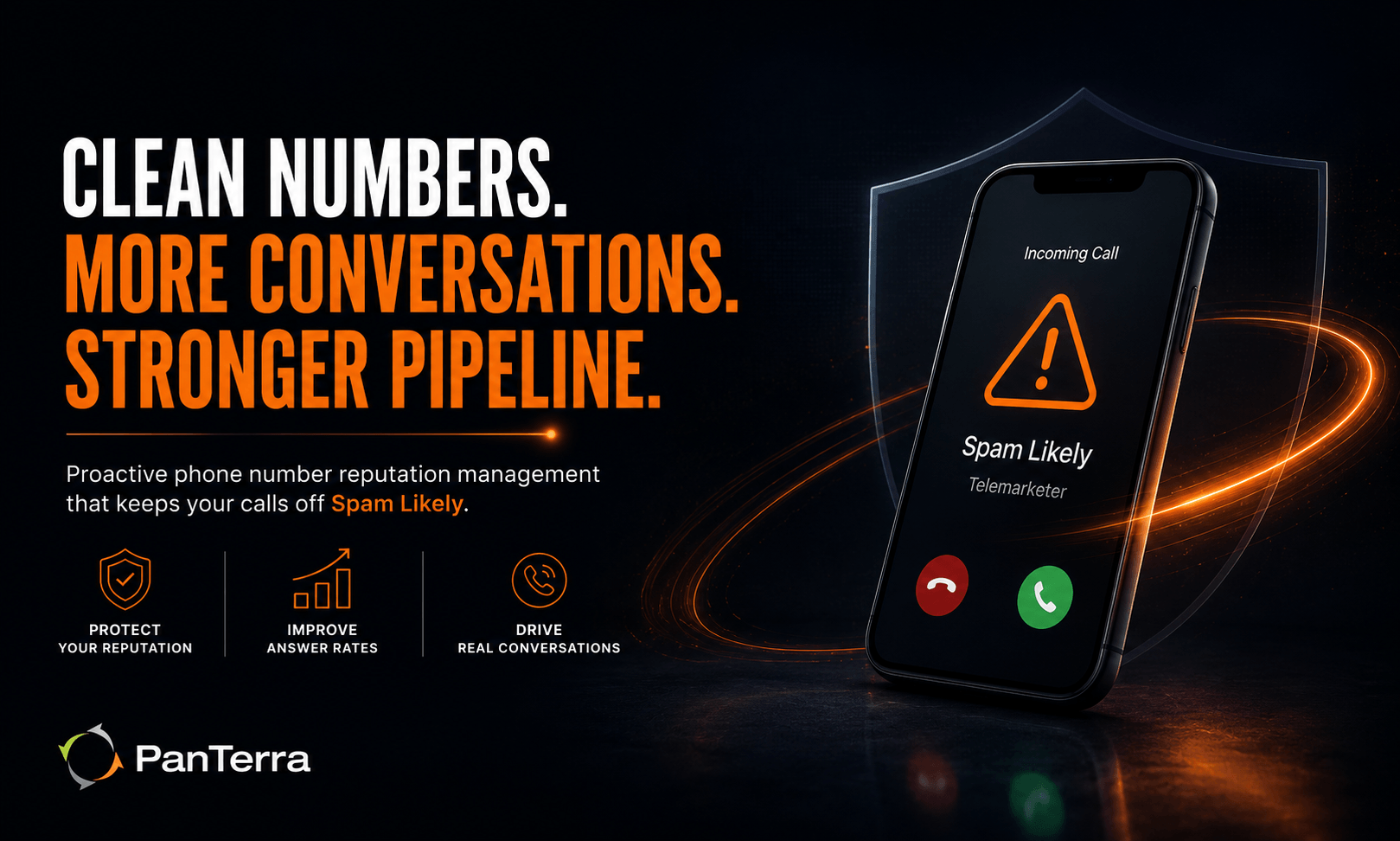
The outbound sales conversation has shifted from 'how do we improve our pitch' to 'how do we get the phone to ring in the first place.' The bottleneck for most mid-market sales teams in 2026 is not closing rate. It is the answer rate.
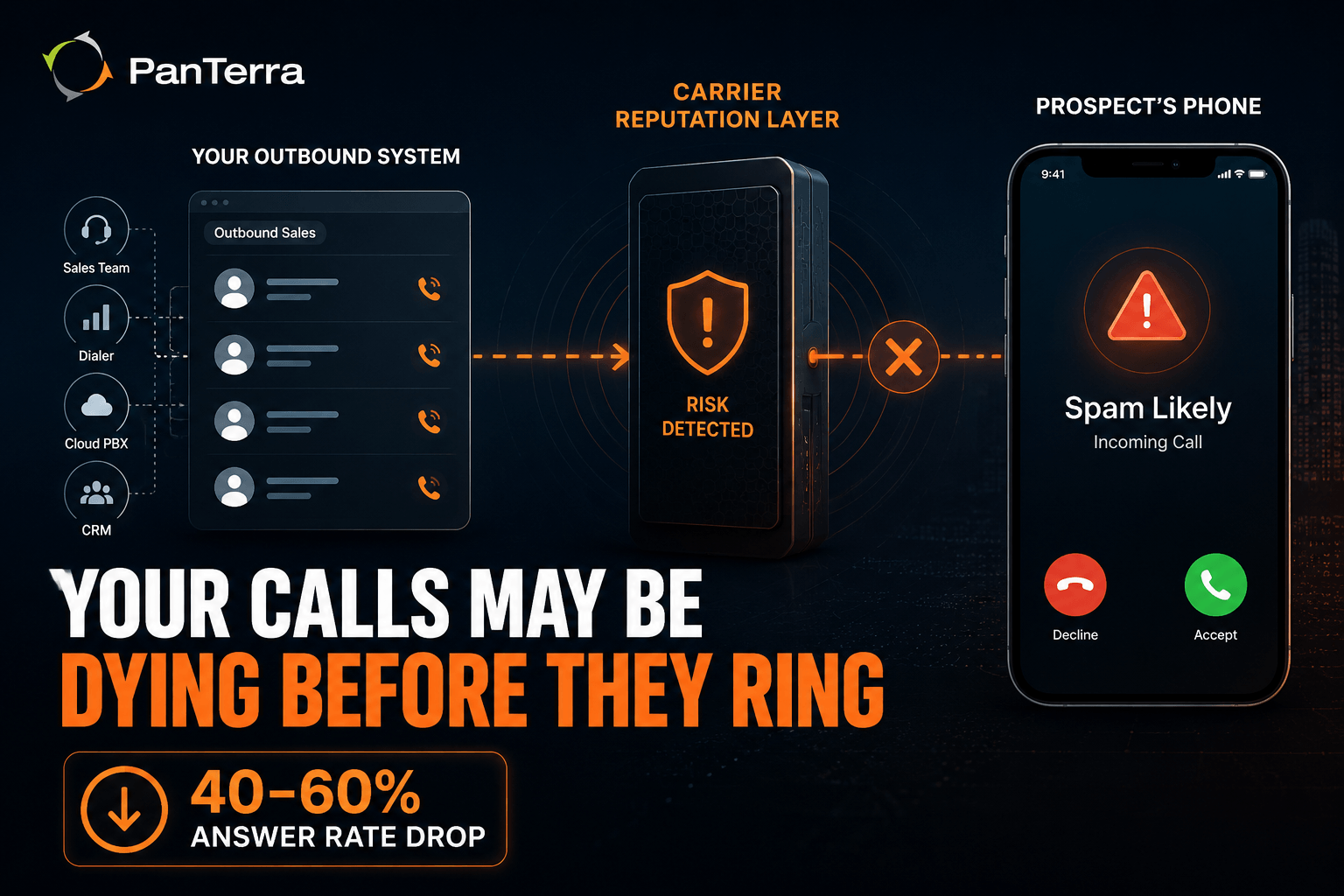
When a business phone number gets labeled 'Spam Likely' or 'Scam Risk' by a carrier analytics engine, answer rates drop 40 to 60 percent: not because prospects are rejecting the message, but because they never see it. The call is flagged before the phone rings. According to Pew Research data from 2025, 8 in 10 U.S. adults now generally ignore calls from unknown numbers. A 2025 Google survey found that 31 percent of people missed at least one important call because it was incorrectly labeled as spam. These are not robocall statistics. They are the operating conditions for every legitimate outbound team in 2026. See our full VoIP statistics reference for the broader data context.
Key Data Points
40–60%
Answer rate drop when a business number is labeled 'Spam Likely' (PanTerra data)
80% of U.S. adults ignore unknown callers
Pew Research, 2025 — rises to 95% when a spam label is visible
2.3% dial-to-conversation rate in 2026
Down from 4.82% the prior year — spam labeling is a primary driver (Prospeo)
TL;DR
- When a business number is labeled 'Spam Likely,' answer rates drop 40 to 60 percent overnight, not gradually. The label goes on before the phone rings.
- 80% of U.S. adults ignore unknown callers. When a spam label is present, that figure approaches 95%.
- STIR/SHAKEN authentication is necessary but not sufficient. It verifies number ownership. It does not protect against behavioral spam scoring.
- Phone number reputation management monitors your numbers 24/7 across AT&T, Verizon, T-Mobile, Hiya, First Orion, and TNS — and initiates remediation when a label appears.
- PanTerra is the only major UCaaS provider that integrates phone number reputation management natively. Remediation typically completes in 2 to 3 business days.
Who This Is For
- Best for: Sales managers, revenue operations leaders, and IT directors at mid-market organizations running outbound calling programs where answer rate directly affects pipeline.
- Not ideal for: Businesses where phone is a support channel only and outbound volume is low. The answer rate problem is concentrated in outbound-heavy operations.
- Top use case: Adding 24/7 phone number reputation monitoring and automated remediation to a UCaaS platform so outbound teams are not blindsided by spam labels that silently kill answer rates.
The Answer Rate Problem Is Getting Worse
The numbers tell the story plainly. According to 2026 outbound sales research from Prospeo, the average dial-to-conversation rate has dropped to 2.3 percent, down from 4.82 percent the prior year. The decline is not entirely attributable to spam labeling, but carrier filtering is a primary driver.
Here is the specific mechanic: carrier analytics engines analyze every call on their networks. They look at call volume, calling patterns, complaint rates, call duration, and authentication signals. When a number triggers enough criteria: even from normal, compliant business activity, it gets scored as potential spam. The label appears on the recipient's screen before the phone rings. According to research from Convoso, when a call displays as 'Spam Likely' or 'Scam Risk,' answer rates plummet to near zero. Even prospects who would be interested do not pick up.
Industry estimates suggest roughly 1 in 4 legitimate business numbers has some risk of being flagged, and contact rates have dropped approximately 40 percent across industries due to labeling and blocking. What makes the problem particularly damaging for mid-market teams: most sales managers do not know when a label is applied. The reps dial. The calls do not connect. The natural conclusion is that the list is bad, the timing is wrong, or the product message needs work. None of those are the actual problem.
What Triggers a Spam Label on a Legitimate Business Number
Understanding how spam labels work removes the assumption that they only happen to bad actors. Carrier spam detection systems do not verify intent. They analyze behavior. Any number can be flagged when its calling pattern looks like what spam looks like: high call volume, short call durations, many unanswered calls, and calls to numbers that have been previously flagged by recipients.
The threshold for 'suspicious' has dropped significantly as carriers tighten filtering. A 20-person SDR team making 50 calls per day per rep shares calling pattern characteristics with spam operations at a certain scale.
The critical point: STIR/SHAKEN authentication: the FCC-mandated framework described in our STIR/SHAKEN guide. It addresses number identity verification. It does not protect against behavioral spam scoring. A fully authenticated number with valid A-level attestation can still receive a spam label if its calling behavior triggers carrier algorithms. According to TNS's 2026 Robocall Report, 43 percent of spam-labeled traffic carries A-level STIR/SHAKEN attestation. Authentication and reputation are separate systems.
The Five Stages Where Spam Labels Enter the System
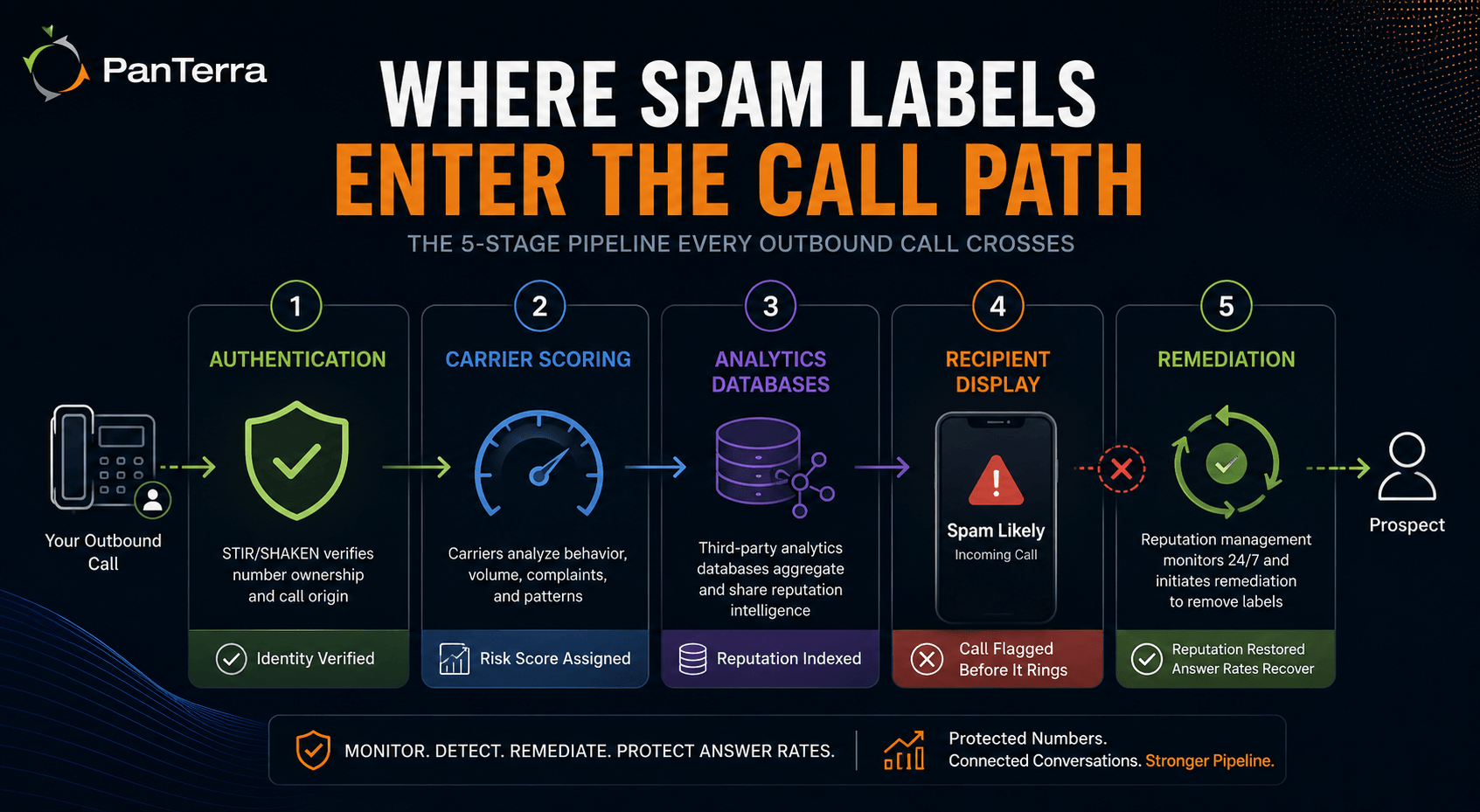
Most guides to fixing spam labels stop at 'register your numbers.' That covers one stage. Here is what happens across the full pipeline:
Stage 1: STIR/SHAKEN registration and attestation. Your VoIP provider signs outbound calls with a digital attestation level (A, B, or C). A-level attestation means the provider certifies both that you are a legitimate caller and that you are authorized to use the number you are calling from. If your provider cannot consistently deliver A-level attestation, you start every call under suspicion. This is the stage most guides address.
Stage 2: Carrier network scoring. Each Tier-1 carrier (AT&T, Verizon, T-Mobile) runs its own analytics system that scores numbers based on behavioral patterns. A number can pass Stage 1 with full A-attestation and still score negatively at Stage 2 based on call volume, duration patterns, and complaint data.
Stage 3: Analytics provider databases. Separate from carrier networks, analytics companies (Hiya, First Orion, TNS) maintain their own reputation databases used by caller ID apps, device-level filtering, and many carrier systems. A label in Hiya's database affects millions of smartphone users through native Android and iPhone caller ID.
Stage 4: Carrier display to recipient. The compiled score from Stages 1 through 3 determines what displays on the recipient's screen: the business name (branded caller ID), nothing (clean but unregistered), or a warning label if the number has been flagged.
Stage 5: Remediation. When a number carries a spam label, removing it requires contacting each carrier or analytics provider separately, filing a dispute, and waiting for the database to update. Without monitoring, businesses do not know a label exists until they notice their answer rates have dropped. This typically happens weeks after the label was applied.
What Phone Number Reputation Management Actually Does
Phone number reputation management is a monitoring and remediation service that addresses Stages 2 through 5 directly. A 24/7 monitoring layer watches your business numbers across AT&T, Verizon, T-Mobile, Hiya, First Orion, and TNS continuously. When a spam label appears, an alert fires and remediation initiates automatically. The label is typically removed within 2 to 3 business days. See our complete phone number reputation management guide for a full breakdown of how each network's scoring works.
Continuous monitoring vs point in time registration. Carrier databases update daily. A clean number today can be flagged tomorrow if call patterns shift. Registration is a one-time action. Monitoring is ongoing.
Remediation initiation without manual IT involvement. The alternative to automated remediation is manual dispute filing: visiting AT&T's review portal (att.com/reviewmycalllabel), T-Mobile's reporting tool (callreporting.t-mobile.com), and Verizon's feedback page (voicespamfeedback.com) for each affected number. Our spam label removal guide covers the manual process in full. Manual is the fallback, not the strategy.
Cross-network coverage. A business number can have different reputation status on different networks. AT&T might show the number as clean while T-Mobile shows it as spam. Monitoring requires watching all three Tier-1 carriers and the major analytics providers simultaneously.
The Business Impact for Mid-Market Outbound Teams
The math is not abstract. On a team making 500 outbound calls per day, a 40 to 60 percent answer rate reduction means 200 to 300 conversations that never happen. Not because of prospect disinterest. Because of an infrastructure label that the team cannot see.
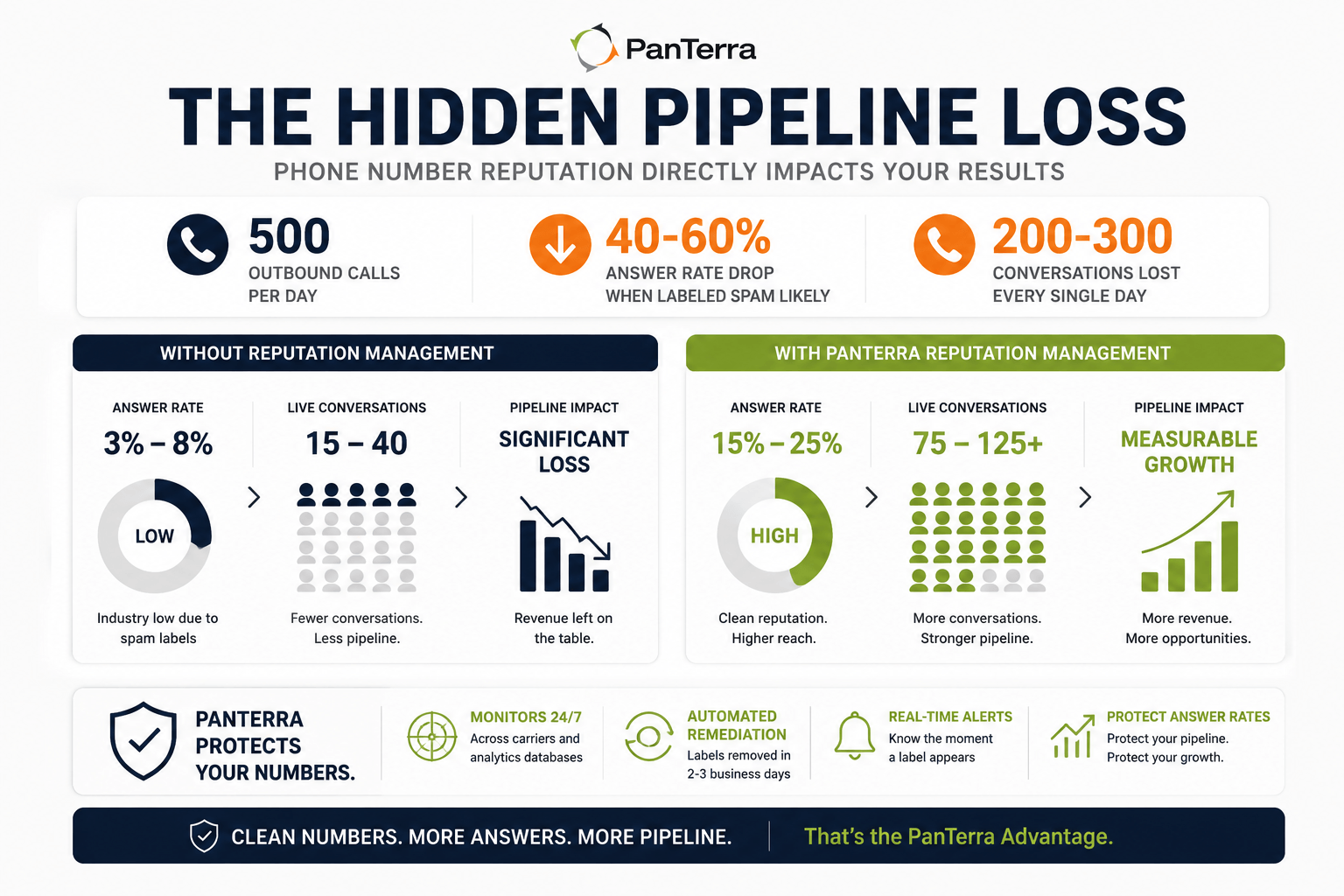
For sales teams where the 2.3 percent dial-to-conversation rate is the baseline, every percentage point of answer rate matters disproportionately. Improving answer rate from 8 percent to 12 percent on a team that dials 500 times per day is 20 additional live conversations daily. At a standard conversion rate, that is a meaningful pipeline change: not from hiring more SDRs, not from buying better lists, but from removing an invisible filter.
According to 2026 outbound benchmarks, teams with clean number reputation and properly managed DIDs achieve connection rates of 15 to 25 percent on fresh, healthy lists. Teams hitting the industry-low end (3 to 8 percent) are almost always dealing with number reputation issues in addition to list quality problems.
How PanTerra Integrates Reputation Management
PanTerra is the only major UCaaS provider that integrates phone number reputation management natively into the Streams.AI platform. The service monitors business numbers across AT&T, Verizon, T-Mobile, Hiya, First Orion, and TNS continuously, initiating automated remediation when a label appears. Remediation typically completes in 2 to 3 business days.
For mid-market outbound teams on Streams.AI, the calling infrastructure handles both the communication layer (calls, SMS, video) and the reputation layer (monitoring, alerting, remediation) from a single platform. No separate tool to manage, no manual dispute process to run, no guesswork about which numbers are carrying labels.
The service is available as an add-on at $10/number/month. For a team running 20 outbound numbers, that is $200/month to protect the pipeline those numbers generate. The alternative is experiencing a spam label event, watching answer rates drop 40 to 60 percent, not knowing why for two to three weeks, and then spending IT time manually filing disputes across three carrier portals.
Frequently Asked Questions
What is phone number reputation management?
Phone number reputation management is a monitoring and remediation service that watches business phone numbers across carrier networks (AT&T, Verizon, T-Mobile) and analytics providers (Hiya, First Orion, TNS) for spam labels, and automatically initiates disputes when labels appear. It is distinct from STIR/SHAKEN authentication, which verifies number identity but does not protect against behavioral spam scoring by carrier analytics engines.
How much does a spam label reduce answer rates?
When a business phone number displays as 'Spam Likely' or 'Scam Risk' on the recipient's screen, answer rates typically drop 40 to 60 percent. Research puts the figure higher in some contexts: when a spam label is present, up to 95 percent of recipients will not answer. The drop typically happens overnight following a labeling event, not gradually, which means outbound teams often see a sudden unexplained decline in connect rate before they identify the cause.
What causes a legitimate business number to get a spam label?
Carrier analytics engines score numbers based on behavioral signals, not intent. Triggers include high call volume from a single number in a short window, low answer rates (which create a vicious cycle), calls to numbers that have previously filed spam complaints, and very short call durations indicating immediate hangups. A number that is fully STIR/SHAKEN authenticated with A-level attestation can still receive a spam label if its calling behavior triggers carrier scoring algorithms.
What is the difference between STIR/SHAKEN and phone number reputation management?
STIR/SHAKEN is the FCC-mandated call authentication framework that verifies whether the number on a caller ID is legitimately owned by the calling party, preventing number spoofing. Phone number reputation management monitors how carrier analytics engines score your numbers based on behavioral data: call volume, duration patterns, complaint rates. The two systems operate independently. A number can pass STIR/SHAKEN with full A-attestation and still carry a spam label.
How long does it take to remove a spam label?
Manual remediation through individual carrier portals typically takes 1 to 4 weeks depending on the carrier. Automated remediation through PanTerra's phone number reputation management service typically completes in 2 to 3 business days. See our spam label removal guide for the full manual process breakdown.
Why is STIR/SHAKEN not enough to prevent spam labels?
STIR/SHAKEN authenticates number identity: it tells the carrier whether the calling party legitimately owns the number they are calling from. It does not evaluate behavioral patterns. Carrier spam detection systems analyze call volume, answer rates, call duration, and complaint data separately from authentication. According to TNS's 2026 Robocall Report, 43 percent of spam-labeled traffic already carries A-level STIR/SHAKEN attestation, confirming that authentication alone does not prevent spam labels.
What does phone number reputation management cost?
PanTerra's phone number reputation management service is available at $10 per number per month. Enterprise-level reputation management solutions from standalone providers typically run $50 to $75 per user per month. PanTerra's native integration with Streams.AI eliminates the separate vendor relationship and includes monitoring and remediation in the same platform as voice, video, messaging, and SMS.
How does poor caller ID reputation affect a sales team's pipeline?
The impact is direct and compounding. A spam label reduces answer rates 40 to 60 percent. On a team making 500 dials per day, that means 200 to 300 fewer live conversations daily. Lower live connection rates reduce pipeline creation. Fewer pipeline entries reduce closed revenue in the following quarter. The label also creates a vicious cycle: when fewer people answer, the carrier algorithm scores the number more negatively, which causes even fewer people to answer. Without reputation management to interrupt that cycle, the compounding effect continues until the number is effectively dead for outbound use.
.jpg?width=500&height=500&name=Are%20you%20Getting%20a%20Good%20Deal%20(1).jpg)
Comments