The Ultimate Guide to AI-Powered Customer Engagement


AI-powered customer engagement is the use of artificial intelligence layered on unified communications platforms to analyze intent, route interactions, preserve context across channels, and improve customer experience and agent productivity at scale.
It builds on the same foundation as unified communications, voice, video, messaging, email, and collaboration, while using AI to reduce friction and improve consistency at scale.
For mid-market enterprises and growing SMBs, this approach reduces response time and agent handling effort and customer experience without requiring proportional increases in support staff or tool complexity.
A key reason this topic matters now: the AI for customer service market is projected to grow from $12.06B (2024) to $47.82B (2030).
AI-Powered Customer Engagement: Key Takeaways:
- AI-powered customer engagement combines unified communications with intelligence that interprets intent, routes interactions, and improves outcomes.
- Mid-market organizations use AI engagement to scale support without proportional increases in staff.
- AI-assisted routing and summarization improve first-contact resolution and agent productivity.
- Cloud-based, unified platforms reduce fragmentation and preserve customer context across channels.
Why have customer expectations changed, and why does it matter now?
Customer expectations have shifted toward speed, convenience, and continuity across channels.
People don’t think in “departments” or “channels”, they think in outcomes, and they want the business to keep context across touchpoints.
For mid-market teams, this creates a pressure gap:
- Interaction volume grows faster than hiring budgets
- Customers expect faster response times and fewer handoffs
- Support teams need better visibility across channels to resolve issues efficiently
This is where AI-powered engagement becomes practical: it reduces the “switching cost” of fragmented systems and helps teams handle growth without turning the support org into a patchwork of tools.
The foundation for meeting these expectations is unified communications, the convergence of channels into one platform.
AI-powered engagement is the next layer: intelligence added to unified communications so the system can assist with routing, triage, and analysis instead of functioning as a passive set of communication pipes.
What is AI-powered customer engagement?
AI-powered customer engagement is unified communications enhanced with artificial intelligence to support faster, more consistent customer interactions.
It integrates customer-facing channels and applies AI to interpret intent, route requests, and help optimize responses in real time.
The unified communications foundation
Traditional unified communications typically include:
- Voice communication (VoIP): voice calls and conferencing over the internet, reducing reliance on traditional landlines.
- Video conferencing: face-to-face collaboration across locations.
- Instant messaging + presence: real-time chat plus availability indicators so teams can coordinate quickly.
- Email integration: centralized access and management in the same environment.
- Collaboration tools: file sharing, document collaboration, and project coordination.
- Mobile integration: access across devices so employees stay connected from anywhere.
AI-powered customer engagement improves first-contact resolution by reducing transfers and preserving context across channels.
When channels are unified, teams don’t need to hunt across tools, and customers don’t need to repeat context as often.
The intelligence layer: NLP + machine learning
AI-powered engagement adds capabilities that go beyond static automation:
- Natural language processing (NLP): helps systems interpret customer intent from conversational language (not just menu options).
- Machine learning: helps systems improve routing and recommendations based on interaction history and outcomes.
- Interaction analysis (including sentiment signals): helps prioritize or escalate interactions and identify recurring issues.
These features don’t replace the UC foundation; they operate on top of it.
How is AI-powered engagement different from traditional automated systems?
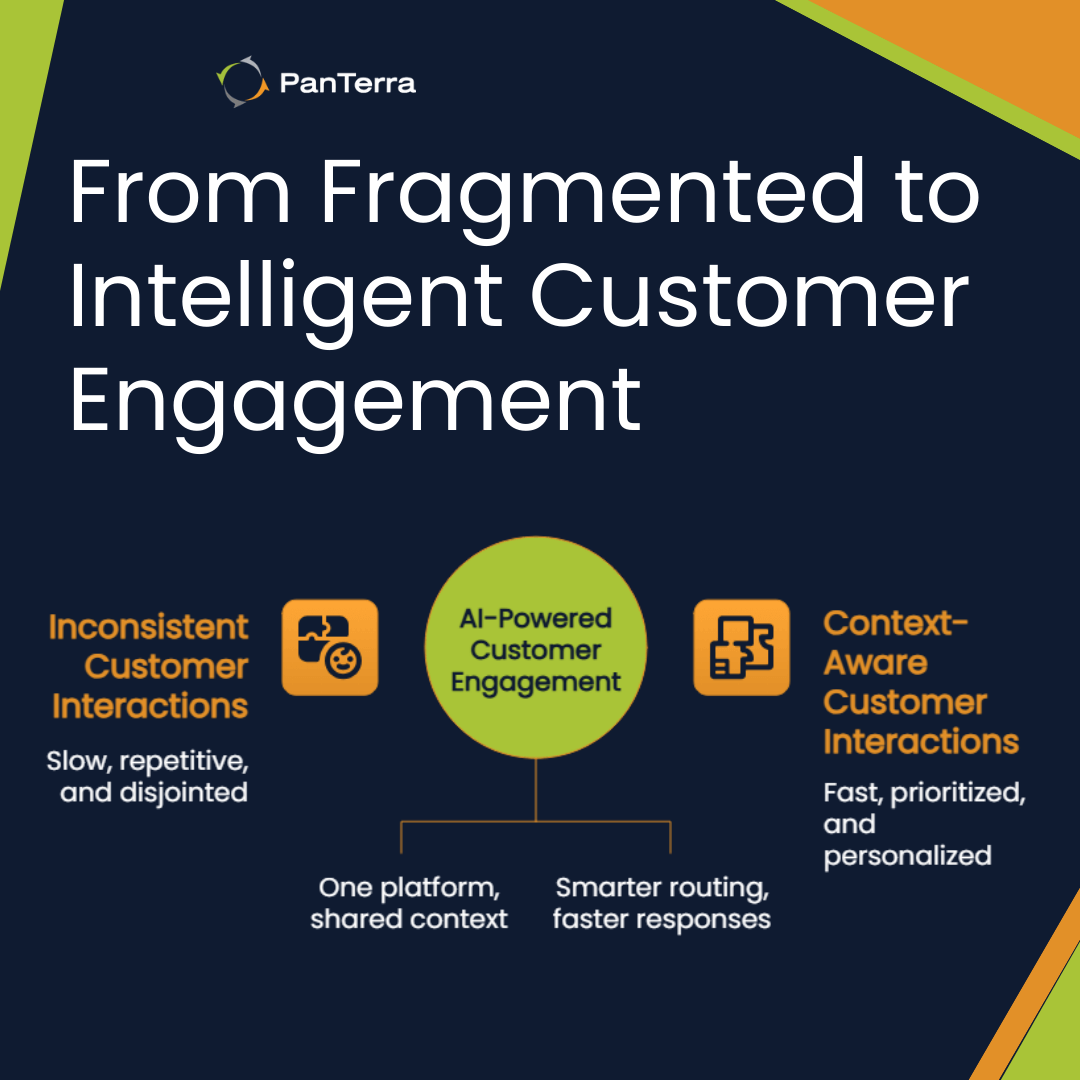
AI-powered engagement can adapt based on intent, context, and patterns in interactions, unlike traditional automation, which follows fixed decision trees.
A traditional workflow might look like:
- “Press 1 for Billing, press 2 for Support…” If the customer’s need doesn’t fit the tree, they get bounced around.
An AI-assisted workflow aims to:
- interpret intent from the customer’s words,
- route to the right queue or resource faster,
- preserve context across channels,
- and support agents with summaries, transcripts, and recommended next steps.
Even when AI is used for self-service, the highest-value use cases often involve AI + human workflows: AI handles routine triage and repetitive inquiries, and humans focus on nuance, judgment, and exceptions.
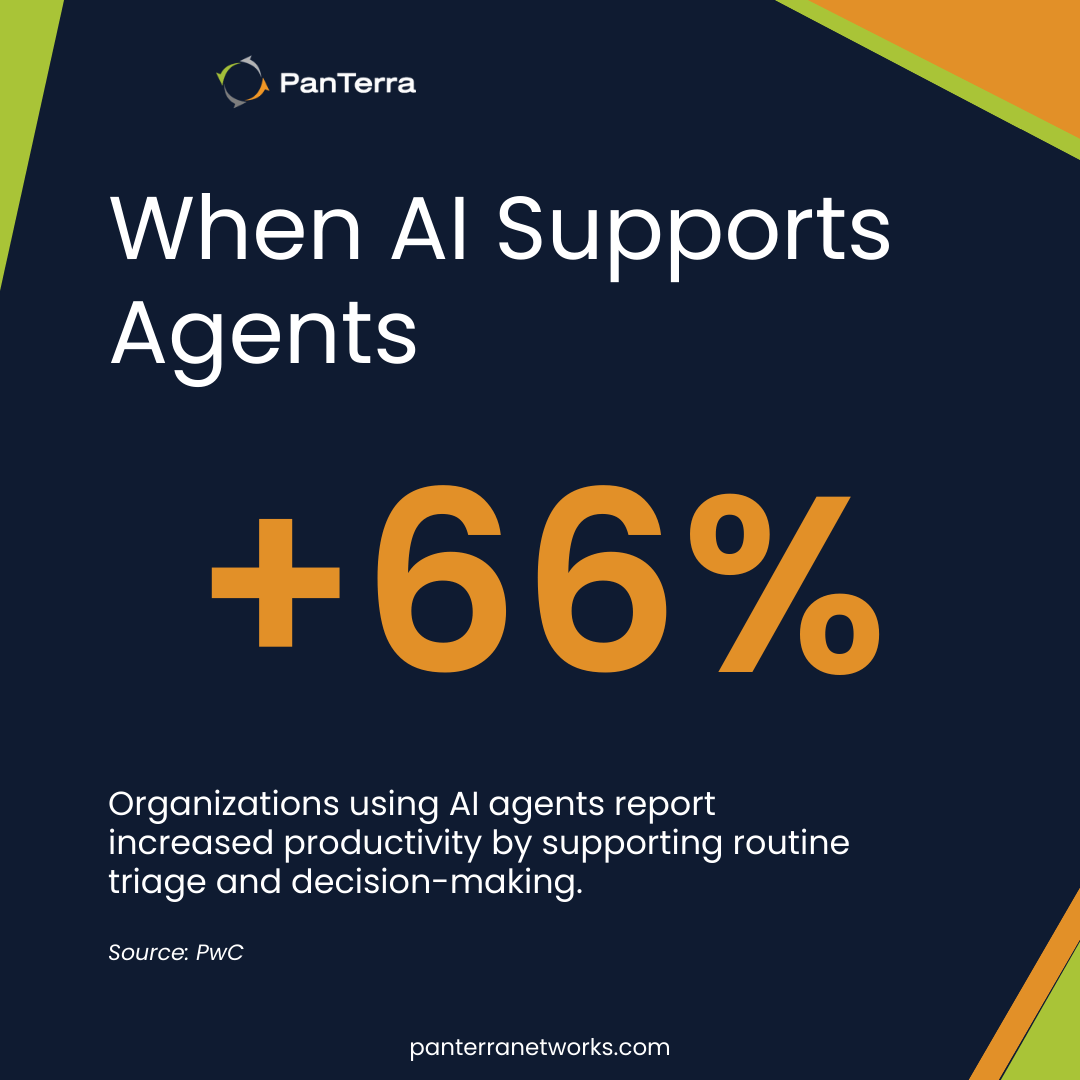
In a PwC survey, 66% of organizations adopting AI agents reported increased productivity, and 57% reported cost savings.
What are the key benefits for mid-market enterprises?
AI-powered engagement inherits the benefits of unified communications and strengthens them by improving routing, insight, and scalability.
For mid-market orgs, the biggest wins tend to show up in efficiency, quality, and operational leverage.
Increased agent efficiency and productivity
Unified platforms reduce time lost switching between tools and searching for context. AI can further reduce effort by assisting with triage, summaries, and routing.
In practice, this often looks like:
- Fewer transfers;
- Faster access to customer history;
- Better queue assignment;
- Less time spent on repetitive questions.
Organizations report in AI agent adoption: productivity gains are one of the most common measurable outcomes.
Platforms such as PanTerra, which combine unified communications with AI-assisted routing and analytics, illustrate how mid-market organizations can deploy AI-powered engagement without enterprise-level complexity.
Hyper-personalization at scale
“Personalization” in support isn’t marketing fluff. It’s operational: the customer doesn’t want to repeat context, and the agent needs relevant details fast.
When communication channels are unified:
- The business can maintain continuity across voice, video, messaging, and email;
- And teams can collaborate around a shared customer context.
AI can help by surfacing patterns and recommended responses based on past resolutions, without forcing agents to manually search or reconstruct context.
24/7 intelligent support coverage
Mid-market enterprises rarely want to staff full human coverage for all hours. AI-enabled systems can support after-hours responsiveness by handling routine inquiries or capturing structured context for follow-up.
Even without “full autonomy,” AI is useful for:
- Collecting the right information upfront;
- Summarizing the issue;
- Routing it to the correct team;
- Reducing customer effort.
Unlocking data-driven insights
Unified communications already centralize interactions. AI-powered engagement helps extract insight from them. Common insight outputs include:
- Recurring pain points and drivers of contact volume;
- Topics that generate escalations;
- Issues correlated with churn or dissatisfaction;
- Gaps in documentation or self-service coverage.
This turns “support volume” into a feedback loop for product, operations, and training, without forcing manual tagging for every interaction.
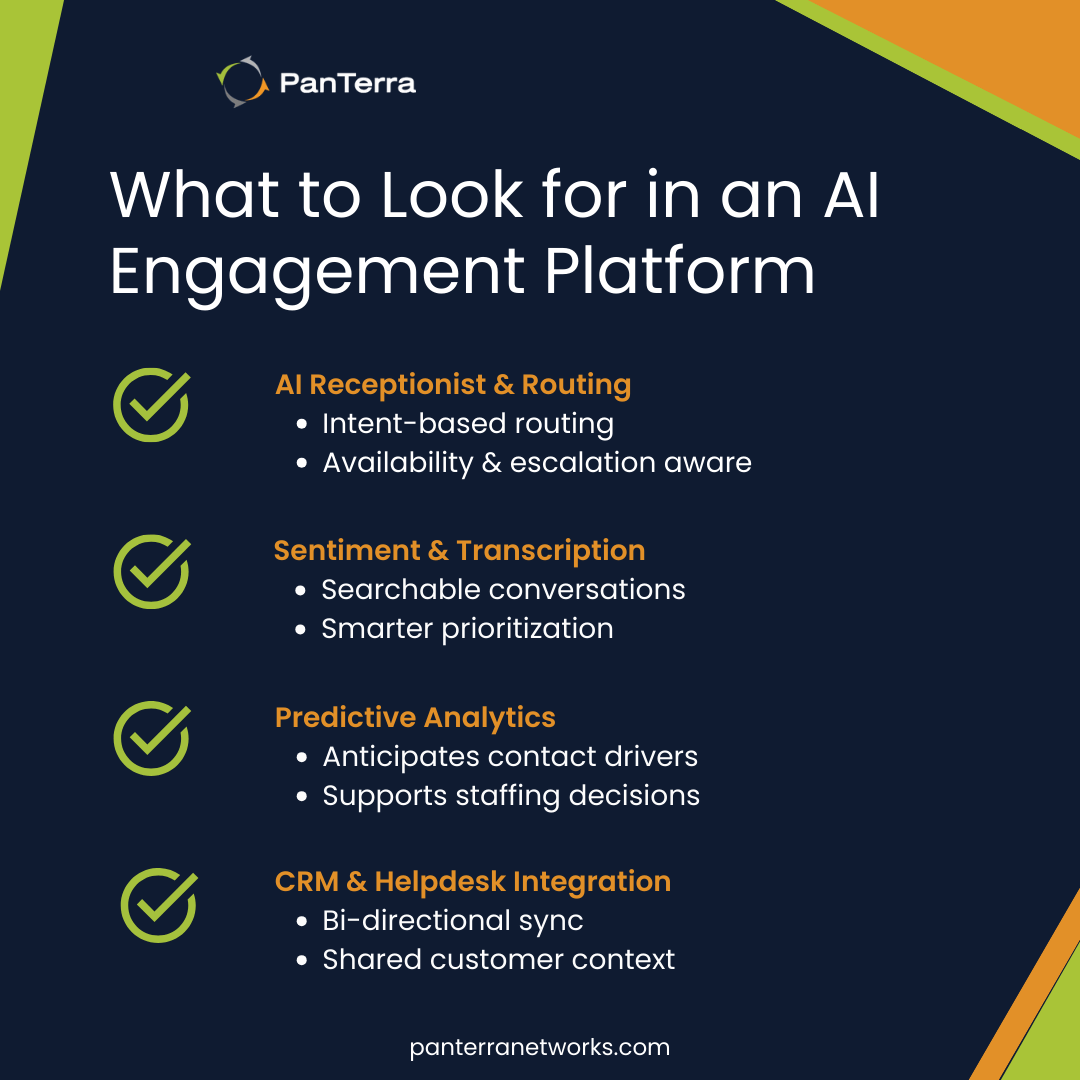
What features should you look for in an AI engagement platform?
An effective AI engagement platform unifies communication channels and applies AI to improve outcomes.
AI receptionist and intelligent call routing
At minimum, routing should account for:
- Intent;
- Availability;
- Team specialization;
- Escalation paths.
An AI receptionist should reduce menu friction and route more accurately than static IVRs, while still allowing clear fallbacks and human handoffs.
Real-time sentiment signals and transcription
Voice calls contain high-value context, but they’re difficult to analyze at scale without transcription. Transcription enables:
- Searchable interaction history;
- Better handoffs;
- Consistent documentation;
- Training/coaching insights.
Sentiment signals (used carefully) can support prioritization and escalation—especially when combined with clear policies for human review.
Predictive analytics for customer behavior
Predictive analytics should support operational outcomes, such as:
- Anticipating contact drivers;
- Identifying customers at risk of repeat contact;
- Surfacing probable root causes;
- Informing staffing/queue planning.
The key is that predictions should be actionable, not just dashboards.
Seamless CRM and helpdesk integration
Unified engagement fails if the system can’t integrate with the tools where customer truth lives. Look for:
- Bi-directional sync (not manual exports);
- Consistent customer identity across channels;
- Support for workflows like ticketing, escalation, and internal collaboration.
Without integration, teams revert to copy/paste, and the platform becomes “yet another tool.”
How do you implement your AI engagement strategy successfully?
Implementation of AI engagement strategy requires planning and attention to integration, security, reliability, and user adoption.
Step 1: Audit your current communication stack
Start by mapping:
- All channels (voice, video, messaging, email);
- Systems used by different departments;
- Handoffs and escalation paths;
- Where context gets lost.
The goal is to identify fragmentation. In many organizations, customers bounce between channels while internal teams operate in silos.
Step 2: Define KPIs (before rollout)
Choose KPIs that reflect both efficiency and experience, such as:
- Response time and first-contact resolution trends;
- Transfer rate and repeat-contact rate;
- Handle time and time-to-context for agents;
- Customer satisfaction signals aligned with your current measurement model.
Avoid vanity metrics. Pick what your team can measure consistently.
Step 3: Choose the right vendor (checklist included)
Use this checklist to evaluate fit:
- Unified channels: voice, video, messaging, email, collaboration;
- AI capabilities: intent handling, routing assistance, interaction analysis;
- Integration: CRM/helpdesk compatibility and workflow support;
- Security: access control, auditability, data protections;
- Reliability: uptime posture, redundancy, continuity planning;
- Adoption support: training, onboarding, admin controls.
Step 4: Train your team and drive adoption
User adoption is a core risk in unified communications, and it remains one in AI-powered engagement.
Best practice:
- Train for workflows, not features;
- Establish when agents should rely on AI assistance vs override;
- Keep escalation paths clear;
- Iterate based on frontline feedback.
AI succeeds when it reduces friction without forcing agents into unnatural scripts.
FAQ
Is AI-powered customer engagement only for large companies?
AI-powered customer engagement actually helps SMBs and mid-market teams scale efficiently.
How should businesses evaluate performance improvements?
Performance improvements of AI-powered customer engagement can be measured by internal KPIs before and after implementation.
How can companies avoid AI tool sprawl?
By unifying channels and adding AI selectively.
Next Steps
AI-powered customer engagement is most effective when built on a communication platform that centralizes channels, preserves interaction context, and supports AI-assisted routing and analysis across teams.
Before expanding AI-driven workflows, organizations should evaluate whether their current infrastructure reduces fragmentation or adds complexity.
PanTerra provides a unified communications platform that supports AI-powered customer engagement across voice, messaging, video, and analytics.
.jpg?width=500&height=500&name=Are%20you%20Getting%20a%20Good%20Deal%20(1).jpg)
Comments