VoIP for Healthcare in 2026: The Complete Buyer's Guide for HIPAA-Compliant Phone Systems


If you run a medical practice, dental office, or multi-location healthcare organization in 2026 and you’re searching for the best VoIP for healthcare, the market looks deceptively crowded. A handful of providers — Weave, Mango Voice, and a long tail of niche resellers — dominate search results because they integrate with popular Electronic Health Records (EHR) and Practice Management Software (PMS). But integration depth is not the same thing as platform reliability. A HIPAA compliant phone system that drops calls during patient hours costs you more than any reminder text can save.
This guide cuts through the noise. We’ve evaluated the most relevant healthcare VoIP and UCaaS platforms on the criteria that actually matter: HIPAA/HITECH compliance, documented uptime, US-based 24/7 support, secure file sharing for protected health information (PHI), telehealth-ready video, and total cost of ownership over two to three years. Every data point comes from published pricing, verified customer reviews on G2 and Capterra, and independent uptime tracking — not vendor marketing.
The U.S. healthcare communications market is shifting fast. More than 90% of healthcare organizations now operate hybrid front-office workflows that mix in-person, telehealth, and remote staff, and the average dental or medical practice handles 60–120 inbound patient calls per day. The cost of a wrong VoIP decision is no longer just a higher invoice — it's missed appointments, HIPAA exposure, and patient churn.
What We Cover in This Guide
- Why Healthcare Organizations Are Moving to Cloud VoIP
- The HIPAA Challenge with Standard VoIP
- What to Look for in a Healthcare VoIP Provider
- The Best VoIP for Healthcare in 2026 — Ranked
- Side-by-Side Comparison: PanTerra vs. Weave vs. Mango Voice vs. Nextiva
- Why Patient Reviews and Phone Number Reputation Matter for Healthcare
- VoIP Pricing Guide for Medical Practices
- How to Choose the Right Healthcare VoIP Provider
- Frequently Asked Questions
Why Healthcare Organizations Are Moving to Cloud VoIP
Legacy on-premises PBX systems were not designed for the way modern medical practices operate. Today’s healthcare front office has to handle inbound patient calls, route after-hours urgent calls to on-call providers, send appointment reminders by SMS, conduct telehealth video visits, and securely transmit referrals and lab results — all without exposing protected health information. A traditional phone system handles roughly two of those jobs.
The shift to cloud VoIP for healthcare is driven by four pressures: aging PBX hardware costs, the rise of hybrid and telehealth workflows after 2020, federal STIR/SHAKEN mandates, and the staffing crisis that forces practices to do more with smaller front-desk teams. A modern HIPAA-compliant cloud phone system reduces communication costs by 40–60% versus legacy systems. It scales without new hardware and consolidates voice, video, messaging, and secure file sharing into a single subscription.
The critical shift in 2026 is that core features no longer differentiate healthcare VoIP providers — every serious vendor offers calling, texting, and basic appointment reminders. The differentiators that matter now are native HIPAA/HITECH certification (not bolt-on compliance), documented uptime, the quality of US-based live support when something breaks during patient hours, secure file sharing for PHI, and integrated phone number reputation management to keep appointment-confirmation calls from getting flagged as 'Spam Likely.'
The HIPAA Challenge with Standard VoIP
Most consumer-grade and small-business VoIP services are not HIPAA-compliant out of the box. Many that claim compliance only achieve it by signing a Business Associate Agreement (BAA) and asking the customer to configure the rest. That puts the legal and operational burden on the practice, not the vendor. For any phone system for a medical office, that is an unacceptable risk.
True HIPAA-compliant VoIP requires several things: end-to-end encryption of voice, video, and messaging traffic; a signed BAA from the provider covering all transmission and storage of electronic protected health information (ePHI); role-based access controls; full audit logging; secure voicemail and fax handling; and a documented disaster recovery plan. Anything less exposes the practice to breach notification requirements, OCR enforcement, and seven-figure penalties under HITECH.
This is where the gap between marketing language and operational reality is widest. Several popular healthcare communication platforms describe themselves as 'HIPAA-compliant' but route call recordings, voicemail-to-email, or SMS through systems that are not natively encrypted or covered by the BAA. Always ask for the specific BAA language and confirm which features are in scope — not just which products carry the label.
What to Look for in a Healthcare VoIP Provider
Before comparing platforms, every healthcare buyer should evaluate these seven criteria. They determine whether a VoIP platform will protect your practice and your patients — or create a new set of expensive compliance and operational problems.
Native HIPAA/HITECH Certification with BAA Included
Look for providers where HIPAA/HITECH compliance is built into the entire platform — voice, video, messaging, file sharing, and storage — not gated behind an enterprise tier or available only as a configuration option. The BAA should be standard, not a paid upgrade or a quarterly negotiation.
Documented Uptime, Not Just Claimed Uptime
Every VoIP vendor advertises high availability. Few publish historical uptime data, and some have well-documented histories of multi-hour outages that disrupt patient care. Independent monitoring services like StatusGator and IsDown track real-world incidents across the major healthcare communication platforms — check them before signing.
US-Based Live Support During Patient Hours
When the front-office phone goes down at 9:15 a.m. on a Tuesday, every minute costs you scheduled patients. Verify that support is US-based, available 24/7 (not just business hours), and answered by a human within a defined response time. Read recent verified reviews on Capterra and G2 specifically for support sentiment — not feature ratings.
Secure File Sharing for Protected Health Information
Practices need to send referrals, intake forms, lab results, and imaging securely. Most VoIP and patient communication platforms do not include enterprise file sharing, forcing practices to layer on a separate vendor (Box, Dropbox, Google Workspace) — which means another BAA, another subscription, and another compliance surface to monitor.
Telehealth-Ready HIPAA Video
Telehealth is no longer a pandemic-era workaround; it's a permanent service line. Your VoIP platform should include HIPAA-compliant video conferencing as a native feature, not require a separate Zoom for Healthcare or Doxy.me subscription that introduces another vendor to manage.
EHR and Practice Management Integration
Caller ID screen pops, click-to-dial from patient charts, and call logging back into the EHR or PMS save your front desk an estimated 3–4 minutes per call. Most healthcare-specialized vendors integrate deeply with a narrow list of dental and small-practice PMS systems. UCaaS-grade providers typically integrate via open APIs with major EHRs and CRMs — confirm which integrations apply to your specific systems.
Phone Number Reputation Management
This is the most overlooked criterion in healthcare VoIP. Carriers like AT&T, Verizon, and T-Mobile use automated algorithms to flag business numbers as 'Spam Likely' — even legitimate ones making routine appointment-reminder calls. Once your number is flagged, patients stop answering, no-show rates climb, and revenue drops. STIR/SHAKEN compliance does not prevent this. You need a provider that monitors and remediates spam labels across major carriers.
The Best VoIP for Healthcare in 2026
Ranked by total value for U.S. medical, dental, and multi-location healthcare practices: HIPAA depth, uptime, support quality, file sharing, and total cost of ownership.
#1 — PanTerra Networks (Streams.AI)
Best for: Medical, dental, and multi-location healthcare practices that need an all-in-one HIPAA/HITECH-compliant platform with secure file sharing, telehealth video, US-based support, and phone number reputation management.
PanTerra Networks is a UCaaS provider founded in 2001 and headquartered in San Jose, California. PanTerra builds and operates its own cloud infrastructure — there are no third-party subcontractors and no support hand-offs. The Streams.AI platform delivers cloud business phone (VoIP), HIPAA-compliant video conferencing, team messaging, business SMS/MMS, enterprise file sharing (SmartBox), Luna AI Receptionist, and integrated phone number reputation management. It is a purpose-built cloud phone system for hospitals, medical groups, and multi-location practices — all end-to-end HIPAA/HITECH certified in a single application.
PanTerra's healthcare track record is documented. Customers like Dickson Medical Associates (eight locations, 250+ employees) and Vanguard Health Services (thirteen locations, 270 employees) consolidated disparate phone systems onto Streams to unify dialing plans, secure file sharing, and HIPAA video into a single platform. PanTerra signs an all-inclusive BAA — something most cloud providers will not do without restrictions.
What sets PanTerra apart for healthcare is what’s included in the base tier. SmartBox HIPAA-compliant file sharing, 99.999% uptime SLA, US-based 24/7 live support with 30-second response times, and end-to-end HIPAA/HITECH certification across calls, video, messaging, and file storage are all standard — not premium add-ons. Luna AI Receptionist, PanTerra’s AI receptionist for medical practices, is included starting at the Professional tier. Reputation Management proactively monitors and remediates phone number spam labels across AT&T, Verizon, T-Mobile, and major analytics providers — protecting outbound appointment-reminder and patient-callback campaigns.
|
Plan |
Starting Price |
Healthcare-Relevant Inclusions |
|---|---|---|
| Business Plus | $17.50/user/mo | HIPAA/HITECH cloud calling, softphone, iOS/Android, 2GB SmartBox secure file sharing, BAA included |
| Professional | $20.95/user/mo | Adds Luna AI Receptionist, unlimited SmartBox, HIPAA video conferencing up to 1,000 participants, e-fax |
| Call Center | $29.95/user/mo | Live monitoring, 10 queues, lifetime analytics — ideal for multi-location practices and patient access centers |
| Contact Center | Custom quote | Blended inbound/outbound, multi-channel, virtual agent — for hospital systems and large clinics |
#2 — Weave

Best for: Single-location dental and small medical practices that prioritize deep PMS integration and are willing to accept reliability and support tradeoffs in exchange for vertical-specific features.
Weave is the most recognized brand in healthcare-focused communications, particularly in dental, optometry, veterinary, and small medical practices. Weave's strength is its deep library of integrations into more than 100 dental and medical practice management systems including Dentrix, Eaglesoft, Open Dental, and others. The platform bundles VoIP calling, two-way patient texting, online scheduling, payment processing, and review management into a single subscription that starts at approximately $249 per month flat-rate, with a one-time setup fee of $500–$750.
The reliability picture is the central concern. Independent monitoring services have tracked more than 380 Weave outages and incidents since 2021 — averaging roughly 7–8 incidents per month, with typical resolution times around 200 minutes per incident. Verified customer reviews on Capterra, G2, and Trustpilot consistently cite frequent glitches, phones that need to be reset every week or two, slow customer support, and a pattern of unresolved support tickets after onboarding. One verified office manager review noted that phones have to be reset 'at least bi-weekly,' and multiple reviewers describe Weave as 'one of the most expensive VoIP services you will find.'
Weave's adjacent features — review management, digital forms, online scheduling — are real, but verified reviews suggest many practices use them sporadically once the initial enthusiasm fades, while continuing to pay full subscription cost. For practices that need rock-solid uptime during patient hours and responsive support when something breaks, Weave's tradeoffs are significant. Pricing is also quote-driven and increases as features get unbundled into higher tiers.
#3 — Mango Voice

Best for: Single-location dental practices on Open Dental, Eaglesoft, or Dentrix that want a focused VoIP system with screen-pops and click-to-call — without the broader engagement suite.
Mango Voice is a Utah-based VoIP provider that has built a vertical reputation in dental practices, hotels, and insurance agencies. The platform focuses on cloud calling fundamentals — desk phones, softphones, mobile app, drag-and-drop call flow builder, call recording, voicemail-to-email, SMS, and screen pops integrated into common dental PMS systems. Mango advertises 99.99% uptime across seven U.S. data centers and offers in-house U.S.-based customer support.
Pricing runs $22.95–$32.95 per user per month on the Essentials plan with discounts for annual commitment, and the Plus plan adds $5 per user per month for SMS, fax, voicemail transcription, and click-to-call. Verified Capterra and Software Advice reviews are generally positive about the screen-pop integrations and the U.S. support team, but reviewers consistently flag dropped or unconnected calls, an inconsistent mobile app, and slower-than-expected response from support tickets. Mango does not offer 24/7 support, native HIPAA video conferencing, secure file sharing for PHI, telehealth tooling, or phone number reputation management. For multi-location practices or any organization that needs more than basic PBX-replacement calling, Mango is feature-thin.
#4 — Nextiva
Best for: Mid-sized healthcare organizations that want a unified customer experience platform combining voice, SMS, and review monitoring — and are willing to pay enterprise pricing for HIPAA compliance.
Nextiva is a general-purpose UCaaS provider that has positioned itself as a unified customer experience platform. The Core plan starts at $15/user/month and includes voice, SMS, video meetings, and team chat. Nextiva claims 99.999% uptime and offers 24/7 support on all plans, which makes it operationally stronger than several healthcare-specific vendors.
The healthcare problem with Nextiva is that HIPAA compliance is restricted to enterprise tiers — not the small-practice plans most medical and dental offices buy. Practices that need a BAA must commit to higher-priced contracts, and key features like advanced reporting, AI transcription, and contact center routing are gated behind tier upgrades. Nextiva does not offer integrated secure file sharing, native phone number reputation management, or healthcare-specific PMS integrations at the depth Weave or Mango provide.
#5 — RingCentral

Best for: Multi-state hospital systems and large healthcare organizations that need broad third-party integration coverage and global calling.
RingCentral is the largest UCaaS provider by market share and offers a mature platform with 300+ third-party integrations and international calling in 33+ countries. The Core plan starts at $20/user/month. RingCentral does support HIPAA configurations but the BAA and HIPAA features require specific plan tiers and implementation steps — it is not a native, all-tiers capability the way it is at PanTerra. Cost escalation is the dominant complaint: features that competitors include at base — call recording, advanced analytics, AI Receptionist — require Advanced ($25) or Ultra ($35) plans, and add-ons accumulate. No native enterprise file sharing, no integrated phone number reputation management.
#6 — 8x8

Best for: Multinational healthcare organizations with significant international calling needs across 40+ countries.
8x8 operates 15 global data centers with calling coverage in 40+ countries and combines UCaaS and contact center in tiered plans. For U.S. healthcare practices, 8x8's documented issues include pricing increases after the first year, offshore support routing for many customer segments, additional charges for support beyond the first 60 days, and contact center capabilities gated to X6+ plans. No native file sharing, no integrated phone number reputation management, and HIPAA compliance is configuration-dependent rather than native to all plans.
Side-by-Side Comparison: VoIP for Healthcare in 2026
This table compares the four most relevant healthcare VoIP options head-to-head on the criteria that determine real-world fit for medical and dental practices.
|
Feature |
PanTerra |
Weave |
Mango Voice |
Nextiva |
|---|---|---|---|---|
| Starting Price | $17.50/user/mo | ~$249/mo flat + setup | $22.95–$32.95/user/mo | $15/user/mo |
| HIPAA / HITECH | ✅ Native — all plans, BAA included | ⚠️ HIPAA-compliant, BAA available | ⚠️ HIPAA-compliant, dental focus | ⚠️ Enterprise tier only |
| Documented Uptime | ✅ 99.999% SLA | ❌ 380+ outages tracked since 2021 | ⚠️ 99.99% claimed | ✅ 99.999% claimed |
| US-Based 24/7 Support | ✅ 30-second response | ⚠️ Widely criticized in reviews | ⚠️ Not 24/7 | ✅ All plans |
| Secure File Sharing | ✅ SmartBox included | ❌ Not offered | ❌ Not offered | ❌ Not offered |
| AI Receptionist | ✅ Luna AI (Pro+) | ⚠️ Add-on | ❌ Not offered | ⚠️ Add-on |
| EHR/PMS Integrations | ⚠️ Open API + major EHRs | ✅ 100+ dental/medical PMS | ✅ Dental PMS focus | ⚠️ Limited |
| Phone # Reputation Mgmt | ✅ Integrated | ❌ Not offered | ❌ Not offered | ❌ Not offered |
| Telehealth Video | ✅ HIPAA video to 1,000 | ❌ Not offered | ❌ Not offered | ⚠️ Limited |
| Pricing Transparency | ✅ Published per-user | ⚠️ Quote-only, setup fees | ⚠️ Tiered, quote-based | ✅ Published |
Why Patient Reviews and Phone Number Reputation Matter for Healthcare
Healthcare practices live and die by two reputations: the online review reputation that determines whether new patients pick up the phone, and the phone number reputation that determines whether existing patients answer when you call them back. Most practices manage the first one (barely) and have never heard of the second.
How Healthcare Phone Numbers Get Flagged as Spam
Carriers and analytics engines like Hiya, First Orion, and TNS score every outbound call against behavioral patterns. Healthcare practices are unusually vulnerable. A typical front-office line places 60–120 outbound calls per day for appointment confirmations, prescription callbacks, lab result notifications, and rescheduling. From a carrier algorithm’s perspective, that pattern is indistinguishable from a robocall operation. Once your main line is flagged, your answer rate can drop by 30–50% within a week — and you may not realize it until your no-show rate spikes.
STIR/SHAKEN authentication, now federally mandated, only verifies that you own the number you're calling from. It does not prevent spam labeling. A practice can be fully STIR/SHAKEN compliant and still have its main number marked 'Spam Likely' on every major carrier.
What PanTerra Does Differently for Healthcare
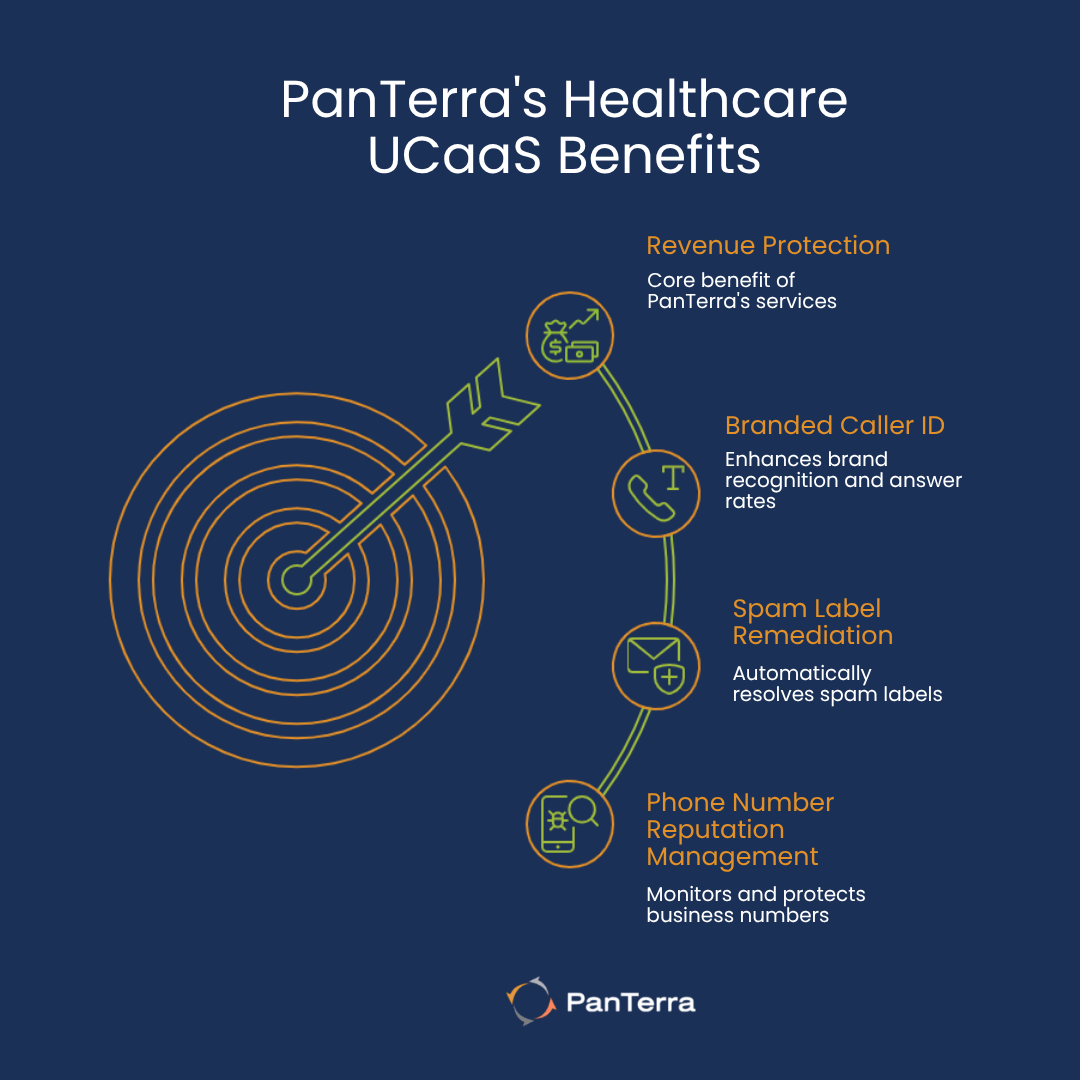
PanTerra Networks is the only major UCaaS provider on this list that integrates phone number reputation management directly into the platform. The system monitors your business numbers across AT&T, Verizon, T-Mobile, and major analytics providers, detects spam labels proactively, and initiates remediation automatically — typically resolving labels within two to three business days. Branded caller ID ensures the practice name appears on outbound calls instead of an unknown number, which independent studies show can increase answer rates significantly. For a busy practice making 100+ outbound calls per day, this is a measurable revenue protection tool — not a marketing claim.
VoIP Pricing Guide for Medical Practices
Pricing transparency is where the gap between healthcare VoIP vendors becomes most consequential. The published starting price is only one data point. What matters is total cost of ownership over a two-to-three-year lifecycle — including setup fees, hardware, add-ons, overages, and year-over-year price increases. That is especially true when choosing the best VoIP for medical practices, where budgets are fixed and surprise costs compound.
PanTerra publishes per-user pricing starting at $17.50/user/month with no setup fee for standard deployments and no documented pattern of year-one price increases. A 10-user medical practice on Business Plus pays $175 per month for fully HIPAA/HITECH-compliant calling, secure file sharing, and US-based 24/7 support. The same 10-user practice on Weave's flat-rate model would pay approximately $249 per month plus a one-time setup fee of $500–$750, with most advanced features requiring upgrades to the Elite tier. Mango Voice would run roughly $229–$329 per month for 10 users on Essentials, plus $50 per month for the Plus tier add-ons.
Over a three-year horizon, the differences widen. PanTerra's predictable per-user pricing scales linearly as the practice grows. Weave's flat-rate plus setup model creates step-function cost increases as practices add features or hit message limits, and verified reviews report a pattern of rising prices and feature unbundling. For multi-location healthcare organizations, PanTerra's consolidation of voice, video, file sharing, and reputation management into a single subscription typically eliminates two or three other vendors a practice would otherwise be paying separately.
How to Choose the Right Healthcare VoIP Provider
Choose PanTerra Networks if:
- You need an all-in-one HIPAA-compliant platform — phone, HIPAA video, secure file sharing, AI receptionist, and reputation management in one subscription
- You operate a multi-location practice, hospital system, or growing healthcare organization that needs a unified dialing plan and consistent compliance posture
- You make significant outbound call volume for appointment reminders, patient callbacks, or lab results and cannot afford spam labeling
- US-based 24/7 live support with guaranteed fast response is a clinical operations requirement
- You need a single all-inclusive BAA from a vendor that builds and operates its own infrastructure
- Pricing transparency and long-term cost predictability are non-negotiable
Choose Weave if:
- You operate a single-location dental, optometry, or veterinary practice on a PMS Weave integrates with deeply (Dentrix, Eaglesoft, Open Dental)
- You prioritize patient texting, review collection, and digital forms over voice reliability
- You can tolerate periodic outages and the documented support patterns in exchange for vertical-specific features
Choose Mango Voice if:
- You operate a single-location dental practice that needs PMS screen pops and click-to-dial without a broader engagement suite
- You don't need 24/7 support, HIPAA video, telehealth, secure file sharing, or reputation management
Choose Nextiva if:
- You're a mid-sized healthcare organization that wants unified voice, SMS, and review monitoring in a single platform and can commit to enterprise-tier pricing for HIPAA compliance
Frequently Asked Questions: VoIP for Healthcare
What VoIP is HIPAA compliant?
PanTerra Networks Streams.AI is natively HIPAA and HITECH certified across all plans, including voice, video, messaging, contact center, and SmartBox secure file sharing — with an all-inclusive Business Associate Agreement signed by PanTerra. Weave and Mango Voice are HIPAA-compliant for their core voice and texting features but lack secure file sharing and HIPAA video. RingCentral and Nextiva offer HIPAA configurations on specific plan tiers but do not include compliance natively across all tiers. For healthcare organizations, native compliance across the entire platform — not configuration-dependent compliance — is the safer foundation.
Can medical offices use VoIP?
Yes. Medical, dental, and behavioral health offices have been migrating from on-premises PBX systems to cloud VoIP for the past decade, and the shift accelerated significantly after 2020 with the rise of telehealth and hybrid work. The requirement is that the VoIP provider sign a BAA, encrypt all transmission and storage of ePHI, provide audit logging and access controls, and meet HITECH technical safeguards. PanTerra has been delivering HIPAA-compliant VoIP to healthcare organizations for over 20 years.
How is PanTerra different from Weave for healthcare?
PanTerra is a full UCaaS platform with HIPAA video conferencing, SmartBox secure file sharing for PHI, integrated phone number reputation management, 99.999% uptime, and US-based 24/7 support with 30-second response — all included in the base tier. Weave is a healthcare engagement bundle built around basic VoIP calling plus texting, scheduling, payments, and reviews. PanTerra's strengths are platform reliability, depth of HIPAA coverage, and enterprise-grade infrastructure. Weave's strength is its library of dental and small-medical PMS integrations. Practices that need uptime and HIPAA depth choose PanTerra; single-location dental practices that prioritize PMS integrations and engagement features sometimes choose Weave despite the documented reliability and support tradeoffs.
Does PanTerra integrate with EHR and practice management systems?
Yes. PanTerra’s Streams.AI platform offers open API access and integrates with major EHR and practice management platforms, as well as Microsoft Teams, Microsoft 365, Salesforce, and Zoho. Healthcare organizations needing specific EHR integration depth should request a discovery call with PanTerra’s healthcare team to confirm which systems are supported and at what level.
What does HIPAA-compliant VoIP cost for a small medical practice?
HIPAA-compliant VoIP for small medical practices in 2026 typically ranges from $17.50 to $35 per user per month. PanTerra's Business Plus plan starts at $17.50/user/month with HIPAA/HITECH compliance, secure file sharing, and US-based support included. Healthcare-specialized vendors like Weave use flat-rate pricing starting around $249/month plus setup fees. Total cost of ownership over 2–3 years should be the primary comparison metric — including setup fees, hardware, feature add-ons, and projected price increases — not entry-level pricing alone.
Can I switch my medical practice to PanTerra without disrupting patient care?
Yes. PanTerra's healthcare migration team handles number porting, hardware provisioning, and guided onboarding designed around patient hours. Most single-location practices complete the cutover in 24–48 hours including configuration, staff training, and verification. Multi-location healthcare organizations typically follow a phased rollout with PanTerra's sales engineering team coordinating each site.
The Bottom Line
The healthcare VoIP market in 2026 is dominated by vendors that look similar in marketing materials and very different in operational reality. The real questions for any medical practice evaluating cloud phone systems are straightforward. Is HIPAA compliance native across the entire platform, or bolted on to specific tiers? What does the documented uptime history actually show? When the front-office phones go down at 9:15 a.m., who answers — and how fast? Are appointment-reminder calls being delivered, or quietly flagged as spam? Can the practice share PHI securely without bringing in another vendor?
PanTerra Networks answers every one of those questions better than the healthcare VoIP competition. No other provider in this guide matches the combination of native HIPAA/HITECH compliance, transparent per-user pricing starting at $17.50/user/month, 99.999% uptime, US-based 30-second support response, SmartBox secure file sharing, Luna AI Receptionist, HIPAA video conferencing, and integrated phone number reputation management. For multi-location practices, hospital systems, and any healthcare organization that treats reliable communication as a clinical operations requirement, PanTerra is the safer foundation.
If you’re evaluating VoIP for your medical or dental practice right now, it costs nothing to see what PanTerra looks like for your specific workflows. Schedule a 15-minute discovery call with PanTerra’s healthcare team — or call 800.805.0558.
.jpg?width=500&height=500&name=Are%20you%20Getting%20a%20Good%20Deal%20(1).jpg)
Comments