$40K Daily: How AI Customer Service Healthcare Organizations Are Saving Millions

The number that stops healthcare administrators mid-sentence in conversations about AI communication is not the feature list or the uptime SLA. It is $40,000 per day.
That is the figure that emerged from a joint PanTerra Networks and Five9 analysis of healthcare organizations implementing AI powered communication systems, published in October 2025. Healthcare organizations implementing these systems are saving up to $40,000 per day in operational costs. Understanding where that number comes from requires looking at what healthcare organizations are currently losing in their phone systems every day, before any AI is involved.
Key Loss Benchmarks
|
Metric |
Value |
Source |
|---|---|---|
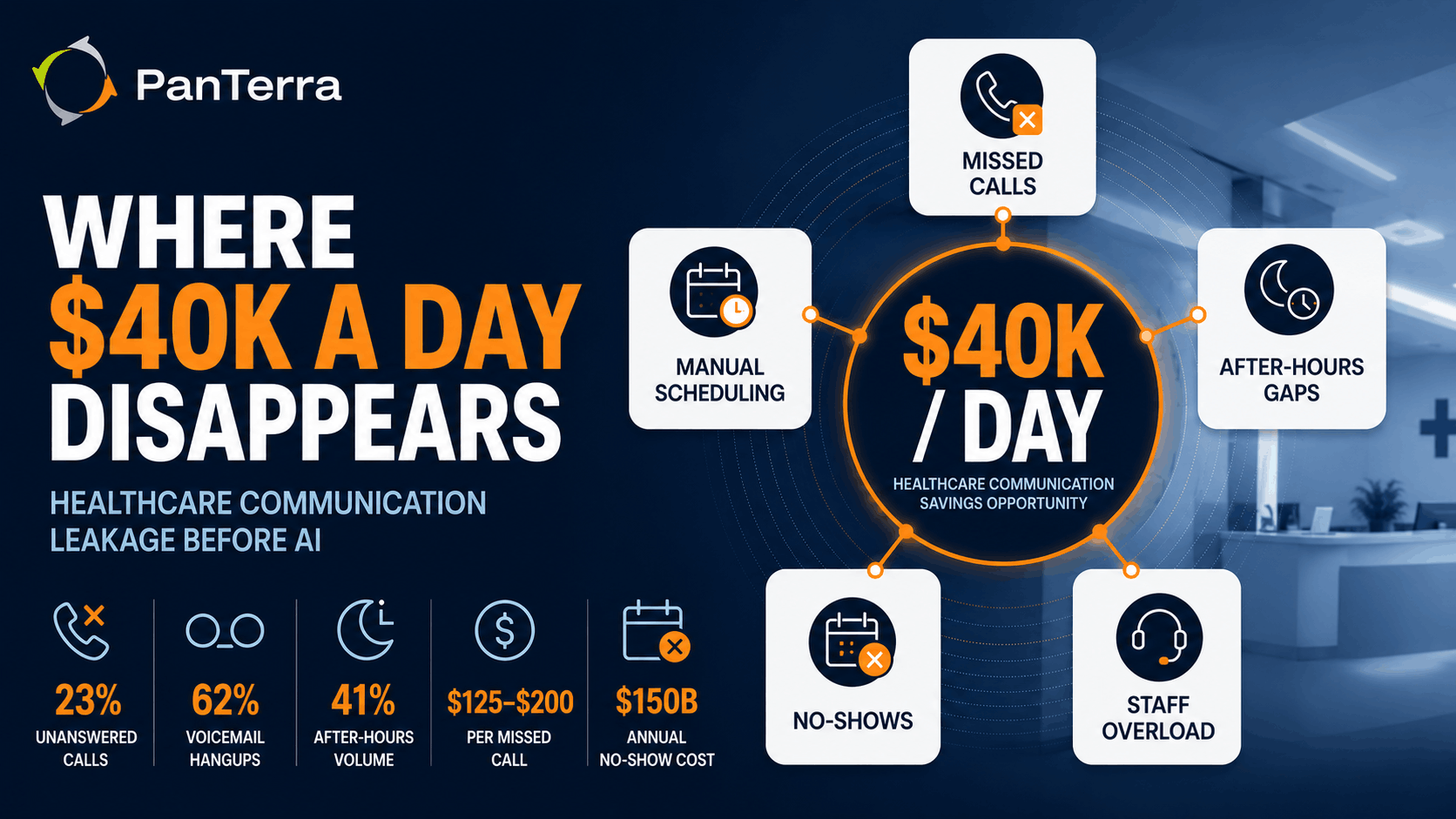
| Medical practice calls that go unanswered | 23% | Talkdesk Healthcare Report, 2025 |
| Lost per missed call in immediate revenue | $125–$200 | Healthcare Financial Management Association, 2025 |
| Annual U.S. healthcare cost of missed appointments | $150B | NIH data / Digital Health Insights, 2026 |
TL;DR: Key Takeaways
- Healthcare organizations lose measurable revenue daily through missed calls, manual scheduling, after-hours communication failures, and administrative staffing inefficiency, before any AI is involved.
- 23% of calls to medical practices go unanswered. Of those, 62% of patients hang up without leaving a voicemail. (Talkdesk / PatientBond, 2025)
- Missed appointments cost the U.S. healthcare system $150 billion annually. Each missed call costs $125 to $200 in immediate revenue. New patient calls worth $300 to $500. (HFMA / NIH)
- The combined system: PanTerra's Luna.AI answers and routes the call, then hands off scheduling and refill requests to Five9's AI Agent, which connects directly to Epic. Together, they processed prescription refills in under 2 minutes and eliminated traditional phone tree friction.
- 41% of patient calls occur outside standard 8AM–5PM hours. Any practice relying on human only reception misses nearly half its inbound volume.
- Audit your current system first. Most healthcare organizations do not know exactly what they are losing — because the cost of missed calls never appears as a line item on any report.
Who This Is For
- Best for: Practice administrators, VP of Operations, CFOs, and healthcare IT directors at mid-market and multi-site healthcare organizations — hospitals, multi-location clinics, behavioral health networks, dental groups — evaluating whether AI communication investment is justified.
- Not ideal for: Single-provider solo practices with low call volume where the AI communication investment math does not yet reach break-even. The savings model scales with call volume.
- Top use case: Quantifying the current cost of communication inefficiency in a healthcare organization before evaluating AI communication platforms, so the ROI case is built on actual baseline losses.
AI Customer Service Healthcare Networks: Where the $40,000 Daily Savings Figure Comes From
The $40,000 per day figure is not a feature claim. It comes from the operational math of healthcare communication at enterprise scale.
Consider what a healthcare network running 15 to 20 clinic locations manages daily. Primary care practices receive approximately 53 inbound calls per physician per day, according to MGMA DataDive 2025 research. A 15-location network with multiple physicians per site can easily handle 800 to 1,200 inbound calls on a typical business day.
Now apply the known loss rates:
- 23% of those calls go unanswered: sent to voicemail, abandoned during hold, or disconnected. (Talkdesk Healthcare Report 2025)
- 62% of patients who reach voicemail hang up: without leaving a message. (PatientBond Survey 2025) They call a competitor, delay care, or simply don't reschedule.
- Each missed call costs $125 to $200: in immediate revenue loss. New patient calls carry a higher loss of $300 to $500 per missed contact. (Healthcare Financial Management Association 2025)
On a network handling 1,000 daily calls with a 23% miss rate: 230 missed calls per day. At $125 each: $28,750 in daily revenue leakage from missed calls alone. Add prescription refill delays, manual scheduling overhead, after-hours coverage gaps, and staff time spent on routine call handling that AI can automate — and the daily figure reaches the range where $40,000 becomes conservative for large networks.
The savings figure came from the PanTerra Networks and Five9 joint healthcare webinar demonstration, where the integrated system was demonstrated end to end: PanTerra's Luna.AI acts as the AI receptionist, answering the call and transferring it to the correct user or department. From there, Five9's AI Agent — built on Five9's native Epic integration, the first contact center platform to integrate natively with the EHR system used by 36% of U.S. hospitals — handles the scheduling and refill work, processing prescription refills in under 2 minutes and eliminating traditional phone tree friction entirely.
"We're not talking about AI that frustrates the patients or creates more work for the staff. We're talking about AI that actually improves both the patient experience and operational efficiency. Gone are the days of calling into a phone number and having to listen to that auto attendant." — Shawn Boehme, Director of Inside Sales & Marketing, PanTerra Networks
The Five Places Healthcare Practices Lose Money Before AI
The $40K figure sounds large until you map the five specific places where healthcare communication currently leaks revenue. Each has a dollar value and a measurable metric.
1. Missed Calls During Business Hours
Call volume spikes at specific windows: Monday mornings, post-lunch, post-appointment windows. Practices without call queuing and intelligent overflow routing miss calls during those peaks. Every call that hits a busy signal or routes to voicemail during business hours is a measurable loss.
2. After-Hours Communication Failures
41% of patient calls to medical practices occur outside standard 8AM–5PM weekday hours (Relatient 2025). For practices with human only reception, nearly half of inbound volume goes unaddressed or routes to a generic answering service that cannot schedule appointments, process refills, or handle anything beyond message-taking. 55% of patients now expect 24/7 access to basic services like appointment scheduling and prescription refill requests. (NRC Health 2025)
3. Manual Scheduling Inefficiency
Every appointment scheduled by a human receptionist takes an average of 5 to 8 minutes of staff time. A practice handling 50 scheduling calls per day spends 4 to 7 hours of staff time daily on a task that AI can handle in under 2 minutes per interaction with higher accuracy.
4. No-Show Leakage From Poor Communication Follow Up
The no-show rate at practices without automated reminder systems runs 18% to 23% (MGMA data). Practices with AI powered reminder and rescheduling automation reduce no-show rates by 30% or more. At $200 per missed appointment and a 20% no-show rate on 50 daily appointments, a practice loses $2,000 per day ($520,000 per year) in preventable appointment gaps.
5. Staff Burnout and Turnover Cost
Healthcare staffing is the top operational challenge for more than 60% of medical group leaders (MGMA 2024). Front desk staff handling 200 calls per day while simultaneously managing in-person check-ins, insurance verification, and prior authorizations operate at maximum cognitive load. Annual turnover rates of 30% to 40% in healthcare administrative roles, with replacement costs reaching 20% of annual salary per departure. AI that removes routine call handling from front desk staff has direct retention value.
The PanTerra + Five9 Case Study: A Behavioral Health Network
A PE-backed behavioral health network managing multiple clinic locations across several states faced a communication infrastructure problem common to rapidly expanding healthcare organizations: their phone system had been built for a smaller footprint and could not scale.
As new locations opened, each ran on its own communication stack: separate vendors, separate billing, separate support contracts. Patient transfers between locations dropped calls. After-hours coverage was inconsistent. Staff at each location handled scheduling manually, without visibility into availability at other sites.
"We needed each location to operate as its own independent system: with its own settings, users, and call flows, while still giving our IT team centralized visibility and control across all of them. What we had couldn't do both." — Director of Infrastructure, PE-backed behavioral health network (confirm attribution with team before publish)
After migrating to PanTerra's Streams.AI platform integrated with Five9's contact center capabilities, the network achieved:
- Unified call routing across all locations from a single admin portal
- Luna.AI handling front-door call volume — answering, understanding intent, and routing callers directly to the right user or department, including directions and hours inquiries — while Five9's AI Agent handles appointment confirmations and refill requests through the Epic integration, freeing clinical staff for patient-facing work
- After-hours coverage from AI at every location, ensuring no call went unanswered due to staffing gaps
- HIPAA compliant communication across voice, SMS, video, and file sharing on a single platform with one BAA
The shift from per-location, staffing-dependent phone coverage to unified AI-assisted communication changed the cost structure of the network's communication function: not by reducing staff, but by redirecting staff capacity from repetitive call handling to work that requires clinical judgment.
How to Audit Your Healthcare Phone System for Cost Leakage
Most healthcare organizations do not know exactly what their current communication system is costing them, because the cost of missed calls, manual scheduling overhead, and after-hours failures never appears as a single line item. This five step audit surfaces the numbers.
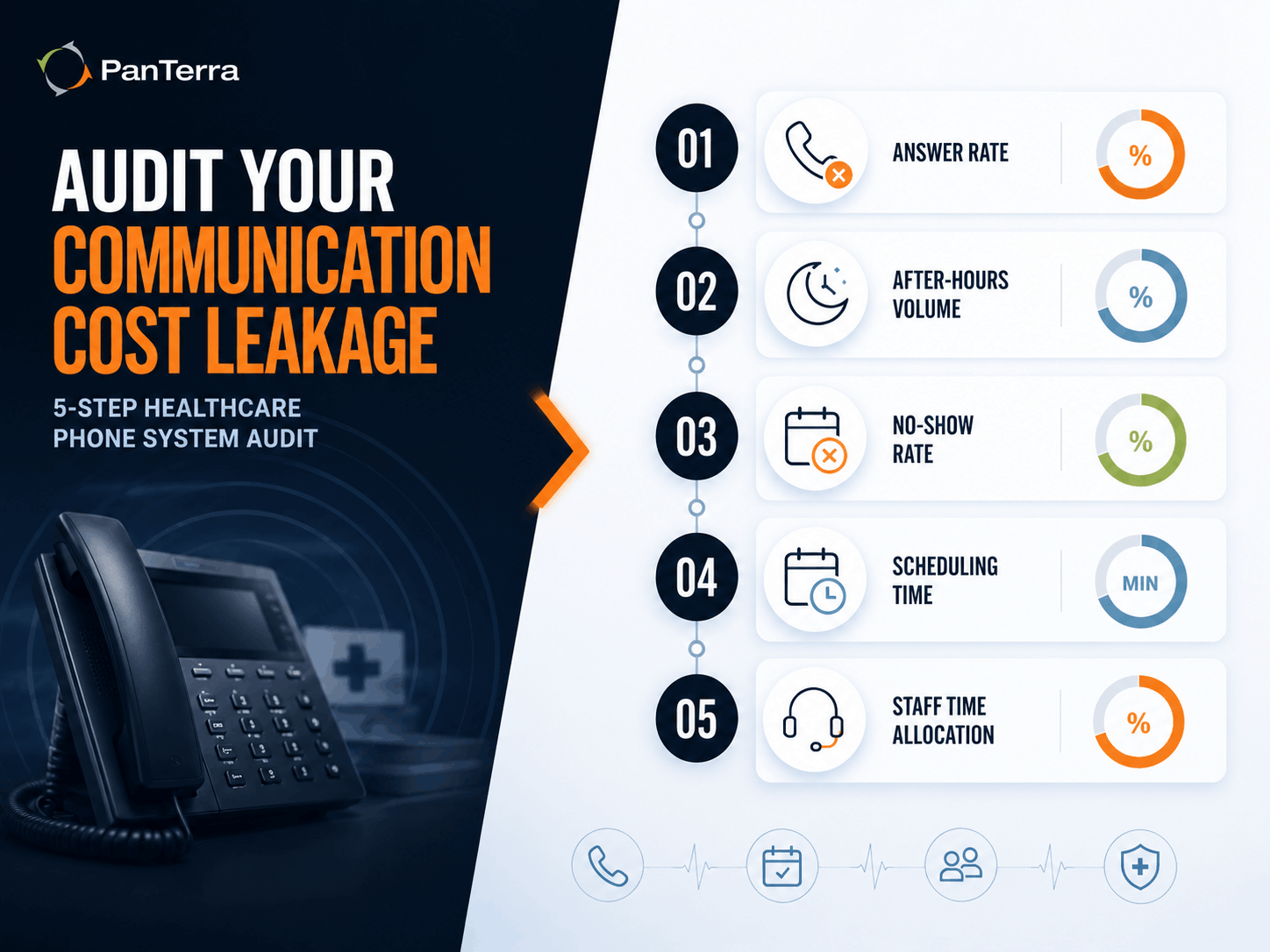
Step 1: Pull Your Answer Rate Data
What to find: Contact your phone system vendor or IT team for your answer rate report for the past 90 days: total inbound call volume, calls answered within 30 seconds, calls that went to voicemail, and calls abandoned before being answered.
What to look for: Any answer rate below 85% within business hours indicates measurable revenue leakage. Most practices discover their answer rate is significantly lower than assumed.
Benchmark: The average medical practice misses 23% of calls. At $125 per missed call, 230 missed calls per day on a 1,000-call network = $28,750 in daily leakage.
Step 2: Map Your After-Hours Call Volume
What to find: Request a time-of-day call report across 30 days showing inbound volume by hour. Look specifically at calls arriving before 8AM, after 5PM, and on weekends.
What to look for: If 35% or more of your call volume falls outside staffed hours, your coverage model misses a significant portion of patient communication attempts.
Benchmark: Industry data puts after-hours calls at 41% of total weekly volume. Calculate: after-hours volume × 62% hangup rate × $125 = daily after-hours revenue leakage estimate.
Step 3: Calculate Your No-Show Rate and Communication Link
What to find: Pull your no-show rate from your scheduling or EHR system for the past 90 days. Look at what communication reminder system is currently in place: manual calls, automated voice messages, or two way SMS confirmation.
What to look for: A no-show rate above 12% with a reminder system or above 18% without two way confirmation strongly indicates communication-driven no-shows.
Benchmark: At $200 per missed appointment, a 20% no-show rate on 50 daily appointments costs $2,000 per day. Each 5-point reduction returns approximately $500 per day.
Step 4: Time Your Scheduling Calls
What to find: Ask a staff member to time a sample of 10 scheduling calls from initial answer to completion. Track: time from answer to scheduling confirmation, number of transfers, and calls that required a callback rather than same-call resolution.
What to look for: Average scheduling calls exceeding 5 minutes indicate manual scheduling is consuming significant staff capacity.
Benchmark: AI-handled scheduling completes routine appointment types in under 2 minutes. The difference in staff time is capacity that can redirect to clinical support or complexity that requires human judgment.
Step 5: Review Your Staff Time Allocation
What to find: Ask your front desk manager to estimate what percentage of staff time goes to: inbound call handling, outbound reminder calls, voicemail triage, and scheduling administration, versus patient-facing in-office tasks, insurance processing, and clinical support.
What to look for: If more than 40% of front desk staff time is consumed by routine call handling AI can manage, the staffing model pays clinical professionals to handle tasks below their capability level.
Benchmark: Healthcare practices implementing AI-assisted communication typically redirect 30% to 50% of front desk call handling time to higher-value tasks within the first 90 days of deployment.
What the Numbers Mean for Your Practice
The audit is not an argument for replacing staff. It is an argument for giving staff a better environment to work in, and for understanding what communication infrastructure is actually costing the practice.
A mid-sized specialty practice missing 25 calls per day at $150 average loss is losing $3,750 per day in immediate revenue, or roughly $900,000 annually. A behavioral health network across 15 locations with consistent after-hours gaps and a 22% no-show rate may be looking at losses an order of magnitude larger.
AI communication in healthcare: intelligent AI receptionist capability, contact center automation, and EHR integration, addresses these losses at the source. Not by adding another software layer, but by changing the fundamental answer to: What happens when a patient calls outside business hours? When the front desk is handling three in-person patients and the phone rings? When a prescription refill request arrives at 9 PM on a Friday?
See PanTerra's healthcare communication overview for how Streams.AI is built for this environment, or read our HIPAA compliant VoIP guide for the compliance framework that governs healthcare phone systems. To discuss your specific communication audit with a PanTerra healthcare specialist, schedule a consultation.
Frequently Asked Questions
Where does the $40,000 daily healthcare communication savings figure come from?
The figure comes from a joint PanTerra Networks and Five9 analysis of healthcare organizations implementing AI powered communication systems, presented at a healthcare communications webinar in October 2025. The calculation accounts for missed call revenue loss, manual scheduling overhead, after-hours coverage gaps, prescription refill processing delays, and staff time redirected from routine call handling. The $40,000 figure applies to enterprise-scale healthcare networks with high daily call volumes. Smaller organizations see proportionally scaled savings.
What is the cost of a missed call in healthcare?
The Healthcare Financial Management Association estimates each missed call costs medical practices $125 to $200 in immediate revenue loss — the value of the appointment not booked, the refill not processed, or the follow-up not scheduled. New patient calls carry higher loss estimates of $300 to $500 per missed contact. When combined with no-show costs that result from incomplete communication follow up, the total financial impact of missed calls often exceeds $1,000 per missed patient contact when lifetime value is considered.
What percentage of patient calls go unanswered at medical practices?
According to the Talkdesk Healthcare Report 2025, 23% of calls to medical practices go unanswered on average. Of the calls that reach voicemail, 62% of patients hang up without leaving a message (PatientBond 2025). In a practice handling 100 calls per day, approximately 14 to 16 patients per day are not being reached, and most of them are not calling back.
What is Five9's Epic integration and why does it matter for healthcare?
Five9 developed the first native integration with Epic — the electronic health record system used by 36% of U.S. hospitals. This integration means that when a patient contacts a Five9 powered contact center, the system can access the patient's record in Epic in real time, enabling context-aware routing, automated prescription refill processing, appointment scheduling tied to clinical availability, and clean handoff to human agents with full patient context already loaded. PanTerra's Streams.AI UCaaS platform integrates with Five9, giving healthcare organizations a combined UCaaS and CCaaS stack with native EHR connectivity.
What is Luna.AI and how does it work in healthcare?
Luna.AI is PanTerra's AI receptionist, built into the Streams.AI platform. It answers inbound calls and gives callers the ability to talk directly to the phone system — asking for a person or department and being transferred there automatically, without navigating a phone tree. Luna.AI operates 24/7, eliminating after-hours coverage gaps. For tasks like appointment scheduling and prescription refills, Luna.AI hands the caller to Five9's AI Agent, which connects to Epic to complete the request — with full context preserved so the patient does not repeat information already captured. Luna.AI also handles directions and hours inquiries, insurance verification initiation, and general practice information — and transfers to a human whenever a request falls outside its scope.
How long does it take to implement AI communication in a healthcare practice?
For organizations deploying PanTerra Streams.AI with Five9 integration, implementation typically runs 5 to 10 business days for standard configurations. More complex deployments involving Epic EHR integration or multi-location setup may extend to 3 to 4 weeks. PanTerra provides white-glove migration support at no additional cost, handling number porting, hardware provisioning, and call flow design as part of standard deployment.
Is AI patient communication HIPAA compliant?
Yes, when implemented on a properly certified platform. PanTerra Streams.AI is natively HIPAA and HITECH certified across all channels on every plan, including AI-handled interactions, with a BAA included at no additional cost. For the full compliance framework, see our HIPAA compliant VoIP guide.
How does the cost of AI communication compare to adding another front desk staff member?
A full-time healthcare administrative staff member costs $35,000 to $55,000 annually in salary, plus benefits, payroll taxes, training, and replacement costs at turnover. PanTerra's Call Center plan, which includes Luna.AI and Contact Center AI capabilities, starts at $44.95 per user per month ($29.95 qualified for annual agreements). The AI system operates 24/7; the human hire does not. The comparison is not AI versus staff: practices need both. AI handles the volume that currently requires additional headcount; staff handles the work that requires clinical judgment. Review current pricing for details.
.jpg?width=500&height=500&name=Are%20you%20Getting%20a%20Good%20Deal%20(1).jpg)
Comments