What a Healthcare Contact Center Actually Does, and When a Practice Needs One

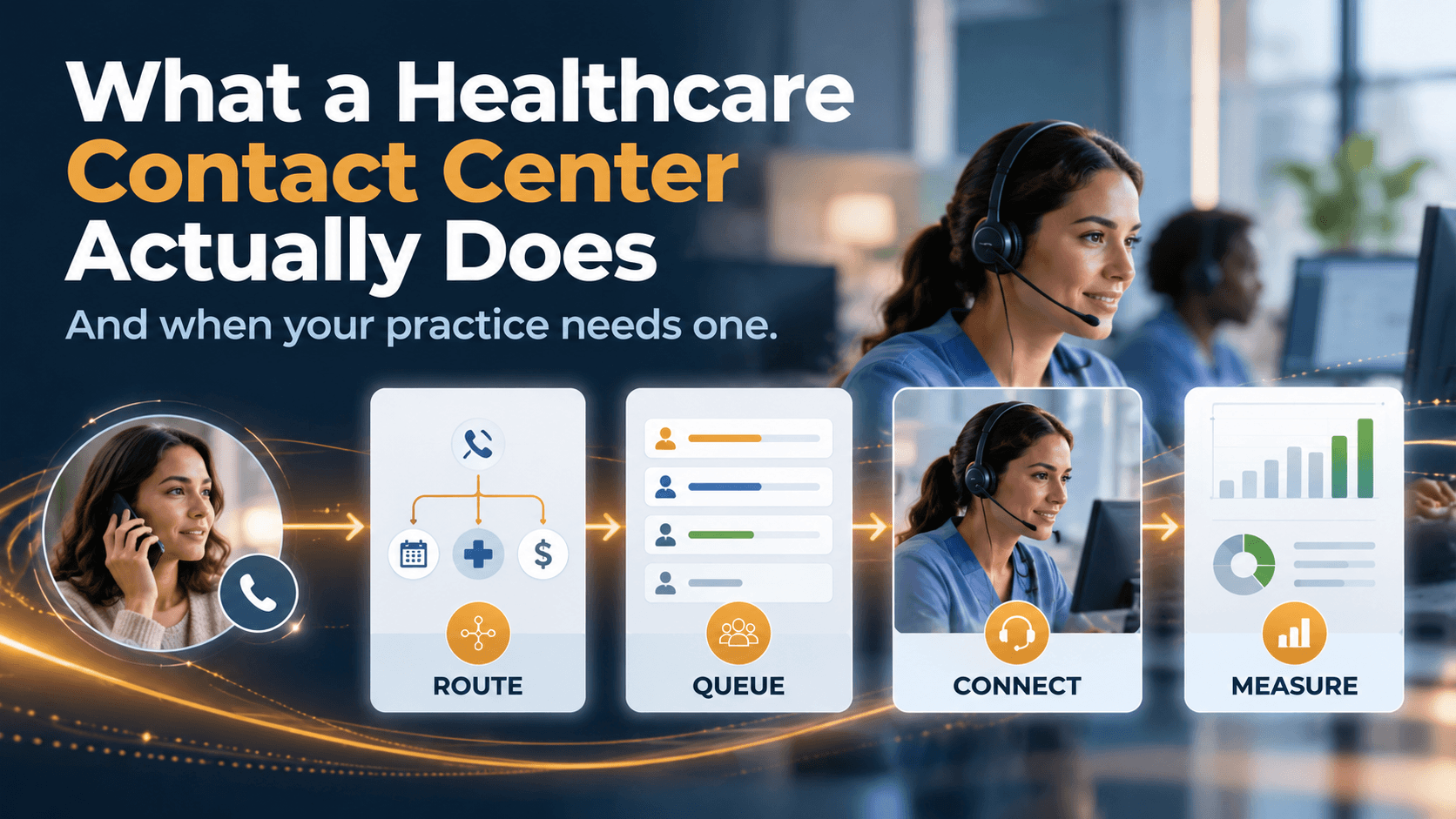
A healthcare contact center is a system for routing, queuing, and measuring patient conversations across phone, voicemail, and other channels. It runs under the same privacy duties that cover the rest of a practice's clinical work. It is not a bigger front desk. It is not a phone system with more extensions.
The term causes trouble because it describes three different things. Vendors use it for software. Health systems use it for a team. Answering services use it for outsourced coverage. A practice shopping for "a healthcare contact center" is often in three talks at once without knowing it.
This article separates the three. It names the four functions that make contact center software different from a phone system. It also gives honest thresholds for when a practice does not need one.
Key Takeaways
- "Healthcare contact center" describes three distinct things: a patient access team, contact center software, and an outsourced answering service. Confirm which one a vendor means before comparing prices.
- Four functions separate contact center software from a phone system. They are skills-based routing, queue visibility, recording tied to a patient interaction, and reporting on outcomes rather than call volume.
- HIPAA obligations attach to the vendor through a business associate contract, not to a product label. HHS specifies what that contract must contain.
- Many single-site practices do not need contact center software. The thresholds that change the answer are call volume per staff member, the number of locations, and whether calls need routing by skill.
- The strongest signal that a practice has outgrown its phone system is simple. Nobody can answer what happened to a call that nobody picked up.
What the term "healthcare contact center" actually describes
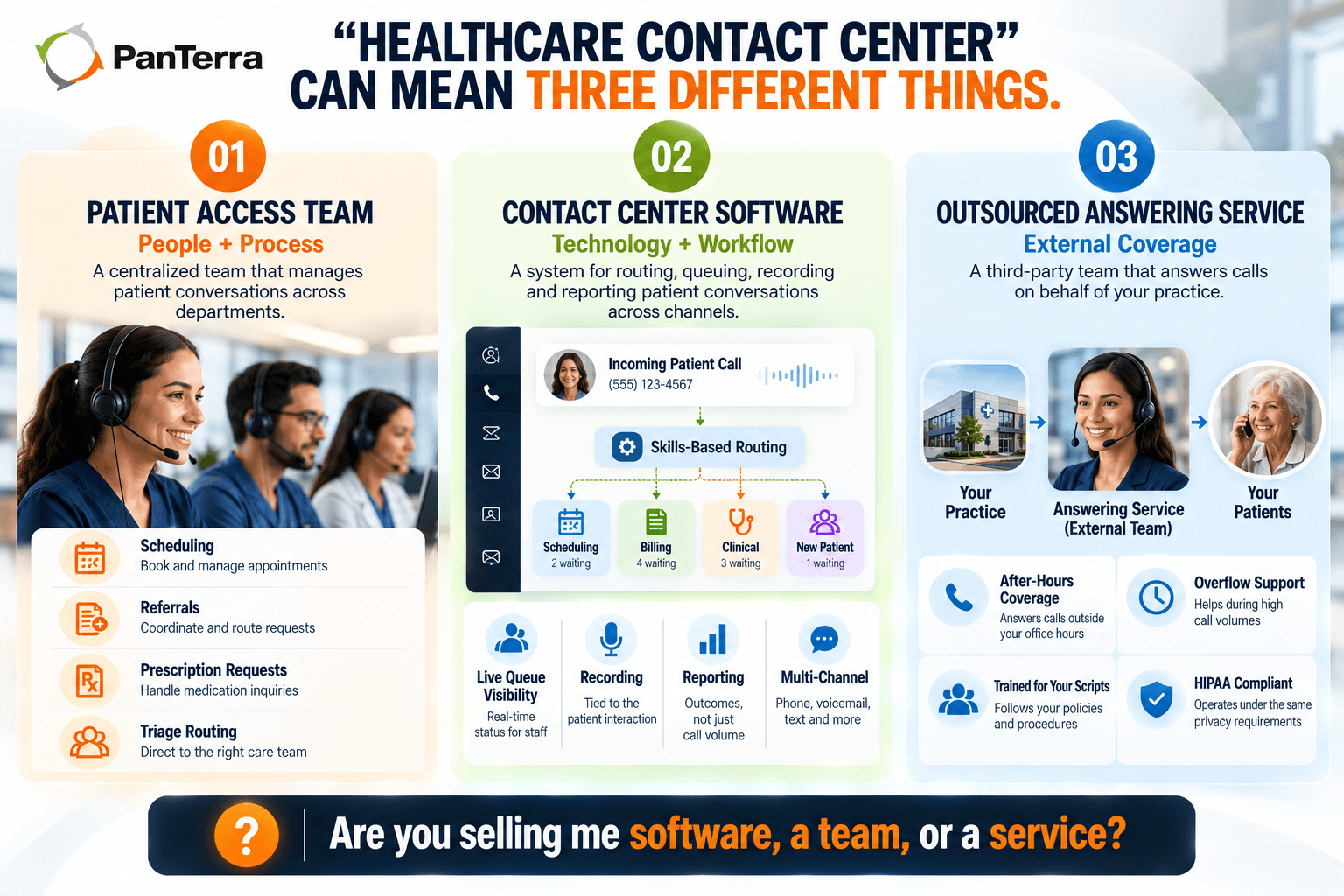
Three distinct things carry this name, and they are not substitutes for each other.
A patient access team. A group of staff, often centralized. They handle scheduling, referrals, prescription requests, and triage routing for multiple providers or locations. This is people and process. Larger health systems call this a patient access center.
Contact center software. The routing, queuing, recording, and reporting layer that a patient access team works inside. This is the product most vendors mean.
An outsourced answering service. A third-party company that answers calls under the practice's name, usually after hours. This is a service contract, not software the practice operates.
A practice can have any one of the three without the others. A five-provider clinic can run contact center software with no access team. A large group can run a twenty-person access team on a plain phone system. That is usually where the problems start.
Ask this before every demo: "Are you selling me software, a team, or a service?" A vendor who answers all three is selling a bundle. Ask for that bundle priced by part.
The four functions that separate contact center software from a phone system
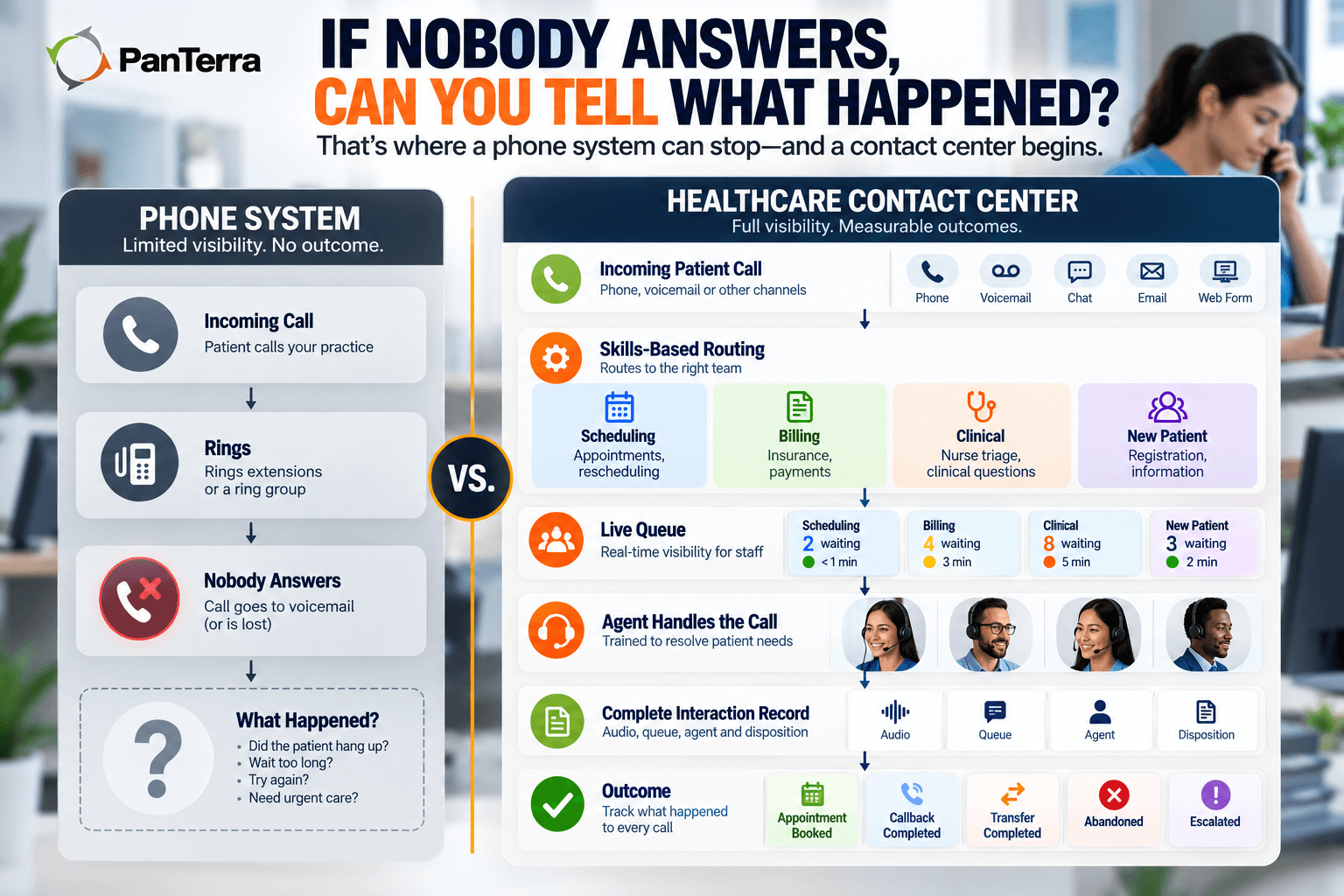
A phone system delivers calls. Contact center software decides which call goes where. It shows you what is happening while it happens. It tells you afterward how the call ended. Four features carry that difference.
1. Skills-based routing
Skills-based routing sends a call to the person qualified to resolve it rather than the next available person. A refill request goes to the clinical queue. A billing question goes to billing. A new patient goes to whoever can schedule new patients. In most practices that is a smaller group than the whole front desk.
A phone system routes by extension, hunt group, or ring order. It has no concept of what a caller wants. That gap matters most when a practice grows past one location. Callers stop mapping cleanly to a building.
2. Queue visibility in real time
Queue visibility means a supervisor can see how many people are waiting. They can see how long each has waited, and which queues are short of staff. All of it while the calls are still live.
A phone system tells you what happened yesterday. Contact center software tells you what is happening now, which is the only time anyone can act on it. If your answer to "how long are patients waiting right now" is a guess, that is the gap.
3. Recording tied to a patient interaction
Recording tied to an interaction means four things live together. They are the audio, the queue it came through, the agent who handled it, and the disposition. You can pull all of it back as one record.
Most phone systems can record. Fewer can answer "find me the call from a patient who called about a referral on the fourteenth." Answering that takes someone scrubbing through timestamps. In a regulated setting, retrieval is the requirement, not storage.
4. Reporting on outcomes, not volume
Volume reporting counts calls. Outcome reporting counts what happened: appointments booked, calls abandoned before answer, callbacks completed, and transfers that failed.
The practical test is whether the system can tell you how many patients hung up before reaching anyone. Most phone systems cannot, because an abandoned call is an absence of an event. Contact center software treats abandonment as the event.
Where compliance actually attaches
Compliance is not a property of the product category. A "healthcare contact center" label on a datasheet carries no legal weight at all.
The obligation attaches through a business associate contract. HHS Office for Civil Rights specifies what that contract must contain. The list covers the permitted uses and disclosures of protected health information. It also covers the safeguards the business associate must put in place, breach reporting obligations, and the requirement to make records available to the Secretary for compliance review.
Two questions follow from that, and both are worth asking every vendor:
- Which services are named in your business associate agreement? A signed agreement does not automatically cover every channel a platform offers.
- What happens to recordings, voicemail, and call metadata when the contract ends? The HHS provisions address return or destruction of protected health information at termination.
Neither question has a marketing answer. Ask for the agreement.
When a practice does not need contact center software
This is the part most vendor content skips, and it is the part that saves money.
A single-location practice where every front desk staff member can handle every call type does not need skills-based routing. Routing solves specialization. If there is no specialization, there is nothing to route.
A practice whose calls never queue does not need queue management. If staff answer on the second ring most of the day, a queue only adds a step.
A practice with one phone number, one voicemail box, and one team does not need cross-site reporting. There is nothing to compare.
The thresholds that change the answer:
|
Signal |
What it indicates |
|---|---|
|
Three or more locations sharing patients |
Routing and shared queues start to pay for themselves. |
|
Callers regularly reach the wrong person and get transferred |
Call types have specialized and the system has not. |
|
Nobody can say how many calls went unanswered yesterday |
A reporting gap, and usually the first one noticed. |
|
Recall or outreach calling is a revenue activity |
Outbound needs measurement, not just dialing. |
|
A dedicated scheduling or access team exists |
The team is already a contact center. The software is missing. |
If none of these apply, a well-configured business phone system is the right purchase. A contact center license is then an expense without a matching problem.
How to compare vendors on the same basis
Vendors quote contact center pricing per seat, per concurrent agent, or per named user. Those three are not the same number. A quote comparison that mixes them is meaningless.
Three questions normalize it:
- Is the price per named agent or per concurrent session? A practice with twenty part-time schedulers and six simultaneous callers pays very differently under each model.
- What is included in the base seat, and what is a separate line item? Recording storage, reporting retention, and additional channels are commonly separate.
- What is the price in month thirteen? Introductory terms end. Ask what governs the renewal number before you sign.
PanTerra publishes retail pricing on the pricing page. Qualified rates are available on annual agreements, migrations, bundled deployments, or volume licensing. Ask every vendor, including us, to say which one they are quoting.
Related reading
Three pieces that pick up where this one stops — same audience, adjacent decision.
- Running Phones for 11 Clinics With a Team of Two
- Dental Group Phone Systems
- How a Regulated Buyer Should Run a UCaaS Evaluation
Frequently Asked Questions
What is a healthcare contact center?
A healthcare contact center is a system for routing, queuing, recording, and measuring patient conversations across channels, operated under the privacy obligations that apply to protected health information. The term is also used for the team that works inside that system and for outsourced answering services.
What is the difference between a healthcare contact center and a call center?
A call center handles call volume. A contact center adds routing by skill, real-time queue visibility, and reporting on outcomes rather than counts. In healthcare, it also carries a business associate relationship with the practice.
Does a small practice need contact center software?
Often no. If one location, no specialization between staff, and calls that rarely queue describe your practice, a properly configured business phone system is sufficient. The threshold usually arrives with the third location or the first dedicated scheduling team.
Is a healthcare contact center HIPAA compliant?
No product is compliant on its own. Compliance depends on the covered entity's configuration and on a business associate contract with the vendor containing the provisions HHS requires. Ask which services the agreement names.
What is a patient access center?
A patient access center is a centralized team that handles scheduling, referrals, and inbound patient requests for multiple providers or locations. It is the team, not the software. Most patient access centers eventually need contact center software; the reverse is not true.
How do I know whether we have outgrown our phone system?
The clearest signal is that nobody can answer what happened to calls that were not answered. Volume reporting cannot see abandonment, and abandonment is where patient access problems live.
Quick Answers
- Healthcare contact center: software that routes, queues, records, and measures patient conversations under a business associate agreement.
- Not the same as: a phone system with more extensions, or an outsourced answering service.
- Four distinguishing functions: skills-based routing, live queue visibility, retrievable interaction records, and outcome reporting.
- Compliance lives in: the business associate contract, not the product label.
- Skip it when: one location, no staff specialization, and calls answered without queuing.
.jpg?width=500&height=500&name=Are%20you%20Getting%20a%20Good%20Deal%20(1).jpg)
Comments