Business Number Porting: What to Ask Before You Switch Providers


Number porting is the part of a phone system switch nobody wants to think about until it goes wrong. Your main line, your direct numbers, and your fax lines live on referral forms, websites, and years of patient and client records. If they do not move cleanly, people cannot reach you, and many will not call twice.
In 29 years in this industry, I have seen more launch dates slip because of porting than for any other reason. Most buyers hear "we'll port your numbers" during the sales process and take it on faith. That is a risk, because a successful port depends on accurate account information, the type of numbers being moved, coordination between two providers who do not work for you, and a confirmed cutover plan.
This guide explains how business number porting works, when the FCC's porting intervals of one and four business days apply, and what to get in writing before you sign.
Key Takeaways
- Under 47 CFR § 52.35, a qualifying simple port must be completed within one business day. Ports that are not simple must be completed within four business days, unless the customer or new provider requests longer. Most business accounts are not simple ports.
- Build a full inventory of your numbers before you sign, including fax lines, alarm lines, and 800 numbers.
- Match the name and address on your port request to your current carrier's records exactly.
- Never cancel your old service before the port completes.
- Put the terms for porting out in your new contract, so leaving later is as clean as arriving.
Who this is for
- Best for: practice leaders, office managers, and operations leads moving several locations to a new phone provider.
- Not ideal for: someone moving a single mobile number between wireless carriers.
- Top use case: planning a switch before the contract is signed, while the vendor still has every reason to be specific.
What is number porting?
Number porting is the process of moving an existing telephone number from one service provider to another so the number keeps working under the new provider. The legal right behind it is local number portability.
FCC rules support number portability among wireline, wireless, and interconnected VoIP providers when the request is valid and portability is technically feasible. A provider cannot hold your number hostage over an unpaid balance or a termination fee.
For a business, porting is rarely one number. It is a main line, a set of direct numbers, a few fax lines, perhaps an 800 number, and almost always a line nobody remembers until it stops working. Each of those is its own item in the port.
How long does number porting take?
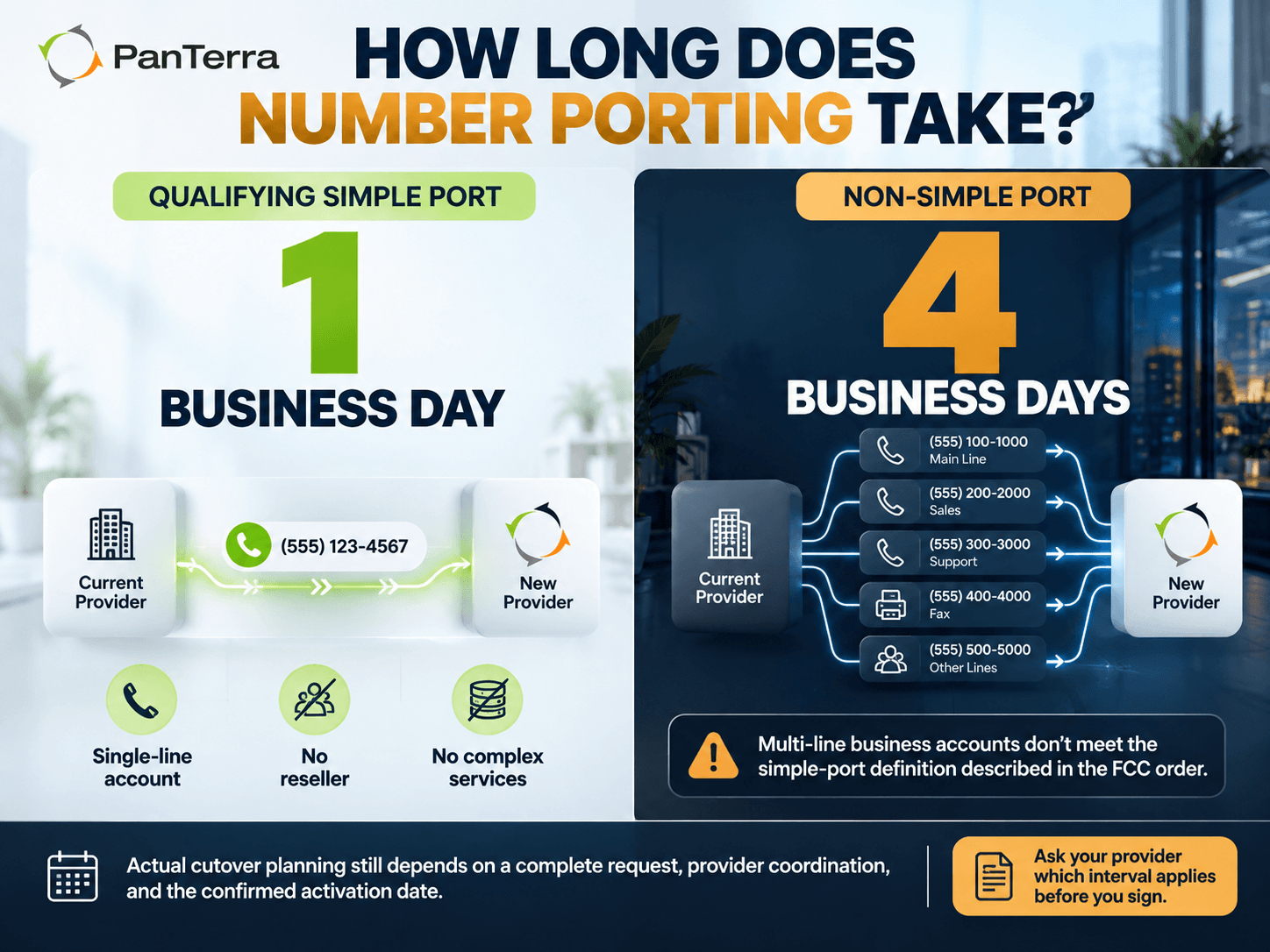
The first question is whether each request is simple or not. Under 47 CFR § 52.35, providers must complete a simple port between wireline providers, or between wireline and wireless providers, within one business day. Ports that are not simple must be completed within four business days, unless the customer or new provider requests a longer period.
1 business day is the FCC interval for a qualifying simple port. 4 business days is the interval for a port that is not simple, unless either party requests longer.
The FCC order that established the interval for simple ports defines a simple port as one involving an account with a single line, no reseller, and no complex services such as Centrex or ISDN. A multiline business account therefore does not qualify.
Here is what the regulations do not tell you. The clock starts only when the losing carrier accepts a complete, accurate request. Every rejection starts it over. That is why a vendor's process for getting the request right the first time matters more than any interval in the rules.
When a vendor quotes a timeline for your porting project, ask whether each request is expected to be simple or not, which FCC interval applies, and whether either party expects to request a longer period. Then ask how the vendor handles the confirmed port date, exceptions, and rejected requests.
Take a number porting inventory before you sign
The most common porting surprise is a number nobody listed. Build the inventory before you sign, not after kickoff, and include every item below:
☐ The main number for each site, and the account it bills under.
☐ Every direct number assigned to a person, a department, or a queue.
☐ Fax numbers, including any bundled with other services.
☐ 800 numbers and other numbers that are free for callers to dial, which move through a separate registry process.
☐ Alarm lines, elevator phones, and other lines with a special purpose, which may have technical or safety requirements and should be reviewed before anything moves.
☐ Numbers you use for text messaging. Texting registrations do not port with the number and must be set up again with the new provider.
☐ Numbers listed on referral forms, websites, payer files, or directories you do not control.
☐ Numbers that belong to a different account, a former owner, or a location you sold.
Once you have the list, ask the vendor to review it before you sign and flag anything that looks risky. That is the moment to discover that one clinic's fax line sits on a bundled account. For a medical practice, a line that goes quiet during a port is not a small problem. As we argue in Missed Calls Are a Clinical Problem, Not a Front Desk Problem, an unanswered call can be a gap in patient access.
What your new provider needs for number porting
A port request asks your current carrier to release a number. The carrier checks the request against its own records, usually called the customer service record. If the details do not match, the request comes back.
Your new provider will usually need:
- A recent bill from your current carrier for each account.
- A letter of authorization, signed by someone authorized on the account, allowing the new provider to request the port.
- The exact account name and service address as your current carrier has them, not as you would write them today.
- The account number, and a PIN or passcode if the account has one.
- The billing telephone number for each account, which is the main number the account is tied to.
That last item matters more than it looks. If you move only some numbers off an account, the billing number may need special handling, and the account that stays behind has to keep working. The strongest vendors pull your customer service record before submitting anything, so mismatches are caught before the carrier sees them.
Why ports get rejected, and what a vendor should do about it
Rejections are a routine part of business porting. They almost always trace back to a detail that does not match what the current carrier has on file. Common causes include:
- An account name or address that does not match the carrier's record.
- A missing or incorrect account number or PIN.
- A pending order on the account, such as a move or a change in service.
- A port freeze or lock on the account that nobody remembered was there.
- A number on the request that belongs to a different account.
A rejection is not a failure on its own. What matters is who catches it, how fast it gets fixed, and whether your cutover date moves because of it. Ask every vendor who owns the resubmission on their side and how you will hear about it. A vendor who only tells you rejections are rare has not told you what happens when one occurs.
The order that keeps your phones ringing
Sequence is where business porting projects go right or wrong. This order keeps service running the whole way through.
- Sign and confirm the inventory. Confirm which numbers move, which stay, and which lines with a special purpose need a different migration path.
- Stand up the new system on temporary numbers. Staff can train and test while callers still reach the old numbers.
- Submit the port requests. Your new provider sends them with the letter of authorization and the account details.
- Wait for the confirmed port date. Your current carrier confirms when each number will move.
- Move each number on its date. Test inbound and outbound calls, fax, and routing as each number arrives. Confirm the emergency calling address for each number and the caller ID name callers will see.
- Cancel the old service last. FCC guidance warns against ending service with your current provider before the port is complete, because doing so can put the number at risk.
If your staff take calls inside Microsoft Teams, test each ported number there at step 5 as well. Our piece on what happens to your calls during a Microsoft Teams outage covers the continuity side.
Getting your numbers back out if you ever leave
Plan the exit side of porting before you sign, not the week you decide to leave. The rules help you. According to the FCC, your current provider cannot refuse to port your number, even if you owe an outstanding balance or a termination fee. Providers may charge fees related to porting, so review the contract and ask in advance which fees, if any, apply when you port out.
What the rules do not cover is how cooperatively the old vendor works with the new one. That depends on the vendor, which is exactly why it belongs in the contract. Ask how quickly the vendor will process a request to port out, what it needs from you, and whether any fee applies. A vendor confident in its service will put that answer in writing without hesitation.
Mobile numbers add one more layer. In 2023, the FCC adopted protections against fraudulent transfers of mobile numbers, including secure customer authentication and other account protections. As of September 30, 2026, however, the current text of 47 CFR § 52.37 still states that compliance is not required until a compliance date is set. Some carriers already offer stronger controls, including port locks and transfer PINs, so verify the current process with your specific carrier rather than assuming every adopted protection is already mandatory.
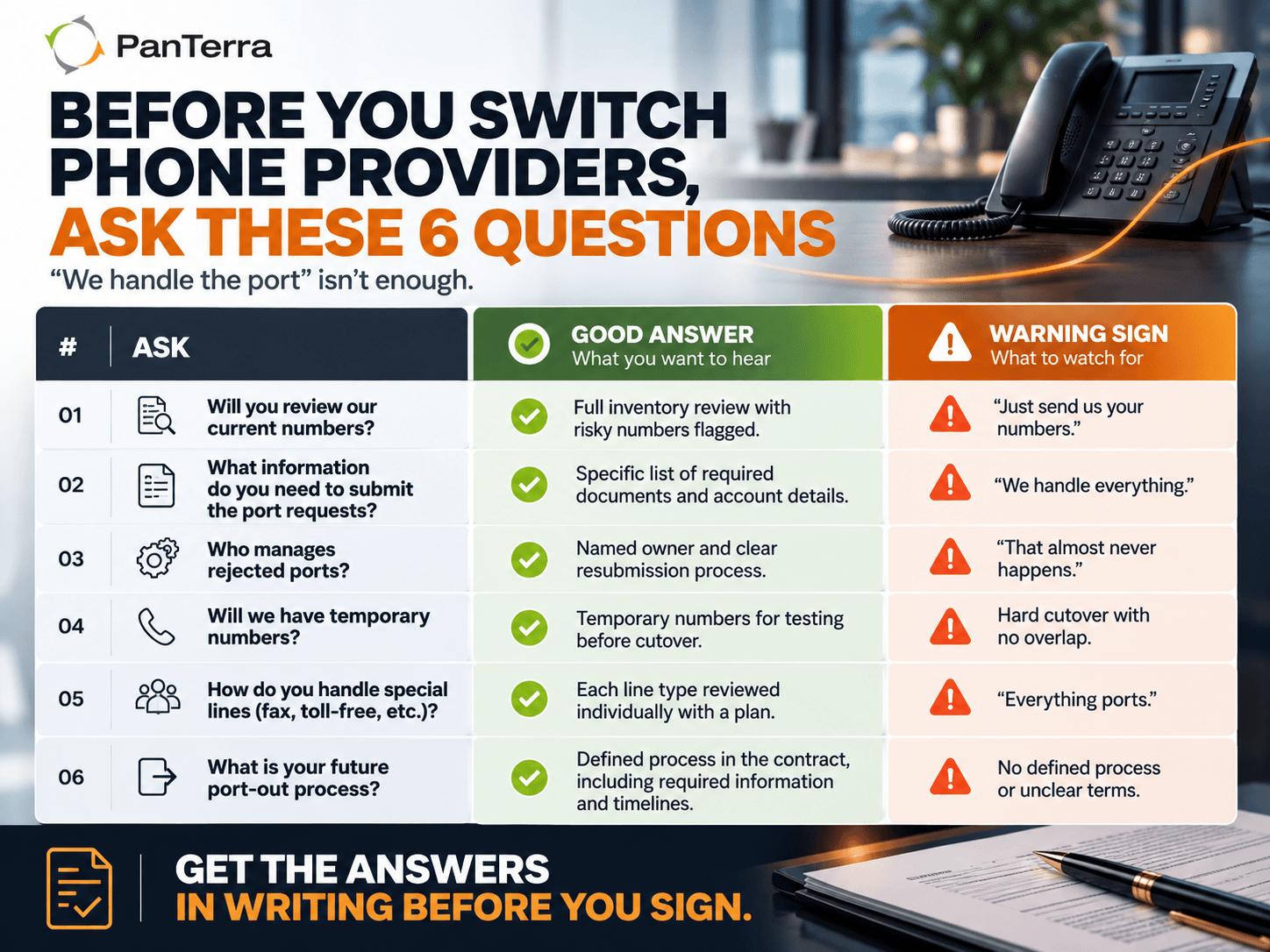
Questions to ask about number porting before you sign
Ask these of every vendor on your shortlist, including us. The answers are only useful if you get them in writing.
|
Ask this |
A good answer |
A warning answer |
|---|---|---|
|
Will you review our number inventory before we sign? |
Yes, with risky numbers flagged |
"Just send us your numbers." |
|
Who submits the port requests, and what do you need from us? |
A specific document list, and a check of our customer service record before submission |
"We handle all of it." |
|
What happens when a port is rejected? |
A named owner and a resubmission process |
"That almost never happens." |
|
Can we run on temporary numbers before the port completes? |
Yes, with forwarding in place |
A hard cutover with no overlap |
|
Which of our numbers need a different migration path? |
A review of each line |
"Everything ports." |
|
How fast will you release our numbers if we leave? |
A stated process in the contract |
"We've never had to." |
These questions belong in your wider decision. Porting is one of the terms worth settling alongside compliance scope, how sites are managed, and support. Get them answered while you still have leverage, and the day your numbers move will be uneventful, which is exactly what it should be.
Frequently Asked Questions
How long does it take to port a business phone number?
Under 47 CFR § 52.35, a qualifying simple port must be completed within one business day. Ports that are not simple must be completed within four business days, unless the customer or new provider requests longer. Most business accounts are not simple ports. Ask your vendor which category each request falls into and what could change the confirmed port date.
Can I keep my business phone number when I switch providers?
Generally, yes. FCC guidance says customers who switch providers and remain in the same geographic area can keep an existing number, and portability can apply across wireline, wireless, and interconnected VoIP providers. Keep your current service active until the port is complete, because canceling first can put the number at risk.
Can my current provider refuse to port my number?
No. According to the FCC, your current provider cannot refuse to port your number even if you owe an outstanding balance or a termination fee. You still owe what your contract says, but the number can move.
Should I cancel my old phone service before porting?
No. Keep your old service active until every number has moved and been tested on the new system. Canceling first can close the account the number is tied to, which can stop the port.
Can 800 numbers be ported?
Yes. 800 numbers and other numbers that are free for callers to dial can move between providers, but they follow a separate process from local numbers. List them in your inventory so your new provider plans for them from the start.
What is a transfer PIN?
A transfer PIN is a code some carriers, mostly wireless, require before they will release a number to another provider. It helps stop someone from moving your number without permission. Your new provider will ask for it if your account has one.
.jpg?width=500&height=500&name=Are%20you%20Getting%20a%20Good%20Deal%20(1).jpg)
Comments