Three Things Mid-Market Healthcare Should Be Asking About AI Patient Experience in 2026


The Questions Most Healthcare AI Evaluations Skip
AI patient experience is moving fast in healthcare. New tools for appointment scheduling, patient communication, and clinical workflow automation are launching faster than most mid-market healthcare organizations can evaluate them.
The evaluations that fail focus on features. They skip three questions that matter more. Not "can it schedule appointments?" More important: "does it meet HIPAA rules for patient data?" Not "does it have sentiment analysis?" More important: "what happens when a patient is distressed and the AI needs a human?"
These are the questions PanTerra and Five9 walked through with healthcare leaders in their joint webinar on transforming healthcare communications with AI. This article takes those three questions and turns them into an evaluation framework any mid-market healthcare organization can use before a purchase decision.
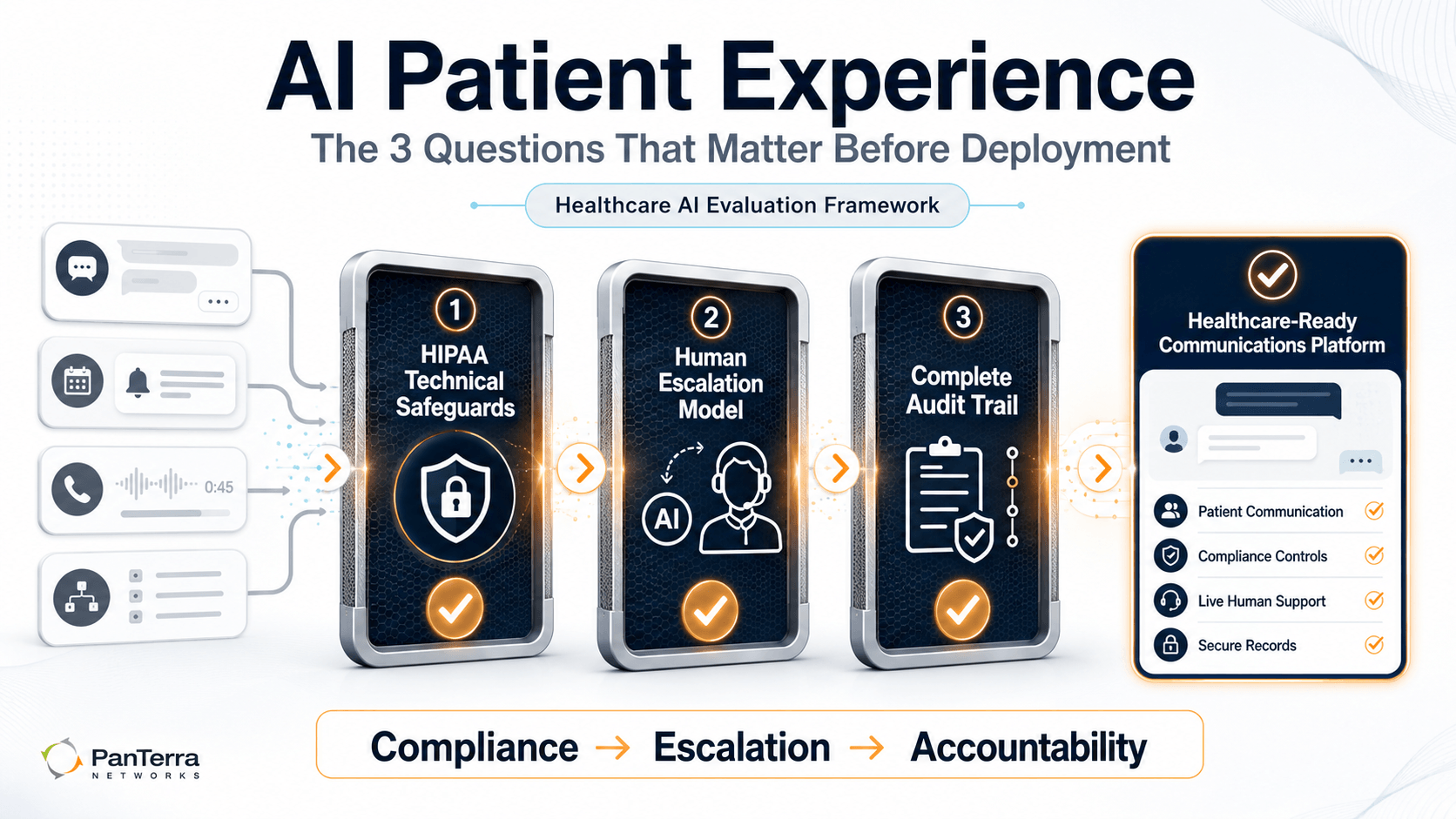
TL;DR
In real business terms: most AI patient experience tools were built for general business communication, then adapted for healthcare. A smaller set were built for healthcare from the ground up — with HIPAA, HITECH, and BAA architecture native to the platform rather than layered on after the fact. The evaluation questions below separate these two categories in a 30-minute conversation with any vendor.
Key takeaways:
- HIMSS research on AI in healthcare finds that failure rates for AI in clinical settings are significantly higher when compliance architecture is treated as a retrofit rather than a foundation.
- HIPAA covers any AI tool that creates, receives, maintains, or transmits protected patient data. Every AI tool in a patient communication workflow is subject to this requirement — regardless of how the vendor markets it.
- The three questions: Does it meet HIPAA's security requirements specifically? What does the human escalation model look like? And can you see the audit trail for every patient interaction?
- The HHS HIPAA Security Rule security requirements specify exactly what encryption, access control, and audit logging standards AI tools handling patient data must meet.
- Most AI patient experience evaluations take 30 to 90 days. The three questions in this article can filter out non-compliant tools in the first vendor conversation.
Question 1: Does It Actually Meet HIPAA's Technical Safeguards?
"HIPAA-compliant" is the most overused claim in healthcare tech marketing. Every vendor says it. The real question is not whether they claim it. It is what their platform specifically does to meet the HIPAA Security Rule.
The Technical Safeguards section of the HIPAA Security Rule requires four specific categories of controls for any system that handles protected patient data:
- Access controls: Unique user IDs, auto log-off, and encryption
- Audit controls: Hardware, software, and procedural mechanisms to record and examine activity in systems containing patient data
- Integrity controls: Authentication mechanisms to ensure patient data has not been altered or destroyed
- Transmission security: Encryption of patient data during transmission across open networks
When evaluating any AI patient tool, ask how their platform meets each of the four categories. Not a general statement. Ask for the specific technical details.
A Business Associate Agreement (BAA) is also required before any vendor handles patient data on your behalf. A vendor that cannot produce a BAA or delays providing one is not ready for healthcare deployment, regardless of what their marketing says.
Question 2: What Does Human Escalation Look Like?
AI in patient communication is only as good as its escalation model. A patient with a billing dispute, an urgent medication question, or signs of distress needs a live person. The AI context must transfer with them — not get lost.
The evaluation table below maps the escalation scenarios that matter most in mid-market healthcare, what weak AI tools typically do, and what good escalation looks like.
|
Escalation scenario |
What weak AI tools do |
What good AI escalation looks like |
|---|---|---|
|
Patient shows signs of distress |
Continues routing through standard call flow; may drop to voicemail |
Immediate detection and warm transfer to a human agent with full conversation context |
|
Clinical question beyond AI scope |
Provides generic information or asks patient to call a different number |
Transfers to a clinical staff member with interaction summary and reason for escalation |
|
Complex billing dispute |
Routes to a general queue with no context |
Transfers with complete call transcript and dispute details already captured |
|
After-hours urgent inquiry |
Records a voicemail or plays a generic after-hours message |
Triages urgency, provides emergency information if appropriate, and flags for morning callback with context |
|
Language barrier or accessibility need |
Falls back to a menu or drops the call |
Detects the need and routes to appropriate support with context preserved |
In real business terms: a patient who gets transferred and has to repeat everything they already told the AI is a patient who will not trust the system. The escalation model is not a secondary consideration — it is the primary test of whether an AI patient experience tool is safe to deploy.
Question 3: Can You See the Audit Trail?
Healthcare organizations are accountable for every patient interaction that flows through their communication systems. That accountability requires an audit trail — a complete, tamper-evident record of what happened in every patient interaction, who handled it, what was said, and what the outcome was.
Most AI tools generate logs. Three questions matter about those logs:
- Complete: Does it cover AI interactions AND human interactions?
- Accessible: Can your team pull a specific interaction log without filing a support ticket?
- Tamper-evident: Is the log protected against changes? Does the vendor's SOC 2 Type II certification cover it?
Ask every vendor to demonstrate a live audit trail pull. Not a slide showing a screenshot — a live pull from their system, for a test interaction, showing the complete record. A vendor who hesitates on this request is telling you something important about their compliance readiness.
PanTerra's HIPAA-compliant VoIP platform includes AES-256 encryption, SOC 2 Type II certified infrastructure, native audit logging, and BAAs included with every deployment. The audit trail is a core architectural feature — not an add-on.
FAQ
Does every AI tool used in patient communication require a BAA?
Yes. Any tool that handles, processes, or stores protected patient data on your behalf requires a Business Associate Agreement under HIPAA. This includes AI scheduling tools, sentiment analysis platforms, call recording services, and transcription engines — even if they only touch patient data briefly.
What is the difference between HIPAA and HITECH compliance?
HIPAA establishes the baseline privacy and security requirements for patient data. HITECH (the Health Information Technology for Economic and Clinical Health Act) strengthened HIPAA's enforcement provisions and extended compliance requirements to business associates. A healthcare AI tool should be compliant with both — not just HIPAA alone.
How do you evaluate AI patient experience tools without a pilot?
The three questions above can be answered in a vendor conversation without deploying anything. Ask for the compliance documentation. Ask to see the escalation model in a demo scenario. Ask for a live audit trail demonstration. If a vendor cannot address all three before a pilot, a pilot will not resolve the gap.
What should healthcare organizations prioritize in 2026 AI evaluations?
Compliance architecture first — before capabilities. A highly capable AI tool that cannot meet HIPAA Technical Safeguards is not deployable in a healthcare environment, regardless of its feature set. Once compliance is confirmed, focus on escalation. Then evaluate fit: what share of daily patient inquiries can the AI handle? What does ROI look like at your call volume?
What This Adds Up To
AI patient experience tools are advancing fast. The organizations that will deploy successfully in 2026 are the ones that evaluate compliance architecture, escalation models, and audit trail requirements before they evaluate capabilities.
The three questions in this article — HIPAA security requirements, human escalation, and audit trail — are not the only evaluation criteria. But they are the ones that determine whether a tool is deployable in a regulated environment at all.
The PanTerra and Five9 webinar content is in the PanTerra newsroom. The HIPAA-compliant VoIP platform page covers the compliance setup in detail.
.jpg?width=500&height=500&name=Are%20you%20Getting%20a%20Good%20Deal%20(1).jpg)
Comments