What the G2 2026 UCaaS Rankings Tell Buyers


The Badge Is Not the Point
Every UCaaS vendor with a G2 High Performer badge will show you that badge in a sales presentation. That is expected. What they rarely explain is what the badge actually measures — or how to read the underlying data to find the information that matters for your specific evaluation.
G2's scoring methodology is worth understanding before you start comparing platforms. The High Performer designation is not a sponsorship, an analyst recommendation, or a self-reported claim. It is calculated from verified buyer reviews — written by people who have used the platform, confirmed their identity and employer, and rated the product on specific criteria. No review can be gated, cherry-picked, or removed by the vendor.
That methodology makes the data genuinely useful. But reading a badge is not the same as reading the data behind it. The badge tells you that verified customers rated this product positively. The underlying data tells you which customers, at what company sizes, in which use cases, and on which specific criteria.
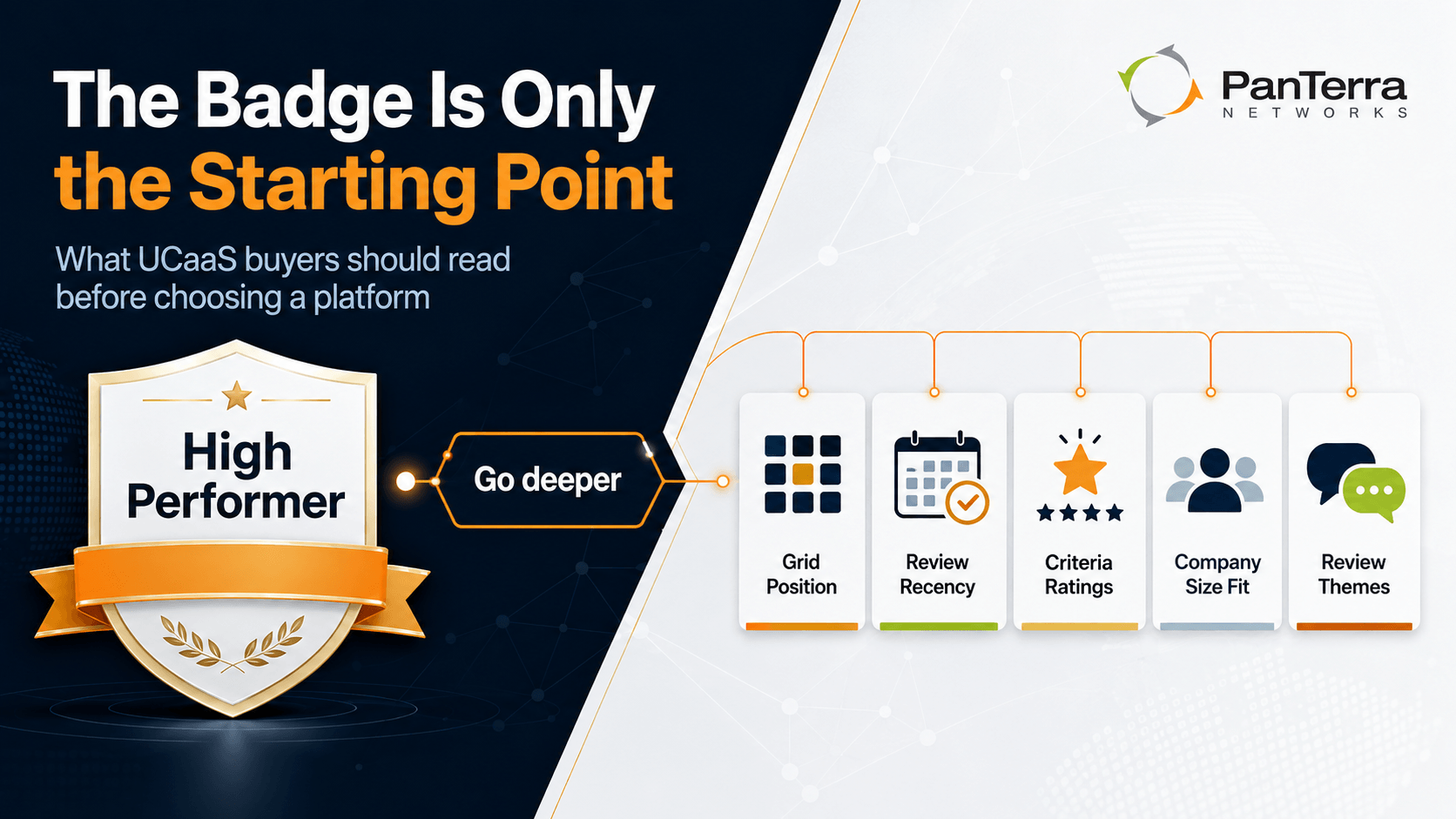
TL;DR
G2 named PanTerra Streams.AI a Spring 2026 High Performer in the UCaaS category. The badge reflects verified buyer reviews — not analyst agreements or paid placements. But the badge itself is the starting point, not the endpoint. The most useful G2 data for a UCaaS buyer is in the grid position, the review sentiment breakdown, and the specific criteria ratings — not the award headline.
Key takeaways:
- The UCaaS market reached $161.79 billion in 2025 and is projected to reach $415 billion by 2034. More than 90% of organizations have implemented UCaaS, according to Metrigy's 2025 workplace study. The evaluation pressure has shifted from "should we adopt?" to "which platform is right for us?"
- G2's scoring methodology combines Satisfaction scores (from buyer reviews) and Market Presence scores (from third-party data) to position products on its Grid. High Performer means high Satisfaction relative to Market Presence.
- High Performer designation on the G2 Momentum Grid reflects a pattern: more verified reviews, higher satisfaction ratings, and growing adoption — not a single quarter spike.
- The most predictive data in a G2 profile is the breakdown of reviews by company size and use case. A platform that scores well with enterprise buyers may score differently with mid-market buyers in your specific vertical.
- Reading G2 data critically means looking at the review count, the review recency, the criteria-level ratings (ease of use, support, implementation), and the size distribution of reviewers.
How G2 Calculates Its Rankings
G2's Grid has two axes: Satisfaction and Market Presence. Understanding each one helps buyers read rankings accurately.
Satisfaction is derived from verified buyer reviews. G2 scores reviews on specific criteria — ease of use, quality of support, ease of setup, and product direction, among others. The Satisfaction score reflects the weighted average of those criteria ratings, adjusted for recency. Reviews from the past 90 days are weighted more heavily than older reviews.
Market Presence is derived from third-party data — market share estimates, social presence, employee count, and web traffic. It is not a review-derived score. High Market Presence simply means a vendor is large and widely used — not necessarily well-reviewed.
The four quadrants on the G2 Grid follow from these two scores:
- Leader: High Satisfaction, High Market Presence — large, well-reviewed vendors
- High Performer: High Satisfaction, Lower Market Presence — platforms with strong reviews relative to their size
- Contender: Lower Satisfaction, High Market Presence — large vendors with room to improve
- Niche: Lower Satisfaction, Lower Market Presence — emerging or specialized tools
High Performer is the most useful designation for mid-market buyers. It means high customer satisfaction without the scale of a market leader. That often means tighter product focus, stronger support economics, and a customer base that is more similar in size to a mid-market buyer.
What to Look for Beyond the Badge
The badge tells you a platform earned a High Performer designation. These are the data points worth examining before you use G2 as part of your evaluation.
|
G2 data point |
What it shows |
How to use it |
|---|---|---|
|
Review count and recency |
How many verified buyers have reviewed the platform, and how recently |
Low review count means thin data. Look for products with 30+ reviews and meaningful activity in the past 12 months. |
|
Criteria-level ratings |
Scores broken down by ease of use, support quality, ease of setup, and product direction |
A product may score overall well but have weak support ratings — which is a different evaluation decision |
|
Company size distribution |
Breakdown of reviewers by organization size (SMB, mid-market, enterprise) |
A platform reviewed primarily by enterprise buyers may behave differently for a 200-person company |
|
Grid position trajectory |
Where the product sits on the Momentum Grid |
A vendor moving into the High Performer quadrant signals growing adoption and improving satisfaction |
|
Review themes |
Common language across multiple reviews — what buyers consistently praise and what they consistently flag |
Read the 3- and 4-star reviews, not just the 5-star ones. Patterns in mid-tier reviews reveal operational friction |
The trade-off worth understanding: G2's methodology is transparent and anti-manipulation, but it reflects the experience of the buyers who reviewed the platform — not every buyer. A small review set may not represent your specific vertical or use case.
How to Use G2 Data in an Active UCaaS Evaluation
When I walk IT and ops leaders through a UCaaS evaluation, I recommend using G2 data at two stages. Early filtering. Reference validation.
Early filtering: Use the G2 Grid to generate a qualified shortlist. Filter by company size — look at platforms where reviewers are similar to your own organization in headcount and industry. Sort by Satisfaction score rather than Market Presence. Platforms in the High Performer quadrant with 30+ reviews in the past 12 months from mid-market reviewers are worth including in your next stage.
Reference validation: Before a final decision, pull the 10 most recent reviews for each platform you are seriously evaluating. Read the specific criteria ratings. Check the support quality scores. Look for mentions of implementation timeline. Cross-reference what the vendor told you in sales conversations against what verified buyers described after deployment.
What businesses actually need to evaluate is not the headline number — it is the pattern. A platform scoring well on setup and support from reviewers in your vertical is a stronger signal than a broad badge from reviewers across 20 industries.
FAQ
Can vendors influence their G2 rankings?
Vendors can invite customers to review their products on G2, but they cannot control what those customers write. Reviews are screened by G2 for authenticity and must be linked to a verified LinkedIn profile or company email. Vendors cannot remove negative reviews. The review sourcing is more transparent than most buyers realize.
What is the G2 Momentum Grid?
The Momentum Grid tracks change in a vendor's G2 data over 90 days. It measures review growth, satisfaction trend, and social presence. A High Performer designation on the Momentum Grid reflects a sustained pattern of growing adoption and improving satisfaction, not a one-time spike.
Is G2 data more useful than analyst reports for mid-market buyers?
For mid-market buyers, G2 and TrustRadius data is often more directly applicable than analyst reports. Analyst rankings tend to weight enterprise feature sets and global market presence heavily. Verified buyer review platforms weight actual deployment experience from organizations that may be more similar to your own.
Where do I start on G2 for a UCaaS evaluation?
Start with the G2 UCaaS Grid. Filter by company size. Sort by Satisfaction. Then open each shortlisted product profile. Read the review themes. Check criteria-level ratings. The Streams.AI platform page links to the full G2 profile for additional context.
What This Adds Up To
G2 High Performer recognition is meaningful because it comes from verified buyers, not analyst relationships or paid programs. But reading it correctly requires going deeper than the badge. The Momentum Grid position, the criteria-level breakdown, and the reviewer company-size distribution are where the actionable data lives.
For a 2026 UCaaS evaluation, the G2 data on mid-market platforms is worth using. Check satisfaction scores, review recency, and grid position when building your shortlist. The badge is the signal that a platform is worth looking at. The underlying data tells you whether it is worth choosing.
.jpg?width=500&height=500&name=Are%20you%20Getting%20a%20Good%20Deal%20(1).jpg)
Comments