RingCentral Stability: Leadership & Financial Review


RingCentral stability questions come up in nearly every enterprise evaluation I see, and they deserve better answers than rumors. When a business signs a multi year UCaaS contract, it is betting that the vendor's leadership, finances, and roadmap hold steady for the life of the agreement. So here is the sourced record on the market share leader: what actually happened in the 2023 and 2024 leadership turnover, what the 2025 financial results really show, and the questions the record raises for buyers. Fair warning: parts of this story reflect well on RingCentral. A stability review that only finds problems is a sales pitch wearing a lab coat.
TL;DR and Key Takeaways
RingCentral went through visible leadership churn in 2023 and 2024: a CEO who lasted about three months and a CFO resignation that moved the stock 9 percent. The 2025 financial results, however, show a real turnaround, with the company's first GAAP profitable year, record free cash flow, and a first ever dividend. The open question is what managing for margin at 4 to 5 percent growth means for customers at renewal time.
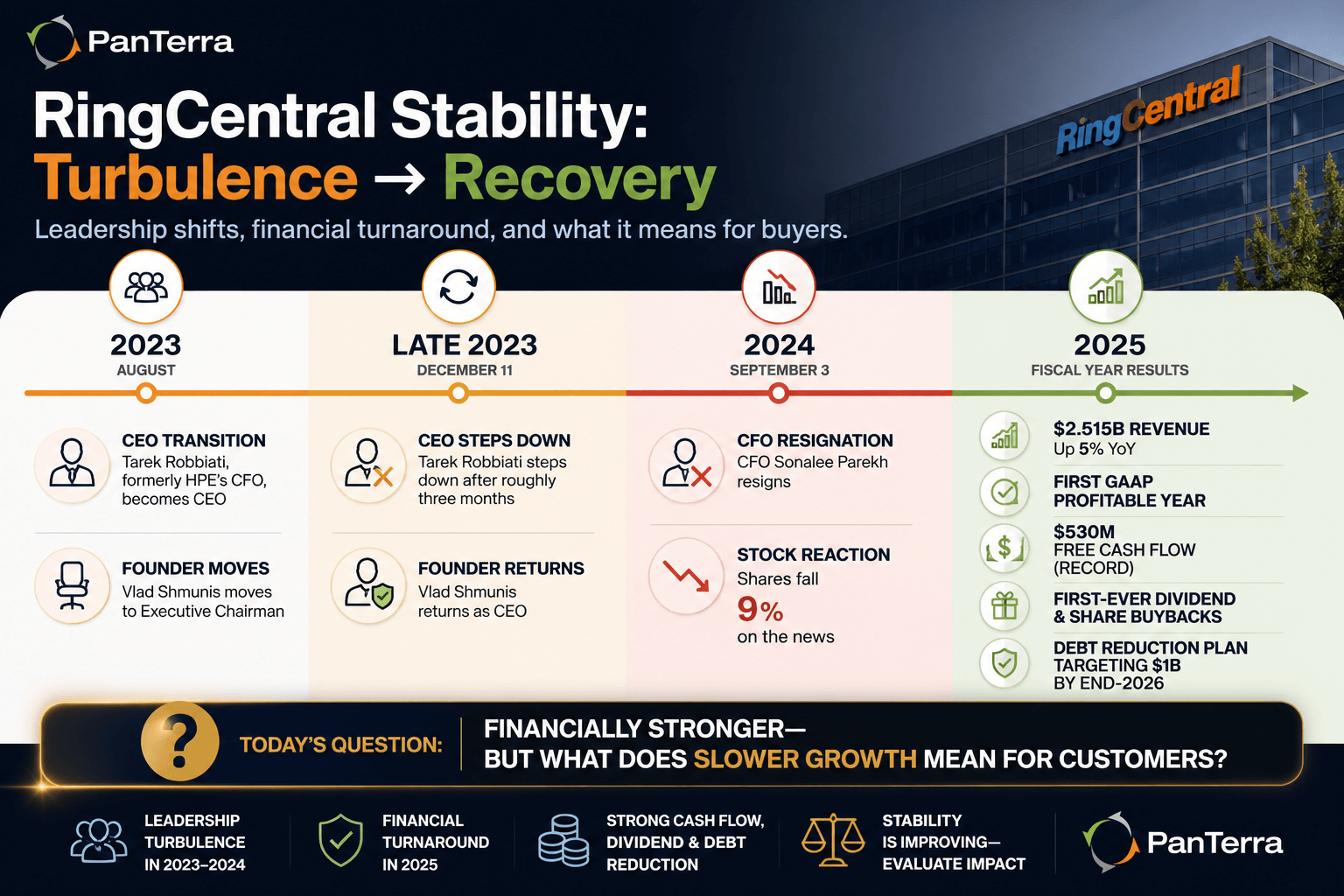
- CEO succession in August 2023 reversed within about three months; founder Vlad Shmunis returned as CEO in December 2023.
- CFO Sonalee Parekh resigned in September 2024, and shares fell 9 percent on the announcement.
- Fiscal 2025: $2.515 billion revenue, up 5 percent; first GAAP profitable year; record $530 million free cash flow.
- The company began paying a dividend and buying back shares, with debt reduction targets through 2026.
- Growth guidance of 4 to 5 percent signals a company managed for margin, which buyers should price into renewal expectations.
Who This Is For
Best for: IT and finance leaders running vendor diligence on RingCentral, whether as current customers approaching renewal or shortlist evaluators.
Not ideal for: Readers wanting a feature comparison, which our platform comparison covers separately.
Top use cases: Renewal negotiations, procurement risk reviews, and building the vendor stability section of a UCaaS evaluation.
Why Vendor Stability Belongs in a UCaaS Evaluation
Vendor stability belongs in the evaluation because a phone system contract outlives most product roadmaps. Your business commits for years, and over that horizon the vendor's leadership continuity, cash position, and strategic focus shape everything you experience: how fast features ship, how renewals get priced, and how support is staffed. Feature checklists compare what vendors are today. Stability review asks what they will be in year three of your term.
RingCentral makes an instructive case study precisely because the record contains both turbulence and recovery. The point of this review is not to disqualify anyone. It is to show what a sourced stability check looks like, using public record, so you can run the same check on any vendor — ours included.
The RingCentral Leadership Record, 2023 to 2024
The documented sequence, from company press releases and industry coverage:
|
Date |
Event |
|---|---|
|
Aug 2023 |
Tarek Robbiati, formerly HPE's CFO, becomes CEO; founder Vlad Shmunis moves to executive chairman |
|
Dec 11, 2023 |
Company announces Robbiati is stepping down after roughly three months; Shmunis returns as CEO |
|
Sep 3, 2024 |
CFO Sonalee Parekh resigns; shares fall about 9 percent on the news |
The December 2023 reversal drew wide industry attention, including coverage at UC Today, because three month CEO tenures are rare at companies of this size. The CFO departure nine months later extended the churn into the finance organization, and the market reaction, a 9 percent single day drop reported by financial press, showed how sensitive investors were to further turnover.
What does that record mean? Read fairly, it means the company went through a rocky transition at the top and resolved it the way founder led companies often do: the founder came back. Shmunis built RingCentral and has run it for most of its existence. Continuity concerns after 2024 center less on who is in charge and more on bench depth beneath the founder.
RingCentral's Financial Picture in 2025: A Real Turnaround
The fiscal 2025 results, from the company's own reporting, are the strongest in its history. Revenue reached $2.515 billion, up 5 percent. The company posted its first GAAP profitable year, with operating income of $121 million against $3 million the prior year, and GAAP earnings of $0.48 per diluted share versus a loss of $0.63 in 2024. Free cash flow hit a record $530 million. On the strength of that, RingCentral initiated its first dividend, repurchased about $135 million in shares, and reported net leverage down to 1.7x with a stated plan to cut gross debt to $1 billion by the end of 2026.
Metric callout: Fiscal 2025 by the numbers: $2.515B revenue (+5%), first GAAP profitable year ($0.48 EPS vs. a $0.63 loss), record $530M free cash flow, first ever dividend. The balance sheet story improved materially.
Credit where due: this is what financial stabilization looks like. The debt overhang that worried analysts through the downturn years is being worked down on a public schedule, and a dividend is a statement of confidence that cash generation will continue.
Now the other side of the ledger. Revenue growth was 5 percent, and the company guided 2026 to 4 to 5 percent. For a company that grew at several times that rate during the UCaaS boom, single digit growth is the defining fact of the current chapter. Profitability came from margin discipline, not acceleration.
What Slower Growth Means for Customers
Here is my read, clearly labeled as analysis rather than fact. A vendor managed for margin at 4 to 5 percent growth tends to behave differently from a vendor managed for growth, in three ways buyers feel directly.
- Renewal pricing firms up. When new customer acquisition slows, expansion revenue from existing customers carries more of the plan. Expect disciplined, and sometimes aggressive, renewal quotes, and negotiate accordingly.
- Investment concentrates. Margin managed companies fund fewer bets. RingCentral is visibly concentrating on AI products, which its recent results credit for growth. Features outside the strategic focus may move slower.
- The customer math gets scrutinized. Support tiers, professional services, and add on pricing all get reviewed when a company optimizes for cash flow. Read your contract's escalation and support terms before renewal, not after.
None of this is unique to RingCentral, and none of it makes the platform a bad choice. It makes the renewal conversation a negotiation between a well informed customer and a margin focused vendor. Our PanTerra vs RingCentral comparison covers the feature and pricing side, and the RingCentral alternatives guide maps the field if the evaluation widens.
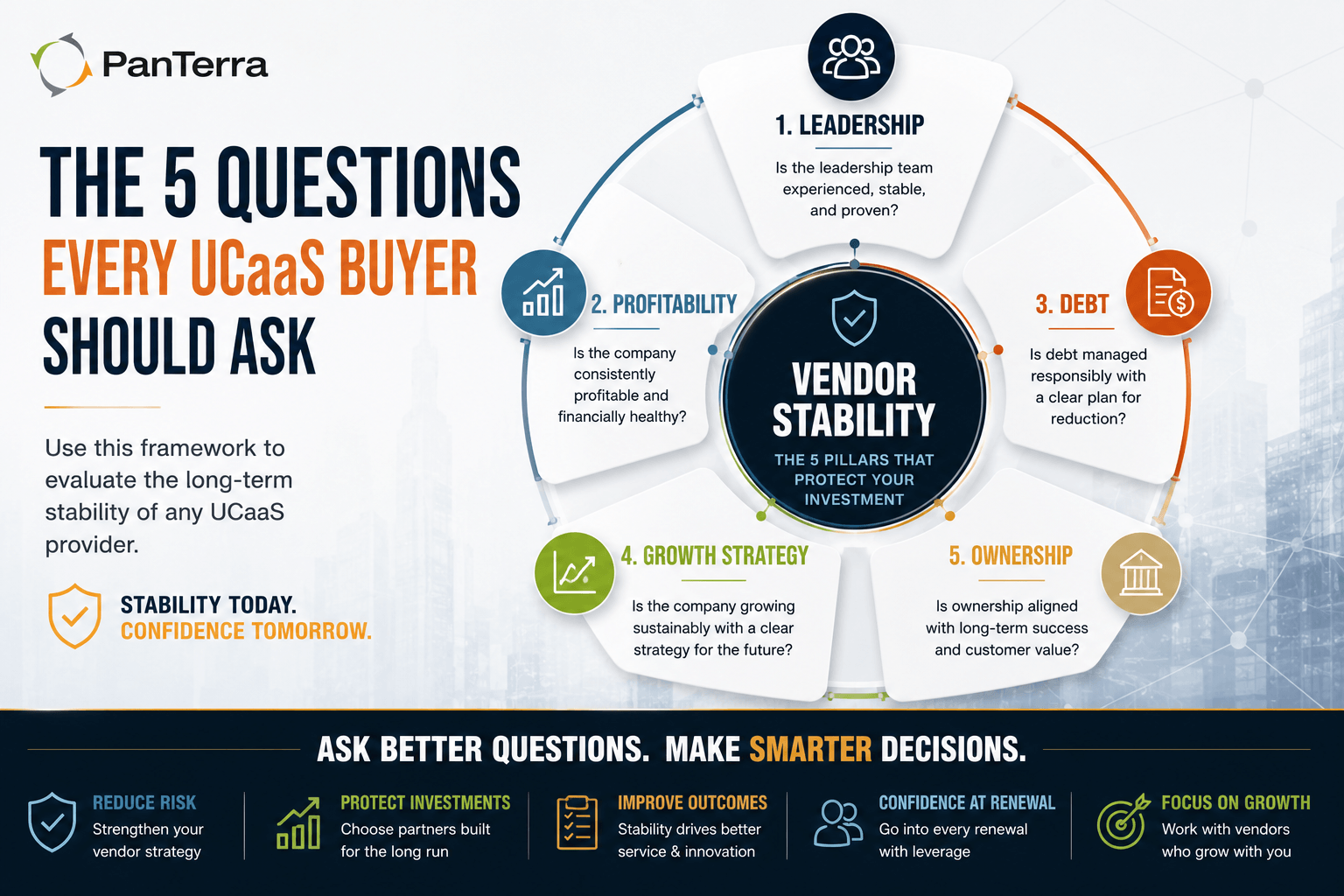
The 5-Question Vendor Stability Checklist
Run these five questions on any UCaaS vendor, including us:
- Leadership tenure. How long have the CEO and CFO been in role, and what does the last three years of executive turnover look like?
- Profitability trend. Is the company GAAP profitable, and is the trend improving or deteriorating?
- Debt schedule. What debt comes due during your contract term, and is there a public plan for it?
- Growth versus margin posture. Is the company managed for growth or margin, and what does that imply for your renewal?
- Ownership structure. Founder led, professionally managed, or private equity owned? Each behaves differently under pressure, as our GoTo Connect alternatives analysis shows on the private equity side.
Ask every vendor these questions directly, and compare answers against public record rather than sales decks. Stable vendors answer with specifics. For a wider view of how stability fits the full platform decision, our unified communications guide frames the whole evaluation, and current retail pricing for comparison sits on our pricing page.
FAQ
Is RingCentral financially stable?
By the fiscal 2025 record, yes: first GAAP profitable year, $2.515 billion revenue, record $530 million free cash flow, a new dividend, and net leverage down to 1.7x with a public debt reduction plan. The caution flag is growth, which slowed to 5 percent with similar 2026 guidance.
Why did RingCentral's CEO leave after three months?
The company announced in December 2023 that Tarek Robbiati would step down as CEO roughly three months after taking the role, with founder Vlad Shmunis returning as CEO. The company framed it as a leadership decision; detailed reasons were not made public.
Who runs RingCentral now?
Founder Vlad Shmunis returned as CEO in December 2023 and has led the company since. He founded RingCentral and ran it through most of its history, so his return restored leadership continuity at the top after the brief succession attempt.
Did RingCentral stock drop when the CFO left?
Yes. Financial press reported shares fell about 9 percent on the September 2024 announcement that CFO Sonalee Parekh was resigning, reflecting investor sensitivity to executive turnover following the 2023 CEO reversal.
Should the leadership churn stop me from choosing RingCentral?
Not by itself. The 2023 to 2024 turnover is documented history, and the 2025 financial results show genuine stabilization. Treat it as one input: weigh leadership tenure, profitability, debt schedule, and growth posture together, and negotiate renewals knowing the company is managed for margin.
.jpg?width=500&height=500&name=Are%20you%20Getting%20a%20Good%20Deal%20(1).jpg)
Comments