POTS Line Replacement: Are POTS Lines Going Away, and When?


On October 15, 2026, amended FCC rules took effect that change how carriers announce network changes and how they end legacy services. If your organization still pays for analog lines, those changes affect where notices appear, who receives them, and how quickly some services can be discontinued.
I have spent most of three decades on the carrier and vendor side of transitions like this one. The pattern rarely changes. The carrier's plan is public long before most customers notice it, and the customers who are caught off guard are the ones whose analog lines run something nobody has written down.
For a business that still carries POTS lines, three practical questions matter: does a carrier plan affect a specific service address, what notice applies to that action, and what equipment depends on the line?
POTS line replacement starts as a paperwork problem. Left alone, it becomes a safety problem.
Key Takeaways
- There is no single national deadline for POTS line replacement. Your date comes from your carrier's plan for your wire center, not from a law.
- Under the amended rules effective October 15, 2026, carriers no longer file notices of network changes with the FCC.
- The rule requiring 90 days of direct notice runs to other carriers and to 911 providers. It does not run to you.
- A carrier can now meet its public notice duty by posting on its own website. Nobody is required to make sure you read it.
- Some lines should never be treated as ordinary voice migrations. Elevator phones, fire alarm communicators, and other circuits that protect lives can carry code, listing, monitoring, and local approval requirements. Review them as a separate workstream before you choose a replacement.
Who This Is For
- Best for: facilities, IT, and operations leaders at organizations with multiple sites that still carry analog lines on the bill and have no current list of what those lines do.
- Not ideal for: sites that have already completed an analog cutover, or single offices with one spare line and no safety circuits.
- Top use cases: you received a notice and cannot tell what it asks of you; you are budgeting a POTS line replacement project; you hold three quotes and cannot tell what each one covers.
What Is a POTS Line, and Why Is It Going Away?
A POTS line, short for plain old telephone service, is a traditional analog phone circuit carried over copper wire from the carrier to a building. It handles one call at a time. Traditional POTS service draws power from the carrier's network, so it can keep a basic analog handset working when the building loses power. That is one reason analog lines were chosen for equipment that had to stay reachable during an outage.
What POTS Lines May Still Be Doing in Your Building
Many of the business analog lines still in service do something other than ordinary phone calls, including:
- Elevator emergency phones
- Fire alarm panel lines
- Burglar and intrusion alarm panels
- Fax machines, often in a back office nobody visits
- Gate and door entry intercoms
- Card readers and payment terminals in older setups
- Modem lines for building controls, HVAC, or meters
These circuits are easy to miss because a facilities, alarm, elevator, or building systems contractor often installed them, not the team that now manages communications. Take an inventory before you request replacement quotes, so the phone bill is not your only source of truth.
Why Carriers Retire Copper Instead of Fixing It
Carriers have been moving their legacy copper networks to fiber, IP, and wireless infrastructure for years. FCC 26-19 reduces several of the regulatory steps tied to network changes and service discontinuance, which makes those transitions easier for carriers to carry out.
The consequence matters more than the motive. If a carrier retires the copper serving an address, paying a higher monthly rate will not preserve that network. The useful planning question is whether a retirement or discontinuance affects each site, and if so, what has to replace the service that depends on it.
What Changed at the FCC in 2026
This is the part that has not reached most buyers, because it happened in a rulemaking rather than a press release.
In an order titled Reducing Barriers to Network Improvements and Service Changes, Accelerating Network Modernization, the FCC rewrote how carriers disclose network changes and how they end old services. The FCC adopted the order on March 26, 2026, and the new rules were published in the Federal Register on April 20, 2026. Several provisions waited on clearance under the Paperwork Reduction Act. After the Office of Management and Budget approved them in late September, the FCC set October 15, 2026 as the effective date for those provisions.
Four changes shape any POTS line replacement that starts now.
The FCC Filing Is Gone. The Public Notice Is Not.
Carriers no longer file notices of network changes with the FCC. Under the new rules, a carrier may give public notice "through publicly accessible industry fora, industry publications, or the incumbent LEC's website."
Read that last option twice. A carrier can satisfy its duty by posting the notice on its own site. The notice still exists. Whether it reaches the person who pays your analog bill is another matter entirely.
These notices used to appear on a single FCC page of wireline network change notices, sorted by carrier and state. That page is worth knowing about. It is also worth knowing that the rules no longer send new filings there.
The 90 Day Clock for Copper Retirement Runs to Carriers and 911 Providers
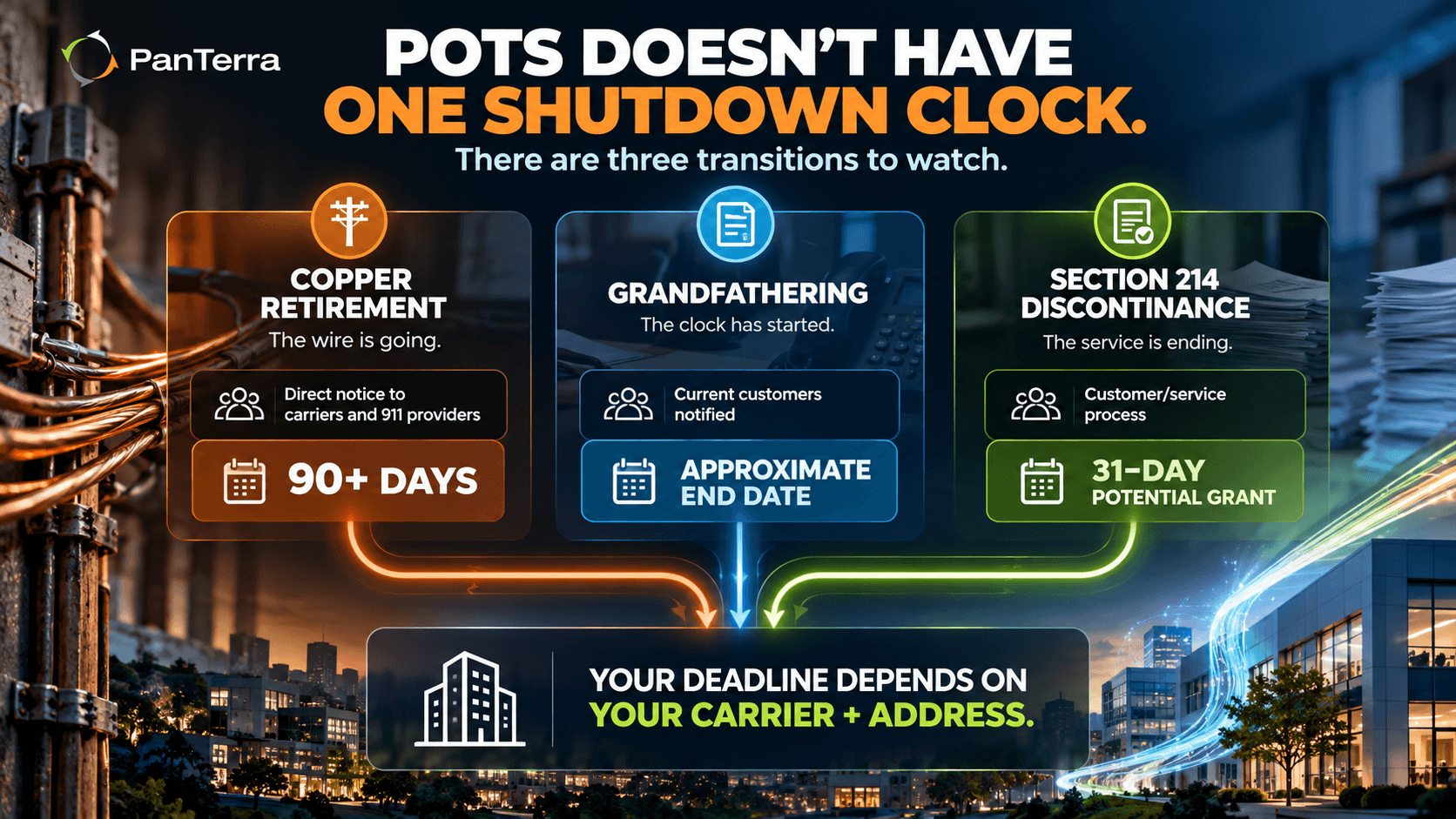
The new rules keep a direct notice duty for copper retirement. A carrier must notify interconnecting telephone providers and 911 service providers directly at least 90 days before it acts. Where the copper serves no customers at all, that interval drops to 15 days. This is the rule governing notice of network changes, not the separate process for notifying customers when a service is discontinued.
For copper retirement, direct notice goes to interconnecting carriers and 911 service providers rather than to you. That does not mean customers never receive notice. If the carrier is discontinuing, reducing, or impairing service under the separate Section 214 process, affected customers are owed their own notice.
So when a vendor tells you the FCC requires 90 days of notice, the number is right and the recipient is wrong.
Automatic Grants After 31 Days
Retiring copper and discontinuing a service are two different legal steps. A carrier that wants to stop offering old voice service files under Section 214 of the Communications Act.
For qualifying applications tied to a technology transition, the amended rules grant the discontinuance automatically 31 days after the FCC's public notice of the application, not 31 days after filing. The carrier must meet the rule's conditions, including the availability of a qualifying replacement service. An objection or action by the Commission can prevent the automatic grant, so do not treat a filing as a guaranteed termination date.
Notice what that condition promises. It says a replacement exists near you. It does not say the replacement works for your elevator phone.
What Grandfathering Means
Grandfathering is the step before a service ends. The carrier stops selling the service to new customers and continues serving existing ones for a period of time. The new rules let carriers grandfather old voice service, slower data service, and VoIP carried over copper without a separate filing for each.
For customers, the rules call for notice that names an approximate date by which the carrier intends to end the service permanently, along with the other services it offers.
|
Copper retirement |
Grandfathering |
Section 214 discontinuance |
|
|---|---|---|---|
|
What it is |
The copper itself leaves service |
The service is no longer sold to new customers |
The service is no longer offered at all |
|
Who gets direct notice |
Connecting carriers and 911 providers |
Current customers of that service |
Customers, no later than the filing date |
|
Timing |
At least 90 days ahead |
Notice names an approximate end date |
Eligible applications are granted automatically 31 days after FCC public notice, subject to the rule's conditions |
|
What it means for you |
Legacy copper facilities are being retired or replaced |
The clock has started |
The service is over |
When Are POTS Lines Going Away?
There is no single national date for every POTS line. The timing of copper retirement varies by carrier and service area, so an organization with multiple sites should confirm the status and expected timeline for each service address rather than assume one date applies everywhere.
You can still pin down your own dates. It takes a few direct questions to your carrier, and those questions appear at the end of this guide.
What Notice Are You Actually Owed?
A Copper Retirement Notice
This notice names the carrier, the area, the planned date, and a reference number. It is written for other carriers, which is why it reads like an engineering memo rather than a letter.
If one reaches you, treat it as a date, not a request.
A Grandfathering or Discontinuance Notice
This notice is written for customers, and it is the one that counts. It should name the service that is ending, give an approximate date, and list what the carrier offers instead.
Those alternatives are the carrier's alternatives. Nobody has checked whether they suit the equipment connected to the line today.
Your First Week
Start by identifying the notice and taking inventory of what depends on each line.
Five steps:
- Find the notice and note its date. Sort it into one of the three types above.
- Pull billing records for every analog line on the account, not only the lines the notice names.
- Walk the building and record what each line connects to.
- Separate the lines governed by a safety code from the lines that are not.
- Only then ask for quotes.
Skip the equipment inventory and the gap is predictable: the replacement quote covers the lines you identified, while an overlooked alarm, elevator, fax, paging, or building system circuit is left unresolved.

POTS Line Replacement: Which Lines Can Move, and Which Cannot
This is where POTS line replacement stops being a simple purchase.
Ordinary voice, fax, and modem circuits each require different checks. Some voice workflows can move to IP, a fax workflow may move to a digital service, and an unused line can simply be retired. Test the actual equipment, signaling, power, and operational dependencies before you assume the transition will be seamless.
Other lines need a separate review, because carrying audio or signaling is not their only requirement. Elevator emergency communications, fire alarm communicators, and similar systems may be governed by safety codes, equipment listings, monitoring requirements, and local enforcement. The replacement has to satisfy those requirements, not merely reproduce dial tone.
One rule covers it. Before you accept any replacement for a safety circuit, ask the vendor to confirm in writing that the device is listed or approved for that purpose. A generic analog replacement is not automatically suitable for a fire alarm panel.
What to Ask Before You Buy a POTS Line Replacement
Five questions for your career. Ask them in writing, and keep the answers.
1. Is my service affected by a copper retirement, a grandfathering, a discontinuance, or more than one? A good answer names the action and gives you a reference or docket number. A warning answer says everything moves to fiber eventually.
2. What is the date for my service address? A good answer gives a date or a quarter for each address. A warning answer describes a national program.
3. Which lines on my account are in scope, by circuit number? A good answer is a list that matches your bill. A warning answer is "all of your analog services."
4. What replacement are you certifying as available here? A good answer names the service and confirms it reaches your address, not just your region. A warning answer walks you through the product catalog.
5. Who owns this transition for my account, and how do I reach them? A good answer is a name. A warning answer is a general support number.
Thin answers tell you something too. They usually mean a program is handling your account rather than a person, and that you will have to drive the POTS line replacement yourself.
The Order of Operations
POTS line replacement rewards teams that count first and buy second. The notice gives you a date. The count tells you what that date will cost. Quotes gathered before the count cover the lines that were easy to find, and those are rarely the lines that cause trouble.
In my experience, the organizations that come through these transitions cleanly are not the ones with the biggest budgets. They are the ones that started with an honest list.
If a broader move away from legacy equipment is also planned, map the dependent circuits before you choose the architecture.
Related reading: Why Legacy PBX Migrations Fail as a Lift and Shift and Hosted PBX. Confirm current plan terms on our pricing page.
Frequently Asked Questions
What is a POTS line?
A POTS line is a traditional analog phone circuit carried over copper. It typically handles one call at a time. Because the service draws power from the carrier's network, it can keep a basic analog handset working during a local power outage. A cordless handset or other equipment powered in the building still needs backup power, and the carrier's service must remain available.
Are POTS lines going away?
Yes, though not on one national schedule. Carriers are retiring copper and ending old voice services area by area, under FCC rules the agency rewrote in 2026 to speed up the process.
When are POTS lines going away?
There is no universal date. Your timeline depends on your carrier's plan for your wire center. Ask your carrier in writing for the date at each service address.
What does POTS stand for?
Plain old telephone service. The term distinguishes the traditional analog circuit from digital and IP alternatives.
What are POTS lines used for?
Business POTS lines may still support elevator phones, fire and burglar alarm communicators, fax machines, gate intercoms, payment terminals, modem links, or ordinary voice service. The mix varies by site, which is why an inventory should come before the replacement decision.
What are my POTS line replacement options?
There are four paths: a managed analog replacement over cellular or IP, conversion of the line to IP on your phone system, a dedicated path built for safety circuits, or retiring the line outright. The right choice depends on what is connected to the line, so count before you choose.
Is copper retirement the same as ending my phone service?
No. Copper retirement removes or replaces legacy copper facilities, and your phone service may continue over another network. Discontinuance ends or changes the service itself under a separate FCC process. A transition can involve both, each with its own notice requirements.
How much notice does my carrier owe me?
It depends on the action. For copper retirement, the requirement of 90 days of direct notice covers interconnecting carriers and 911 service providers rather than end customers, and public notice may appear on the carrier's website or in another permitted forum. A service discontinuance follows a separate Section 214 process that includes notice to affected customers. Grandfathering carries its own customer notice requirements as well.
What happens if I do nothing?
If service is discontinued without a working replacement, the equipment that depends on it may lose communications. For equipment that protects lives, that can create a serious safety and code problem. Inventory those circuits and coordinate the replacement and any required acceptance tests before the service ends.

Comments