Veterinary Answering Service: Why Phone Advice Is Named in the Practice Act

Every practice shopping for a veterinary answering service is thinking about the same call. It is nine at night, an owner is frightened, and the question is whether the animal needs to be seen now.
That call is why you buy a veterinary answering service — and it is the call the service is least allowed to answer. Veterinary medicine is unusually blunt about why.
TL;DR
A veterinary answering service answers client calls in place of your own front desk, either through a remote team of people or through software that answers and acts. A veterinary answering service can book, confirm, route, take a message, and send a true emergency to the right place with an address. It cannot tell an owner what a symptom means or whether it can wait. The AVMA model practice act puts advice given by telephone inside the definition of practicing veterinary medicine, in those words, and adds that a veterinarian-client-patient relationship cannot be created by phone in the first place.
Key Takeaways
The model act names it. Practicing veterinary medicine includes the "rendering of advice or recommendation by any means including telephonic and other electronic communications."
There is also no relationship to hang phone advice on. The model act says a VCPR cannot be established solely by telephonic or electronic means.
So the job of a veterinary answering service is routing, not reassurance. "Go to the emergency hospital now, here is the address" is a routing output. "That can probably wait until morning" is not.
Write the emergency referral path before the booking logic on any veterinary answering service. Most practices do it the other way round.
HIPAA does not apply to animal patients. If you came here from a medical guide, that whole analysis drops away.
The federal AI voice rule attaches to the call your system places, not the call it answers, which makes the callback the regulated moment.
Who This Is For
Best for: multi-site practices and veterinary groups weighing a veterinary answering service because evening and weekend calls reach voicemail · practices with an emergency referral relationship that needs to be applied consistently · groups standardizing front desk handling across several hospitals.
Not ideal for: a single doctor with low call volume, where a per-call service stays cheap · practices wanting outbound reminder campaigns, which is a separate category · anyone hoping to hand off triage, which no product can take on.
Top use cases: evening, overnight, and weekend cover from a veterinary answering service · emergency referral routing with a tested address and number · booking and reschedules during appointments · prescription refill request capture · one routing pattern across every hospital.
What Is a Veterinary Answering Service?
A veterinary answering service is any setup where someone other than your own staff answers calls from clients. A veterinary answering service comes in two shapes, as everything in this category does.
One kind of veterinary answering service is people. Calls route to a remote team who answer in your practice name and follow a script you supply. Billing usually runs per minute or per call against a monthly floor, so a busy week costs more.
The other kind of veterinary answering service is software, an ai receptionist. It answers on the first ring, works out what the caller wants in plain speech, and acts on the rule you set: book it, route it, take a message, or hand the call to a person. There is no queue, which matters on the evening a storm brings in six calls at once. The Cluster A pillar works through the category split in full.
One thing to clear away before you shop for a veterinary answering service, because buyers arriving from the human healthcare side assume it. HIPAA does not apply to animal patients. There is no business associate agreement to chase for a veterinary answering service, and no protected health information in the call. Client records still carry privacy and confidentiality duties under state law and professional rules, so this is not a reason to be careless. It is a reason not to spend the evaluation on the wrong questions.
What May a Veterinary Answering Service Say?
One provision decides how a veterinary answering service gets configured, and it is far more direct than its equivalents in human medicine.
The AVMA Model Veterinary Practice Act, in the 2019 revision, defines the practice of veterinary medicine in Section 2.18. Alongside diagnosing and treating animal disease, the definition includes the "rendering of advice or recommendation by any means including telephonic and other electronic communications."
Read that clause on its own. Telephone advice is not adjacent to the practice of veterinary medicine. It is inside the definition, named.
Section 5.1 closes the other door. A veterinarian-client-patient relationship "cannot be established solely by telephonic or other electronic means." The VCPR requires, among other things, that a licensed veterinarian has taken responsibility for medical judgments and has enough knowledge of the patient to reach at least a preliminary diagnosis, usually through a timely physical examination. So even setting aside who is speaking, there is no established relationship for phone advice to a new caller to sit inside.
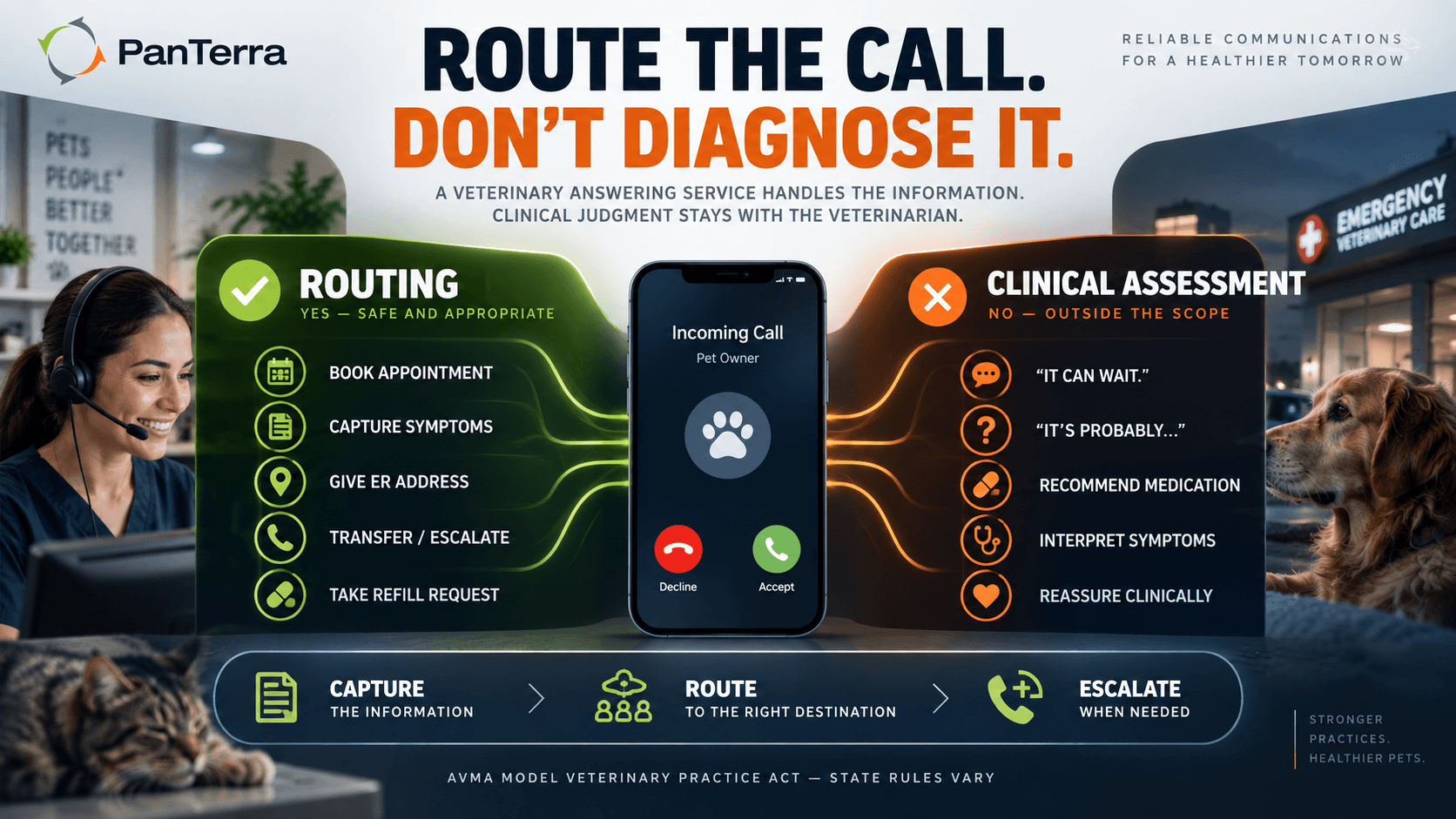
Put together, those two provisions give a veterinary answering service an unusually clean rule. It may capture and route. It may not assess.
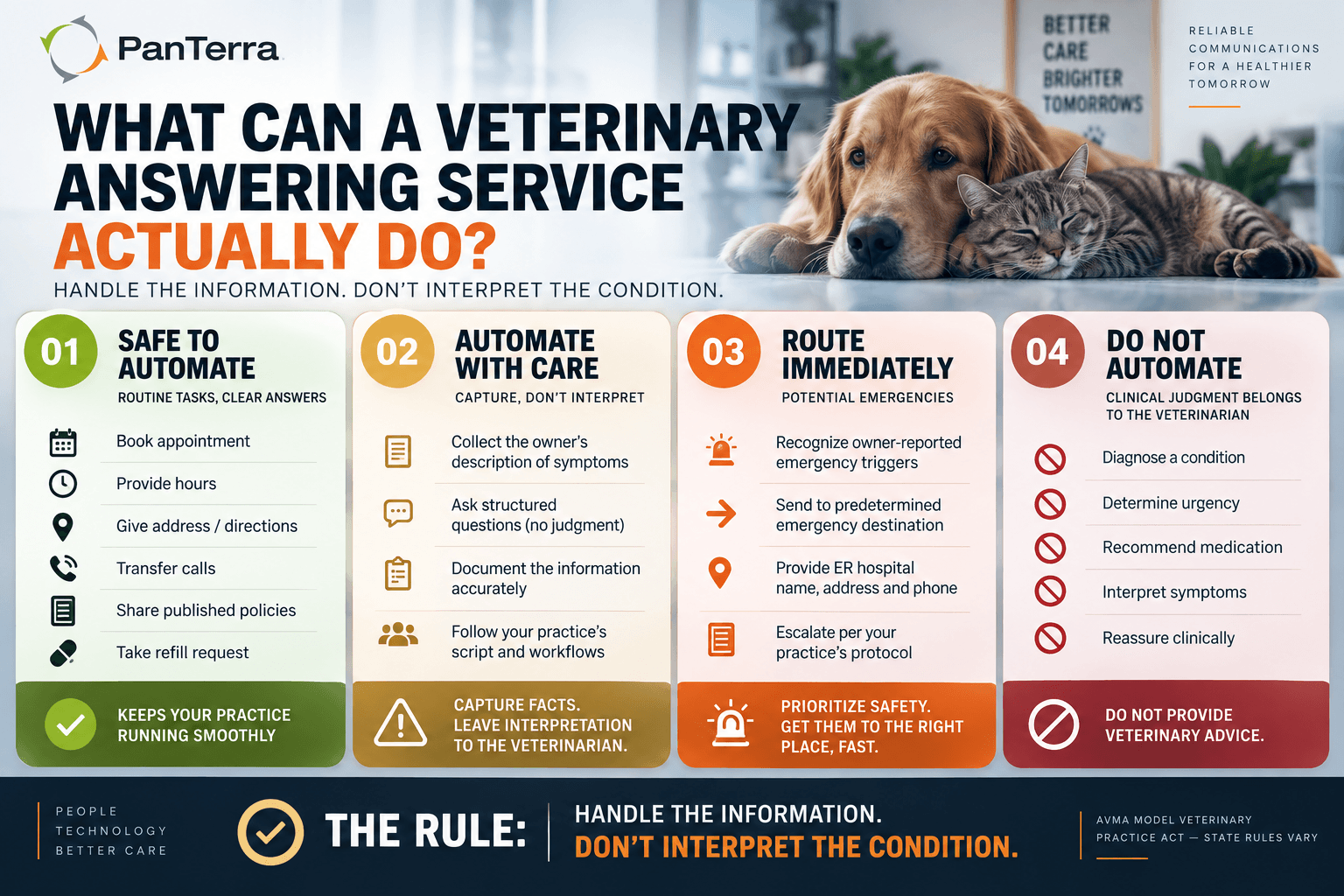
☐ Safe to automate. Booking, cancelling, moving, and confirming an appointment. Practice hours and address. Transferring to a named person. Taking a prescription refill request for the practice to review. Stating your published policy on new patients or payment.
☐ Safe to automate with care. Taking down the owner's description word for word and passing it on. Writing down "vomiting since this morning, has not eaten" is clerical. Reacting to it is not.
☐ Never automate. Telling an owner what a symptom probably is. Saying whether it can wait. Suggesting a dose of anything, including anything sold over the counter. Offering reassurance about a clinical situation.
☐ Route immediately, with an address. Anything the owner frames as an emergency, and anything on your own referral trigger list.
The model act is a model. States adopt from it with variations, and a few diverge in ways that matter, so check the act in every state where you practice rather than relying on the model. What travels is the shape: clerical handling can be handed off, and clinical judgment cannot.
The distinction the whole script turns on. Sending an owner to an emergency hospital is not advice. It is routing, and it is the single most valuable thing a veterinary answering service does. "Go now, here is the address and the number" carries no assessment of the animal. "It is probably not serious, watch overnight" carries one, and it is the sentence that creates the problem.
How Should Emergency Referral Work?
Write this before you talk to a vendor. It is the reason a veterinary answering service either earns its money or does not.
Your referral trigger list should be observable, not diagnostic. A stranger at nine at night can apply an observation. They cannot apply a diagnosis. Write it as things an owner reports, not as conditions:
- List what the owner might say that sends them straight out the door. Hit by a car. Struggling to breathe. Swollen or hard abdomen with retching. Ate something you think is poisonous. Seizure. Cannot urinate. Bleeding that will not stop. Collapsed.
- Attach a destination to each, not a judgment. The emergency hospital, the name, the address, the number, and how far it is. Confirm those details on the call rather than reading from a form last updated two years ago.
- Write what happens when the owner asks whether they really need to go. The right answer is that the practice cannot assess over the phone, and that is what emergency services are for. Not a probability.
- Decide what gets recorded. What the owner said, what the service told them, and where they were sent. This record is worth having.
- Write the override. Any caller who escalates after being routed gets a person, regardless of category.
- Test it from outside, in the evening, quarterly. Place the call. Check the address the service reads out is still the right one.
Everything else in a veterinary answering service script can be configured after that, because everything else is recoverable. Our guide to the after hours answering service covers the general escalation design, which applies here with the referral list on top.
Does the AI Voice Rule Apply?
Yes, and it reaches a veterinary answering service on the way out rather than on the way in.
In Declaratory Ruling FCC 24-17, adopted 2 February 2024 under CG Docket 23-362, the FCC confirmed that the Telephone Consumer Protection Act's limits on an "artificial or prerecorded voice" reach current AI tools that sound like human voices. Calls using them "require the prior express consent of the called party to initiate such calls absent an emergency purpose or exemption."
The operative word is initiate. An owner who rings your practice and reaches a veterinary answering service running in software is outside the ruling, because the owner placed the call.
The regulated moment is the callback. Vaccination reminders, recall calls, and post-visit follow-ups placed in an AI voice are calls your system initiates, and consent rules attach. Veterinary practices run a lot of reminder volume, so this is worth settling before go-live rather than after. Ask any vendor which direction their product works in, and how consent is captured and logged.
What Does a Veterinary Answering Service Cost?
A veterinary answering service comes in two pricing shapes, and the evening skew matters more here than in most fields.
A staffed service usually bills per minute or per call against a monthly floor, and evening and overnight minutes often cost more. Veterinary call volume is concentrated in exactly those hours, so ask for the evening rate and the overage rate rather than a blended figure.
Software usually carries a flat monthly fee with volume tiers, and an evening call costs the same as a morning one. That is the structural argument for a software veterinary answering service in this vertical, and it holds whatever else is true.
Deliberately absent: any figure for what a missed veterinary call is worth, or what share of evening calls are emergencies. Nothing in this space survived a source check. The numbers in circulation trace back through vendor marketing citing other vendor marketing. Measure your own instead: pull a month of evening calls, count what rang out, and count how many of those clients booked anything in the following week. Our companion piece on what an AI receptionist costs models both pricing shapes against a real call volume.
What Should You Ask a Vendor?
Eight questions to put to any veterinary answering service, in the order that rules vendors out fastest.
Which kind of veterinary answering service is this, software or staffing? Everything below turns on it.
Show me the default script, and specifically what it says when an owner describes a symptom. You want capture and route. Anything resembling assessment is a fail.
How does my emergency referral list get into the system, and who can change it? If the answer is an onboarding form and nothing after, you cannot fix it when the referral hospital moves.
What does the service say when an owner asks whether they really need to go in? Ask for the exact wording.
Can the script differ by hospital, and by state? Practice acts vary, so a group in several states needs more than one script.
Does it place outbound calls, and how is consent captured? Reminder volume makes this live for veterinary practices.
Can it write into our practice management system, and which one? A service that only takes messages moves work rather than removing it.
Can I hear a recording of a real evening call? Daytime demos tell you nothing about the call you are actually buying for.
Frequently Asked Questions
What is a veterinary answering service?
A veterinary answering service answers client calls in place of a practice's own front desk, then books, confirms, routes, takes a message, or sends a caller to an emergency hospital. It runs either as a remote team of people working from your script or as software that answers and acts on its own. What it does not do is assess the animal, which in most states is reserved to a licensed veterinarian.
Can a vet answering service tell an owner whether it is an emergency?
No, and this is a legal limit rather than a product limit. The AVMA model practice act includes advice given by telephone inside the definition of practicing veterinary medicine, and adds that a veterinarian-client-patient relationship cannot be established by phone alone. The correct output is routing with a destination, not an assessment of urgency.
What is a veterinary virtual receptionist?
The same thing under a different name, and the term is worth pinning down before you shop. Some vendors use it for software that answers calls, and some use it for a remote person placed on your phones. Those are different purchases with different costs and different questions, so ask which one is on offer before comparing prices.
What is an answering service?
An answering service answers inbound calls on your behalf when your own staff cannot, then routes the call, takes a message, answers a published question, or escalates. It runs either as a remote team of people working from your script or as software that answers and acts on its own. A veterinary answering service is that service with a referral list and a tighter clinical limit attached.
How does an answering service work?
Calls to your number forward to the service, either continuously or outside the hours you set. A staffed service delivers them to a remote team following your script. Software answers in place of a person, interprets the request in ordinary speech, and applies the rules you configured. Either way a veterinary answering service follows a routing list you wrote, and for a practice the emergency referral triggers come first.
How much does an answering service cost?
The two models price differently, so compare shapes rather than headline numbers. A staffed service usually bills per minute or per call against a monthly floor, often at a higher rate in the evening, with a separate overage rate. Software usually carries a flat monthly fee with volume tiers, and an evening call costs the same as any other. Ask for the evening rate rather than the blended one.
How much is an after hours phone answering service for a practice?
There is no published market range for this that survives a source check, so treat a quoted figure as a starting point for questions. On a staffed quote, what moves the number is your evening call volume, your average call length, and the evening rate. On software it is integration scope and the number of hospitals.
How do you choose a veterinary answering service?
Write the emergency referral list first, then shop against it. A veterinary answering service that can implement your list, let you edit it, and tell you exactly what the script says when an owner asks whether they really need to come in has answered the only questions that matter. Price and coverage hours are easier to compare and far less predictive.
Where this article describes the AVMA model practice act, it describes a model rather than the law in any state. States adopt from it with variations and amend without announcement, and this is not legal or clinical advice, so confirm the position in every state where you practice with your counsel or state board.

Comments