Property Management Answering Service: What It May and May Not Say


Most property management companies shopping for a property management answering service are trying to solve a timing problem. Maintenance calls arrive at eleven at night, leasing calls arrive while everyone is out on a turn, and both go to voicemail.
That is the easy half. The half that carries real exposure is what the person or the system on the other end says back. Under the Fair Housing Act, a statement your answering service makes is a statement you made — and an oral one counts.
TL;DR
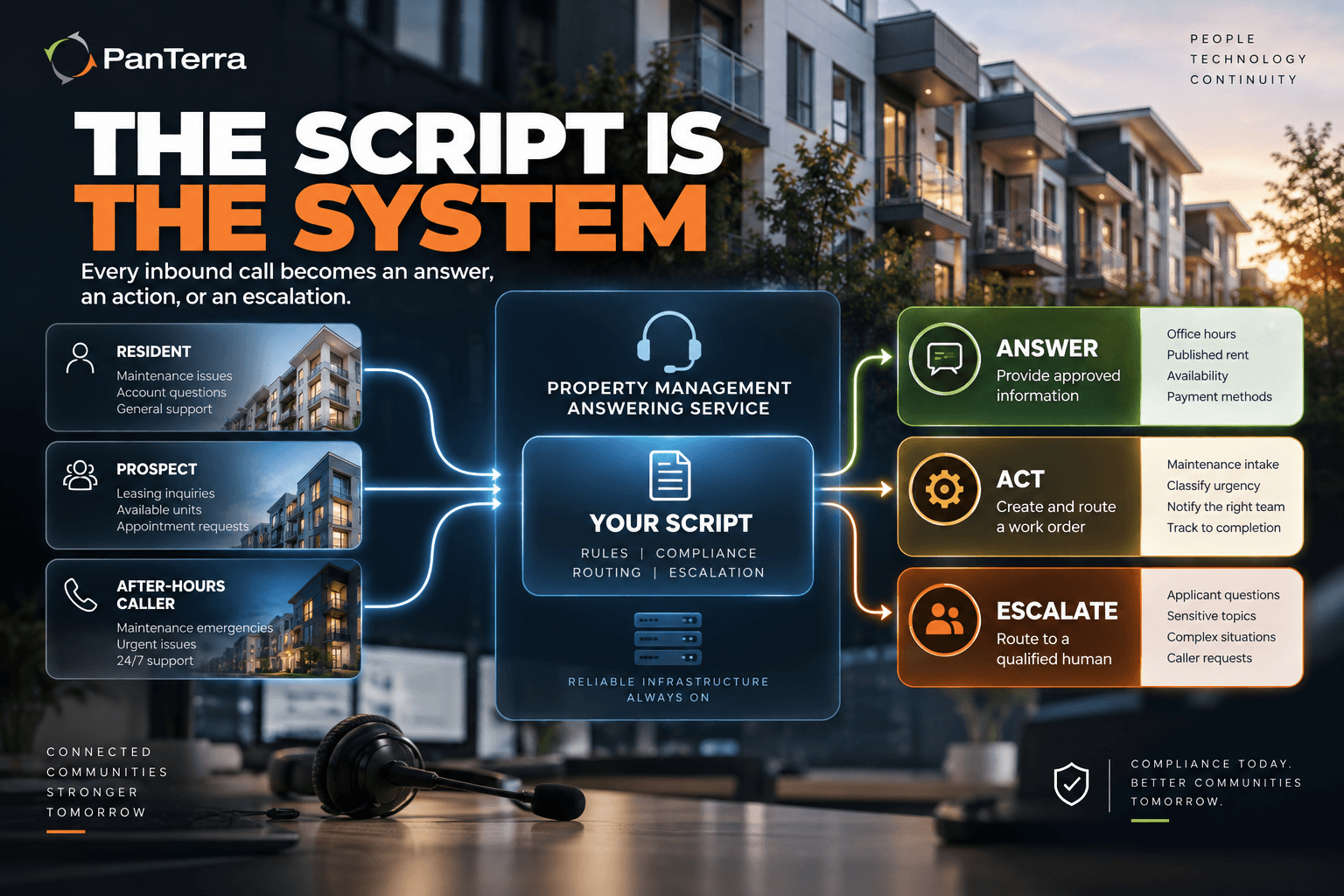
A property management answering service answers your inbound calls when your team cannot. It comes in two forms: a remote team of people following your script, and software that answers and acts on its own. Either way, a property management answering service is your agent in the eyes of the Fair Housing Act. Federal regulation applies the ban on discriminatory statements to oral statements, and makes the housing provider liable for an agent's conduct whether or not it knew. So the script is the product. Maintenance triage is the second design problem, and it is an operational one rather than a legal one.
Key Takeaways
The discriminatory statements rule reaches what a property management answering service says out loud, not just what you publish. 24 CFR 100.75(b) applies the prohibition to "all written or oral notices or statements."
You are liable for what your agent says. 24 CFR 100.7(b) makes a housing provider vicariously liable for an agent's discriminatory housing practice regardless of whether it knew or should have known.
HUD withdrew eight fair housing guidance documents in April 2026, including the assistance animals notice and the criminal records guidance. The regulations did not change. Scripts written against the withdrawn guidance now rest on nothing.
The two highest-risk inbound questions are the two whose guidance was just withdrawn: assistance animals and criminal history. Neither belongs in an answer from a property management answering service.
Maintenance triage is a definition problem before it is a routing problem. Write down what counts as an emergency, then build the flow.
The federal rule on AI voices attaches to calls your system places, not to calls it answers.
Who This Is For
Best for: multi-site property management companies weighing a property management answering service because after-hours maintenance calls reach voicemail · operations leaders standardizing call handling across a portfolio · companies whose leasing calls peak outside office hours.
Not ideal for: a single owner managing a handful of units, where a per-call service stays cheap · companies looking for outbound leasing campaigns, which is a separate category · anyone hoping to hand off a fair housing judgment call, which no service can absorb.
Top use cases: after-hours and weekend maintenance intake · leasing and availability calls during turns · rent and payment questions · one routing pattern across every property · escalation to on-call maintenance.
What Is a Property Management Answering Service?
A property management answering service is any arrangement where someone other than your own staff answers calls from residents and prospects. The category splits in two, and the split changes your cost shape more than your risk.
One kind of property management answering service is people. Calls route to a remote team who answer in your company name and follow a script you supply. Billing usually runs per minute or per call against a monthly floor, so a busy month costs more.
The other kind of property management answering service is software, an ai receptionist. It answers on the first ring, works out what the caller wants in plain speech, and acts: it logs a maintenance request, answers a published question, routes to on-call, or hands the call to a person. Concurrency is not a real constraint, so the storm that generates forty calls in an hour does not produce a queue. Pricing is usually a flat monthly fee with volume tiers. The Cluster A pillar works through that category split in full.
|
Software (ai receptionist) |
Staffing (virtual receptionist service) |
|
|---|---|---|
|
Who answers |
The platform |
A remote person |
|
Answer speed |
Instant on every call |
Depends who is on shift |
|
Calls at once |
Not a real limit |
Capped by staff on shift |
|
Pricing shape |
Flat monthly fee, volume tiers |
Per minute or per call |
|
Cost in a storm week |
Close to flat within tier |
Rises with the call count |
|
Your agent under the Fair Housing Act |
Yes |
Yes |
|
Script changes |
Setup you control |
A request to the vendor |
|
Handles a fair housing question |
Should route, not answer |
Should route, not answer |
Note the second-to-last row and the last row. Whichever model you choose, the legal position is identical. That surprises buyers, so it is worth stating plainly: a property management answering service is your agent either way.
What Does the Fair Housing Act Require of a Property Management Answering Service?
Two regulations do almost all the work here, and neither is about advertising in the way people assume.
The first is 24 CFR 100.75, which bans any notice, statement, or advertisement about the sale or rental of a dwelling that indicates a preference, limitation, or discrimination on a protected basis. The part that matters for a phone line is subsection (b): the prohibitions "shall apply to all written or oral notices or statements by a person engaged in the sale or rental of a dwelling."
Oral. On a call. In real time, by someone reading a script you wrote, or by software you configured.
The second is 24 CFR 100.7. Subsection (b) establishes that a person is "vicariously liable for a discriminatory housing practice by the person's agent or employee, regardless of whether the person knew or should have known of the conduct." Subsection (a)(1) adds direct liability for failing to correct an agent's discriminatory practice where the person knew or should have known.
Put the two together and the position is clear. A property management answering service speaking on your behalf is your agent, and a property management answering service is what you are buying either way. What it says is an oral statement about the rental of a dwelling. You carry it whether you heard the call or not.
None of this makes a property management answering service risky to use. Plenty of portfolios run one well. It makes the script a compliance artifact rather than a customer service document, which is a different thing to review and a different thing to buy.
The statements that create exposure rarely sound like discrimination. "This building is mostly young professionals." "The upstairs units are not really suitable for kids." "We don't usually do the paperwork for that." Each one is a friendly, improvised answer to a reasonable question, and each one is an oral statement indicating a preference or limitation.
What Changed When HUD Withdrew Its Guidance?
This is the part that most content on this topic has not caught up with, and it matters because it changes what your script can rely on.
HUD withdrew eight fair housing guidance documents, following a September 2025 memo and published in the Federal Register on 6 April 2026. Among them: FHEO Notice 2020-01 on assessing a request to have an animal as a reasonable accommodation, FHEO Notice 2013-01 on service and assistance animals, the guidance on applying fair housing standards to the use of criminal records, and the guidance on advertising housing through digital platforms.
Read what did and did not change, because the distinction is the whole point.
The statute did not change. The regulations did not change. 24 CFR 100.7 and 100.75 stand exactly as quoted above, and the duty to grant a reasonable accommodation for a disability remains statutory.
What went away is the reading layer that told staff how to handle two of the most common calls any property management answering service takes. "Can I bring my emotional support animal?" and "Do you rent to people with a record?" were the two questions with the clearest published playbook, and that playbook has been withdrawn.
So the practical instruction is narrow and firm. Both of those questions come off the automated answer list entirely. A property management answering service should take the caller's name and number, say that someone will follow up, and route it to a named human who works from your current written policy. Any vendor script that still answers either question from the withdrawn guidance is working from a document that no longer exists.
Which Property Management Calls Can You Safely Automate?
Before you configure a property management answering service, pull a hundred recent inbound calls and sort them. The mix is more lopsided than most teams expect.
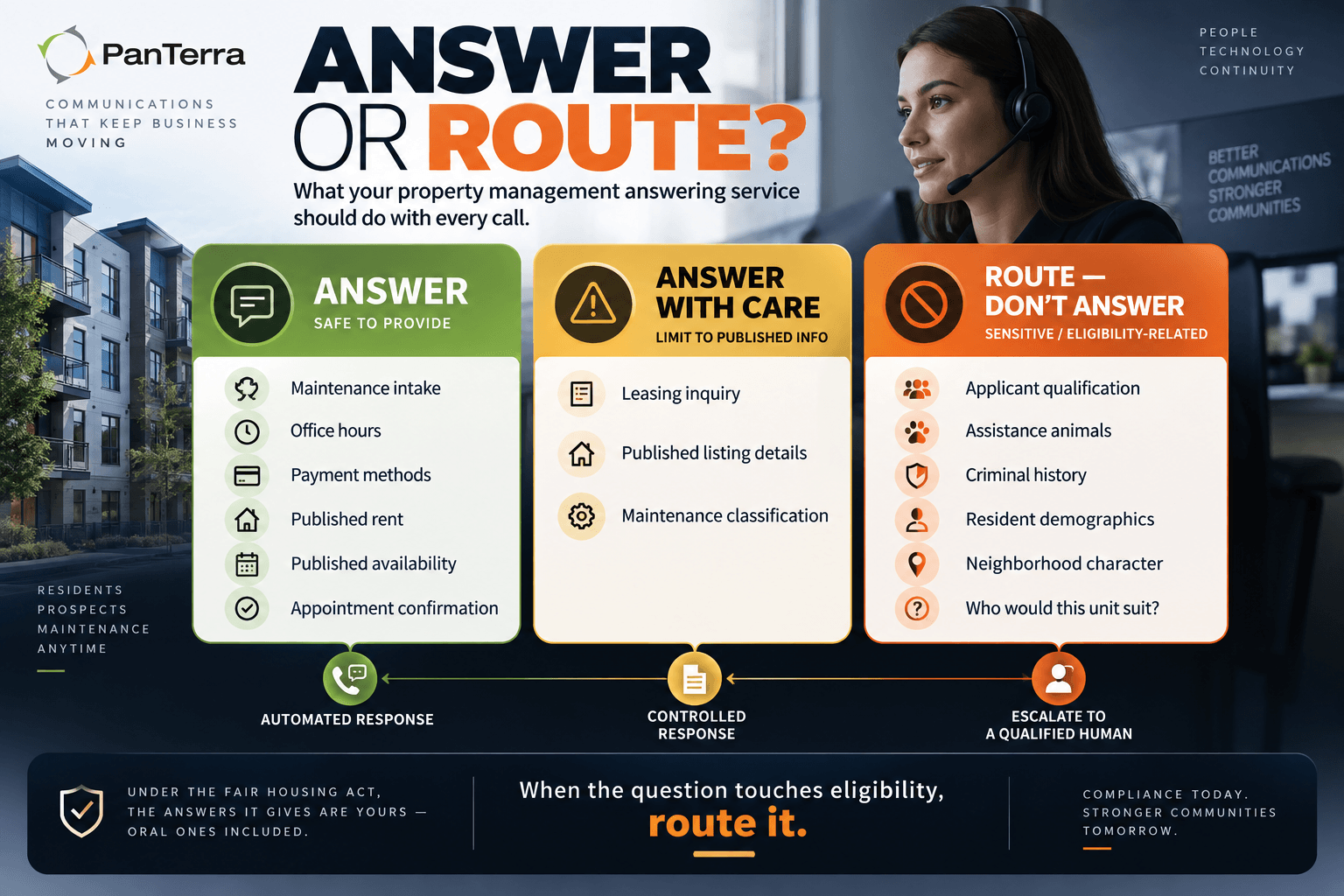
☐ Safe to automate. Logging a maintenance request with the unit, the problem, and a callback number. Office hours and address. Payment methods and where the portal is. Confirming a scheduled appointment. Transferring to a named person. Stating an advertised rent, unit size, or availability date already published.
☐ Safe to automate with care. Taking a leasing inquiry. Capturing who is calling and what they want is fine. Answering anything beyond what you have already published in the listing is where oral statements start.
☐ Never automate. Whether an applicant would qualify. Assistance and support animal requests. Criminal history questions. Anything about other residents, or the character of a building or neighborhood. Any description of who a unit would suit.
☐ Must escalate, on a timer. Anything the caller frames as an emergency. This one is operational rather than legal, and it is covered next.
The safest configuration for a property management answering service is to route rather than answer on anything touching tenancy eligibility. That single rule removes most of the fair housing surface area, and it costs you nothing that a caller values. Nobody calls hoping to be prequalified by a receptionist.
How Should Maintenance Triage Work?
Here the constraint is not a regulation. It is a definition, and almost nobody writes it down before buying.
An after-hours maintenance call needs one of three answers: dispatch now, first thing tomorrow, or a work order in the queue. No property management answering service can make that judgment unless you have already made it. The failure mode is not a service that dispatches too slowly. It is a service that dispatches everything, or nothing, because the script never defined the middle.
Write the definition first. A workable version fits on one page:
☐ Dispatch immediately. No heat in freezing weather, no water, active flooding, sewage backup, gas smell, electrical burning smell, fire or smoke, a resident locked out, any report of a security breach.
☐ Next business morning. No hot water, a single non-working appliance, a slow leak already contained, a failed lock that still secures, cooling loss outside extreme heat.
☐ Work order queue. Cosmetic damage, a fixture request, anything the resident says can wait.
☐ Route to a person regardless. Any injury, any dispute between residents, anything involving law enforcement, anything the caller escalates after being classified.
Then test it from outside the office, after hours, quarterly. The call you bought the system for is the one nobody has ever placed as a test.
On benchmarks, a word of warning that applies to every vendor conversation you will have. There is no reliable published figure for how many calls a property management answering service recovers, how many property management calls go unanswered, what an after-hours call is worth, or what triage accuracy the category achieves. The numbers in circulation trace back through vendor marketing citing other vendor marketing. Ask any vendor quoting you one for the base and the method, and drop the figure if they cannot produce both. Measure your own baseline instead: pull one month of call records and count what rang out and what came back.
Does the AI Voice Rule Apply?
Mostly not, and the difference is regularly stated wrong.
In Declaratory Ruling FCC 24-17, adopted 2 February 2024 under CG Docket 23-362, the FCC confirmed that the Telephone Consumer Protection Act's limits on an "artificial or prerecorded voice" reach current AI tools that sound like human voices. Calls using them "require the prior express consent of the called party to initiate such calls absent an emergency purpose or exemption."
The operative word is initiate. A resident who dials your office and reaches software is outside the ruling, because the resident placed the call.
The duty attaches the moment your system calls out: rent reminders, renewal chases, inspection notices, or a leasing follow-up in an AI voice. Ask any property management answering service vendor which direction their product works in, and how consent is captured and logged for anything outbound. The toggle is usually easy to switch on and easy to forget.
What Should You Ask a Vendor?
Nine questions, in the order that rules vendors out fastest.
Which kind of property management answering service is this, software or staffing? Everything below turns on it.
Show me the default script. Specifically, what does it say to "can I bring my support animal" and "do you rent to people with a record"? The only right answer is that it takes a message and routes.
Can we edit the script ourselves, per property? If every change is a support ticket, your compliance posture moves at your vendor's speed.
How is an emergency defined in the system today? If the answer is a vendor default rather than your list, you have found the gap.
What is the dispatch path after hours, and how is it tested? Ask for the escalation log from a real night.
Does it place outbound calls, and how is consent captured? See the section above.
Can it write a work order into our system, and which system? A service that only takes messages moves work rather than removing it.
What does the property management answering service record and keep, for how long, and who can reach it? Call recordings in a fair housing complaint are evidence, in both directions.
What happens to our call records if we leave? Ask before signing, not after.
For the cost side of that shortlist, our piece on what an AI receptionist costs works through both pricing models. If your portfolio also includes brokerage or sales activity, the licensing constraints on listing questions are a separate problem, covered in the realtor virtual receptionist guide.
This article describes published federal regulation and a Federal Register notice. It is a description of those sources rather than legal advice, state and local fair housing laws add protected classes and duties beyond the federal floor, and you should confirm your position with counsel.
Frequently Asked Questions
What is a property management answering service?
A property management answering service answers inbound calls from residents and prospects when your own staff cannot, then logs a maintenance request, answers a published question, routes the call, or takes a message. It runs either as a remote team of people following your script or as software that answers and acts on its own.
How much does a property management answering service cost?
The two models price differently, which makes a headline comparison misleading. A staffed service usually bills per minute or per call against a monthly floor, so a storm week costs more. Software usually carries a flat monthly fee with volume tiers, so cost moves far less with call volume. Ask for the overage rate on a staffed quote, since that is where the surprise lives.
Is a property management answering service covered by the Fair Housing Act?
Your obligations are. Under 24 CFR 100.75(b) the ban on discriminatory statements applies to oral statements as well as written ones, and under 24 CFR 100.7(b) a housing provider is vicariously liable for an agent's discriminatory housing practice regardless of whether it knew. A service speaking on your behalf is your agent, so its answers are treated as yours.
Can an answering service answer questions about assistance animals?
It should not. HUD withdrew its assistance animals guidance, FHEO Notice 2020-01, in the Federal Register notice of 6 April 2026, while the statutory duty to consider a reasonable accommodation remains. The safe handling is to take the request, say a person will follow up, and route it to a named human working from your current written policy.
What should a property management answering service do with an after-hours emergency?
Whatever your own written definition says, which is why the definition comes first. Decide in advance which reports get immediate dispatch, which wait for the next business morning, and which become a queued work order, then build the call flow to match and test it from outside the office after hours.
Is a property management call center the same as a property management answering service?
The terms overlap in the market and the distinction worth holding is scale rather than function. A call center usually implies a larger staffed operation handling volume across clients, often with reporting and quality management attached. The fair housing analysis is the same either way, because both are answering on your behalf.
Should our property management answering service be software, staffed, or both?
For many portfolios the answer is both, and it is worth naming as its own option. Software answers every call at once, logs maintenance intake, and answers published questions. A person takes the leasing conversations and anything touching eligibility. The requirement is that the handoff passes the caller's number and what they already said, so nobody has to start over.

Comments