Insurance Agency Answering Service: The Three Words That Need a License


An agency buying an insurance agency answering service is usually solving a capacity problem. Calls arrive while producers are in appointments, renewals cluster, and a missed call is a lost policy.
An insurance agency answering service will fix that — and unless you stop it, it will also do two things that require a license nobody on the other end of the phone holds.
TL;DR
An insurance agency answering service answers your calls in place of your own staff, either through a remote team of people or through software that answers and acts. An insurance agency answering service can take the call, book an appointment with a producer, answer a published question, take a message, and handle a payment or billing question. It cannot offer a quote or discuss what a policy covers. Model licensing law makes a producer license necessary to sell, solicit, or negotiate insurance, and the second and third of those are exactly what a helpful receptionist does without noticing.
Key Takeaways
Three activities require a producer license: sell, solicit, and negotiate. Two of them are conversational rather than transactional.
"Solicit" covers attempting to sell or urging someone to apply. A script that offers a quote is soliciting.
"Negotiate" covers conferring with or advising a purchaser about substantive benefits, terms, or conditions. "Yes, your policy covers that" is negotiating.
So the safe setup for an insurance agency answering service is to capture and book, never to answer a coverage question, however obvious the answer seems.
Producer licensing is state law. Before you configure an insurance agency answering service, note that the model act sets the shape and your state sets the rule.
The federal AI voice rule attaches to outbound calls, which matters for an insurance agency answering service because agency outbound volume is high.
Who This Is For
Best for: multi-location agencies and agency groups weighing an insurance agency answering service because calls land while producers are in appointments · operations leaders who want one call standard across offices · agencies whose after-hours and renewal-season calls currently reach voicemail.
Not ideal for: a single producer with low call volume, where a per-call service stays cheap · agencies looking for outbound lead campaigns, which is a separate category and a separate consent problem · anyone hoping to hand off quoting, which no unlicensed service may take on.
Top use cases: an insurance agency answering service booking appointments with a named producer · payment, billing, and document requests · claim intake and routing to the carrier or adjuster path · after-hours and weekend cover · one consistent routing pattern across offices.
What Is an Insurance Agency Answering Service?
An insurance agency answering service is any setup where someone other than your own staff answers calls from clients and prospects. An insurance agency answering service comes in the two shapes this category always comes in.
One kind of insurance agency answering service is people. Calls route to a remote team who answer in your agency's name and follow a script you supply. Billing usually runs per minute or per call against a monthly floor, so renewal season costs more.
The other kind of insurance agency answering service is software, an ai receptionist. It answers on the first ring, works out what the caller wants in plain speech, and acts on the rule you set: book with a producer, log a payment question, route a claim, or take a message. Volume does not queue, which matters in the weeks when everything renews at once. The Cluster A pillar works through the category split in full.
The licensing analysis below applies to either kind of insurance agency answering service. A remote person without a producer license and a piece of software are in exactly the same position, which surprises buyers who assume a human can use judgment where software cannot. On this question, judgment is the problem.
Which Activities Require a Producer License?
Three, and the list is short enough to hold in your head while you read an insurance agency answering service script.
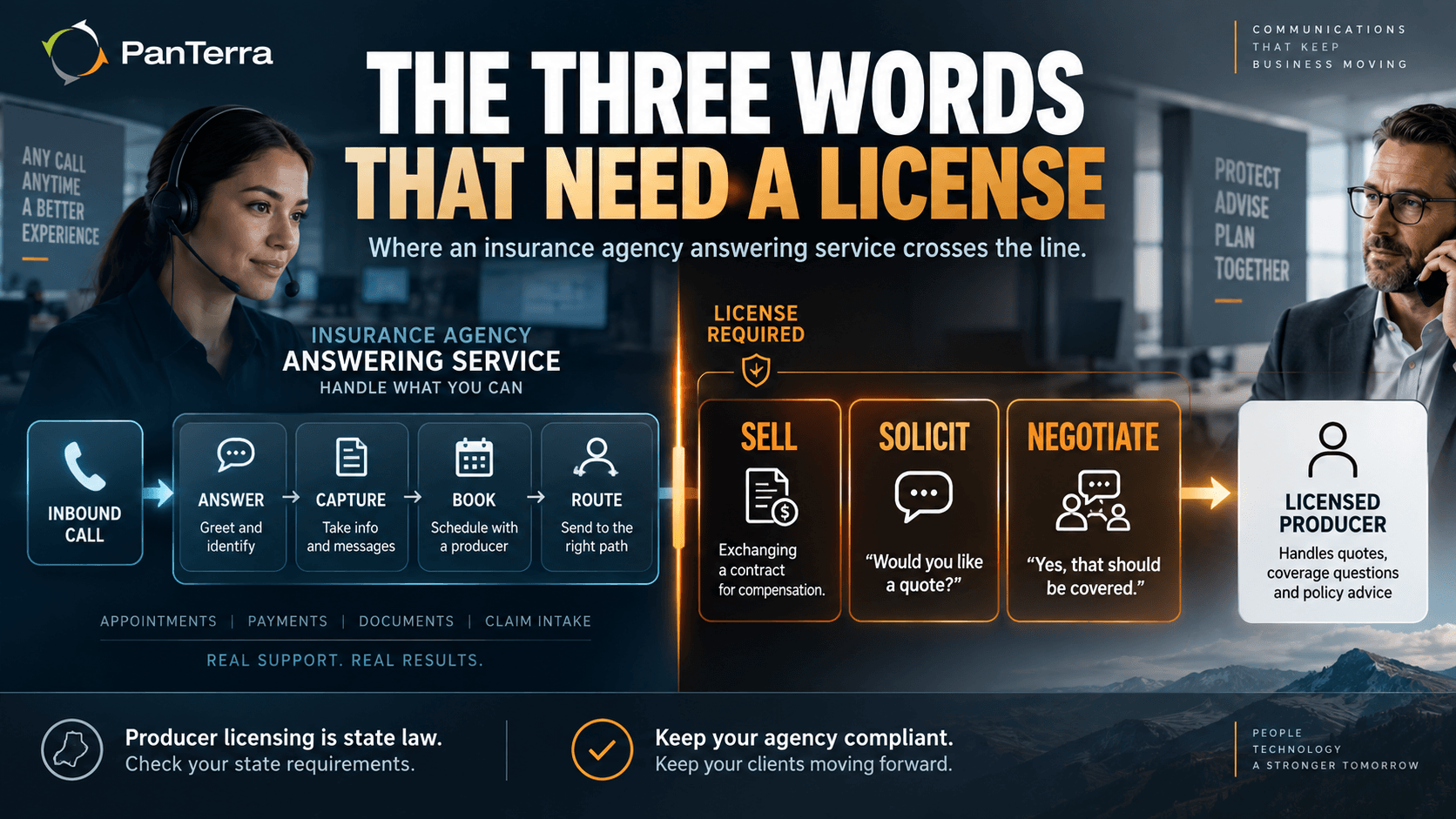
The NAIC Producer Licensing Model Act, model #218, makes a license necessary for selling, soliciting, and negotiating insurance. The definitions are what matter:
Sell means exchanging a contract of insurance for compensation. This one is obvious and no insurance agency answering service is doing it.
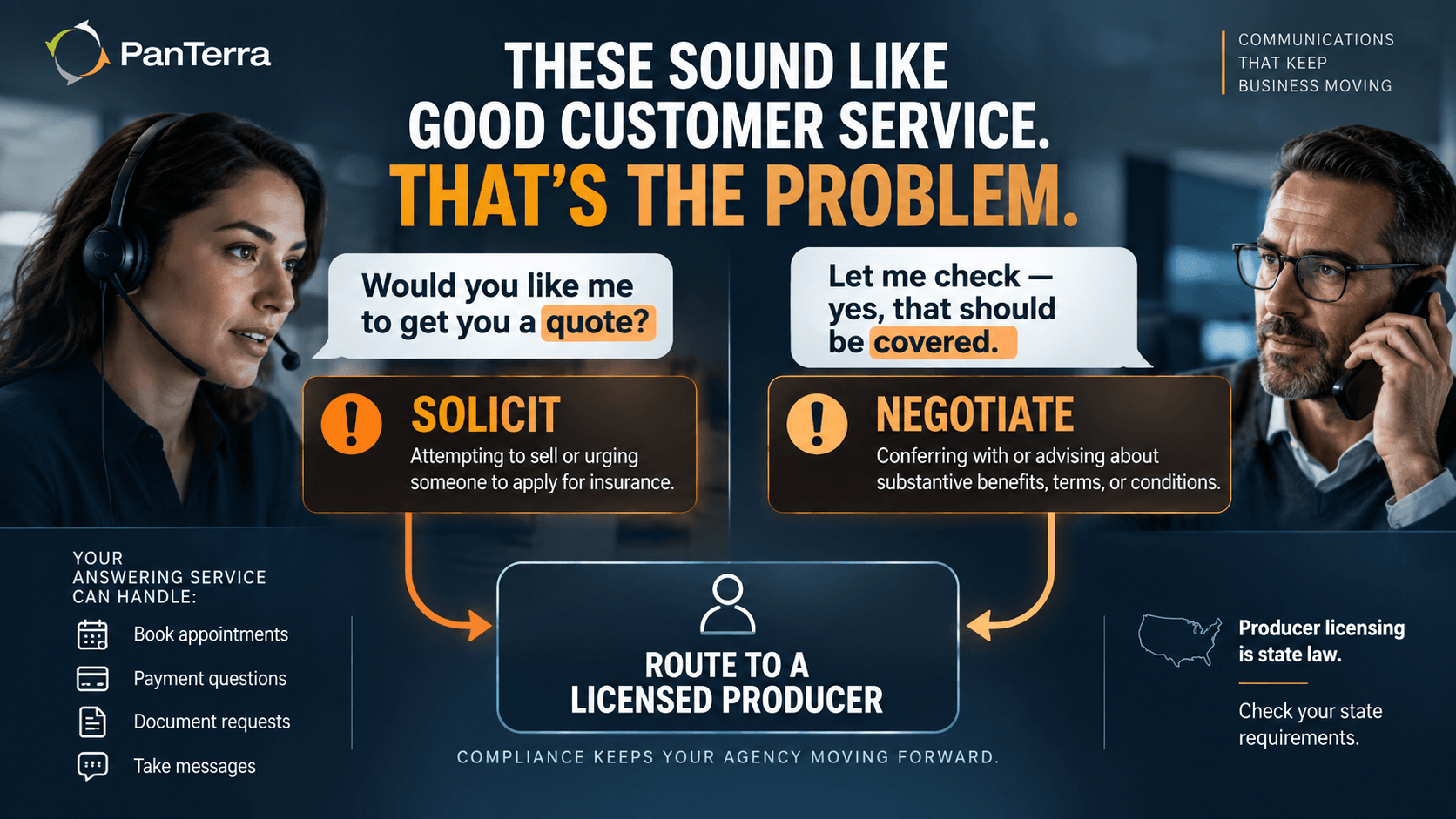
Solicit means attempting to sell insurance, or urging a person to apply for a particular kind of insurance from a particular company. Read that against a standard insurance agency answering service script. "Would you like a quote?" is an attempt to sell. "We could probably save you money on that" urges an application. Both are soliciting, and both appear in demo scripts as helpfulness.
Negotiate means conferring directly with, or offering advice to, a purchaser or prospective purchaser about the substantive benefits, terms, or conditions of a contract. This is the one that catches agencies. A caller asks whether their policy covers a rental car, or whether water damage is included, or what the deductible is on a specific claim. A receptionist who answers is conferring about substantive terms.
The two sentences that break the script. "Would you like me to get you a quote on that?" and "Let me check, yes, that should be covered." Both sound like good service. Both are activities the model act reserves to a licensed producer, and neither is a sentence the caller will remember hearing differently.
Producer licensing is state law. States adopt from the model act with variations and some publish their own guidance on what unlicensed staff may do, so check your own states before you configure an insurance agency answering service. The three-activity shape travels; the detail does not.
What Can the Service Actually Do?
A fair amount, and this is the part that makes an insurance agency answering service worth buying. The safe reading of those three defined activities leaves an insurance agency answering service plenty of useful work.
☐ Safe. Answering the call and identifying the agency. Taking the caller's name, number, and policy number. Booking an appointment with a named producer. Giving office hours and address. Transferring to a licensed person. Taking a message.
☐ Safe. Payment and billing logistics: where the portal is, which methods you accept, confirming that a payment was received if your system shows it. Money mechanics are not coverage terms.
☐ Safe. Document requests. Sending an ID card, a certificate, or a declarations page through your normal process is administration, not advice.
☐ Safe. Claim intake as capture. Recording what happened, when, and where, and routing it to the claim path. Taking the facts is clerical; interpreting them is not.
☐ Never. Quoting a rate. Offering to get a quote. Saying whether something is covered. Explaining a deductible or an exclusion. Comparing policies or carriers. Suggesting a coverage change. Saying whether a claim will be paid.
☐ Route immediately. Any coverage question, any quote request, anything where the caller is deciding whether to buy, and anything about a claim outcome.
The rule that makes this easy to configure: an insurance agency answering service may talk about the appointment, the money, and the paperwork. It may not talk about the policy.
That parallel will look familiar to anyone who has read our legal virtual receptionist guide. The shape is the same in both verticals. Facts can be taken down by anyone; judgment about what the facts mean belongs to a licensed professional. Insurance is the cleaner case, because the licensing statute names the activities rather than leaving them to be construed.
Where Do Agencies Get This Wrong?
Four ways an insurance agency answering service goes wrong, all of them configuration rather than bad faith.
The default script sells. Vendor scripts are written to be commercially helpful, because most of the vendor's clients are not licensed businesses. Offering a quote is a feature in every other vertical and a licensing problem in this one. Ask to see the insurance agency answering service script and read it with the three words in mind.
Nobody tells the service what it cannot say. Onboarding asks what you want handled. It rarely asks what must never be answered, so the prohibition is never written down anywhere the service can see it.
It tries to be helpful on an easy question. The coverage questions that get answered are the ones that seem obvious. Obviousness is not the test.
Outbound gets switched on. Follow-up and renewal chasing are usually a toggle, and outbound insurance calls carry both a licensing question about what the call says and a consent question about the call itself.
Does the AI Voice Rule Apply?
Yes, and it matters more for an insurance agency answering service than for most verticals, because agencies run high outbound volume.
In Declaratory Ruling FCC 24-17, adopted 2 February 2024 under CG Docket 23-362, the FCC confirmed that the Telephone Consumer Protection Act's limits on an "artificial or prerecorded voice" reach current AI tools that sound like human voices. Calls using them "require the prior express consent of the called party to initiate such calls absent an emergency purpose or exemption."
The operative word is initiate. A client who rings your agency and reaches an insurance agency answering service in software is outside the ruling, because the client placed the call.
The duty attaches to what you place: renewal reminders, quote follow-ups, cross-sell calls, and lapse notices in an AI voice. Insurance is also a heavily litigated area under the TCPA generally, so this is worth settling with counsel rather than with a vendor's assurance. Ask which direction the product works in, how consent is captured and logged, and what the vendor's position is on the exemptions.
What Does an Insurance Agency Answering Service Cost?
An insurance agency answering service comes in two pricing shapes, with a seasonal pattern worth planning around.
A staffed service usually bills per minute or per call against a monthly floor, with a higher overage rate above the plan. Agency call volume is seasonal and spiky, clustering at renewal and after weather events, which is exactly when a per-minute model costs the most. Ask for the overage rate first.
Software usually carries a flat monthly fee with volume tiers, so a spike costs little or nothing extra within the tier. That is the structural argument for a software insurance agency answering service in a seasonal vertical.
Deliberately absent: a market rate range, and any lead-response-time statistic. The speed-to-lead figures that circulate in insurance marketing trace back through vendor material citing other vendor material, and none of them survived a source check. Measure your own: count the calls that rang out during your last renewal cycle and how many of those clients renewed. Our companion piece on what an AI receptionist costs models both shapes against a real call volume, and the after hours answering service guide covers the escalation design.
What Should You Ask a Vendor?
Eight questions to put to any insurance agency answering service, in the order that rules vendors out fastest.
Which model is this, software or staffing? Everything below turns on it.
Show me the default script. Read it for the word quote and for any sentence that answers a coverage question.
Can you remove the quote offer entirely? If the answer is that it is standard, that is your answer about the vendor.
What does the script say when a caller asks whether something is covered? You want a clean handoff to a licensed producer, not a hedge.
Can we edit the script ourselves, per office and per state? Licensing rules vary, so an agency in several states needs more than one script.
Does it place outbound calls, and how is consent captured and logged? See the section above.
Can it write into our agency management system, and which one? A service that only takes messages moves work rather than removing it.
Can I hear a recording of a real client call? Ask for one during a busy period, not a quiet Tuesday.
Frequently Asked Questions
What is an answering service?
An answering service answers inbound calls on your behalf when your own staff cannot, then routes the call, takes a message, answers a published question, or escalates. It runs either as a remote team of people working from your script or as software that answers and acts on its own. An insurance agency answering service is that service with a licensing limit configured into the script.
What is a phone answering service for an insurance agency?
The same thing as an insurance agency answering service, described by the channel. The useful framing is what it is allowed to say rather than how it connects: it can book, take payment and document requests, and capture claim facts, and it must route anything touching a quote or a coverage term to a licensed producer.
How does an answering service work?
Calls to your number forward to the service, either continuously or outside the hours you set. A staffed service delivers them to a remote team following your script. Software answers in place of a person, interprets the request in ordinary speech, and applies the rules you configured. Either way an insurance agency answering service follows a routing list you wrote, and the list has to include what must never be answered.
Can an answering service quote insurance rates?
No, unless the person quoting holds a producer license. Model licensing law makes a license necessary to sell, solicit, or negotiate insurance, and quoting a rate or offering to get a quote falls inside soliciting. The safe setup has the insurance agency answering service book an appointment with a licensed producer instead.
Can an answering service tell a client what their policy covers?
No. Conferring with or advising a purchaser about the substantive benefits, terms, or conditions of a contract is negotiating under model licensing law, and that requires a producer license. This holds even when the answer is on the declarations page and seems obvious, which is exactly when unlicensed staff tend to answer it.
How much does an answering service cost?
The two models price differently, so compare shapes rather than headline numbers. A staffed service usually bills per minute or per call against a monthly floor, with a higher overage rate. Software usually carries a flat monthly fee with volume tiers. For an insurance agency answering service the seasonal pattern matters: renewal and post-event spikes are when a per-minute model costs the most, so ask about the overage rate before the base rate.
How much does it cost to hire an answering service versus software?
Compare them against your own peak, not your average. A staffed service priced per minute looks reasonable at an ordinary week's volume and expensive during renewal season, while software priced per tier looks flat through both. Whichever way your volume swings is the number that should decide it.
How do you choose an insurance agency answering service?
Start with the insurance agency answering service script rather than the feature list. Read the default script for anything that quotes, offers to quote, or answers a coverage question, then ask whether those can be removed and who can edit the script afterward. A vendor that can strip the quote offer and route coverage questions cleanly has solved the only problem specific to this vertical.
Where this article describes the NAIC model act and a federal ruling, it describes a model and a ruling rather than the law in any state. Producer licensing is state law, states adopt with variations, and this is not legal advice, so confirm your position in every state where you operate with your counsel or compliance officer.

Comments